Just now, OpenAI's full range of hardware was exposed: The smart speaker comes with a built-in camera and supports face-scanning shopping. ChatGPT is about to enter your home.
According to a report by The Information, OpenAI is developing a smart speaker that will be equipped with a camera and support facial recognition similar to Apple's Face ID. In the future, you may be able to complete shopping payments with just a "glance." Similar functions have already been implemented in smart glasses such as those from Xiaomi and Rokid.
While Apple and Meta are integrating AI into wearable devices like glasses, watches, and pendants, OpenAI is trying to put a camera into a speaker. It can "see" you and your surroundings, allowing AI to understand you not only from your language but also from your behavior. Your daily routine, habits, and emotional state will all enable AI to read and piece together a real you.
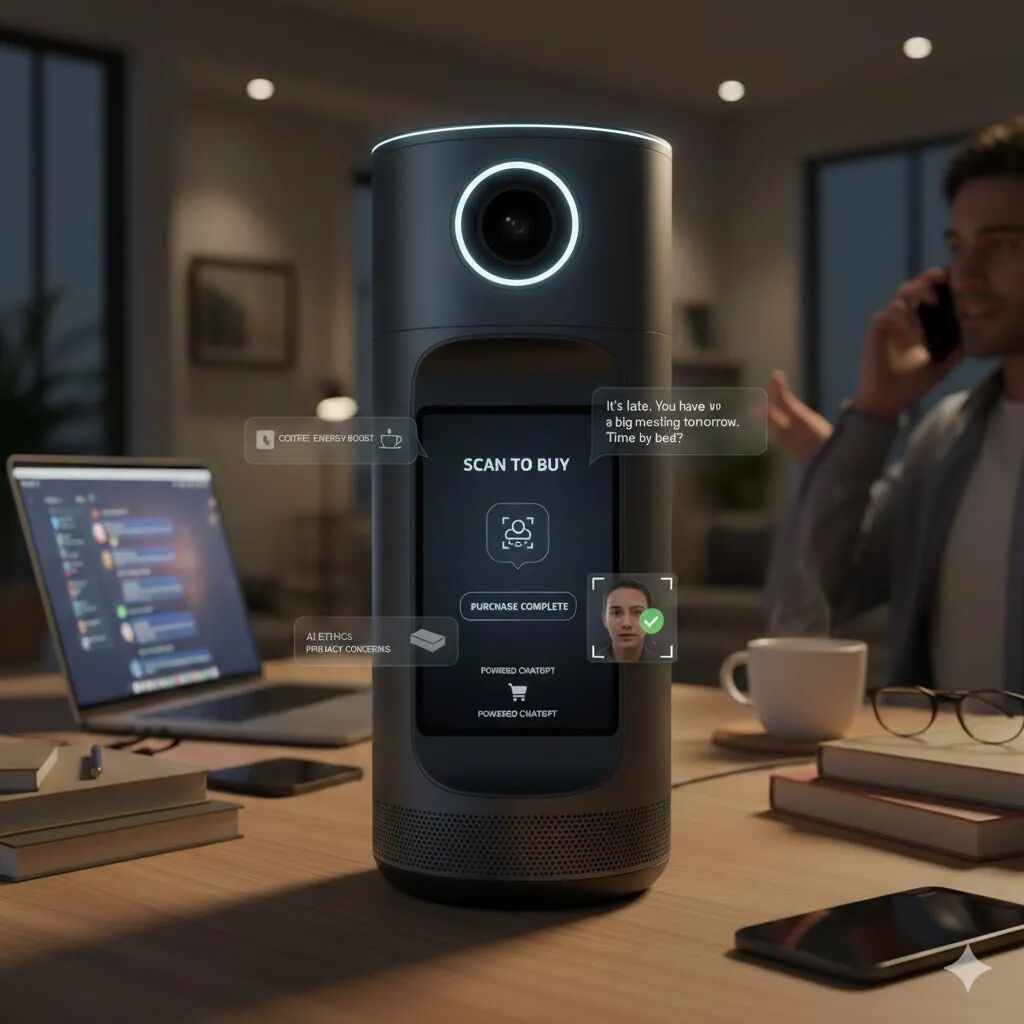
Product concept image, generated by Nano Banana Pro
APPSO will quickly summarize the key information about OpenAI's smart speaker for you.
- Pricing: $200 - $300 (approximately 1,450 - 2,200 RMB)
- Release time: As early as February 2027
- Core functions: Camera environmental perception, Face ID - level facial recognition, voice shopping
- Design team: LoveFrom by Jony Ive + OpenAI's hardware team
- Product matrix: The smart speaker will be launched first, followed by smart glasses and smart lamps.
Would you dare to use a smart speaker with "eyes"?
The smart speaker category has been highly competitive for nearly a decade, from Amazon Echo to Apple HomePod. However, the "intelligence" of these devices often only stays at the level of "understanding keywords," far from true "comprehension."
OpenAI's solution is straightforward: give it "eyes."
The smart speaker is equipped with a built - in camera that can recognize your surrounding environment, such as what's on the table and what people are talking about nearby. It also supports facial recognition similar to Face ID, allowing you to complete purchases with just a face scan. This "what you see is what you get" shopping experience is not yet achievable by smart speakers on the market.
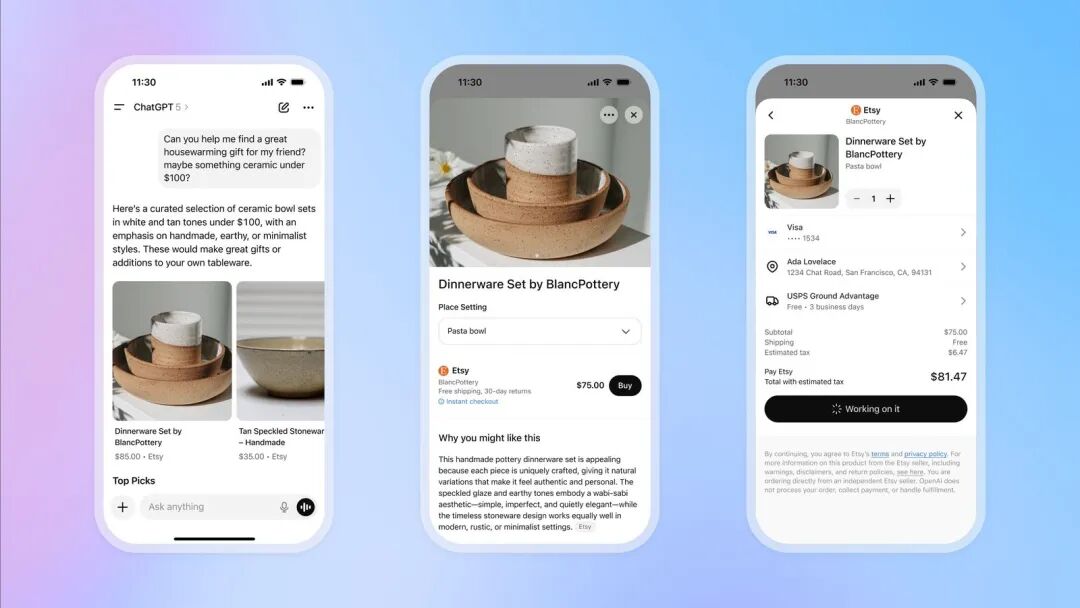
Combined with the shopping function launched by ChatGPT last year, where users can complete the entire process from product selection to order placement in the dialog box, this face - scan purchase function is expected to directly serve the closed - loop of "AI as the shopping entrance" and become the first checkpoint in the consumer decision - making chain.
Without a doubt, this will also pose a significant challenge to the existing traffic distribution logic: Google has enjoyed advertising dividends from search for decades, and e - commerce platforms have built a vast ecosystem based on the shelf logic. OpenAI wants to insert a new decision - making level before both of them.
In addition, this smart speaker can also judge the user's state through continuous visual observation. For example, if it notices that you're staying up late the night before an important meeting, it will actively remind you to go to bed early. In this way, the positioning of the smart speaker changes from a smart home product to an AI butler hub.
However, the boundary of privacy in this all - day data collection may need to be clarified when OpenAI officially launches the product.
You'll have to wait a while to buy this product. The first device won't be shipped until February 2027 at the earliest. Other products like glasses will take even longer, and mass production is expected in 2028. As for the smart lamp, although there's a prototype, it's still uncertain whether it will be released.
OpenAI's hardware team with a strong "Apple flavor"
OpenAI's hardware ambitions can be seen from the size of its team, which has 200 members and is still expanding rapidly. What's more exciting is that Jony Ive, the former chief design officer of Apple, is personally in charge of product design for OpenAI.
This team has a high "Apple content." It's led by Vice President Peter Welinder, who previously headed OpenAI's new product exploration team. The core members include:
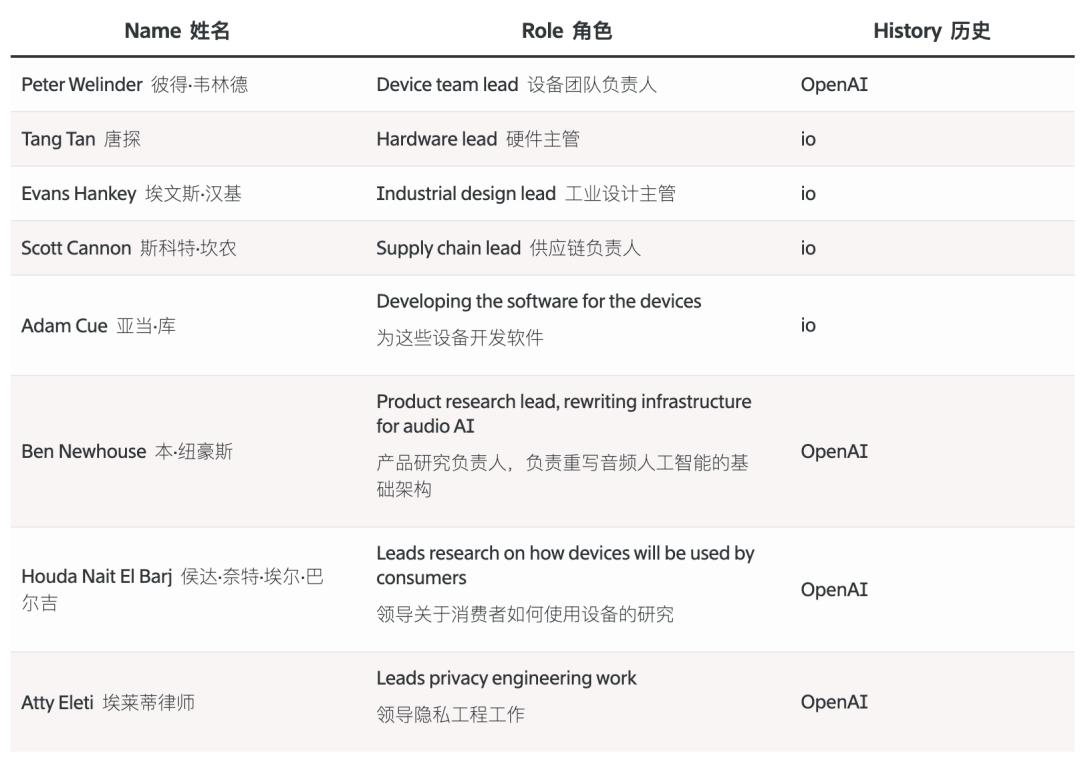
Image from: The Information
- Tang Tan: A 25 - year veteran at Apple, who was the head of product design for iPhone and Apple Watch and reported directly to Apple's hardware chief John Ternus. He's considered the key person in translating Jony Ive's design concepts into mass - manufacturable products.
- Evans Hankey: The former head of industrial design at Apple, who succeeded Jony Ive in leading Apple's design team and is now the head of industrial design at OpenAI.
- Scott Cannon: The head of the supply chain.
- Adam Cue: The son of Eddy Cue, the head of Apple Services, who is responsible for developing the software that will drive OpenAI's future devices.
- Ben Newhouse: The head of product research, who is working on rewriting OpenAI's infrastructure to suit audio AI.
- Atty Eleti: Responsible for engineering work related to device privacy.
Although Jony Ive hasn't directly joined OpenAI, he has the final say on design and is said to appear at the office in downtown San Francisco every week. Some employees have revealed that during team discussions, they often ask "What would Jony want?"
However, the cooperation between Jony Ive and OpenAI hasn't been smooth. According to two people familiar with the matter, some OpenAI employees have complained that LoveFrom is slow in modifying designs and rarely shares its process of conceiving new designs. This secrecy and pursuit of perfection in design are typical of Apple, and many employees and leaders in this team come from there.

To maintain this mode of operation, OpenAI's device team is separate from other departments of the company. Although OpenAI's headquarters is in Mission Bay, the device team works in an office near Jackson Square in downtown San Francisco, not far from LoveFrom's office.
Internal issues are a matter of implementation. But one thing has been clear from the start: OpenAI must develop hardware.
The annualized revenue of $20 billion on the software side has proven that AI is a profitable business. However, to make AI a true infrastructure like water, electricity, and gas, there must be a physical entry point.
The mobile phone path won't work. Apple's ecological moat can't be easily breached by a new AI product, and other mobile phone manufacturers are also fully committed to AI development and won't give up their hardware positions.
Of course, the more fundamental problem is that the form of mobile phones may not be suitable to host AI.
When AI is smart enough, it shouldn't be confined to a rectangular glass screen. It should be everywhere. Therefore, starting with categories like speakers, glasses, and even lamps that provide a stronger sense of companionship is the only and most reasonable choice for OpenAI.
All this may have been foreshadowed in ChatGPT's product design direction. Different from AI companies like Anthropic that focus on enterprise services, OpenAI has a strong ToC gene from the start. ChatGPT is not just a tool; it has emotions, memory, and empathy. Sam Altman has been making it more like a "person."
The logic behind this is now quite clear: You wouldn't want to put a cold AI assistant in your bedroom, but an AI that understands you, remembers your habits, and cares about your sleep quality is worthy of being part of your life.
OpenAI's hardware landscape emerges
The smart speaker is just one part of OpenAI's hardware portfolio. Previously, it was reported that OpenAI is also developing smart glasses, smart lights, and even wearable pins in various forms. As mentioned above, mass production of smart glasses may not start until 2028, which coincides with the rumored release time of Apple's AI glasses.
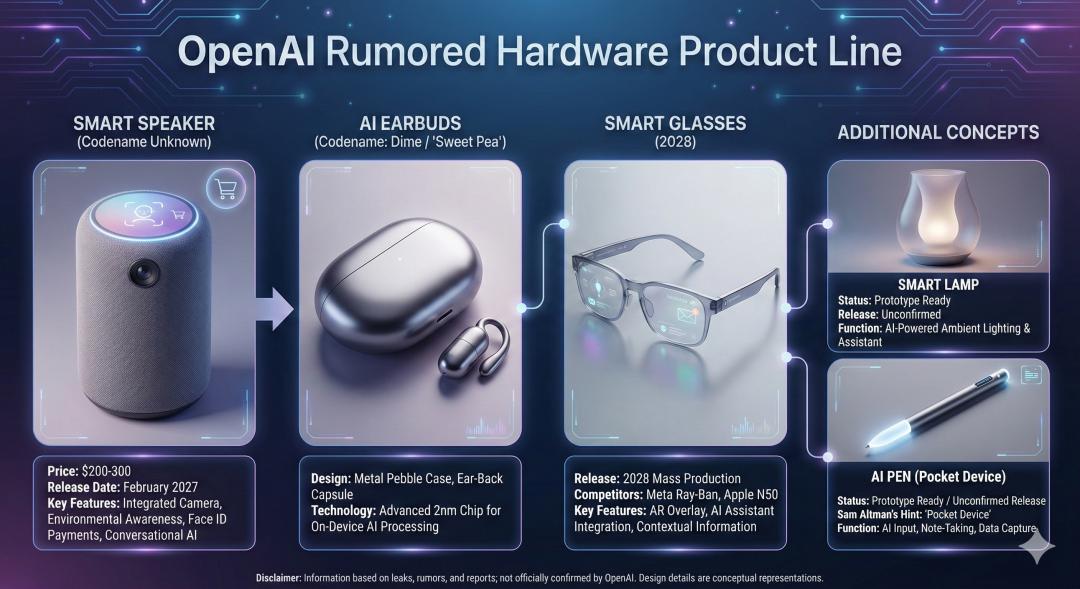
OpenAI's hardware product line (compiled by APPSO based on exposed information)
- Smart speaker (code name unknown): The first product, priced at $200 - $300, to be shipped in February 2027
- AI earphones (code name Dime/ "Sweet Pea"): Shaped like a metal pebble, with capsule - shaped earphones placed behind the ears, equipped with a 2nm chip
- Smart glasses: To be mass - produced in 2028, competing directly with Meta Ray - Ban and Apple N50
- Smart light: The prototype is ready, but it's uncertain whether it will be released
- AI pen: The "pocket device" often hinted at by Sam Altman
It's worth noting that OpenAI seems to have adjusted its hardware strategy. The previously rumored AI earphone project "Dime" (Sweet Pea) was originally planned to be an all - around "phone - like" device equipped with a 2nm smartphone - level chip. However, due to the shortage of HBM memory and high costs, OpenAI was forced to adjust its strategy. It will first launch a "stripped - down" version with only audio functions and then release a high - end version when costs decrease.

This "occupy the position first, then improve" strategy is not uncommon in the hardware industry. For OpenAI, without the constraints of Apple, it doesn't need to polish products to perfection before launching them into the market. Even if the first product is not amazing, this is a common practice in the AI industry when releasing products.
Figuring out "how to do it" is one thing, but finding "the right people to do it" is another. Developing hardware ultimately depends on talent.
According to The Information, OpenAI poached more than 20 hardware experts from Apple last year, while the number was almost zero in 2023.
Apple is clearly worried. According to people familiar with the matter, Apple suddenly canceled its annual closed - door meeting in China last year. This meeting is usually held by executives to introduce future product plans to employees. The reason for the cancellation was "to prevent more executives from jumping to OpenAI."
In addition, OpenAI not only poaches talent from Apple but also has its eyes on the supply chain that Apple has built over decades.
According to people familiar with the matter, Luxshare Precision, the main contract manufacturer of iPhones and AirPods in China, has won the assembly contract for at least one OpenAI device. GoerTek, which is responsible for assembling AirPods, HomePod, and Apple Watch, is also in talks with OpenAI to provide components such as speaker modules for future products.
Sam Altman mentioned OpenAI's vision for hardware in an interview: "Smartphones are like Times Square, bombarding you with information and shattering your attention. What OpenAI wants to create is a 'lake - side cottage' where you can close the door and block out the noise when you need to focus."
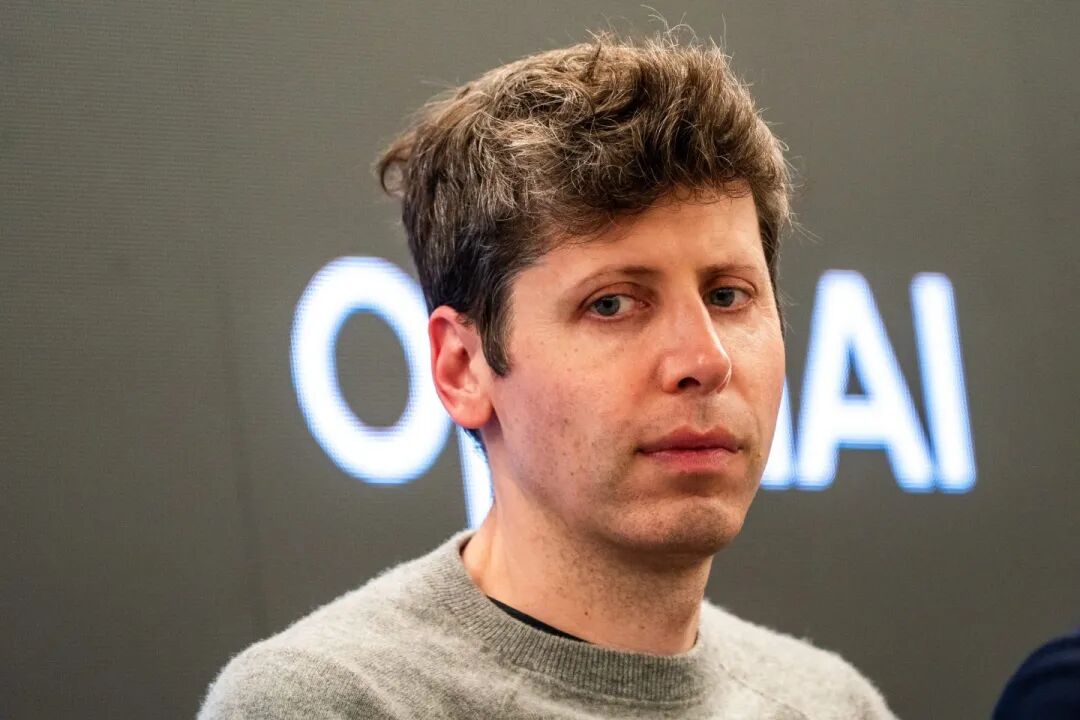
His core logic is that AI hardware is not meant to replace mobile phones but to fill the scenarios where it's "inconvenient to take out a phone" or "deep focus is needed." From this perspective, devices like smart speakers and AI pens that "won't look out of place on the table" are indeed more user - friendly than AI pendants worn 24/7.
However, vision is one thing, and reality is another. OpenAI is not the first company to use AI hardware to redefine human - machine interaction. The sales of "internet - famous AI hardware" such as Human Pin, Rabbit R1, and Friend AI pendants have been disappointing.
Previously, many AI hardware products often addressed "pseudo - needs." Most of what they can do, mobile phones can do better. It's a big challenge to change consumers' nearly 20 - year - old habit of screen - based interaction and make them accept an "invisible and intangible" AI assistant.
OpenAI not only has to face the problem of market education but also the encirclement of giants.
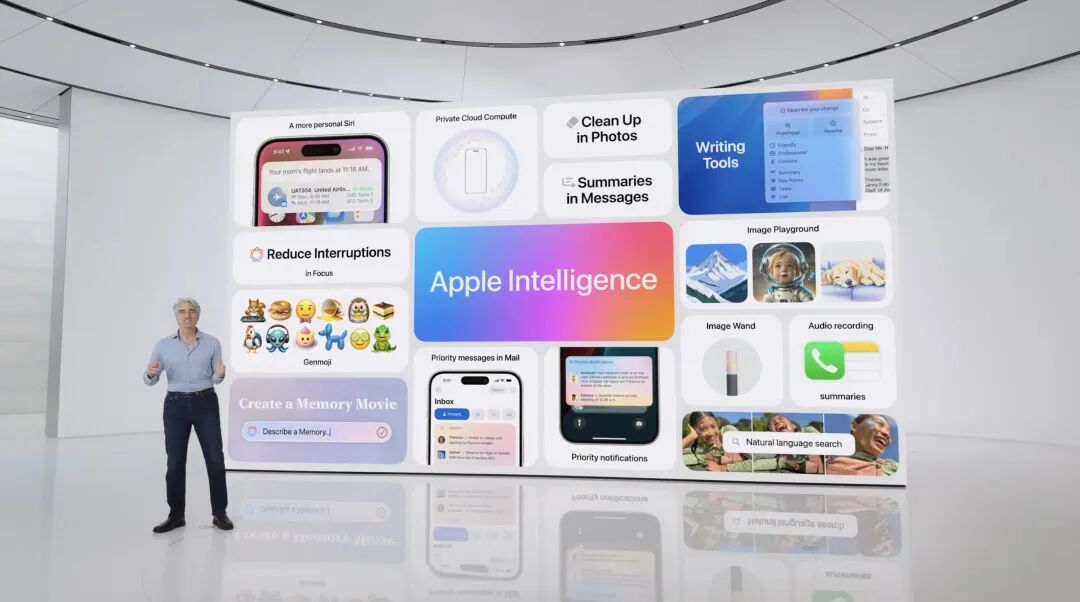
According to Mark Gurman, a reporter from Bloomberg, Apple is accelerating the development of three new AI wearable devices: smart glasses N50, a wearable pendant, and camera - equipped AirPods, all centered around the Siri digital assistant and using cameras to obtain visual context for various operations.
In 2026, OpenAI will face a highly competitive environment for both its large - model AI products and emerging hardware products.
Even so, OpenAI may still bring some changes, or even a turning point, to the AI hardware industry.
It has the most luxurious Apple - based team, the most radical product definition, and ChatGPT, the world's number - one AI product. However, OpenAI also faces the common dilemma of all AI hardware: how to prove that AI + hardware brings a qualitative change to the user experience, rather than just being another reason to make the product more expensive.