You can easily win the gold medal in the Physics Olympiad. Google has released a "Research Partner" model with a monthly fee of 1,800 yuan.
On February 13th, Google released the inference-enhanced version of Gemini 3 Deep Think. This "inference mode" is specifically designed for scientific research and engineering applications, aiming to expand the capability boundaries of intelligent systems in complex tasks.
The new version upgrades the inference mechanism based on the Gemini 3 architecture and introduces "Inference-time Compute". It can conduct multi-step deductions when dealing with complex logic and system-level problems, while improving the accuracy of structural consistency verification and engineering task solving.
Considering that Deep Think needs to call on huge background computing power resources when processing problems, Google has set differential pricing rules:
For individual professional users pursuing maximum output, Deep Think has been officially included in the top-tier Google AI Ultra program. Subscribers need to pay $249.99 per month (approximately RMB 1,800) to enjoy unlimited deep inference privileges, 30TB of large storage space, and the highest priority for computing power response.
For API access for developers and enterprises, it is billed according to usage: $2 for every million input tokens and $12 for every million output tokens.
01 Intelligence Benchmark: Comprehensive Domination from Algorithm Competitions to Cutting-edge Physics
The technical prototype of Gemini 3 Deep Think became famous overnight in the International Mathematical Olympiad (IMO 2025) in July 2025.
At that time, within the stipulated 4.5 hours, the model completed 5 out of 6 extremely difficult questions using pure natural language reasoning, scoring 35 points (reaching the level of a gold medalist). Different from previous AIs that needed to translate questions into computer code, Deep Think proved that AI can directly tackle top-level mathematical problems through logical deduction like human mathematicians.
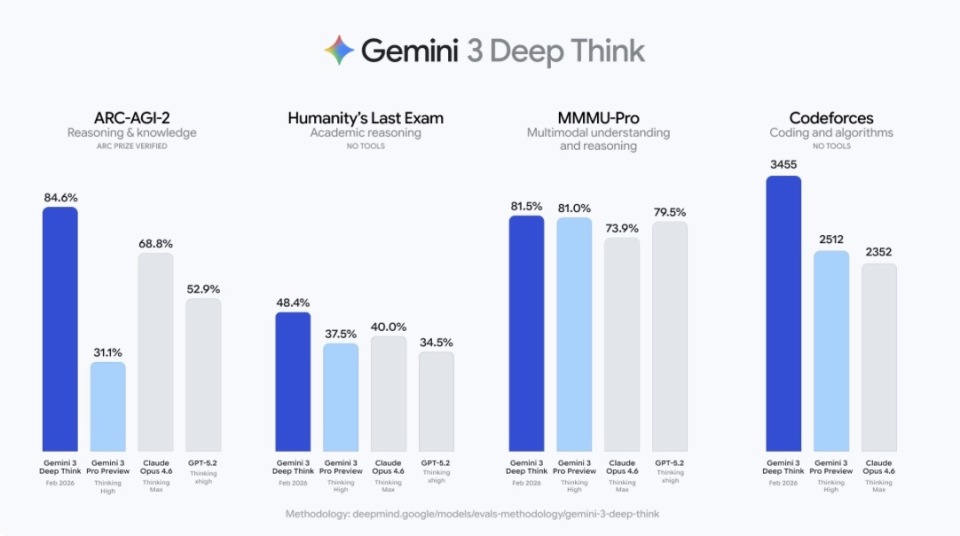
Now, the officially released inference-enhanced version of Gemini 3 Deep Think further achieves cross-disciplinary generalization on the basis of inheriting this top-notch reasoning gene:
On the Codeforces competitive programming platform, the model scored 3,455 Elo, firmly ranking in the "Legendary Grandmaster" level. This scoring range means that it is among the world's top players in complex algorithm design and high-difficulty problem solving.
In the ARC-AGI-2 test, regarded as a touchstone for Artificial General Intelligence (AGI), Deep Think achieved a record score of 84.6% without an internet connection, proving that the model has got rid of its simple reliance on the corpus and achieved true few-shot abstract induction and logical discovery.
In the face of more difficult cross-disciplinary challenges, Deep Think also performed excellently in the Humanity's Last Exam (HLE) (48.4%) and the CMT Benchmark (50.5%).
Whether facing profound cross-disciplinary paradoxes or high-level physics deductions, the model shows strong structural consistency and logical tenacity.
What supports these data is the qualitative change in the inference paradigm of Gemini 3 Deep Think.
Different from the "blurt out" generation mechanism of traditional models, Deep Think introduces the "Inference-time Compute" mode. Before outputting, it will internally construct and simulate multiple solution paths and perform real-time consistency self-checks. Once a premise conflict or logical fault is detected, the system will immediately perform logical backtracking and reorganize the deduction chain.
This "slow thinking" mechanism marks that AI has officially evolved from a "conversational tool" to a "research partner", providing more deterministic intellectual support for rigorous scientific research and complex engineering tasks.
02 Official Demonstration: Inference Mode Covers the Entire Process of Scientific Research and Engineering
Google demonstrated the practical applications of Deep Think in scientific research and engineering through multiple demonstrations.

Mathematician Carbone uses Deep Think to review a highly professional mathematical paper
In a scientific research scenario, mathematician Lisa Carbone from Rutgers University used Deep Think to review a highly professional mathematical paper.
Carbone's research involves the field of high-energy physics, aiming to explore the mathematical structure that bridges Einstein's theory of gravity and quantum mechanics. In this field where training data is very scarce, Deep Think discovered a subtle logical flaw that even peer reviews had not identified before. The model can integrate cross-document information into a unified inference network, make consistency judgments on formulas and conclusions, and generate annotations and analysis reports for researchers to refer to.
This marks that AI is gradually shifting from a "conversational tool" to a "research partner" and, through systems such as Aletheia (Google's internal professional agent architecture for mathematical exploration), achieving a leap from auxiliary retrieval to autonomous logical discovery.

Researchers at Duke University use Deep Think to optimize the manufacturing method of complex crystal growth
At Duke University, the Wang Lab used Deep Think to optimize the manufacturing method of complex crystal growth to assist in the research and development of potential semiconductor materials. Deep Think designed an experimental scheme capable of growing thin films with a thickness of over 100 microns, achieving a precise target that was difficult to reach with previous methods and providing an efficient and feasible experimental path for material research and development.

In the field of engineering applications, scientists use Deep Think to accelerate the design of physical components
In engineering applications, Anupam Pthak - the R & D director of Google's Platforms and Devices department and the former CEO of Liftware - used Deep Think to accelerate the design of physical components. After users upload hand-drawn sketches of complex mechanical structures, the model can automatically identify spatial topological relationships, geometric constraints, and key dimensions and generate executable modeling scripts supporting OpenSCAD and Python formats.
The entire process includes geometric relationship analysis, dimension calculation, connection relationship modeling, and final output file generation. In the official demonstration, the generated script directly drove a 3D printing device to output a physical model that met the design requirements.
In addition, Deep Think also demonstrated its ability in multi-file system-level code analysis. The model can identify variable reference relationships, function call dependencies, and potential boundary condition problems and provide actionable modification suggestions. The demonstration emphasized that the model can handle the overall architecture of complex engineering projects and provide a reliable reference for system design and code verification.
The highlight of the official demonstration is the unified application across scenarios: whether it is scientific research paper analysis, material experiment design, engineering modeling, or complex code system verification, Deep Think can complete logical deductions and result outputs through the same inference chain, providing an efficient and unified intelligent tool for scientific research and engineering tasks.
03 API and Industry Integration: Deep Access in Scientific Research and Industry
With the release of Deep Think, the Gemini API Early Access Program (EAP) was launched simultaneously. Enterprises and scientific research institutions can integrate the model into their internal databases for circuit logic consistency checks, mathematical derivation auxiliary verification, experimental data structure analysis, and software system boundary condition troubleshooting.
Google said that it will give priority to supporting scientific research and industrial teams in the fields of energy modeling, new material research and development, and biomedicine.
Google has not officially announced the full opening schedule and subsequent function expansion plan. However, through the early access program, relevant teams will be able to experience the inference ability of Deep Think in complex scientific research and engineering projects first.
(Contributing translator Wuji also contributed to this article)
This article is from "Tencent Technology" by Su Yang, published by 36Kr with permission.