The new national standard has been released. Is the fully concealed car door handle going out of fashion?
As more and more new energy vehicles drive through the streets, the smooth and seamless sides of the car doors have become a highly "futuristic" sight - the fully concealed door handles. This design, once regarded as a core selling point by car manufacturers and pursued by consumers, is now at a "critical turning point" in the industry's development. On January 28, 2026, the mandatory national standard "Safety Technical Requirements for Automobile Door Handles" formulated by the Ministry of Industry and Information Technology was officially released with the approval of the State Administration for Market Regulation and the Standardization Administration of China. It clearly defines the safety red - line and will be officially implemented on January 1, 2027. This global first mandatory national standard specifically for automobile door handles directly announces the "end" of the pure - electronic fully concealed door handles and also marks that the design concept of the Chinese automobile industry has officially shifted from "emphasizing gimmicks and pursuing appearance" to "emphasizing safety and adhering to the bottom line."
As a "small part" closely related to consumers' vehicle safety, the design iteration of door handles should have centered around convenience and safety. However, in the current situation of intensified competition in the new energy vehicle industry, it has gradually become a tool for car manufacturers to "show off their skills." From the electric pop - out handles first popularized by Tesla Model S to the various designs such as upward - flipping, downward - pushing, and flat - pulling styles launched by domestic car manufacturers, the fully concealed door handles have quickly become the "standard configuration" for mid - to high - end new energy vehicles priced over 150,000 yuan, thanks to their simple and clean visual effect on the car body. But behind the glamour, there are increasingly prominent usage troubles and fatal safety hazards. The introduction of the new national standard precisely addresses these pain points and sets a clear direction for the industry's development.
I. The chaos is prominent. How many hidden pitfalls are there behind the "appearance myth"?
The popularity of fully concealed door handles is essentially a product of the "appearance competition" in the new energy vehicle industry. Data from the China Passenger Car Association in 2025 shows that among mid - to high - end new energy vehicles priced over 150,000 yuan, the installation rate of concealed door handles soared from 45% in 2024 to 68%. Car manufacturers have been hyping up their "futuristic" and "technological" features, claiming that they can improve the vehicle's range by reducing wind resistance, while avoiding talking about the problems behind them. For ordinary consumers, this "appearance bonus" quickly turns into a "trouble list" in daily vehicle use and may even endanger lives in extreme cases.
The most obvious trouble comes from the low - temperature weather in northern winters. In regions such as Northeast and Northwest China, the winter temperature often drops below - 10°C. Since pure - electronic fully concealed door handles rely on electronic drive to pop out, they are prone to icing and malfunction in low - temperature environments. Many people must have seen videos of Northeast car owners struggling with their door handles: car owners brave the cold, pour boiling water, apply heat patches, or even pry with a kitchen knife, but still can't open the door after more than ten minutes of struggling. Some car owners accidentally splash boiling water on the car's paint surface while trying to thaw the door handle, causing irreversible damage. Others are trapped outside the car because the door handle freezes and fails to pop out, delaying urgent matters such as going to work or seeking medical treatment. According to industry research data, in an environment below - 10°C, the failure rate of pure - electronic fully concealed door handles to pop out is as high as 41%, becoming a "winter nightmare" for new energy vehicle owners in the north.
In addition to malfunctioning in low - temperature conditions, the complex opening logic also brings great inconvenience to passengers. Different from the simple operation of traditional mechanical door handles that can be opened with a single pull, the opening methods of fully concealed door handles are diverse: some require touch - sensitive operation, some need to be pressed to pop out, some need to be pulled flat inward, and some need to be flipped upward. For the elderly, children, and first - time passengers, they often end up in the embarrassing situation of "standing in front of the car door, feeling confused." Some online car - hailing drivers reported that on average, 12 out of every 20 passengers don't know how to operate the concealed door handles, and the driver has to get out of the car to open the door each time, which not only wastes time but also affects the travel experience. Even worse, some car manufacturers design the opening logic to be overly complex in pursuit of "ultimate concealment," and even long - term car owners may occasionally misoperate and fail to open the door.
What is most worrying is the fatal safety hazard of fully concealed door handles. Pure - electronic fully concealed door handles completely rely on the vehicle's power supply and electronic system to drive. Once the vehicle encounters extreme situations such as a collision, power outage, or thermal runaway of the power battery, the electronic system is prone to failure, the door handle cannot pop out, and the door gets stuck directly. This means that the passengers inside the vehicle cannot escape on their own, and external rescuers also have difficulty opening the door quickly, thus wasting precious golden rescue time.
Data from the National Automobile Accident In - depth Investigation System (NAIS) shows that in 2024, traffic accidents caused by door handle faults increased by 47% year - on - year, and concealed door handles accounted for as high as 82%. Even more distressingly, many accident cases have already sounded the alarm: after a foreign luxury electric vehicle collided and caught fire, the pure - electronic concealed door handle locked, and the people inside the vehicle could not escape on their own. External rescuers were unable to open the door quickly, ultimately resulting in the death of the people inside the vehicle. In 2025, a new energy vehicle had a rear - end collision on the highway. After the vehicle lost power, the fully concealed door handle failed, and the car owner was trapped inside the vehicle for nearly 5 minutes. Finally, the firemen cut open the car window with hydraulic pliers to rescue the owner. After the incident, the car owner admitted that "he felt like he was going to suffocate inside." The repeated occurrence of such tragedies has made the industry and consumers deeply realize that no matter how cool the technology is, it cannot come at the cost of sacrificing safety.
Moreover, the failure rate and maintenance cost of fully concealed door handles are much higher than those of traditional mechanical handles. Due to their complex electronic structure, the failure probability is three times that of traditional mechanical handles. Data from the Auto Quality Network in the third quarter of 2025 shows that the number of complaints related to concealed door handles increased by 27% year - on - year, with electronic failures and low - temperature malfunctions being the main complaint issues. In terms of maintenance, the single - time maintenance cost of pure - electronic fully concealed door handles ranges from 800 to 3,000 yuan, while the maintenance cost of traditional mechanical handles is only 200 to 500 yuan, significantly increasing the long - term vehicle - using burden.
II. The red - line is clearly defined. Three core requirements, each ensuring safety.
The newly released "Safety Technical Requirements for Automobile Door Handles" does not "completely ban" concealed door handles. Instead, through clear technical requirements, it eliminates the pure - electronic, non - redundant fully concealed design, forcing car manufacturers to improve the safety performance of their products. This national standard, known in the industry as the "safety instruction manual for door handles," has gone through nearly a year of discussion and refinement. It was organized by the Ministry of Industry and Information Technology, involving more than 40 vehicle manufacturers, parts manufacturers, and inspection institutions such as Geely, BYD, and Volkswagen China, and jointly demonstrated by more than 100 industry experts. From the project establishment announcement to the official release, every clause addresses the industry's pain points and builds a solid defense line for consumers' vehicle safety.

The three most core "life - saving red - lines" in the new national standard cover the escape and rescue needs in extreme situations. Each one is highly targeted and operable, completely solving the fatal problems of pure - electronic fully concealed door handles, such as "unable to open when power is off, rescuers unable to reach, and difficult to find in an emergency."
First red - line: Mechanical redundancy is a must, and the door can be opened in extreme situations.
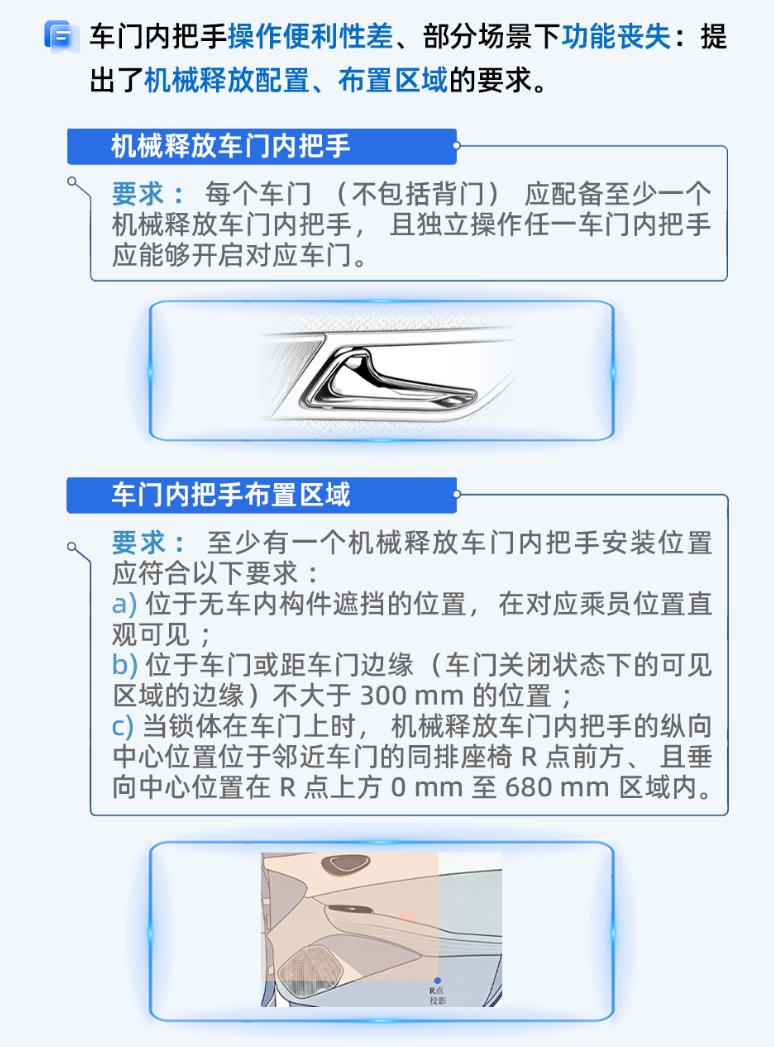
The new national standard clearly requires that the inner and outer handles of each door (excluding the rear door) must be equipped with an independent mechanical release function, and the inner handle of any door should be able to independently open the corresponding door. This means that no matter what extreme situations the vehicle encounters, such as collision deformation, thermal diffusion of the power battery, or a full - vehicle power outage, without the need for any external tools, passengers inside the vehicle can quickly open the door and escape by pulling the mechanical release device. External rescuers can also quickly break in for rescue through the mechanical release function outside the door. This requirement directly addresses the fatal defect of pure - electronic fully concealed door handles that "fail when the power is off," leaving a "way out" for life escape. At the same time, the national standard also stipulates that the outer handle should be able to withstand a force of no less than 500 Newtons (equivalent to the weight of a 50 - kilogram object). Even if it is squeezed by a collision, it should not break or fall off and should still be able to open normally after the test.
Second red - line: Operating space must be reserved to ensure rescue efforts.
In response to the problem that some fully concealed door handles are flush with the car body, making it impossible for rescuers to reach and operate in an emergency, the new national standard clearly requires that in any state of the outer door handle, the hand - operating space for the mechanical release function should be able to accommodate a specified test module. In simple terms, it should leave enough space for at least two or three fingers to reach in (the reference size is about 60×20×25mm), ensuring that rescuers can quickly reach out and grasp the mechanical release device to exert force in an emergency without wasting a single second of rescue time. At the same time, the national standard also stipulates that the outer door handle must be located within the specified shaded area of the car body or near the door or door frame adjacent to the shaded area to facilitate rescuers to quickly locate it.
Third red - line: The signs should be clearly visible to avoid panic in an emergency.
In extreme situations such as vehicle collisions and fires, there may be thick smoke and complete darkness inside the vehicle. If the emergency handle inside the vehicle is hidden by the interior panel, it is difficult for passengers to quickly find the escape switch. In response to this, the new national standard requires that the mechanical emergency handle of each door inside the vehicle must be in an unobstructed and directly visible position and cannot be hidden by the interior panel. At the same time, it should be equipped with a permanent graphic sign with a size of no less than 10mm×7mm, with a strong color contrast to the background, so that it can be clearly identified even in dark environments such as at night. There should also be Chinese or graphic operation instructions near the sign, with the text height no less than 6mm, ensuring that passengers can quickly find and operate the emergency handle in a panic. In addition, the national standard also makes ergonomic calculations for the installation position of the inner handle, requiring it to be located on the door or within a distance of no more than 300mm from the edge of the door (the visible area when the door is closed) to facilitate passengers to quickly reach it.
It is worth noting that the new national standard also sets a reasonable transition period, taking into account the rectification costs of car manufacturers and the smooth transformation of the industry. For newly applied models for type approval, starting from January 1, 2027, they need to meet all requirements except the "hand - operating space." Starting from January 1, 2028, they need to meet all the requirements of the standard. For existing models that have already obtained type approval, they must complete the rectification to meet all the standard requirements before January 1, 2029. This arrangement gives car manufacturers enough time to adjust their designs and transform their production lines, and also avoids a short - term shortage of vehicle models, maximizing the protection of consumers' rights and interests.
III. Tracing the root cause, why are car manufacturers so obsessed with the fully concealed design?
Since traditional mechanical door handles are simple, reliable, and low - cost, why do car manufacturers go to great lengths to turn simple door handles into "complex and delicate" pure - electronic fully concealed ones? The answer is simple: to cater to market aesthetics and create publicity gimmicks. In essence, it is a product of the "intense competition" in the new energy vehicle industry. After the gaps in core areas such as range and intelligent configuration have gradually narrowed, car manufacturers have started to look for breakthroughs in the "details" of the car body design, and the fully concealed door handle has become a "low - cost weapon" for them to demonstrate "technological sense" and attract consumers.
The primary reason is to create a "futuristic" look and cater to the aesthetic needs of young consumers. As the mainstream consumer group of new energy vehicles is gradually getting younger, "good looks are justice" has become the car - buying criterion for many young consumers. A survey by an automobile design studio in Beijing shows that 72% of young consumers believe that "whether a car has concealed door handles" will affect their car - buying decisions. Fully concealed door handles can form a complete and smooth line on the side of the door. When combined with a fastback or low - slung body design, it can significantly enhance the vehicle's technological and futuristic sense, making the vehicle visually different from traditional fuel - powered vehicles and meeting the personalized needs of young consumers. For car manufacturers, simply making a slight change in the door handle design can create obvious "differentiation" and attract more consumers' attention. This "low - cost, high - return" design naturally becomes their first choice.
Secondly, it is to hype up the concept of "reducing wind resistance and increasing range" and create publicity gimmicks. In the new energy vehicle industry, the driving range has always been one of the core pain points that consumers are most concerned about and is also the focus of car manufacturers' publicity. Car manufacturers claim that fully concealed door handles can reduce the wind resistance of the car body, thereby increasing the vehicle's range. This statement has also become an important reason for many consumers to buy. However, in fact, the range - increasing effect is far less significant than what car manufacturers claim.
Actual test data from the China Automotive Technology and Research Center shows that four fully concealed door handles can only reduce the drag coefficient by a maximum of 0.02 - 0.03Cd. In terms of fuel or electricity savings, it can only save 0.3L of fuel or 0.8 kWh of electricity per 100 kilometers, corresponding to an increase in the driving range of new energy vehicles of only 5 - 10 kilometers. The official data of NIO ET7 is even more direct, admitting that its concealed door handles can only contribute to a 0.005Cd optimization of the wind resistance. Under the working condition of a speed of 100km/h, the increase in the range is less than 1.5%. For new energy vehicles with a driving range of hundreds of kilometers, such an increase can be almost ignored. However, even so, car manufacturers still hype up this selling point and use it as an important means of "range optimization." In essence, they are taking advantage of consumers' range anxiety to create publicity gimmicks.

In addition, the lack of industry standards has also allowed fully concealed door handles to "grow wildly." Before the introduction of the new national standard, there was no mandatory safety standard specifically for automobile door handles in China. Only in the "Performance Requirements and Test Methods for Automobile Door Locks and Door Retainers" were there simple requirements for some performance of door handles, without covering the special safety requirements for concealed and electronic door handles. This has given car manufacturers great autonomy in design. They can optimize the appearance and technological sense at will without having to consider safety hazards too much. Some car manufacturers even omitted the most basic safety redundancy design in order to control costs and directly adopted pure - electronic fully concealed handles, further increasing the safety risk.