The AI "arms race": A war Amazon can't afford to lose
1
Quarterly Revenue Exceeds $200 Billion
Recently, Amazon released its financial reports for the fourth quarter and the full year of 2025, ending on December 31. The data shows that in the fourth quarter of 2025, Amazon achieved revenues of $213.4 billion, a year - on - year increase of 14%. This is also the first time that the quarterly revenue has exceeded the $200 - billion mark. During the same period, Amazon reported a net profit of $21.2 billion, a year - on - year increase of 6%. The diluted earnings per share were $1.95, slightly lower than the market expectation of $1.97.
For the full year of 2025, Amazon's revenue reached $716.9 billion, a year - on - year increase of 12%. The revenue scale has exceeded the $700 - billion mark for the first time. During the same period, Amazon's net profit soared from $59.2 billion in 2024 to $77.7 billion, a year - on - year increase of 31%. Against the backdrop of an unclear global economic environment, Amazon's profitability has been significantly improved.
As the world's largest e - commerce platform, Amazon was initially founded in 1994 by Jeff Bezos as an online bookstore. Since then, adhering to business concepts such as long - termism and customer - first advocated by Bezos, Amazon has rapidly developed into a consumer and technology giant integrating e - commerce, cloud computing, artificial intelligence, and offline physical stores. It is also the second U.S. listed company after Apple to have a market value exceeding one trillion dollars.
In terms of revenue composition, Amazon's main business is divided into two major categories: retail business and cloud computing services. Among them, the retail segment is the company's core business, which can be further subdivided into five parts: online stores, offline retail (physical stores), third - party merchant services (commissions and fulfillment fees for online 3P sellers), membership and subscription services, and online advertising.
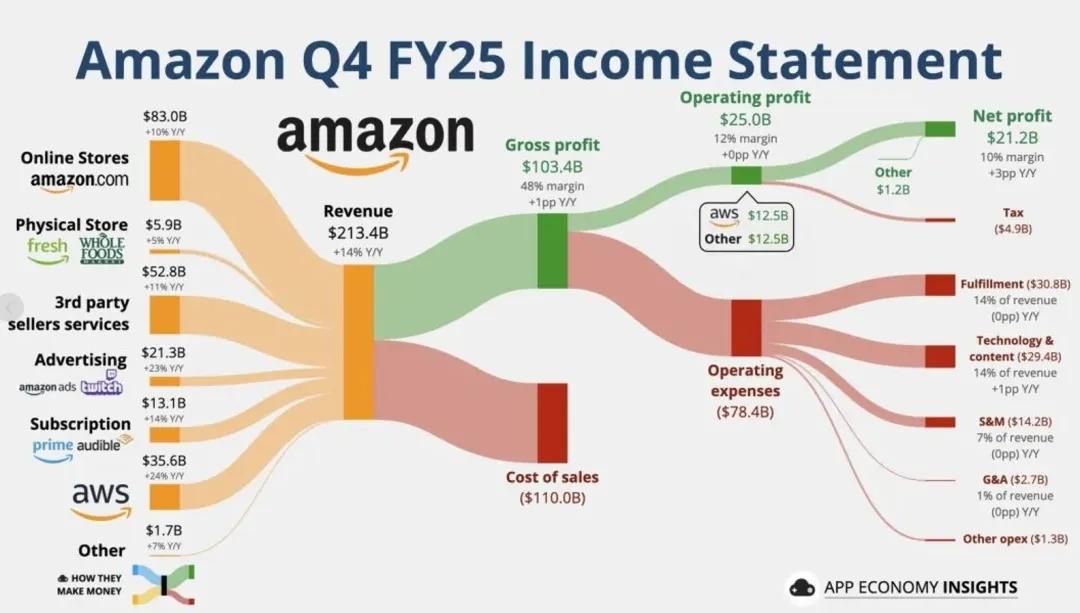
The financial reports show that in the fourth quarter of 2025, Amazon's online store business achieved revenues of $82.988 billion, a year - on - year increase of 10%; the physical store business achieved revenues of $5.855 billion, a year - on - year increase of 5%; third - party seller services achieved revenues of $42.816 billion, a year - on - year increase of 11%; subscription services achieved revenues of $13.122 billion, a year - on - year increase of 14%; and the advertising business achieved revenues of $21.317 billion, a year - on - year increase of 23%.
By region, Amazon's retail business can be divided into two major parts: the North American market and the international market, mainly covering the company's revenues from retail in North America and other parts of the world, as well as subscription and export sales in these regions. Among them, the North American business is the company's core revenue pillar. The financial reports show that in the fourth quarter of 2025, Amazon's North American region achieved sales of $127.083 billion, a year - on - year increase of 10%, and the operating profit reached $9.3 billion, a year - on - year increase of 24%, indicating a significant improvement in profitability.
During the same period, Amazon's international e - commerce achieved revenues of $50.7 billion, a year - on - year increase of 17%. The revenue growth rate is higher than that of the North American region, mainly benefiting from business expansion in emerging markets and the increase in overseas e - commerce penetration. Affected by intensified competition in overseas markets, rising logistics costs, and business adjustments in some regions, Amazon's international business operating profit decreased by 23% year - on - year to $1 billion. The profitability is relatively weak, and overall, it is still in the business optimization stage.

2
Cloud Business Contributes Over 60% of Profits
Compared with the steadily growing retail business, Amazon's cloud business has attracted more external attention. In the fourth quarter of 2025, the AWS business achieved sales of $35.6 billion, a year - on - year increase of 24%. The revenue growth rate reached a new high in 13 quarters, becoming the biggest highlight of this quarter's financial report. During the same period, the AWS business reported an operating profit of $12.5 billion, a year - on - year increase of 18%, and the operating profit margin was 35.0%.
For the full year of 2025, the AWS business achieved total revenues of $128.7 billion, a year - on - year increase of 20%. The revenue accounted for 18%. The cloud business has continued to be a major driving force for Amazon's revenue growth. In addition, in terms of profit contribution, the AWS business contributed more than 60% of Amazon's operating profit in 2025, becoming the company's most important "cash - cow" business.
In 2006, Amazon founder Jeff Bezos gave a speech on the concepts of cloud storage and cloud computing and announced an investment to establish the cloud computing service AWS. In the same year, Amazon Web Services (AWS) officially launched the Amazon EC2 and Amazon S3 services, which marked the official birth of cloud computing as a commercial service. Amazon thus established its dominant position in the cloud computing field.

As Jeff Bezos' first "shadow advisor", Andy Jassy proposed the concept of building a cloud computing platform (AWS) with Bezos. Since the launch of AWS, Andy Jassy has led the team to continuously optimize AWS's products and services. In terms of competitive strategy, Andy Jassy has initiated price wars several times to suppress competitors, enabling AWS to maintain its leading position in the global market and firmly control the global cloud computing dominance.
In July 2021, Jeff Bezos announced his retirement. Andy Jassy took over as the head of Amazon's overall business due to his outstanding performance in leading Amazon AWS. However, with the continuous efforts of competitors such as Microsoft and Google, Amazon's dominant position in the cloud business has been continuously challenged, and Andy Jassy himself has also been questioned by investors.
According to Canalys statistics, in 2017, Amazon's cloud accounted for as high as 49.4% of the global IaaS public cloud service market, while Microsoft's Azure accounted for only 12.7%. Since then, Microsoft Azure has developed rapidly, and the gap in market share between the two has been continuously narrowing.
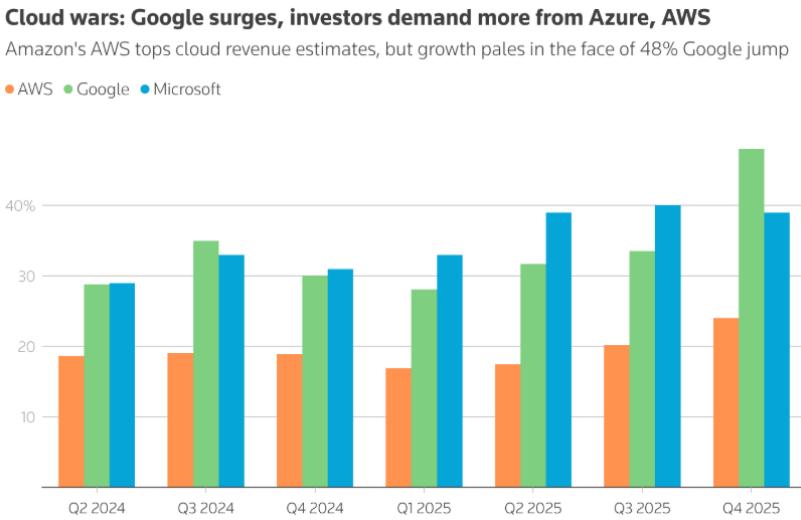
According to the latest data from Synergy Research Group, in the fourth quarter of 2025, Amazon's market share in the public cloud market was approximately 28%, still maintaining a leading position among major cloud service providers. Microsoft ranked second with a market share of 21%, and Google's market share was approximately 14%. The three major cloud service providers controlled 68% of the public cloud market. However, in terms of revenue growth rate, AWS's revenue growth rate in the fourth quarter (24%) was significantly lower than that of Microsoft Azure (39%) and Google Cloud (48%). Microsoft Azure remains a huge threat to AWS in the cloud service market.
3
Annual Revenue from Self - developed Chips Exceeds $10 Billion
Overall, Amazon delivered an impressive performance in the fourth - quarter financial report. Both the retail business and the cloud business outperformed market expectations. In response, Andy Jassy, the company's President and CEO, said: "The AWS business grew by 24%, achieving the fastest growth rate in 13 quarters. The advertising business grew by 22%. The physical store businesses in North America and the international market grew rapidly. The chip business grew by more than triple digits year - on - year. These growths are due to our continuous and rapid innovation and our ability to identify and solve customer pain points."
Andy Jassy also said that given the strong market demand for the company's existing products and services, as well as opportunities in frontier fields such as artificial intelligence, chips, robotics, and near - earth orbit satellites, Amazon is expected to invest approximately $200 billion in capital expenditures in 2026.
The data shows that Amazon's capital expenditure for the full year of 2025 was $131 billion. This means that Amazon's capital expenditure will increase by 52% in 2026. This increase is significantly higher than the company's current revenue growth rate (14%) and also much higher than the previous estimates of Wall Street analysts ($144.7 billion). Therefore, once Amazon's fourth - quarter financial report was released, the company's stock price tumbled by more than 10% in after - hours trading. As of the close on February 9, Amazon's stock price closed at $208.72, and its market value evaporated by more than $250 billion in three trading days.
In fact, secondary - market investors are increasingly showing unease and panic about the AI arms race among technology giants. The latest financial report data shows that Google predicts its capital expenditure in 2026 will reach up to $185 billion, almost doubling year - on - year. Meanwhile, Microsoft's capital expenditure will also increase by as much as 66% in 2026. After the data was released, the stock prices of both companies were hit hard. Among them, Microsoft's stock price dropped by 9.99% in a single day, the worst decline in six years, and its market value evaporated by $400 billion in a single day.
Some analysts believe that the fourth - quarter financial report data of companies such as Amazon and Google have shown that the huge investments made by technology giants in AI infrastructure in recent years have been effectively translated into customer demand and revenue. This is also the reason why the stock prices of the "Magnificent Seven" in the U.S. stock market have repeatedly reached new highs. However, judging from the 2026 capital expenditure plans disclosed by major technology giants, just four companies including Amazon, Microsoft, Google, and Meta are planning to invest $660 billion in AI infrastructure. This shows that the spending speed of these giants far exceeds their revenue - generating speed, and ultimately, they will inevitably sacrifice the company's free cash flow.
In fact, to balance the increasing AI investment, Amazon has significantly reduced its spending in other areas. According to public reports, in October 2025 and January 2026, Amazon carried out two large - scale layoffs, with the number of layoffs being 14,000 and 16,000 respectively. In the fourth quarter of 2025, Amazon accrued a total of $730 million in severance expenses.
It is worth mentioning that, different from technology giants such as Microsoft and Google that are "all - in on AI", Amazon's $200 - billion capital expenditure includes the construction of a large - scale e - commerce fulfillment network to optimize the company's retail business operation efficiency. It also continuously promotes the AI shopping assistant Rufus to improve the customer shopping experience and consolidate its leading position in the retail market.
In addition, investment in self - developed chips is also a major focus of Amazon's unprecedented capital expenditure. According to the financial report, the combined annualized revenue run - rate of Amazon's AI training chip Trainium and general - purpose processor Graviton has exceeded $10 billion and is maintaining a triple - digit annual growth rate. Among them, the cumulative delivery of Trainium 2 has reached 1.4 million units, and the supply of Trainium 3 before the middle of 2026 has been fully booked.
In recent years, Amazon has been committed to independently developing artificial intelligence (AI) training chips to reduce its over - reliance on NVIDIA. On December 3, 2025, AWS officially launched its latest - generation product, Trainium 3. It is reported that Trainium 3 is based on its advanced 3 - nanometer process. The speed of this third - generation chip and its supporting system in training and high - load inference scenarios is more than four times faster than that of the previous - generation product, and the memory capacity has also quadrupled. Many customers, including Anthropic, Japanese large - language - model company Karakuri, SplashMusic, and Decart, have adopted the third - generation Trainium chip and system and significantly reduced their inference costs.

In addition, AWS also voluntarily disclosed the development progress of the next - generation chip, Trainium 4. It is reported that Trainium 4 is expected to be delivered in 2027. This next - generation product will bring a significant leap in performance and will support NVIDIA's NVLink Fusion high - speed chip interconnection technology. This means that the Trainium 4 system can not only operate in conjunction with NVIDIA GPUs but also help AWS attract large - scale AI applications developed based on NVIDIA GPUs to migrate to the Amazon cloud platform. In this way, Amazon has further enhanced its capital and ability to challenge NVIDIA.
It is foreseeable that NVIDIA's monopoly in the AI chip market will eventually be broken, and Amazon has become another major player after Google. This is also the reason why Amazon is willing to invest $200 billion to bet on the future. After all, for Amazon, whose business performance is highly dependent on the cloud computing business, this intensifying AI "arms race" is a war it cannot afford to lose.
This article is from the WeChat official account “Lishi Business Review” (ID: libusiness), author: Li Ping, editor: Ping Fan. Republished by 36Kr with permission.