Three blockbuster products in four years. LiberLive U1 released, cumulative shipments of C series exceed 500,000 units | Frontline
Author | Huang Nan
Editor | Yuan Silai
There is an imperceptible supply - demand gap in the music consumption market.
On one hand, there is a huge pool of potential users, with the annual growth rate of musical instrument consumption in China remaining above 12%. On the other hand, there is a steep conversion gap. The complete learning curve for a traditional folk guitar requires crossing three thresholds: chord memory, fingering training, and rhythm control. Any one of these nodes is enough to make most users put the instrument on Xianyu or under the bed within two months of purchasing it.
The equipment supply in the musical instrument industry has long targeted professional players, offering beginner - level teaching based on the grading system. However, the much larger group of people who just want to express themselves with music at a certain moment has never been truly satisfied.
The emergence of LiberLive happens to fall right on the gap. The stringless guitar, a new category that has only been around for four years, is also being pushed onto the mainstream consumer electronics shelves.
Official data shows that recently, LiberLive's new product, the U1 stringless guitar, was officially launched on the Tmall platform and topped the platform's list on the first day. In the first month of its launch, the U1 and C2 series ranked among the top three on the best - selling list of this category. The cumulative shipments of the C series have exceeded 500,000 units.

LiberLive U1 New Product Launch Conference
Taking "singing while playing" out of the skill set of professional musicians and putting it back on the experience list of ordinary users, the design logic of the U1 is a lightweight expression of this concept.
The U1 features compactness, portability, and high - end appearance. With a 60 - cm body, a weight of 1.5 kg, and a pluggable and foldable structure, users can generate chord segments in real - time by simply pressing and strumming with a single pick. The light - guided operation of "press where it flashes" greatly reduces the user experience threshold. The "smart mode" of the App can automatically match complex chords.
The essence of this interaction is to transform the performance behavior into an immediate dialogue between the user and the instrument. Whether during the commute, outdoor camping, or parent - child interaction, the U1 can be naturally integrated into the fragmented scenarios of daily life, making music expression no longer limited by the venue and skill reserve.
When "singing while playing" no longer requires crossing the threshold of music theory, a new question arises: users can make sounds with the U1, but how can they play the emotions they want to express?
The "patting key" function of the U1 is designed for this purpose. By patting the body of the guitar, users can switch between seven emotional styles. The same chord progression can be re - interpreted between a lively and a soothing style. The tone library has been expanded to nearly 40 types of musical instruments, with the piano, harp, and ukulele integrated into the same instrument. The built - in three drum machine modes support manual and automatic switching, allowing a single person to complete multi - track arrangement. The addition of interesting sound effects such as environment, rhythm, and pets also provides a simpler and lighter way to trigger instrument interaction.
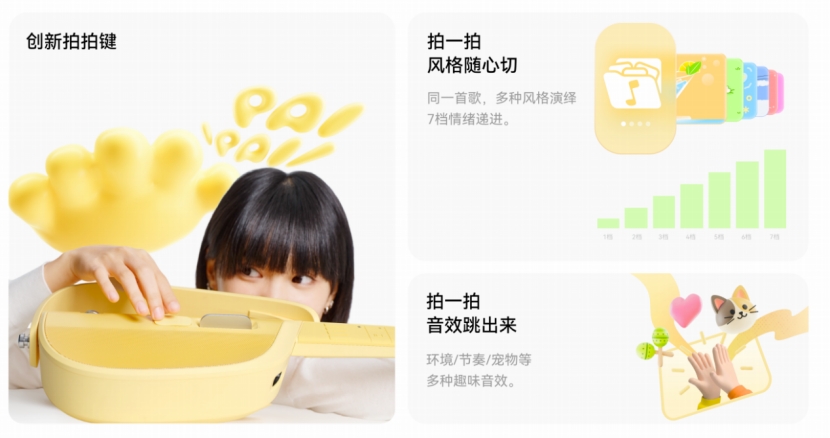
U1 "Patting Key"
The underlying support for these functions comes from the Liber AOS intelligent system. The drone magnetic - induction pick captures subtle finger movements. Combined with the tri - core heterogeneous processing core, it achieves zero - delay feedback of "one pat, one sound". Combined with the multi - million - level sampled audio engine, it restores the details of overtones and resonances, ensuring that the synthesized tone has a real - touch feeling. Its dual - frequency speaker system, equipped with a 10W mid - high - frequency and a 15W low - frequency unit, meets the Hi - Fi standard in acoustic indicators and can restore a sufficiently full sound field in a small volume.
From perception, calculation to sound production, with the superposition of each technical configuration, when users pick up the U1, they don't need to understand any parameters but can directly get "this is the sound I want to play".
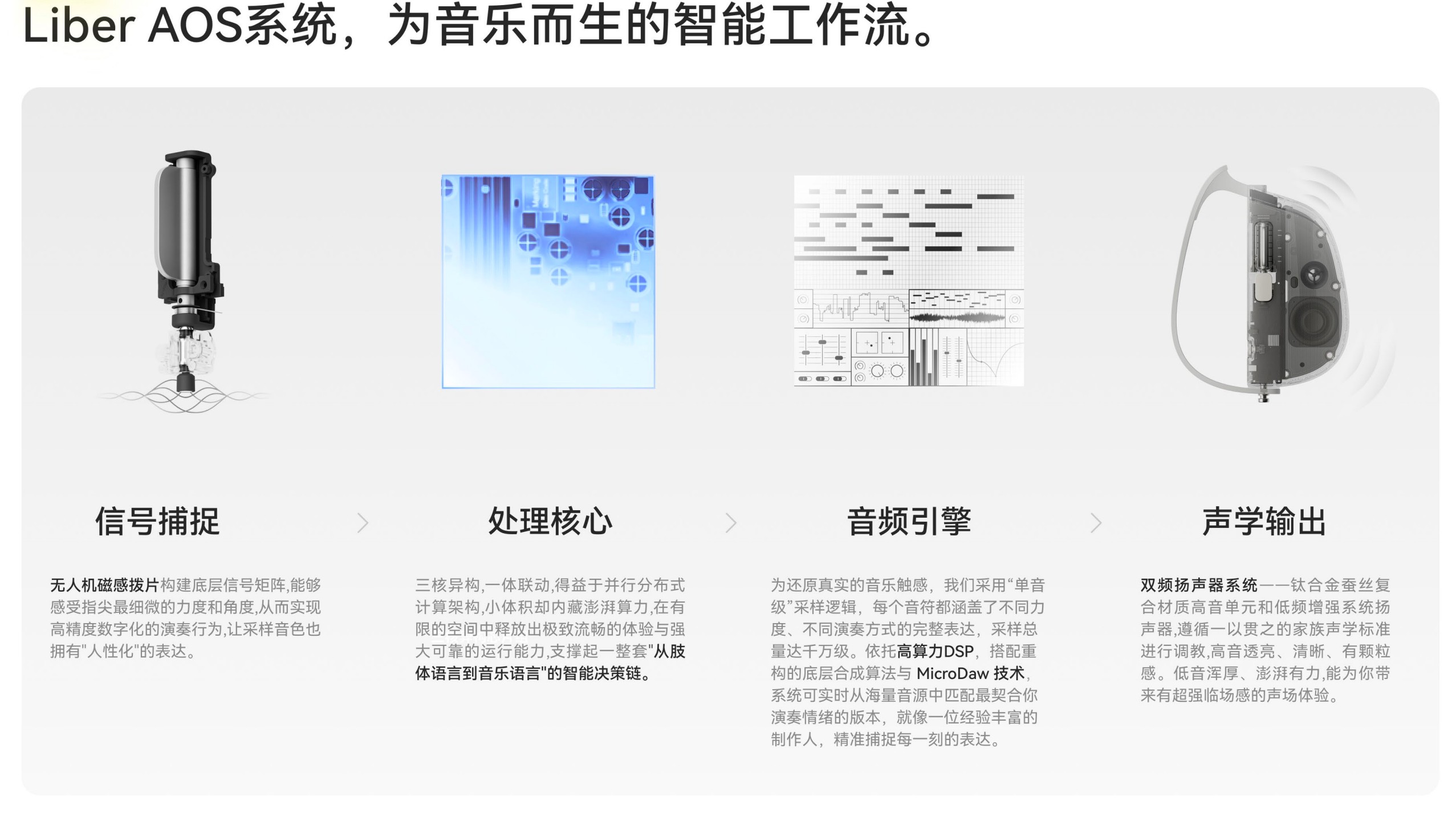
Liber AOS Intelligent System
In terms of function expansion, the supporting ecosystem is also taking shape simultaneously. The U1 supports nearly 40 types of musical instrument tones such as the piano, harp, and ukulele, meeting multiple performance needs with a single instrument. It also has three built - in drum machine modes that support manual and automatic switching, allowing users to create a band effect on their own. The exclusive App has accumulated millions of user - co - created sheet music, and the singing - while - playing videos can be exported and shared with one click. The newly launched LiberDock U1 guitar stand and LiberStrap U1 quick - release strap further reduce the operational cost of "preparing to play the guitar".
The release timing of the U1 is not accidental. When the sheet music library, tone packages, and user community form a data - closed loop around the same set of hardware, LiberLive's positioning has extended from a "stringless guitar supplier" to a service provider of an "instant music expression system".
By separating "performance" from the skill system and redefining it as an interactive and emotional instant behavior, when the threshold of the guitar is lowered, the next thing to be reconstructed may be the piano, drums, or even any creative tools related to "excessively high learning costs".
The global musical instrument consumption market is experiencing a shift in value anchor points: the competition in hardware parameters is approaching the ceiling, and the decision - making weight of incremental users has shifted from "performance redundancy" to "instant gratification". Established manufacturers such as Yamaha and Roland are still lingering in the century - old craftsmanship narrative, while LiberLive is taking a new path - not making musical instruments more like traditional ones, but making them leave the professional shelves and enter the daily lives of ordinary people.