The "Hundred-Model Battle" Kicks off Before the Spring Festival: Why Has AI Image Generation Suddenly "Gotten Smarter"?
On February 10th, Alibaba's Qwen-Image-2.0 and ByteDance's Seedream 5.0 preview version made their debuts on the same day, triggering an "AI image generation battle" ahead of the Spring Festival season.
The release of these two models has attracted wide attention, not only because of the "collision" in their release times, but also because they jointly point to the changes in AI image generation: Currently, AI image generation has made significant progress in key capabilities such as controllable generation, text restoration, and multi-scenario adaptation compared to the past.
Looking back at the development trajectory of AI image generation, it only took less than four years for this field to go from "breaking through the circle" to "maturing".
In 2022, a picture titled "Space Opera" generated by Midjourney won the championship in an art competition at the Colorado State Fair in the United States, instantly detonating the whole network and becoming a synonym for "AI image generation". However, at that time, Midjourney still had several thresholds for the general public: paid subscriptions, Discord operations, complex instructions, etc., making it seem more like a professional creative tool.
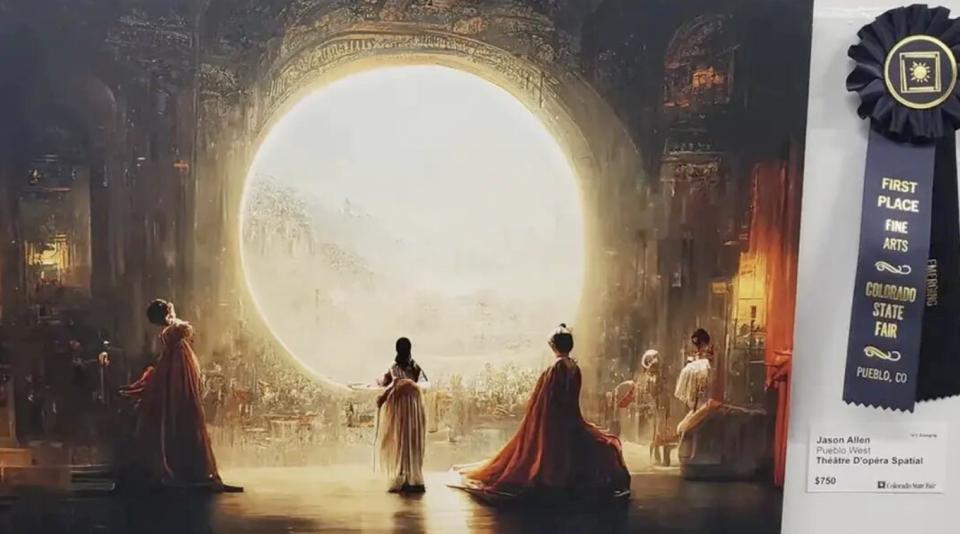
"Space Opera" generated by Midjourney
At that time, the entire industry was still in the early exploration stage. People were more focused on trying "whether AI can draw good - looking pictures" rather than "whether AI can solve practical problems".
The turning point came at the beginning of 2025 when Google's Nano Banana stood out with its lightweight advantage and popularized AI image generation to a wider audience.
In this year, various manufacturers accelerated their entry into the market. For example, Tencent's Hunyuan large model. In the text - to - image ranking list released by LMArena in October 2025, Hunyuan Image 3.0 ranked first among 26 mainstream models globally, indicating the technological strength of domestic manufacturers.
By the beginning of 2026, large image models had become a battleground for multiple large model manufacturers: Qwen-Image-2.0 and Seedream 5.0 sounded the horn of a fierce battle ahead of the Spring Festival holiday.
In just a few years, this industry has evolved from a single model breaking through the circle to a competition among giants. What kind of transformation has AI image generation gone through? Why has Midjourney, once the "ceiling of AI image generation", gradually faded out in 2026?
This article mainly takes Qwen-Image-2.0, Seedream 5.0, and Nano Banana as examples - the first two represent the latest progress of domestic leading manufacturers in the field of image generation, while Nano Banana is a representative of lightweight models that first opened up the mass market in 2025. We focus on the differences in the technical routes of these three models and use straightforward and popular expressions to clarify these key issues.
01 Why has AI image generation suddenly "awakened"?
In the past year, AI image generation has achieved a qualitative change from "being able to draw pictures" to "being able to do practical work": no longer competing in terms of parameters and speed, but in terms of controllability, narrative ability, and implementation scenarios.
Let's first look at the watershed between two key time nodes:
In 2025, Nano Banana detonated the era of "lightweight and inclusive". Before that, AI image generation was "exclusive to high - end players". It required complex operations and often generated a lot of useless pictures. It wasn't until Google's Nano Banana became popular that this barrier was broken: it can achieve native integration of text and images and generate pictures quickly without complex instructions.
The new models jointly released by ByteDance and Alibaba on the same day also represent a concentrated manifestation of technological breakthroughs: The innovation of Qwen-Image-2.0 lies in unifying image generation and editing functions into a single model architecture for the first time, significantly improving the picture generation efficiency. ByteDance's Seedream 5.0 emphasizes the improvement of intelligence level, enhancing the ability to understand prompt words and supporting retrieval - based image generation, multi - step logical reasoning, and integration of online knowledge.
Behind this technological leap are breakthroughs in four core capabilities:
○ Native multi - modal integration: Text generation is no longer a weakness. In the past, the biggest complaint about diffusion models was the "garbled text in pictures". Now, through native multi - modal integration, the model can accurately understand the requirements and generate accurate text. When generating a PPT page, not only are the charts accurate, but the titles and data annotations on it can also be in place at once.
○ Alignment with the physical world: Say goodbye to "anti - physical" pictures. The generated pictures begin to conform to the physical laws of the real world: the direction of light and shadow is unified, the material texture is real, and the spatial relationship is reasonable. The reflection that metal should have and the wrinkles that cloth should have are accurately presented, and there will no longer be absurd bugs like "a person running in the rain with a shadow in sunny weather".
○ Controllable generation: From "random drawing" to "hitting the target precisely", it is finally possible to precisely control the details: local modifications do not affect the whole, the same style can run through the whole set, and multi - round editing will not cause the "appearance" to change. When creating a set of e - commerce pictures, a unified style can be maintained; when changing the color of a product, there is no need to regenerate the whole picture.
○ Dynamic narrative: It can understand complex requirements and actively reason. It is no longer "drawing what you say", but the AI can understand the underlying business logic. When inputting "generate a set of product marketing pictures", the model will automatically infer that it needs various sizes and uses such as main KV, detail pages, and banners, and output a complete deliverable with one click.
02 Different technical routes, different specialties in tasks
Many people may have such a question: Many models seem to be able to generate images from text and perform editing. What are the actual differences when using them?
Actually, the core difference lies in the "technical route". If the commonality is "being able to cook", then the difference is "some are good at Chinese cuisine, some are good at Western cuisine, and some are good at high - end private banquets". The specialties in scenarios are completely different.
Let's first look at the commonalities: The "underlying consensus" of these models. No matter how the focus of each manufacturer changes, the core logic is the same: they all focus on end - to - end multi - modal image generation. Before novices choose a model, they can first understand the common points of popular and useful large models:
First, it can handle everything in one stop in terms of functions. Text - to - image generation, image - to - image generation, image editing, local modification, style switching... all can be covered by one tool, eliminating the need to switch platforms back and forth. In the past, a process that might require three or four software programs to complete can now be closed - loop with one model.
Second, the AI can truly understand the creative intention, and users do not need to disassemble the requirements. For example, if you tell the AI "make a set of e - commerce main pictures for me", it understands the whole visual plan, rather than mechanically giving you just one picture. However, it is recommended that users make the content of the prompt words as clear and precise as possible for better results.
Third, in terms of performance, the generation efficiency is high. The diffusion model algorithm is deeply optimized, and the generation speed is greatly improved without sacrificing quality. In the past, it might take a few minutes to generate a picture, but now the result can be seen in a few seconds.
In addition, it can be adapted to commercial scenarios, support fine - tuning of details, and ensure the unity of multi - image styles, truly meeting the delivery standards of commercial scenarios such as e - commerce, design, and marketing.
The technical routes of large models are different, and their actual characteristics are also different. Let's start from several typical scenarios and see how different models perform in these scenarios:
Let's first look at the Chinese creation scenario.
Taking Qwen-Image-2.0 as an example, in terms of the technical route, Qwen adopts the MMDiT multi - modal diffusion architecture and integrates image generation and editing capabilities into one model.
Specifically, it can parse relatively long Chinese instructions (supporting up to 1000 characters) and generate Chinese text relatively accurately. For example, when generating pictures with ancient poems, such as texts like "Yu Lin Ling - The Cicadas Wail in the Cold", it can maintain a good degree of restoration in terms of font shape and layout. This ability is quite practical for scenarios where Chinese text needs to be accurately presented in pictures, such as posters and advertising pictures.
However, the limitation of this ability is that in some scenarios that require understanding the latest information or complex knowledge, it may be limited by the timeliness of the training data.
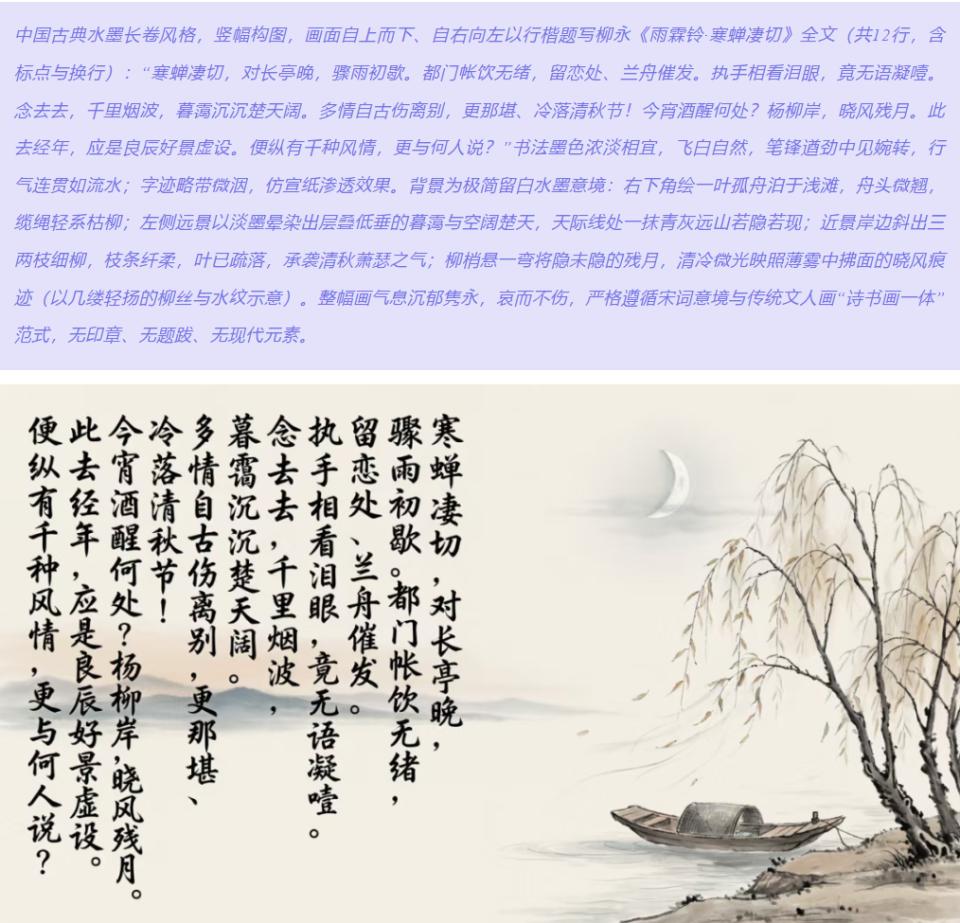
Generated by Qwen-Image-2.0
Qwen-Image-2.0 also supports multiple fonts. For example, it can use Emperor Huizong of the Song Dynasty's Slender Gold Calligraphy to write his Song poem "Tan Chun Ling - The Curtains Flutter Slightly":

Generated by Qwen-Image-2.0
Another typical scenario is the creative demand with requirements for content timeliness.
Taking Seedream 5.0 as an example, it adopts a hybrid multi - modal architecture and incorporates RAG knowledge base and online retrieval capabilities. Simply put, when generating pictures, the model can first search for information, understand the context, and then create.
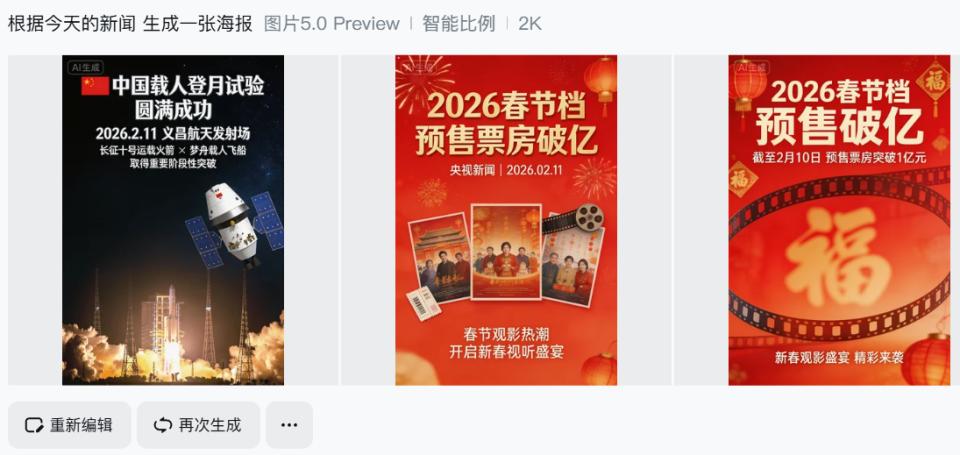
Demonstration of online search ability, a case picture tested by the author
The actual change this brings is that if you want to generate pictures involving new things, such as a new mobile phone released in 2026 or the scene of a recent hot event, it can generate pictures after retrieving real information, rather than "guessing blindly" relying solely on the training data. This is helpful for scenarios that require timely content.
However, the limitation of this technical route is that the results of online retrieval are not necessarily 100% accurate. After all, the content on the Internet is of mixed quality, and it is best to have manual verification for the generated content.
There is also a type of scenario for creative content generation. The characteristic of this type of demand is that the instructions are often relatively abstract, and the model needs to truly understand the creative intention rather than mechanically execute the literal meaning.
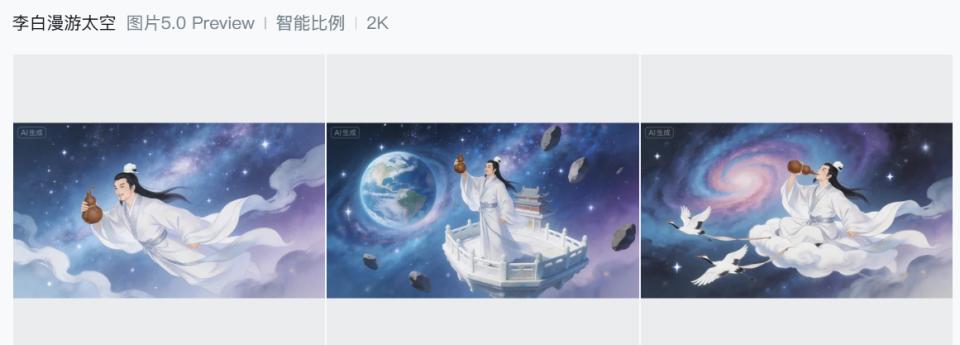
Generated by Seedream 5.0
For example, when I input a creative instruction like "Li Bai roaming in space", the large model can understand that this is a creative demand in a surreal style rather than the literal meaning. The generated picture will integrate the space scene while maintaining the image of the ancient poet.
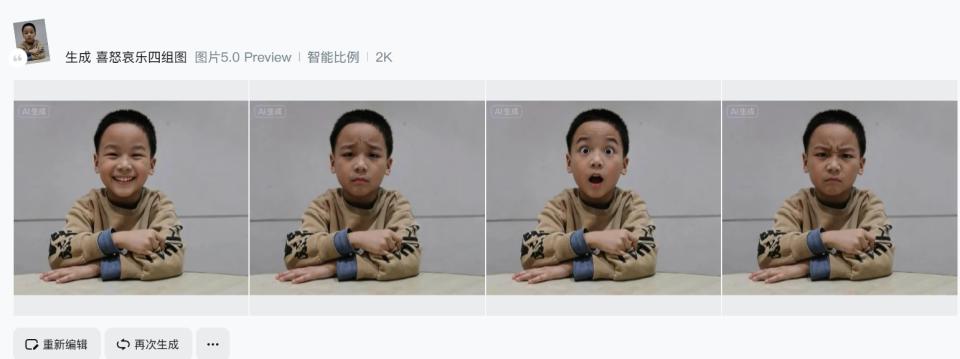
Generated by Seedream 5.0
The large model can also control the detailed editing: it can understand complex and contradictory requirements. For example, in the same picture, while keeping other elements unchanged, it can separately adjust the expression of a character to generate different emotional states.
There are also scenarios with relatively high requirements for picture realism and character consistency. Taking Nano Banana as an example, it adopts the Flow - Matching architecture and performs relatively naturally in restoring physical details such as light and shadow, materials, and the spatial relationship of objects. The character consistency is also relatively stable. The same character can basically maintain the same features in different scenarios and with different costumes, making it suitable for requirements such as story picture books and IP design that need a unified style for multiple pictures.
As a lightweight model, Nano Banana has a relatively low hardware threshold and can run on an ordinary laptop. However, its limitations are also relatively obvious: Its Chinese understanding ability is limited, and it does not support online retrieval, so it will be restricted in scenarios that require timely content.
03 Has the competition logic of AI image generation changed?
Looking back at Midjourney, it has excellent painting styles and strong creative abilities, and is a commonly used tool for many creators. However, in 2026, with the emergence of more large model manufacturers, Midjourney's popularity in the market has significantly declined. It's not that its capabilities have regressed, but the industry demand has changed.
Midjourney follows a different technical route from the current mainstream models: It has different focuses on the depth of text understanding and controllable generation. Its technical route has its advantages: it performs outstandingly in creative divergence. It is good at transforming vague ideas into visual presentations, with strong style diversity. For example, for cross - style combinations like "cyberpunk + Chinese landscapes", Midjourney can provide multiple solutions with a relatively high artistic completion degree, making it suitable for the creative exploration stage from scratch.
However, its limitations are also very obvious: the ability for fine - grained control is insufficient. The image of the same character may be inconsistent in multiple generations, local modifications are likely to affect the whole, and the generation speed is relatively slow. These characteristics make it difficult to meet the commercial scenarios that require mass production and a unified style, such as e - commerce pictures and short drama storyboards.
By 2026, the core demand of the industry has shifted from creative exploration to efficient production. Capabilities such as controllability and scenario adaptation have become more important evaluation indicators. The current focus of the industry competition mainly concentrates on three aspects:
First, controllability: Can it accurately respond to requirements? This is the key turning point for the industry to move from an experimental tool to a production tool. In the early days of AI image generation, the core indicator was the generation quality; now the core indicator has become the "demand matching degree", that is, whether it can understand complex instructions, control specific details, and ensure the consistency of the same subject in multiple generations.
For example, in the past, it might be necessary to generate 50 e - commerce pictures to select 5 usable ones. Now, after inputting clear instructions, the usability rate of the first batch