"Past record" traceable: Former GitHub CEO embarks on a new venture, recording thought processes in Git
For a long time, Thomas Dohmke was regarded as "the least CEO-like CEO."
He would personally reply to GitHub Issues late at night, publicly demonstrate his code - writing process at press conferences, and during the earliest internal testing phase of Copilot, he repeatedly emphasized one thing: "If this thing can't change the daily work mode of developers, then it's not worth existing."
But in August last year, this GitHub CEO officially left his position. The outside world once speculated whether he would join another big company or turn to AI startup investment. But a few months later, his answer was more straightforward - to start a new business.
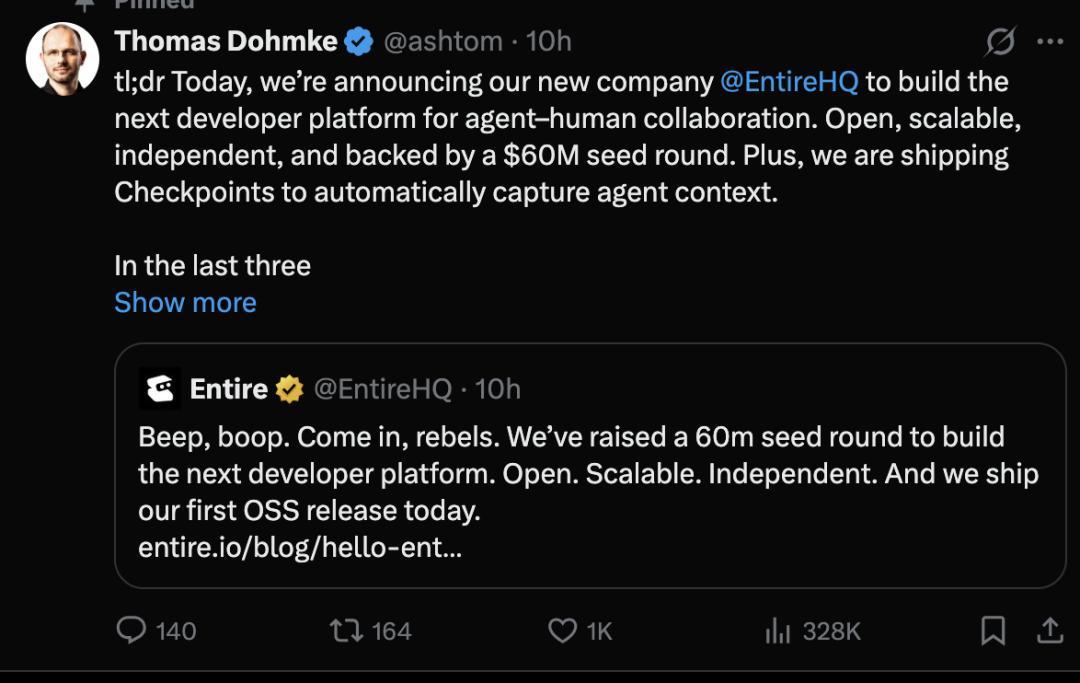
Thomas Dohmke, who is 48 years old this year, founded a new company called Entire, which is an open - source developer platform for the "intelligent coding era".
He announced this news on X.
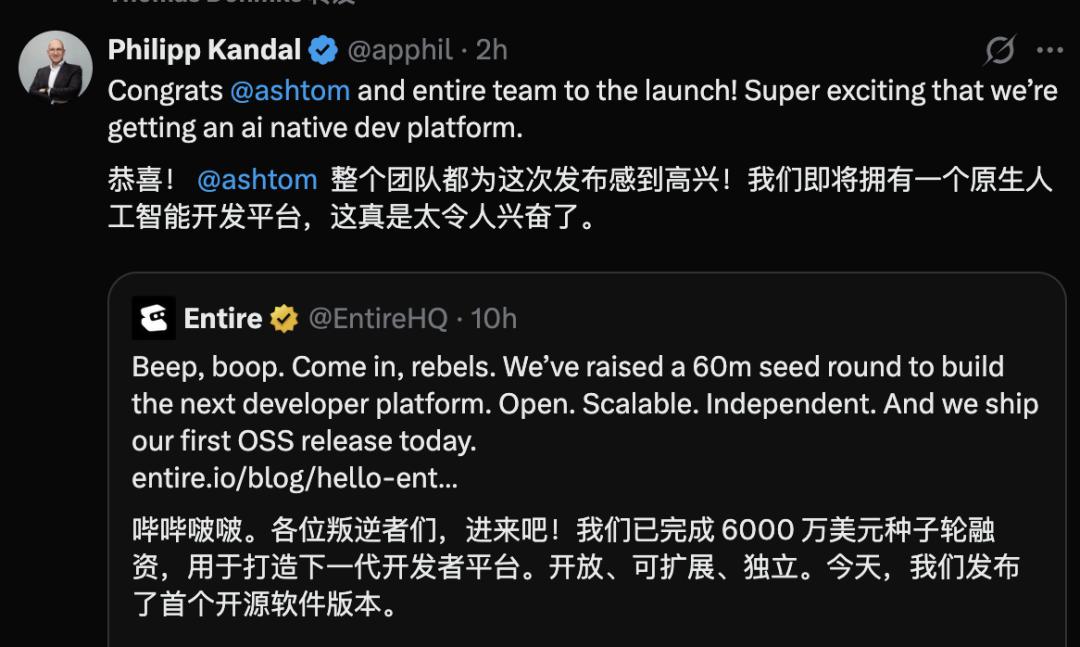
Philipp Kandal, the Chief Product Officer of Grab, posted a congratulatory message on X.
1 Who is Entire?
So, what exactly is Entire?
According to Dohmke, Entire is a platform, but it may not compete with GitHub. Dohmke said that its concept is to build a platform at a higher level of the technology stack, allowing developers to manage and collaborate with the inference process of agents. The code repository will still be at its core.
Entire is building a three - layer platform. Its foundation is a brand - new Git - compatible database built from scratch, the middle layer is a semantic inference layer, and the top is a user interface.
The team believes that since the information stored in these new repositories is different, a new database layer is needed. Specifically, agents can provide more context information than humans when using these tools. This new database will allow humans and agents to query not only the code but also the logic behind it.
Since agents may use this database and its API endpoints far more frequently than humans use Git repositories, the team also needs to consider performance.
Dohmke also said that unlike traditional centralized Git repositories, this new - type database can be built as a globally distributed network of nodes.
For users who need (or want) to ensure data sovereignty, this is an important selling point.
Although the user interface is still under development, Entire has built some functions for visualizing the checkpoints stored in Git. However, currently, the team mainly focuses on the command - line experience.
As for why to develop such a platform, Dohmke gave his explanation.
Dohmke emphasized that a problem in the current developer/customer service workflow that we often hear about is that the bottleneck in code delivery lies not in writing code but in reviewing the code written by customer service. This has led to developer burnout.
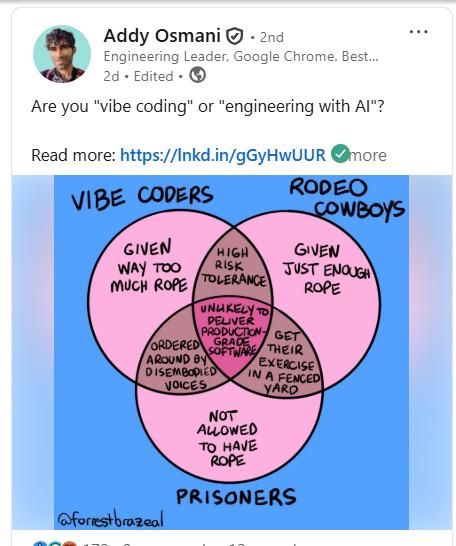
For example, Addy Osmani, an Irish software engineer and a developer of Google Gemini (also involved in Chrome development), publicly expressed his distrust of Vibe Coding.
"We also use Vibe Coding at Google - I find it very suitable for prototyping and minimum viable products (MVPs), and it's also helpful for learning..." Osmani said in a podcast at the beginning of November. "But in general, Vibe Coding focuses more on speed and exploration, rather than correctness and maintainability."
Dohmke believes that there will be more agents in the future.
"If you follow this process throughout the software lifecycle, then the next step after writing code is code review - whether it's your own code or the code of team members through pull requests," Dohmke said. "But pull requests also have the same problem (in understanding the code). It shows changes in files I've never written. And code review tools like Copilot will give me feedback on their code, which is very useful when I have some basic understanding of the code, but if I don't really understand what the code does, then this feedback becomes meaningless or redundant."
When there is a lot of code but little context, the solution may be to use agents and deterministic tools to test the code and ensure its compliance and security.
He explained: "This is gradually becoming a bottleneck, so you have to remove this step from the process. I think this is one of the biggest challenges in the industry because while we are dealing with an increasing number of cyber - attacks, many organizations have introduced a zero - trust process, which means any deployment must be manually reviewed. Therefore, I think, in our opinion, a lot of innovation will emerge in this area, and we hope to be a part of it."
2 Launch the first product, Checkpoints, and open - source it
Checkpoints is the first product launched by Entire. This brand - new open - source tool integrates Claude Code and Google's Gemini CLI (Open Codex will be supported soon) and can automatically extract and record the inferences, intentions, and results of agents.
In the current agent development process, a long - neglected problem is becoming increasingly prominent: conversations are transient, and decisions are irreversible.
In most cases, the prompts of agents stay in the terminal, and the inference process is stuffed into the context window. Once the conversation ends, this information disappears. The code is finally submitted to Git, but Git only records "what has been changed" and cannot answer "why it was changed." When an agent generates hundreds or thousands of lines of code in a single conversation, the lack of context will quickly magnify: early constraints, design trade - offs, and rejected solutions cannot be traced.
As a result, agents can hardly truly collaborate with each other. They will repeat inferences, repeat trial - and - error, consume tokens again, and even reverse decisions made hours or days ago in different conversations. As the size of the codebase expands, this "amnesia - style development" is becoming an implicit cost of efficiency and consistency.
To solve this problem, a new mechanism called Checkpoints has been proposed. It tries to turn the originally ephemeral agent context into a persistent and traceable engineering asset.
The core idea of Checkpoints is to save the complete conversation context of agents as first - class versioned data in Git. When the code generated by an agent is submitted, the system not only records the code itself but also synchronously captures key information in this conversation, including prompts, logs, accessed files, tool invocation, and token consumption. This information is bound to the code submission one by one, forming a semantic trajectory of "why it was written like this."
In terms of usage, Checkpoints runs as a "Git - aware" command - line tool. Every submission triggered by an agent will generate a structured checkpoint object, which is associated with the corresponding submission SHA. The content of the code repository itself does not change; what is added is a layer of context metadata. When developers push the code to the remote repository, these checkpoints will be synchronously written to an independent, append - only branch, forming a complete audit log.
This means that developers can no longer only trace the code differences themselves but also trace the inference process and decision - making background that led to these differences. In the scenario of multi - person and multi - agent collaboration, the evolution of the codebase has, for the first time, the "memory ability" instead of just being a stack of results.
"The role of the middle layer is to provide all the information that contributed to the birth of the software product to humans and agents," Dohmke explained. "Now, in the GitHub codebase, it contains all the code, sometimes documentation and dependencies, but basically lacks all the information on how to implement this code."
This is because these systems are designed for human developers. Although developers may write test cases and documentation after completing code writing, recording their specific reasoning steps has never been included in the process. And in the traditional, non - agent workflow, a large amount of institutional knowledge has never been recorded.
"This is the first step in our greater vision, which is to provide a semantic inference layer in the lifecycle of software projects so that you can trace the reasons for decision - making at any point in the future, whether as a human or an agent," Dohmke explained.
By saving all this data, Checkpoints will allow developers to see how agents generate code.
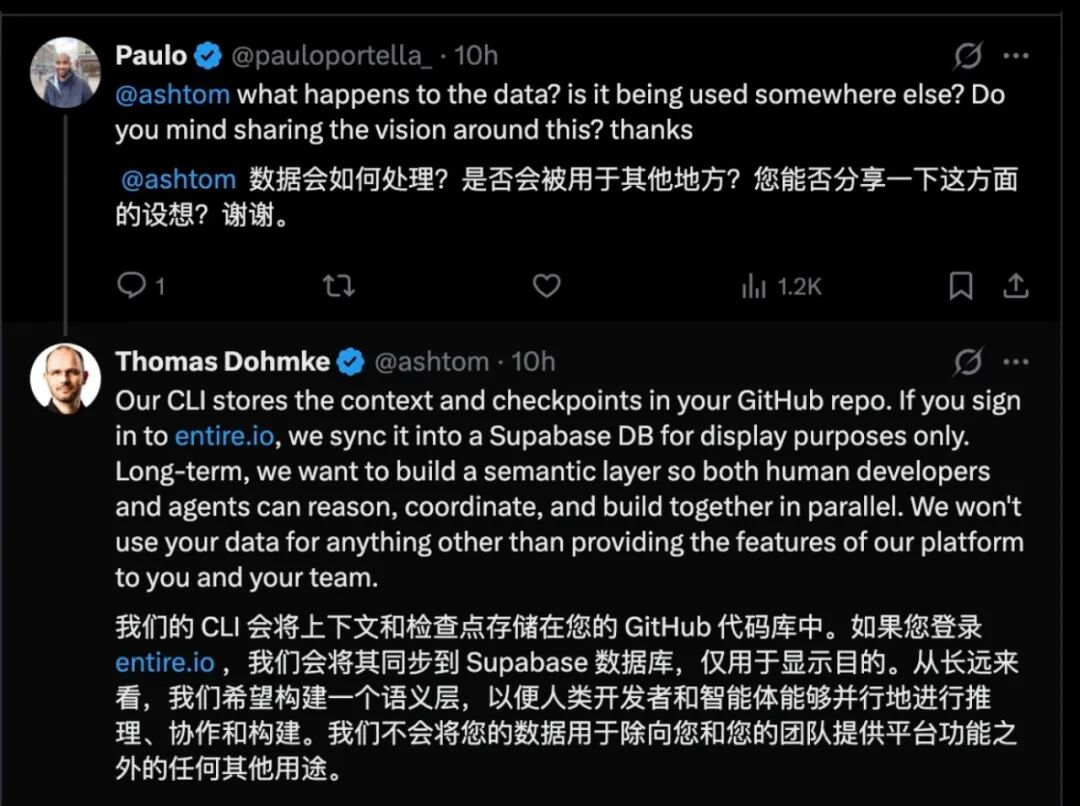
In addition, some X users asked on X how the data will be processed and whether it will be used elsewhere.
Dohmke said: "Entire will store the context and Checkpoints in the user's GitHub codebase. As long as the user logs in, Entire will synchronize it to the Supabase database for display purposes only. In the long run, we hope to build a semantic layer so that human developers and agents can conduct inferences, collaborate, and build in parallel. We will not use your data for any other purpose than providing platform functions to you and your team."
3 The journey of an "engineer - type CEO"
Thomas Dohmke does not come from the traditional "professional manager" background.
Before joining GitHub, he was an engineer, an entrepreneur, and a long - term heavy user of GitHub. After GitHub was acquired by Microsoft in 2018, he entered the Microsoft system and then took over as CEO in 2021, becoming the first true "engineer - type helmsman" in GitHub's history.
During his tenure, GitHub completed a key transformation: from a "code hosting platform" to an "AI development platform centered around Copilot."
The launch of Copilot was not a single - point function upgrade but a fundamental paradigm shift. GitHub no longer only serves "how people collaborate to write code" but also starts to serve "how people write code with AI." This judgment was later proven to be a watershed in the entire industry.
That's why when Dohmke announced his departure in 2025, he specifically emphasized:
This is a completely friendly departure, not a negation of GitHub's or Microsoft's route.
As he recalled in an interview with The New Stack, he had a long conversation with Microsoft CEO Satya Nadella in June. He frankly told Nadella his idea: to return to the state of "creating things from scratch." Nadella's response was to hope that he "finish the CEO job well" and also welcomed him to stay in the Microsoft ecosystem.
This also explains a detail: Microsoft's venture capital department, M12, became one of the investors in Entire.
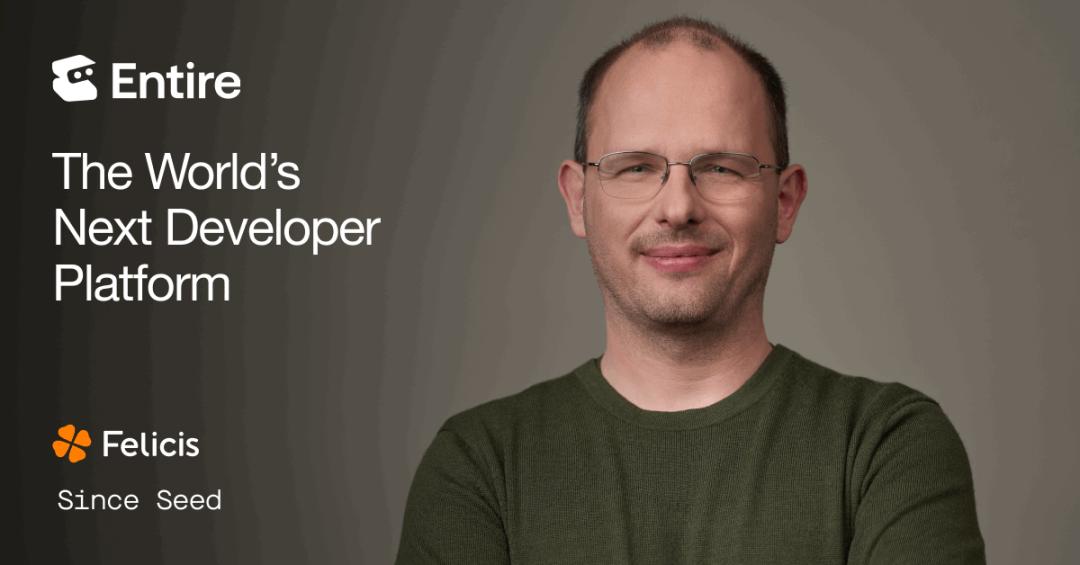
Backed by his professional experience as a technology leader at GitHub, Dohmke is highly favored in the capital market.
Entire's first - round financing reached $60 million, led by Felicis, with Madrona, Basis Set, and Microsoft M12 participating. The company is valued at $300 million.
In fact, a $60 - million financing is not common in the developer tools field. More importantly, this is a platform whose product is still in the early stage.
But in the eyes of investors, this is not an investment in "the product" but an investment in the person + the judgment.
Dohmke's core judgment is:
The generation of developer platforms represented by GitHub was born in the era of "humans writing code," not the era of "agents writing code."
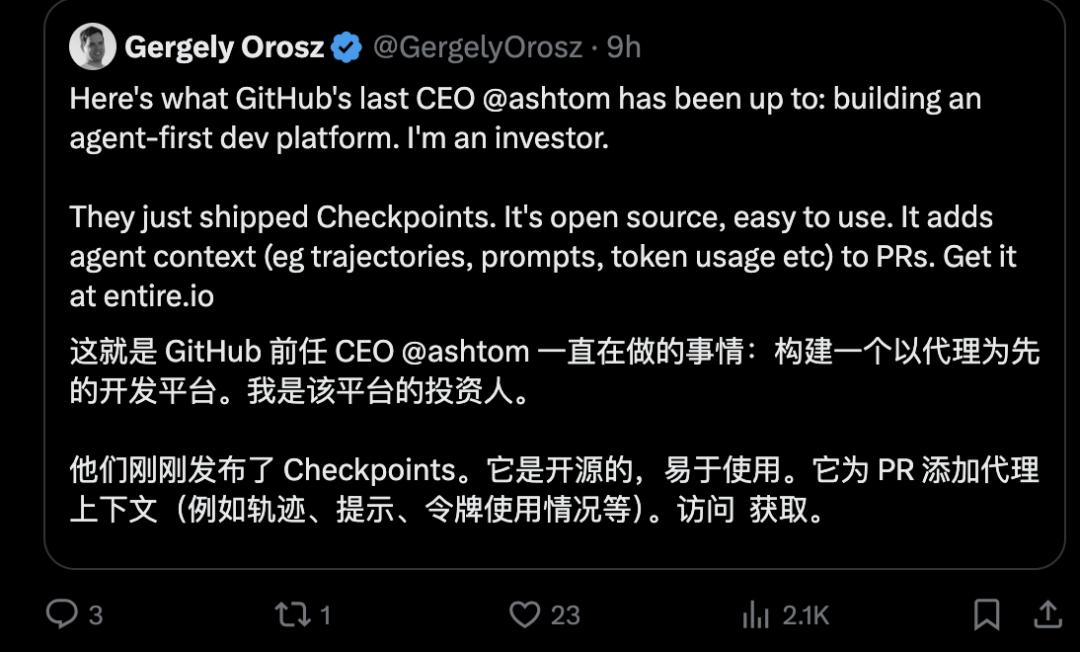
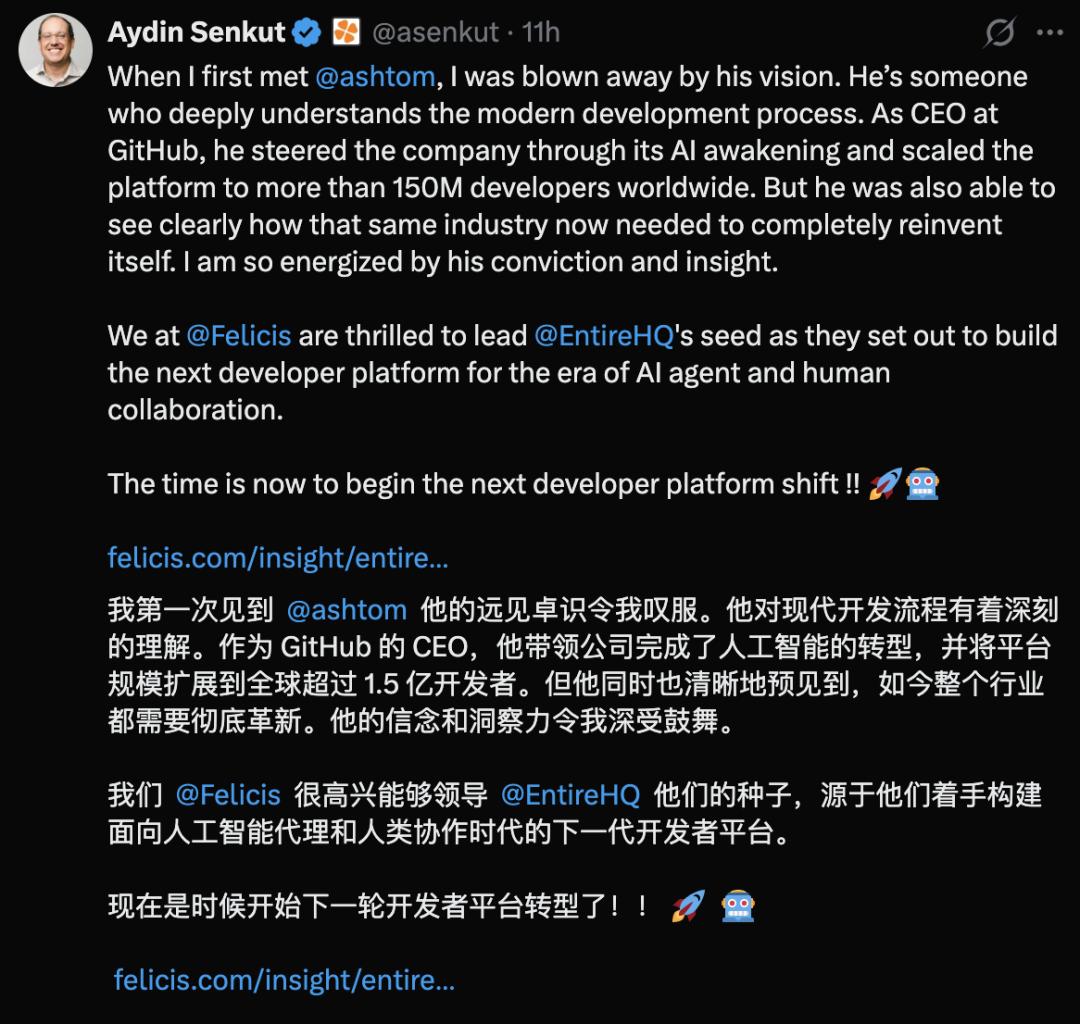
Aydin Senkut, the founder of Felicis, bet on Dohmke's rich industry experience. He posted on X:
I was impressed by @ashtom's foresight when I first met him. He has a deep understanding of the modern development process. As the CEO of GitHub, he led the company through the artificial intelligence transformation and expanded the platform to over 150 million developers globally. But he also clearly foresaw that the entire industry now needs a complete overhaul. His belief and insight inspired me deeply.
With the completion of this round of financing, Entire plans to increase its staff from the current 15 to about 30 and build its platform as soon as possible. But as Dohmke emphasized, employees are not the only important thing today. The Entire team even mentioned in its press release that they plan to expand the team to "hundreds of customer service staff."
"I think by 2026, any leader needs to re - examine the number of employees, not only focusing on salaries, benefits, travel, and expenses but also on the value of tokens. I've talked to some engineers, including those on my own team and those in the Bay Area, and they're all talking about tokens worth thousands of dollars per month," Dohmke said.
As for the business model, Dohmke told us that the team plans to follow the mature open - source model, which is to provide most of the platform's functions under a loose license agreement and then provide hosted services with additional features to make a profit.
4 Netizens: It can be used, but there's no need to over - praise it
After Thomas Dohmke announced the founding of Entire and completed a $60 - million seed - round financing, Hacker News quickly became an "emotion amplifier" for this news.
Some Hacker News users said it was not surprising.
A key figure who has long defined the developer workflow is starting a new business with the grand narrative of "reconstructing software engineering for the agent era," coupled with a seed - round financing that is