Brain-computer wearable devices have become the new favorite.
God Translation Bureau is a translation team under 36Kr, focusing on fields such as technology, business, workplace, and life, and highlighting new technologies, new ideas, and new trends from abroad.
Editor's note: Smartwatches are indeed cool, but have you ever thought about brain science wearables? Wearable devices are entering a brand - new stage of perceiving the "brain". This is not only a hardware innovation but also a deep exploration of the relationship between humans and technology. This article is from a compilation, hoping to inspire you.
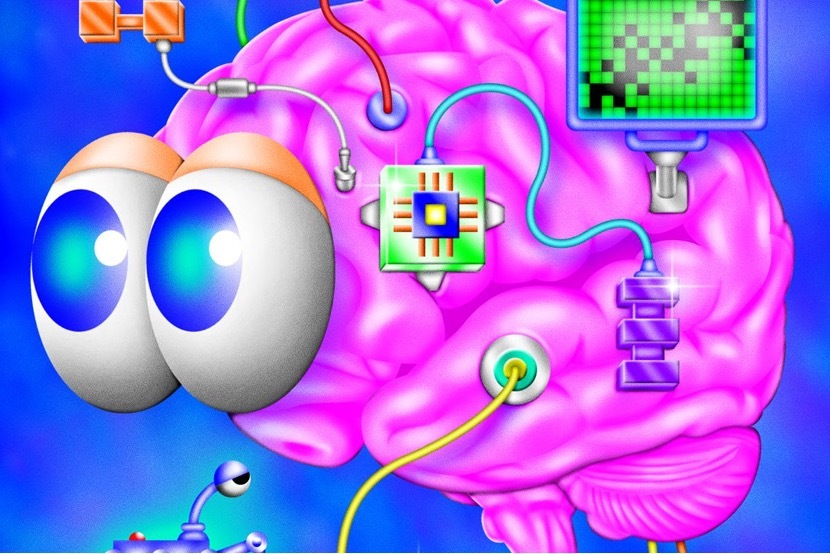
Image source: ROB VARGAS
A decade ago, Fitbit was the most advanced wearable device. Then the Apple Watch quickly replaced it and became the world's best - selling smartwatch. Later, the slimmer and more low - key Oura smart ring came out.
Now, a new generation of wearable devices has emerged - specifically designed for the head. These devices no longer track steps, heart rate, and skin temperature but are dedicated to interpreting brainwaves. They use electroencephalogram (EEG) technology to capture the electrical signals generated by the brain and analyze them through artificial intelligence.
Take Elemind as an example. This company based in Cambridge, Massachusetts, not only tracks sleep states but is also committed to improving sleep quality. Elemind's $350 headband, which looks like the future equipment in "Star Trek", is specifically designed to improve sleep quality. It detects brain signals to determine whether the user is awake or asleep and releases sound waves called pink noise to guide the brain from the awake state to the δ waves representing deep sleep. In a small trial involving 21 people, more than three - quarters of the subjects fell asleep significantly faster.
Outdated: Fitbit
Over - familiar: OURA
Trendy: Brain - machine wearables
If you believe in working smart rather than hard, you can spend $500 on a head - mounted device from Neurable in Boston to boost efficiency. This device equipped with brainwave sensors can track brainwave activities related to concentration (i.e., β waves) and provide real - time feedback on the user's level of concentration. When I tried it last year, it confirmed my intuition: I'm most productive in the morning. When the device detects continuous deep concentration, it will also remind you to take a break. This function is especially considerate for me, who spends all day in front of the computer screen.
Apple is also venturing into the field of wearable brain - machine interfaces. The company applied for a patent for brainwave - sensing AirPods in 2023, but they haven't been launched yet. However, earlier this year, Apple released a new assistive function that allows users to control the Vision Pro through brainwaves rather than physical movements. This means that this augmented reality headset can be integrated with a brain - computer interface (BCI) system, which enables mind - controlled device operation by interpreting brain signals.
The neurotechnology company Cognixion has already adopted this new Apple function.
This startup based in Santa Barbara, California, has developed an AR application that can run on the Vision Pro and a custom headband that can detect brain signals. Currently, Cognixion mainly uses this technology to help people who have lost their ability to speak due to paralysis regain their communication ability. But it's not hard to imagine that the Vision Pro with BCI will be more widely used in the future, for example, playing games and sending messages with the mind.
Earlier this year, I interviewed Andreas Merhed of Elata Biosciences. He is building a so - called "open brain interconnection" open - source network, where anyone can develop neural applications that can run on EEG devices. This non - profit organization has independently developed a device and a table tennis application, which were demonstrated at a cryptocurrency conference in Singapore this fall. About 30 participants gathered on the restaurant terrace for a table tennis game, but the players didn't use hand - held controllers. Instead, they wore head - mounted devices that tracked brain signals. Their goal was to control the racket on the screen to hit the ball with their minds.
The table tennis game is often used for the proof - of - concept of brain - machine interfaces, including by Neuralink. Merhed told me that this game was intended to introduce neurotechnology to the public in a fun and relaxed way. Developers have already developed several other game applications for the Elata network, and he also hopes to attract more research and health - related applications.
"What users want to do and what developers want to build are entirely up to them," he said.
What prompted him to found Elata was witnessing a relative suffering from depression and anxiety. He believes that wearable neurotechnology may provide an answer.
Other wearable device manufacturers are seeking to have their products approved as medical devices, just as Apple has obtained multiple health - function certifications for its smartwatches. Flow Neuroscience, a Swedish company, has developed a headset that treats depression by delivering a low - intensity current called transcranial direct - current stimulation and is paired with an application that provides behavioral therapy, guidance, and monitoring. The device was approved by the US Food and Drug Administration in December this year, becoming the first at - home non - drug treatment for severe depression in the US and has also been approved for sale in markets such as the UK, Europe, and Australia. In a clinical trial involving 174 people, 45% of the participants using the Flow device had symptom relief within 10 weeks, while only 22% of the control group using a sham device achieved relief.
Although implantable brain - machine interfaces can already interpret inner monologues and predict some unconscious thoughts, current consumer - grade wearable devices are not yet capable of reading people's private thoughts. These consumer - grade devices rely on artificial intelligence to recognize brainwave patterns corresponding to specific mental states, but brainwave data is still highly private and may expose the user's mental or emotional state. This raises a question: How will the data collected by these devices be stored and protected?
The brain is the last frontier of privacy.
If current advertising is already scarily accurate, imagine device manufacturers selling users' neural data to third parties, or your employer knowing how many minutes you're not focused at work.
Nita Farahany, a law and philosophy professor at Duke University, explored the new era of brain tracking and hacking in her book "The Battle for the Brain". She predicts that wearable neurotechnology will eventually be everywhere. "These devices will become so common that they won't need to be worn like earphones but will become tiny patches behind the ear and seamlessly connect to all devices," she said. "I think it's an inevitable trend of technological development: to achieve a seamless integration of the brain and devices."
Translator: Teresa