Praised by Elon Musk, CHEN Weipeng hopes to create a "playable TikTok".
Text by | Zhou Xinyu
Edited by | Su Jianxun
It's really hard to describe Loopit's product positioning without hands - on experience.
It's like a "lively" Douyin for content. The content fed to users through the Feed stream is not just videos, pictures, and music, but content that users can interact with through various means such as clicking, swiping, taking selfies, voice commands, and shaking the device.
Due to the product's brand - new interaction mode, before our communication with Loopit founder Chen Weipeng, he strongly advised us: "Don't just look at the demo. You must experience it yourself!"
Previously, Chen Weipeng was the technical leader at Sogou and Baichuan Intelligence. In June 2025, he founded the AI application company "Yongyue Intelligence", with the product direction focusing on AI content communities. Exclusive information from "Intelligent Emergence" reveals that Yongyue Intelligence completed two rounds of financing within the past 30 days. According to estimates, its latest valuation has increased by six times compared to a month ago.
On February 10, 2026, its product Loopit was officially launched. An overseas user posted a usage video on X, which was then commented on and reposted by Elon Musk.
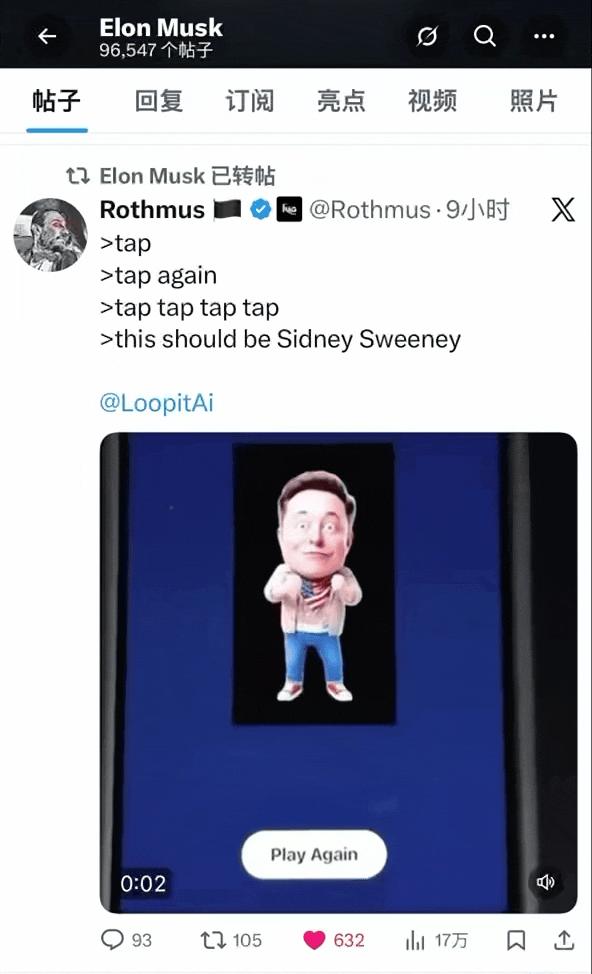
△ Musk reposted Loopit. Image source: Musk's X account
Indeed, among a host of AI products that are either tool - based or serve specific vertical scenarios, this platform - type AI community application called Loopit stands out in terms of its form and gameplay.

△ When you open Loopit, you can see various interactive content posted by users in the single - column Feed stream. For example, you can swipe your finger to make falling grapefruits balance on a capybara's head. Image source: Author's trial
On the other end of content production, similar to UGC platforms, users can create and publish interactive content through Loopit.
However, the difference with Loopit is that AI has significantly lowered the creation threshold. Users only need to input their general ideas in text, and Loopit will actively offer suggestions, generate interactive H5 content that supports all modalities such as images, voice, video, and 3D, and publish it in the community.
For example, it only took us two rounds of conversations to generate a "Y2K - style answer book".

△ Input your ideas in text on the creation interface, and Loopit can generate suggestions and create interactive content. Image source: Author's trial
At the early stage of the product's launch, many people defined it as an "AI game". Chen Weipeng disagreed: "We don't want to define the product so narrowly. Users will expand its boundaries during the process of exploring the product."
In December 2025, Loopit started a small - scale overseas test. Chen Weipeng found that some users would create transformation special effects, design prank games, build their ideal cities, or throw cyber stinky eggs. "In essence, these interactive contents are a new form for users to express themselves."
Throughout his more than a decade - long career, Chen Weipeng is best known for two identities. One is the former R & D general manager of Sogou Search and an NLP (Natural Language Processing) expert who was promoted more than 10 levels in 9 years, and the other is the co - founder and head of the large - model team at Baichuan Intelligence.

△ Chen Weipeng. Image source: Internet
However, in our communication, the experience he mentioned most actively was his time at Soul. In 2021, after Sogou was acquired by Tencent, Chen Weipeng joined Soul as the technical VP, in charge of AIGC technology and content community business.
This experience filled the gap in his content community product management experience. He found that within Soul, "We don't care about our competitors, nor do we think anyone can be our competitor. All we care about is how to create value for users, which really shocked me."
In a sense, the product methodology of Soul has also been applied to his current entrepreneurship. Chen Weipeng told us that he is not worried about potential future competitors of Loopit. "If we can continuously innovate and broaden the industry's imagination of AI applications, we will definitely gain users' recognition."
However, few people know that before Loopit was launched, it went through a long exploration period of more than 7 months. Chen Weipeng remembers that almost every one or two weeks, the team had to scrap the product demo and start from scratch.
Jiao Ke (former co - founder of Baichuan Intelligence), who was also starting a business in the same office building at that time, was confused after meeting Chen Weipeng: "It's been so long. Why haven't you launched your product yet?"
The wavering of the product form was due to Chen Weipeng's bet on a new route: Combining the coding ability of the model with multi - modal ability.
In his view, multi - modality is the ability closest to C - end applications, which can expand the boundaries of user - product interaction. And coding ability is closer to the underlying architecture. "All products are driven by coding", and AI has lowered the coding threshold for ordinary people.
On the first day of entrepreneurship, he put forward a bold idea: AI coding is not just a tool for programmers. An interactive engine driven by AI coding to generate multi - modal content will bring innovation in content interaction.
However, it's not easy to pursue this path.
Firstly, it's technically challenging. Using coding to drive the controllable generation of multi - modal content is a path that few have tried. It took the team a full 7 months to develop a workable architecture.
On the other hand, there was also hesitation about the product form. The team once considered developing a tool - based product, which has high certainty and can generate revenue from the first day. But Chen Weipeng judged that AI tools lack imagination and are difficult to form a network effect. He described his decision as "willful": "Even though building a social platform is more complex and difficult, I'm really excited about it."
In the broader venture - capital environment, in the early days, Chen Weipeng was not a star entrepreneur in the first echelon. During the early financing process, he was labeled with many stereotypes: technicians are not good at product development; he is not young enough; and having served as a senior executive at companies like Sogou and Baichuan, he may lack the drive.
"I've never been the one who was favored from the start, but I've achieved many great things in the past decade." He told us, "If I don't have an advantage a priori, then I'll create one a posteriori."
Below is the edited conversation between "Intelligent Emergence" and Chen Weipeng, the former co - founder of Baichuan Intelligence and the founder and CEO of Yongyue Intelligence:
I convinced Xiaochuan to make several important decisions
Intelligent Emergence: After leaving Sogou, you went to Soul. It seems like a big leap.
Chen Weipeng: This experience is actually very precious. Sogou is an algorithm - driven company. The knowledge I gained there was about how to use algorithms to drive product development.
But technology - oriented companies are more likely to "look for nails with a hammer". So at that time, I was curious about how a more product - oriented company operates.
When I joined Soul, I found that this company is very special. Internally, no one ever discussed who Soul's competitors were. They were more concerned about what kind of user value they wanted to create and how to innovate new user experiences.
They realized as early as 2021 that AIGC would play a very important role in the future. So Soul started to layout dialogue systems, text - to - voice technology, and also developed AI virtual character interaction products, even earlier than MiniMax's Glow (released in October 2022).
This shift in product thinking has had a great impact on my current entrepreneurship. The AI era will reward companies that can expand human imagination.
Intelligent Emergence: How do you understand "expanding human imagination"?
Chen Weipeng: When I first started my business, I was very determined that we must develop a general - purpose product.
This is a rather controversial view. People often say that startups should focus on vertical fields for greater certainty.
However, the core feature of AGI is its generality. From my school days to my work, I've always been involved in NLP (Natural Language Processing). The biggest problem we've faced all along is the lack of generality in technology, which makes it difficult to build a scalable business model, and the market is fragmented.
Now that we've finally seen the possibility of AGI with ChatGPT, why should we go back to developing a vertical product?
Intelligent Emergence: What kind of capabilities are required for a general - purpose startup?
Chen Weipeng: Large - model companies believe in the emergence of capabilities. What AI application companies should pursue is called combinatorial ability, which means how to combine all the capabilities behind AI, such as code, models, language, video, images, reasoning, and even future world models.
Combination can also bring about the "emergence" of user experience. Users will think that your product is worth exploring and can continuously create surprises. So I think generality is the greatest certainty in the AI era, and this is the principle for our product and technology development.
Intelligent Emergence: When ChatGPT was released at the end of 2022, if Xiaochuan hadn't organized the meeting, would you have started your own business?
Chen Weipeng: Yes. I had already decided to leave Soul.
I made a big decision at that time. In three months, I would have received Soul's two - year stock options. But I thought the opportunity presented by large - model technology was once - in - a - lifetime.
As someone in the NLP field, we always say that natural language is the pearl on the crown of intelligence. So I was extremely shocked when I saw ChatGPT because all the things I had been trying to achieve in the past had never made a breakthrough, and suddenly OpenAI showed us a way.
I reflected on my past lack of foresight and my failure to scale up the model with determination. So I gave up Soul's two - year stock options to look for opportunities in large - model development. Coincidentally, Xiaochuan also contacted me at that time.
Intelligent Emergence: Was it the consensus on the first day at Baichuan to train the base model from scratch?
Chen Weipeng: Yes, we were very determined to train it ourselves. Even though there might be great complexity and risks, from a long - term perspective, if we can continuously drive the development of the industry, we will definitely be rewarded by the industry.
Intelligent Emergence: Did you expect the competition in the model layer to become so fierce so quickly?
Chen Weipeng: I did anticipate it. If what we're doing is important enough, competition will inevitably intensify.
However, some things were more difficult than I expected. After many players entered the market, there were doubts in the early days about whether Baichuan could develop good large models.
In May 2023, we were under a lot of pressure. During the financing process, I often had to answer a lot of detailed questions about model training. Why did people ask so many detailed questions? The core reason was that they didn't believe we could do it.
Intelligent Emergence: How did you deal with the pressure?
Chen Weipeng: To be honest, I wasn't really bothered. Throughout my career, I've never been the one who was recognized from the start, but I've always been confident that I can create opportunities.
We made several important decisions at that time:
First, Baichuan should go open - source. Open - source is the easiest way to build a good reputation.
Second, we had to train the model from scratch to master pre - training capabilities. Many companies, considering risks and certainty, wanted to do continue pre - training based on others' models, but this is not fundamental. For example, you don't know the data ratio of others' models, and the team's experience cannot be accumulated. It may seem like a low - risk option, but in the long run, it's high - risk.
Third, if we wanted to achieve short - term results, we should be as conservative as possible in the model structure. In my experience, in the early stage, the impact of the model structure on intelligence is not as significant as that of data, and it's not something that can be innovated radically in a short period.
Fourth, we needed to establish a complete model evaluation system. This is very important for improving the team's iteration efficiency.
I remember clearly that on May 8, 2023, I officially left Soul. I took the high - speed train from Shanghai to Beijing in the morning and arrived at the company in the afternoon to assemble the team.
At that time, we decided to release three models in the next three months, and we achieved it. On June 17, Baichuan released its first open - source model, which only took about 40 days. After that, our financing went very smoothly, and no one had any more doubts.
Intelligent Emergence: Looking back, most of these decisions were correct.
Chen Weipeng: Yes. So I was very happy during the whole year of developing Baichuan 1 - 4.
Intelligent Emergence: What were you doing after Baichuan 4?
Chen Weipeng: I switched to working with Shi Zheng (former head of Baichuan Intelligence's medical business and co - founder of Yongyue Intelligence) on developing a medical large model. At that time, I was a bit confused, not about the technology but about the operational priorities.
Intelligent Emergence: What kind of base - model startups can succeed?
Chen Weipeng: Companies with strong organizational capabilities. Having worked at Sogou and Soul, I know the complexity involved when a technology - oriented company wants to develop a mature application - type product.
You need to combine product thinking and technology thinking in one mind, and few companies can achieve this.
Intelligent Emergence: Can these two types of thinking be compensated for by recruiting?
Chen Weipeng: