The central and western regions outperformed the Yangtze River Delta, rewriting the new energy financing landscape in 2025.
When the global wave of energy transition meets the chill in the capital market, China's new energy industry in 2025 stands at a delicate crossroads.
In this year, over 608 financing events and an injection of approximately 70.5 billion yuan of funds witnessed the significance of the new energy track in the capital landscape. However, compared with the peak in 2022, the nearly halved investment amount reflects the profound transformation of the industry from fanaticism to rationality.
The central and western provinces are rising against the trend, challenging the dominant position of the Yangtze River Delta. Emerging tracks such as sodium - ion batteries and hydrogen energy have quietly become new targets for capital. Amid this interweaving of light and shadow, China's new energy industry is writing a different answer sheet from the past.
Overall Situation: Structural Differentiation between the Increase in Financing Quantity and the Contraction in Amount
In 2025, the financing landscape of China's new energy industry presented a distinct feature of "an increase in quantity but a decrease in price," which profoundly reflects the deep - seated changes in the industrial cycle and capital logic.
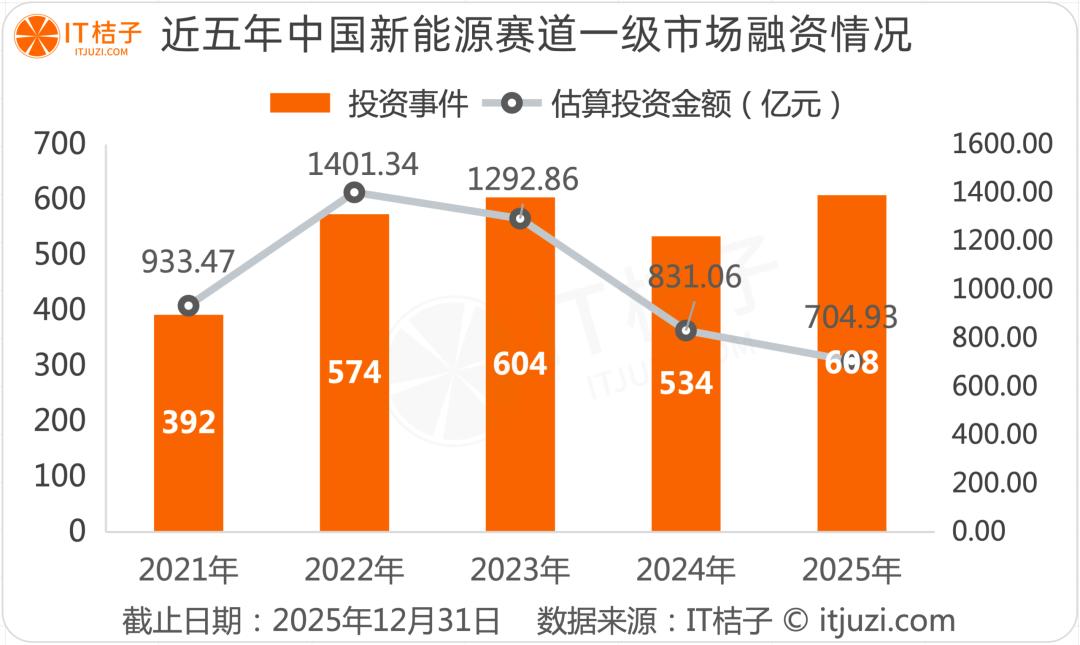
In 2025, the financing enthusiasm in China's new energy industry continued to climb, and capital still maintained a high level of attention. According to statistics from IT Juzi, there were over 608 financing events throughout the year, a year - on - year increase of 14%. The cumulative financing amount was approximately 70.493 billion yuan.
However, in terms of investment amount, the investment in the primary market of the new energy track continued to decline after reaching its peak in 2022. The amount in 2025 was nearly half of that in 2022.
The underlying reason for this structural differentiation stems first from the fundamental change in the industry's driving logic brought about by the gradual withdrawal of domestic new energy subsidy policies.
Over the past decade, policy subsidies were the core engine for new energy enterprises to attract capital. With the end of the subsidy era, projects lacking market competitiveness gradually lost the favor of capital. Investors put forward more stringent requirements for the profitability and technological barriers of projects.
Meanwhile, the after - effects of over - capacity expansion caused by the large - scale influx of capital in previous years began to emerge. There was a stage of over - capacity in industrial chain links such as photovoltaics and power batteries. The industry entered an integration and reshuffle period, and capital became more cautious, with the overall investment pace significantly slowing down.
Regional Landscape: The Rise of the Central and Western Regions against the Trend, Reconstruction of the Industrial Map
The regional distribution of financing in the new energy industry in 2025 presented a completely different pattern from the past. Although the Yangtze River Delta region still led in the number of financing events, the strong rise of the central and western regions in terms of financing scale is rewriting the geographical map of China's new energy capital.
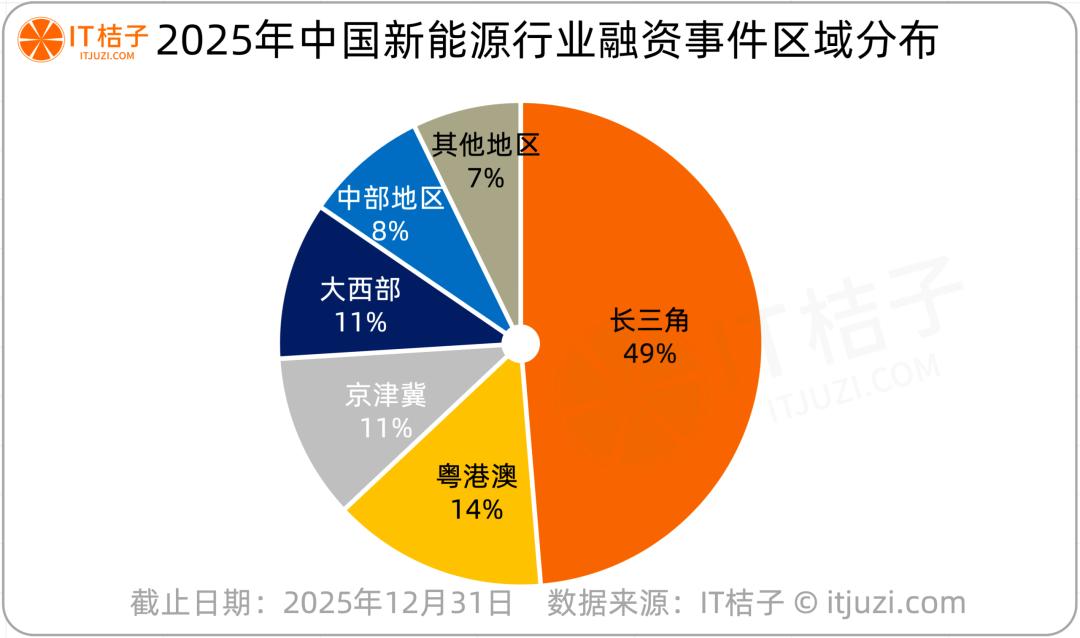
In 2025, the financing in the new energy industry was highly concentrated regionally, mainly in the Yangtze River Delta, the Guangdong - Hong Kong - Macao Greater Bay Area, the Beijing - Tianjin - Hebei region, and energy - rich provinces in the central and western regions, forming a pattern of "led by the Yangtze River Delta with multiple points blooming across the country."
In terms of the number of financing events, the Yangtze River Delta accounted for nearly half, ranking first with 296 financing events. Cities such as Shanghai, Nanjing, Suzhou, Wuxi, and Changzhou formed a complete industrial chain cluster, becoming the core gathering place for new energy enterprises.
In Guangdong, cities like Shenzhen, Guangzhou, and Foshan jointly supported the second - place position of the Guangdong - Hong Kong - Macao Greater Bay Area in the national new energy financing landscape, with financing events accounting for about 14%, still significantly behind the Yangtze River Delta.
Financing events in the Beijing - Tianjin - Hebei region accounted for 11%. In the central and western regions, Sichuan and Hubei performed outstandingly. Relying on local industrial bases and policy support, they formed characteristic industrial clusters in areas such as photovoltaic materials, power batteries, and energy storage.
However, the most remarkable change was the counter - attack of the central and western regions in terms of financing scale.
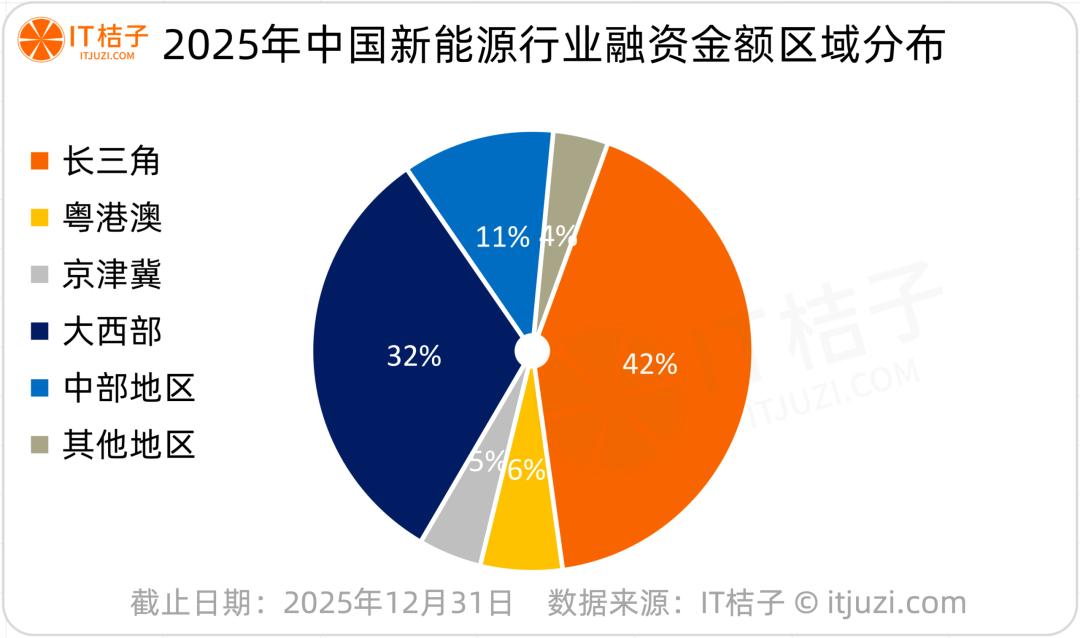
In terms of the distribution of financing scale, the central and western regions received more capital investment in 2025, accounting for 43%, even surpassing the Yangtze River Delta region with the largest number of financing events. In particular, energy - rich provinces such as Inner Mongolia and Sichuan attracted intensive capital inflows in areas such as wind power generation and solar power generation due to their resource advantages.
Among them, CGN Inner Mongolia ranked first in the financing amount of new energy enterprises with a strategic investment of 11.8 billion yuan. Yongxiang Co., Ltd. in Leshan, Sichuan, had a financing amount of over 4.9 billion yuan, Yingfa Ruineng in Yibin, Sichuan, had a financing of over 1 billion yuan, and the financing of leading enterprises such as Wuhan Weineng Battery significantly boosted the financing amount in the central and western regions.
The common feature of these large - scale financings is their focus on mature enterprises, heavy - asset projects, and industrial links with resource endowment advantages, reflecting the higher pursuit of certainty and scale effects by capital during the industry adjustment period.
In contrast, more small - and medium - scale financings showed different flow characteristics, mainly concentrating on start - up enterprises driven by technological innovation, especially in emerging fields such as sodium - ion batteries, hydrogen energy, and nuclear fusion. Enterprises in these tracks are mostly distributed in places such as Shanghai, Jiangsu, and Guangdong, indicating that traditional gathering areas of innovation and R & D activities and financial resources still maintain a close connection.
Provinces such as Sichuan and Hubei, relying on local industrial bases and policy support, have gradually formed characteristic industrial clusters in areas such as photovoltaic materials, power batteries, and energy storage, creating a new pattern of differentiated competition and coordinated development with the eastern regions.
Conclusion
In 2025, China's new energy financing market is writing a new chapter in industrial evolution in its unique way.
The industry is moving from wild growth to rational maturity. The rise of the central and western regions against the trend, the perseverance and innovation of the Yangtze River Delta, and the undercurrent in emerging tracks together constitute a magnificent capital picture.
For new energy practitioners and investors, this is both an era full of challenges and a turning point full of opportunities. Those enterprises that can stay ahead in technological iteration, seize the opportunity in industrial integration, and adhere to value in the changing capital situation will ultimately leave their mark in this green revolution.
The future new energy landscape is destined to belong to those pioneers with both vision and perseverance.
This article is from the WeChat official account “IT Juzi” (ID: itjuzi521), author: Wu Meimei, published by 36Kr with authorization.