3D printers are stepping out of the geek circle.
3D printing is not something new, but what has happened behind this round of market explosion?
Since buying his first 3D printer, in just three months, Zhou Ze's shelves have been filled with various 3D-printed works. Apart from classic animated characters like Pikachu, Mario, and Nick Wilde, and all kinds of interesting fridge magnets, he also spent six or seven hours printing the Hogwarts Castle. The overall design uses gradient colors, looking very exquisite.
Zhou Ze is a typical user in the recent consumer-grade 3D printing boom. On social networks, many netizens are showing off their 3D-printed works. Especially in scenarios such as education, households, and cultural and creative trendy toys, consumer-grade 3D printing has become a new hot spot.
In the past, 3D printing had a relatively high threshold, requiring basic modeling skills and the ability to operate and maintain the equipment. However, with the improvement of the equipment's usability and intelligence, consumer-grade 3D printing is crossing the gap in user experience and is rapidly advancing towards the mass market from the previous circles of geeks and makers.
The Dual Resonance of Capital and Market
There is no shortage of the scenario of being frantically snatched by capital in every popular track, and consumer-grade 3D printing in the past two years is no exception.
At an investment roadshow in the field of cultural intelligence in the Guangdong-Hong Kong-Macao Greater Bay Area at the end of last year, after the co-founder of SmartPi took the stage, the original Q&A session directly turned into a scene where investors rushed to subscribe. A large number of investors surrounded the entrepreneurs and asked if they needed to start a new round of financing.
Statistics show that in 2025, 81 domestic 3D printing companies received 100 rounds of financing, with both the number and the amount of financing far exceeding previous years. Among them, the most highly concerned in the industry include SmartPi invested by DJI, and Kuaizao Technology invested by Meituan and Hillhouse. In January 2026, the 3D printing industry completed 11 rounds of financing (including upstream material suppliers and the industrial-grade market).
Compared with the conservatism of RMB funds, US dollar funds have been particularly aggressive in this round of the smart hardware boom. According to a report by Caixin, entrepreneurs from the DJI and Xiaomi ecosystems have received particular attention. They often encounter competitors trying to snatch projects with higher valuations. Even some projects without products have already received sky-high valuations.
In the secondary market, the A-share 3D printing index rose by nearly 90% in 2025. Creality 3D has submitted its prospectus to the Hong Kong Stock Exchange, and upstream material manufacturers such as Suzhou Jufu, Hangzhou Yijia, and Beijing Yuding are also in the IPO process.
The pursuit of consumer-grade 3D printing by capital is also accompanied by the resonance of the mass market.
The so-called Four Little Dragons of 3D printing in the industry, namely Topwise Technology, Creality 3D, Anycubic, and SmartPi, occupy nearly 90% of the global consumer-grade 3D printing market share. Data disclosed by CIC shows that in 2024, the shipments of 3D printers of these four companies were 1.2 million, 720,000, 550,000, and 500,000 units respectively. Data from the National Bureau of Statistics shows that in 2025, the output of 3D printing equipment in China increased by 52.5% year-on-year.
Topwise is a representative of this round of consumer-grade 3D printing boom. Many industry insiders have affirmed the key role that Topwise has played in this round of the consumer-grade 3D printing boom. This company founded by former DJI employees had a revenue of over 10 billion in 2025. It only took three years from the launch of Topwise's first product to its revenue exceeding 10 billion, and such a rapid growth rate has surprised the industry.
In addition to individual users, many enterprises and studios have also purchased large quantities of equipment to establish 3D printing farms for external services. They are active on various Internet platforms, attracting a large number of consumers who do not own 3D printers but have needs, such as printing highly playable toys and cultural and tourism products, IPs, and peripherals. Their advantages are small batches, personalization, and fast response.
Ju Zheng, the market leader of Creality 3D, told Digital Intelligence Frontline that a customer in Shandong purchased thousands of Creality 3D printers. In addition, many small studios are also taking on customized 3D printing orders. Statistics show that there were already more than 1,000 printing farms in China in 2024.
What's Going on Behind the Move towards the Mass Market?
3D printing is not a new thing. It was popular around 2014.
Zhou Ze worked in a 3D printing company ten years ago. Their company mainly printed wedding photo figurines for newlyweds, which was very popular at that time. Later, this enterprise was acquired by a listed company.
3D printing was still very immature at that time. A common problem was that the layer lines were very obvious, and it was easy to tell that it was a 3D-printed item. "We who are into figurines definitely wouldn't take a fancy to these things." Moreover, multi-color printing was not possible at that time, and the colors were achieved through post-processing.
At the end of last year, Zhou Ze spent more than 4,000 yuan to buy a Topwise P2S. When he got the 3D printer, he found that many of the previous problems had been well solved. For example, surface ironing could significantly reduce layer lines, and multi-color printing was also available.
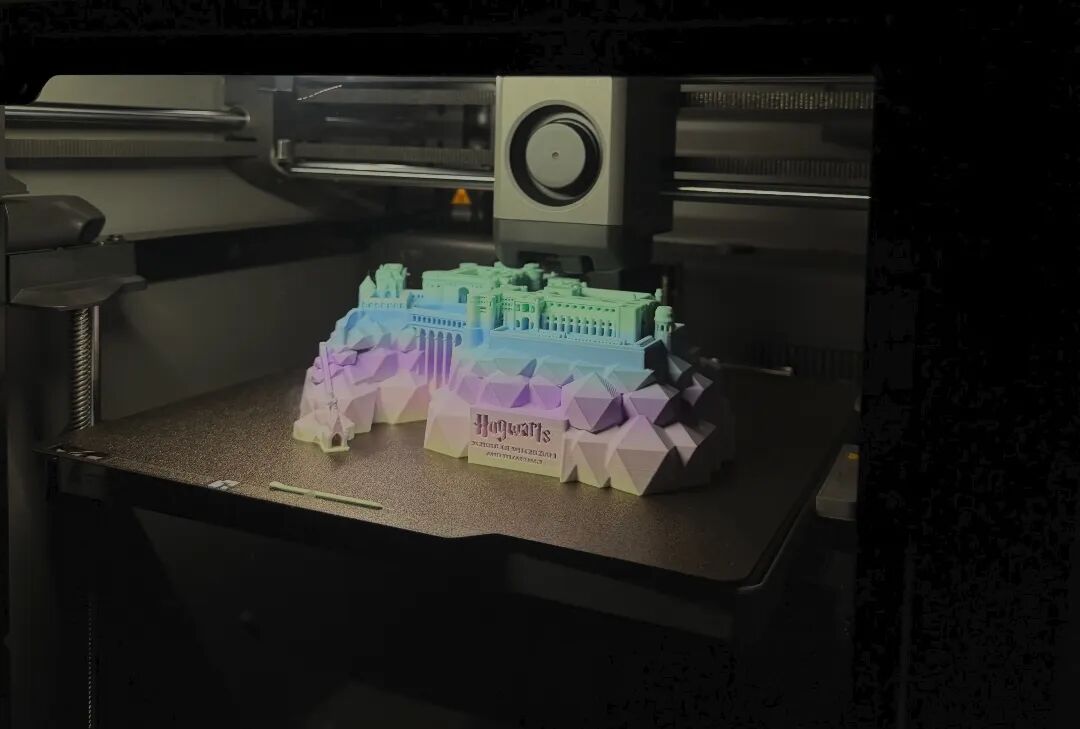
"It's much simpler than I thought," Zhou Ze said. He hasn't designed 3D models by himself yet. He just selects mature works from the community, puts the corresponding colored consumables into the equipment, and then prints them with one click on his phone. This usability is very user-friendly for many users without any design foundation. Moreover, with the emergence of multi-color and various hardness materials, the playability has also increased greatly.
Zhou Ze observed that many moms in the 3D printing communication groups are printing things at home with their children, and he often has friends asking to buy the same figurines from him. He gave an example. Many people would put a more than one-meter-tall Gundam model at home. If they bought it from the market, it would cost ten or twenty thousand yuan, but with 3D printing, the cost is less than one thousand yuan.
Behind the move of 3D printing from the geek circle to the mass consumer market, there have been qualitative changes in the industry in multiple dimensions such as product hardware, software ecosystem, and price.
Both Topwise Technology and Creality 3D told Digital Intelligence Frontline that the significant improvement in the usability and intelligence of the machines has accelerated the popularization of 3D printers.
Traditional 3D printers have a high threshold for use, requiring some assembly skills and complex debugging, including knowledge of some parameters, the format of printing files, and even modeling. However, today's consumer-grade 3D printers have achieved "foolproof" operation. For example, functions such as automatic leveling and flow calibration have become standard, and users no longer need to repeatedly debug the equipment. Relying on the mobile app, even beginners with zero foundation can directly complete 3D printing operations through their phones. The addition of AI functions has further lowered the creative threshold.
Ju Zheng gave an analogy. Photography was a very professional thing in the last century, but now everyone can easily take a good-quality photo with their phone.
Moreover, in the past three or four years, the speed and success rate of 3D printers have also been rapidly improving. Zhang Wang, who has been deeply involved in the 3D printing market for a long time, said that in the past, it might take six hours to print a water cup the size of a purple clay teapot, but now the time can be shortened to two hours, a three- to four-fold increase in speed. In terms of the printing success rate, "The success rate of 3D printers used to be only about 70 - 80%, but now it can basically reach over 95%."
Secondly, the rich content ecosystem has greatly enhanced the playability of 3D printing. In the past, users needed to be able to model and understand some professional design software. Now, in the community ecosystem, users have spontaneously built a large number of interesting and mature models. Users can freely select from the model community and print with one click on their phones without any extra operations. Currently, the total number of models on Topwise's MakerWorld platform and Creality 3D's Creality Cloud both exceed one million.
Chen Yixin, the managing director of CIC, told Digital Intelligence Frontline that for a long time in the past, 3D printing was stuck in the state of "able to print but not easy to use." In recent years, with the maturity of overall machine control, automatic leveling, material adaptation, and slicing algorithms, it has gradually become a device that ordinary consumers can use and is easy to use. The new generation of printer products has also brought the printing success rate and speed to a new level, and the user experience has undergone a generational change. Coupled with the open-source model community and content dissemination, the demand has spread from geeks to families, educational institutions, and creative individuals.
In this round of the consumer-grade 3D printing boom, the contribution of Topwise is widely mentioned. In 2022, Topwise launched its first multi-color 3D printer, the X1, which is considered to have promoted the industry into a new stage of multi-color, intelligent, high-speed, and high-precision printing. Driven by this product, the export volume of Chinese 3D printers increased by nearly 90% year-on-year in 2023.
"Topwise is a phenomenal company that has accelerated the development of the entire industry by at least a decade," Zhang Wang, the aforementioned 3D printing industry insider, told Digital Intelligence Frontline. After the emergence of Topwise, the thinking of the entire industry has reached a new level, and everyone is imitating and learning from it.
In addition to the maturity of product usability and the ecosystem, price is also an important factor in the gradual popularization of consumer-grade 3D printers. Ju Zheng told Digital Intelligence Frontline that Creality 3D was founded in 2014. At that time, 3D printers from European and American brands often cost two or three thousand dollars, while Creality 3D brought the price of 3D printers down to $499 in 2016, enabling it to quickly open up the overseas market.
Zhang Wang remembers that ten years ago, a set of desktop 3D printers cost more than 15,000 yuan, and they were also difficult to use, and the supply chain was not mature. Now, after the national subsidies, the price of the entry-level models of many brands is even less than 1,000 yuan. On e-commerce websites, consumer-grade 3D printers are mainly priced between 1,500 and 8,000 yuan. The price of PLA consumables commonly used in consumer-grade 3D printing has dropped to about 40 yuan per kilogram, a decrease of more than 50% compared with a few years ago.
The development of the "Anime Merchandise Economy" (the economy of anime culture peripherals) has also promoted this area. Zhou Ze observed that in recent years, many popular IPs have emerged, such as Labubu. Many people have started to print these IP images by themselves, which has also indirectly promoted the popularity of 3D printers.
Now, there are already more than two million notes related to "3D printing" on Xiaohongshu. From anime figurines to home renovations, this once niche technology belonging to the geek circle is rapidly entering the daily life of ordinary people.
AI + 3D Printing: A Long Way to Go
Before the popularity of generative AI, 3D printing manufacturers had already implanted AI capabilities into devices such as pressure sensors and cameras. For example, AI is used to calibrate the flow rate of the printing nozzle and actively adjust the flow rate. By installing an AI visual inspection system, when common faults such as noodling and stringing occur during the printing process, the printer will automatically stop. This system also checks the basic settings of the user's printing and the type of the printing plate.
In addition to the application of AI in hardware devices, the greater value of AI lies in the software and modeling aspects. In the past, most ordinary consumers relied on the rich 3D templates provided in the community, and it was difficult for them to create 3D models according to their own needs and imagination.
However, with the rise of large models, platforms such as Tencent Hunyuan 3D, ByteDance Seed3D, Meshy, and Hitem3D, which use AI to generate 3D models, can generate 3D models with just a sentence or a picture. Users don't need professional modeling knowledge and can generate high-quality models that can be directly printed just by uploading a picture, which has unleashed the creative potential of ordinary users.
Currently, the MakerLab on the MakerWorld platform is trying to use AI technology to template high-frequency and mature model templates, allowing users to make lightweight customizations within a clear boundary, which has greatly lowered the usage threshold. Moreover, Topwise has also connected to large models such as Tencent Hunyuan and HITEM, realizing the functions of "image-to-3D" and "text-to-3D". Some simple figurines can basically be generated with a single sentence and then directly printed without other complicated operations.
The AI modeling platform MakeNow launched by Creality 3D has also connected to the Tencent Hunyuan large model. Users only need to upload a picture, and a printable Q-version model can be generated within a few minutes, and 3D printing can be initiated directly on the mobile phone. "For models that focus on appearance, such as figurines, dolls, and tags, AI generation is already very useful," Ju Zheng told Digital Intelligence Frontline.
However, there are also limitations to AI-generated 3D models. For example, experienced modelers will disassemble a complex product for modeling, print various components separately and then assemble them, rather than printing them as a whole. But at present, the function of disassembly with the help of AI is still being explored.
Ju Zheng admitted that for some engineering parts that require precise assembly or structural parts involving specific dimensions, AI is not well adapted yet, and post-processing is still needed.
Currently, from the model to the physical object, slicing processing is required, and this step still requires manual operation. The reason why users can now print with one click is mainly because the platform has pre-processed this step. The latest slicing software is already integrating AI. For example, the structure required for filling and support, and which type of filling is suitable for which part, are determined through algorithms.
Dongfang Liang, the person in charge of the Topwise MakerWorld community, once revealed in an interview with the media that AI-generated models often have hundreds of faces. When importing them into the slicing software, not only is the speed slow, but various problems are also likely to occur. Human modelers know how to avoid designs that are prone to printing failures.
Chen Yixin, the executive director of CIC, told Digital Intelligence Frontline that text-to-3D currently mainly solves the problem of appearance modeling and does not cover strength design, support strategies, part separation logic, and process constraints. Therefore, there is still a gap from being "directly printable", and a large amount of structural and process corrections by humans are still required. The more realistic and achievable value of AI lies in automatic slicing optimization, failure detection, and parameter adaptation.
However, 3D large model manufacturers are also optimizing the AI-generated models. For example, some manufacturers have started to support local editing of 3D models, instead of relying on random selection every time. This means that AI can handle a large amount of basic work in modeling.
The Competition in the Ecosystem and the Future Trends
As more and more manufacturers join this battle, intensified competition is inevitable.
"The stage of simply competing on parameters is over," Ju Zheng said. There isn't much difference in the paper parameters among manufacturers, but what determines the actual experience is the combination of software and hardware. In his opinion, future competition will be at two levels. In the mass market scenario, it means stronger cost-effectiveness and usability, and the market competition will be more intense. In the professional scenario, it will be