Management: The "Superpower" in the AI Era
God Translation Bureau is a translation team under 36Kr, focusing on fields such as technology, business, the workplace, and life, with a particular emphasis on introducing new technologies, new ideas, and new trends from abroad.
Editor's note: How can executives who don't write code outperform a whole semester of development in just four days from scratch? When AI levels the playing field, "management intent" becomes the most crucial survival skill. This article is a compilation.
I recently took an experimental course at the University of Pennsylvania that required students to create a startup project from scratch in four days. Most of the students in the class were in the Executive MBA (EMBA) program. While taking the course, they also held positions such as doctors, managers, or leaders in various large, medium, and small companies. Almost none of them had written code before. I introduced Claude Code and Google Antigravity to them and let them use these tools to build a working prototype. However, having just a prototype doesn't mean it's a startup. So they also used ChatGPT, Claude, and Gemini to speed up processes such as idea generation, market research, competitive positioning, pitch presentations, and financial modeling. I was curious to see how far they could go in such a short time. It turned out they went very far.
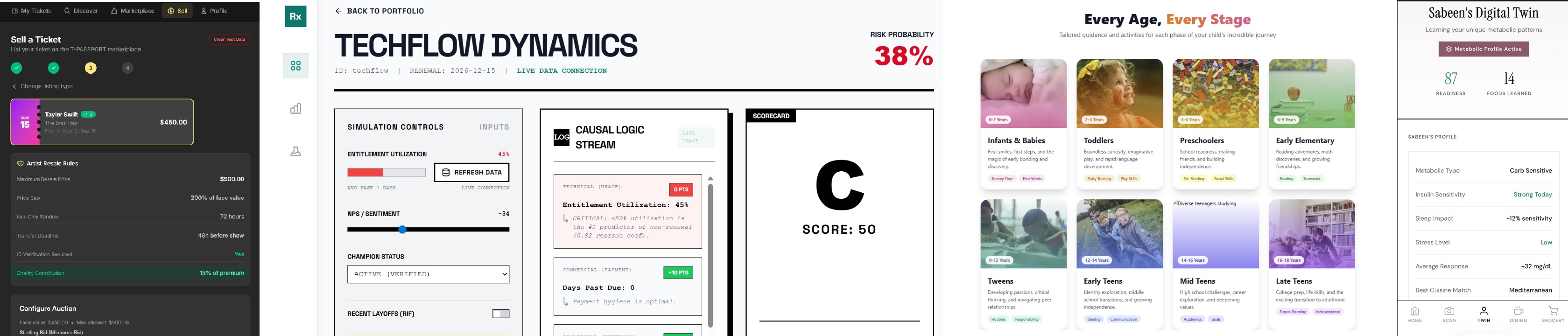
The demonstration cases include: Ticket Passport (a verification ticket sales market) developed by Dee Sethmajhi, Jane Lian Wang, and Yue Ma; Revenue Resilience (identifying revenue risks for small businesses and creating agent solutions) developed by Whit Chiles, Jose Olivares, and Spencer Louie; a parenting companion (matching children's interests with activities) developed by Manoj Massand, Samuel Lee, and Harry Lu; and Invive (blood sugar prediction) developed by Angela Argentati, Sabeen Chawla, and Adeel Rizwan. (There are many other excellent projects, but these teams authorized me to share the screenshots!)
I've been teaching entrepreneurship courses for fifteen years and have seen thousands of startup ideas (some of which have grown into large companies). So I have a clear prediction of what a group of smart MBA students can achieve. I estimate that the results I saw in these two days are an order of magnitude more advanced on the path to a real startup than what students could achieve in a whole semester before the AI era. Most of the prototypes are not just a few demonstration screens but actually have the core functions working. The ideas are more diverse and interesting than ever, and the market and customer analysis are also very insightful. This is truly impressive. Although these projects are not yet mature startups or fully launched products (except for a few exceptions), they save months of time, a huge amount of money, and a great deal of effort compared to the traditional process. There's also one more thing: Most early-stage startups need to "pivot," that is, adjust their direction after a deeper understanding of market needs and technological feasibility. By reducing the cost of pivoting, it becomes much easier to explore various possibilities. Developers won't be stuck with one idea and can even explore multiple startup projects at the same time: you just need to tell the AI your requirements.
I really wish I could attribute these amazing results to my excellent teaching, but in fact, we don't have a mature framework for how to use these tools yet. The students basically figured it out on their own. Their management experience and professional knowledge played a big role because, as it turns out, the key to success is exactly what was mentioned at the end of the previous paragraph: telling the AI what you want. As AI becomes more capable of handling tasks that would take humans hours to complete, evaluating these results becomes more and more time-consuming. At this time, the value of "being good at delegation" becomes prominent. But the question is, when should you delegate work to AI?
The Equation for Agentized Work
We actually have the answer, but the situation is a bit complicated. Three factors need to be considered: First, due to the "Jagged Frontier" of AI capabilities, you can't exactly know what it's good at and what it's not when handling complex tasks. Second, regardless of whether AI does a good or bad job, it's definitely fast and can complete in minutes what would take humans hours. Third, it's cheap (compared to the salaries of professionals), and it doesn't mind you generating multiple versions and throwing away most of them.
These three factors mean that deciding whether to delegate a task to AI depends on three variables:
Human Baseline Time: How long it would take you to complete the task yourself.
Probability of Success: How likely is the AI to produce results that meet your standards in a single attempt.
AI Process Time: The time required for you to send a request, wait for, and evaluate the AI's output.
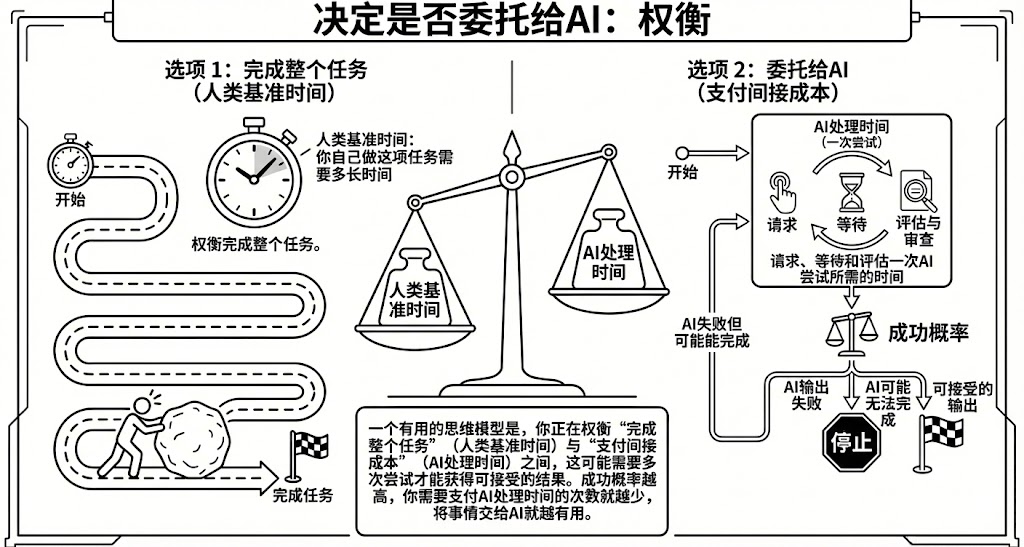
A practical thinking model could be like this: You're weighing between "completing the entire task independently" (Human Baseline Time) and "paying the management overhead" (AI Process Time). You may need to pay the overhead multiple times until you get satisfactory results. The higher the probability of success, the fewer times you need to pay the AI Process Time, and the more cost-effective it is to delegate the task to AI. For example, suppose a task would take you an hour to do yourself, and the AI can finish it in a few minutes, but it takes thirty minutes to check the answer. In this case, you should only delegate it to the AI when the probability of success is extremely high; otherwise, you'll spend more time generating and checking drafts than doing it yourself. However, if the Human Baseline Time is 10 hours, it's worth spending a few hours working with the AI, as long as the AI can eventually handle the job.
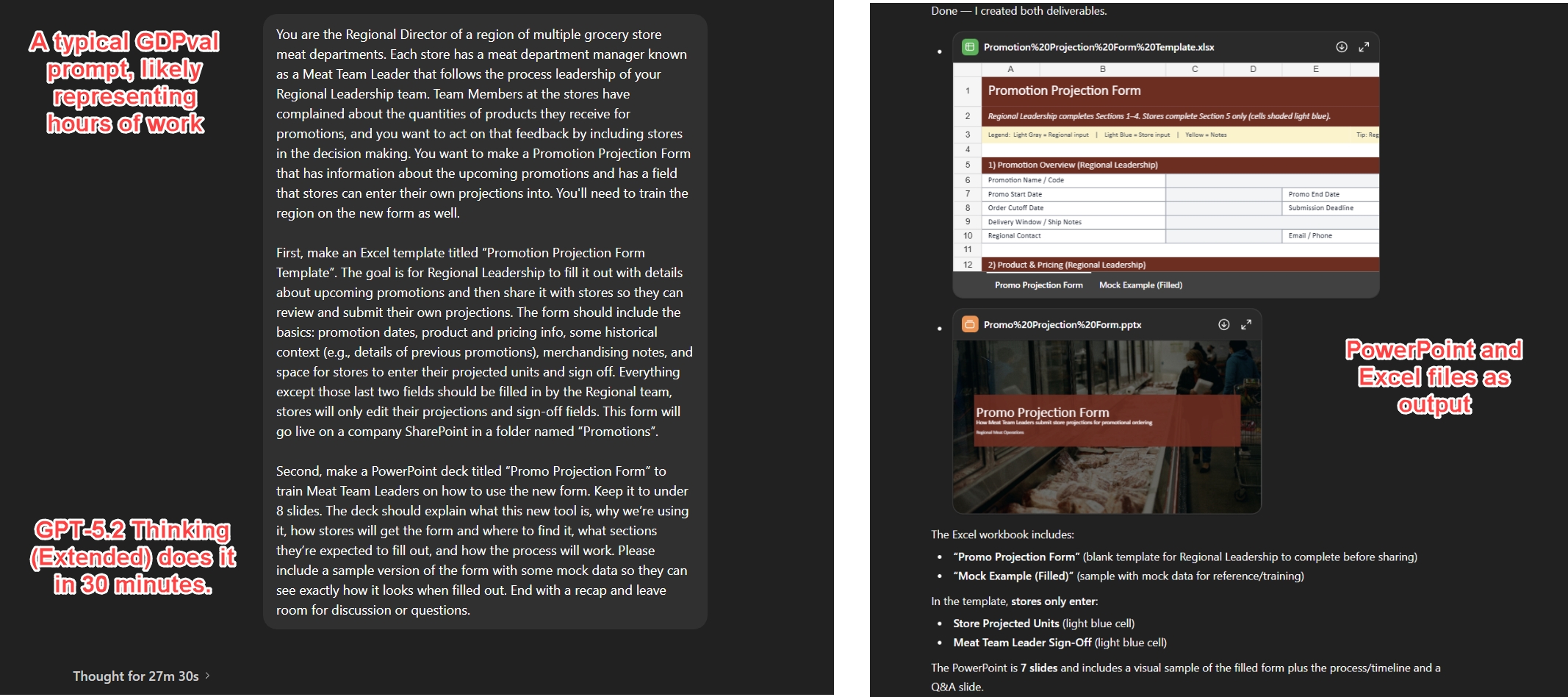
This is an example of a prompt for a task with a "Human Baseline Time of several hours." The initial AI Process Time is 30 minutes (during which you can do other things), plus the time for writing the prompt and checking. But if you have to make a lot of corrections, it's not worth it.
We know this equation works because last summer, OpenAI published one of the most important papers on AI and real work - GDPval. I've discussed this paper before. Its core is to have senior human experts in different fields such as finance, medicine, and government compete with the latest AI, and another group of experts serve as judges. On average, experts need 7 hours to complete the task, so in this case, this is the "Human Baseline Time." The AI Process Time is interesting: the AI can complete the task in a few minutes, but it actually takes an hour for experts to check the work, and of course, it also takes time to write the prompt. As for the "Probability of Success," when GDPval was first released, the judges mostly ruled in favor of humans. But with the release of GPT - 5.2, the balance has tilted. The GPT - 5.2 Thinking and Pro models match or beat human experts 72% of the time on average.
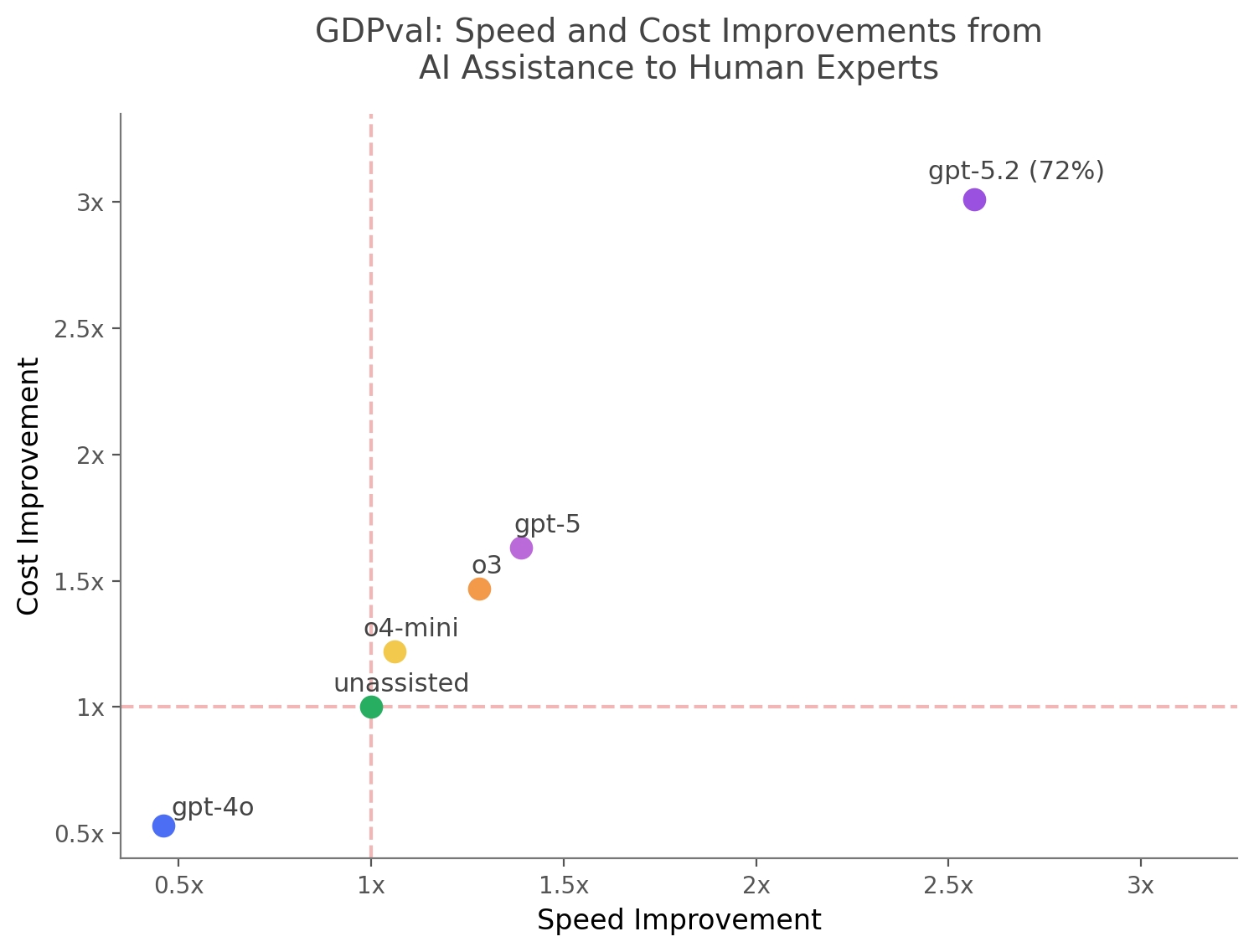
Under the "draft → review → retry if necessary" workflow, the speed and cost improvements brought by AI - assisted completion of GDPval tasks (relative to the 1x baseline of unassisted experts). The data points for GPT - 5.2 are estimated based on its approximately 72% win - draw rate in GDPval; the data points for other models are from the GDPval paper. Real - world results will vary depending on the task: some tasks are "easy wins," some are obvious failures, and the most difficult situation is the kind of failure that "looks okay but is actually wrong."
Now we can calculate how many hours you can save in a 7 - hour task, assuming a 72% probability of success and an evaluation time of one hour. If you try to write a prompt for each task, spend an hour evaluating the AI's results, and redo the task yourself if the AI doesn't do well, you can save an average of 3 hours. Tasks where the AI fails will take longer (because you waste the time on writing and reviewing!), but tasks where the AI succeeds will be much faster. Moreover, we can use management skills to tilt this equation in our favor!
Delegation: The New Form of Prompts
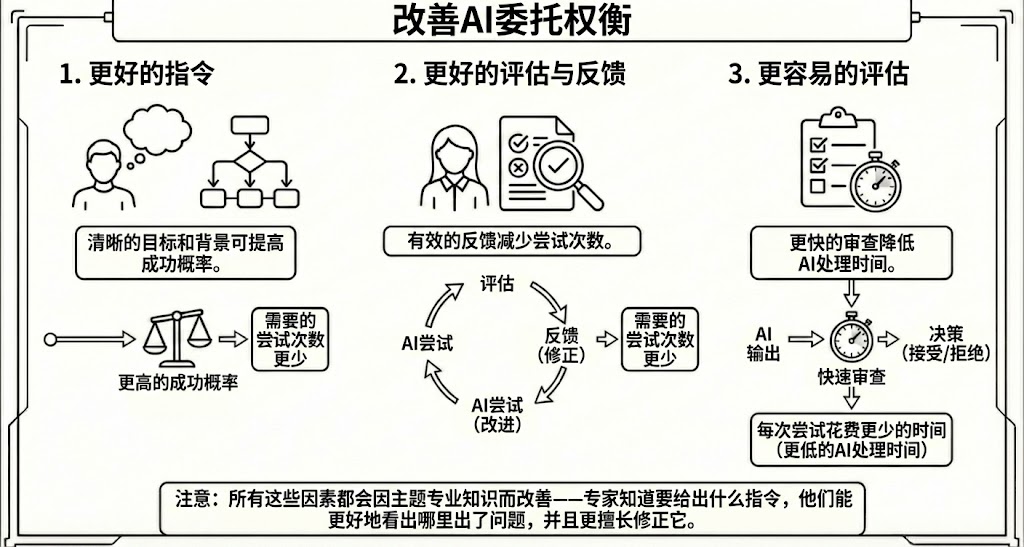
To make delegating work to AI more cost - effective, we can do three things to increase the probability of success and reduce the AI Process Time. First, we can provide better instructions and set clear goals to increase the AI's success rate in execution. Second, we can improve the efficiency of evaluation and feedback, thus reducing the number of attempts needed to get the AI on the right track. Finally, we can simplify the evaluation process and spend less time judging the AI's performance. All these factors rely on professional knowledge - experts know what instructions to give, can spot problems more acutely, and can correct errors more effectively.
If you don't need specific results, AI models have shown amazing capabilities in solving problems autonomously. For example, I found that Claude Code could generate a complete 1980s - style adventure game with just one prompt. My prompt was: "Create a completely original old - school Sierra - style adventure game with EGA - like graphics. You should use your image agent to generate images and provide me with a parser. Make all the puzzles interesting and solvable. Complete the entire game (the game duration should be 10 to 15 minutes) without asking any questions. Make it amazing and enjoyable." Just like that, the AI completed everything, including the art. Then, with two more prompts, it tested and deployed the game. You can play it yourself: enchanted - lighthouse - game.netlify.app.
This is truly amazing, but part of this amazement comes from the fact that I didn't have specific requirements. As long as it was an adventure game, the AI could have free rein. But in actual work and real delegation, you usually have a specific output goal in mind, and then the situation becomes tricky. How do you convey your intention to the AI so that it can use its "judgment" to solve problems while still giving you the output you want?
This problem existed before the advent of AI, and it's so common that every field has invented its own document format to solve it. Software developers write product requirement documents (PRD); film directors provide storyboards; architects create design intent documents; the Marine Corps uses the "five - paragraph order" (situation, mission, execution, administration, command); consultants define the scope of cooperation through detailed deliverable specifications. In today's world of agentized work, all these documents are excellent AI prompts (and the AI can handle dozens of pages of instructions at once). The reason why so many formats can be used to guide AI is that they all have the same essence: trying to translate the ideas in one person's head into the actions of another.
When you look at what a good delegation document contains, you'll find them surprisingly consistent: What do we want to achieve and why? Where are the boundaries of the delegated authority? What are the standards for "completion"? What specific outputs do I need? What intermediate outputs do I need to track your progress? What items do you need to check before I tell you it's done? If these requirements are clearly specified, the AI, like a human, is more likely to do the job well.
In the process of figuring out how to give these instructions to the AI, it turns out that you're basically reinventing "management."
Managing Agents
I've noticed an interesting phenomenon: Some of the most well - known software developers in large AI labs have noticed that their focus is shifting from writing programs to managing AI agents. Programming has always had a very strict structure and clearly verifiable outputs (the code either runs or it doesn't), so it's one of the earliest fields where AI tools matured and the first profession to feel this change. But this won't be the last.
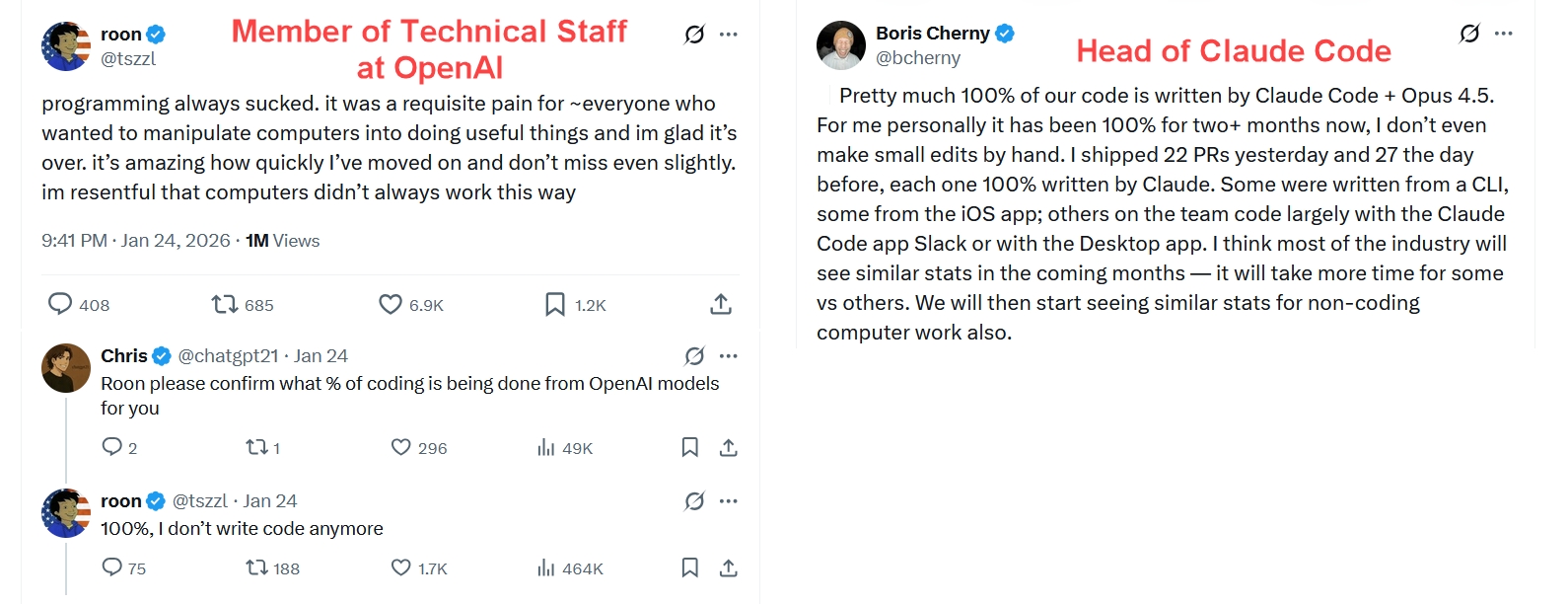
As a business school professor, I believe that many people already have or can acquire the skills needed to work with AI agents - these are the most basic management skills. If you can explain your requirements clearly, provide effective feedback, and design a method to evaluate the work, you can work in collaboration with agents. In many ways, at least in your professional field, this is much easier than designing those elaborate prompts because it's more like dealing with people. At the same time, management has always been based on the premise of "scarcity": you delegate because you can't do all the work alone, and human resources are limited and expensive. AI has changed this equation. Now, "talent" is abundant and cheap. What's scarce is - knowing what to ask for.
This is why my students performed so well. They're not AI experts. But they've spent years learning how to define problems, define deliverables in their respective professional fields, and identify when there are deviations in financial models or medical reports. They have the analytical frameworks painstakingly accumulated from classes and work, and these frameworks become their prompts. Those skills often dismissed as "soft skills" have ultimately proven to be the most crucial ones.
I can't exactly predict what work will be like when everyone becomes a "manager" with an army of tireless agents. But I guess those who will stand out will be those who know "what a good output is" and can explain it clearly enough for the AI to achieve it. My students understood this in just four days. Not because they're AI natives, but because they already know how to manage. It turns out that all the previous training has inadvertently prepared them for this moment.
Translator: boxi.