Google wants to use Android for PCs, but this is likely a bad move.
When it comes to the operating systems under Google, many friends may immediately think of Android, which is dominated by them and currently occupies half of the global smartphone market. However, besides this, Google actually has a "PC system" project, namely Chrome OS.
Strictly speaking, Chrome OS is quite different from the traditional PC operating systems that people usually know, because its main feature is actually a "cloud computer". That is to say, in essence, Chrome OS is more like a browser that starts up automatically. In most cases, all the software that users run on this operating system are "web programs".
Doing this has two very prominent advantages. Firstly, it doesn't require high - performance hardware. Chrome OS can run on many "netbooks" whose performance is even worse than that of mainstream mobile phones. Therefore, the price of the devices can be kept very low.

Secondly, since its programs and even storage are basically based on cloud servers, Chrome OS has instead become an ideal operating system for educational and office computers. Schools/enterprises can very easily restrict these computers to only access the internal network or only use specific online programs (such as learning or office applications). In this way, even if users want to "do something bad" on a Chrome OS computer, they simply can't install any local "time - wasting" programs or leak local data.
For this reason, when there is more and more evidence indicating that Google seems to plan to replace Chrome OS with a brand - new operating system "Aluminium OS" based on Android, we at 3eLife actually think they may have made a wrong decision.
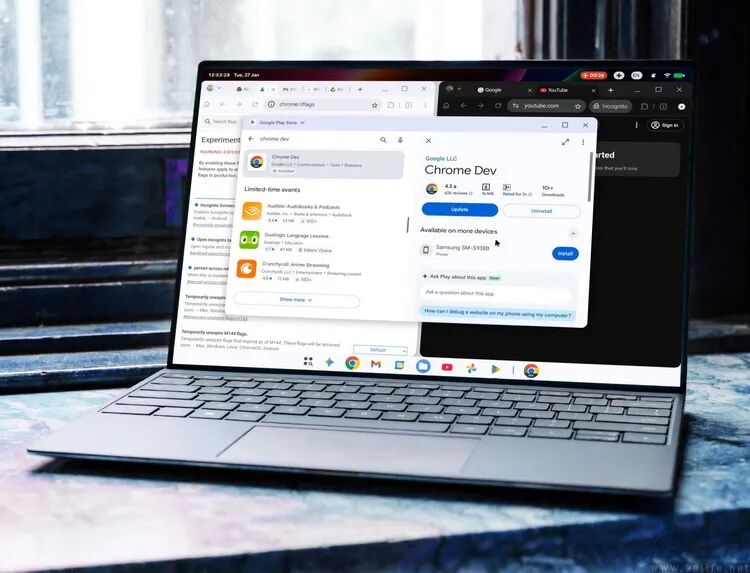
Alleged spy photos of the Aluminium OS engineering machine
Why do we say so? Firstly, the two greatest advantages of Chrome OS are that it "doesn't rely on high - end hardware configurations" and that "all programs are highly online". But what about Android? Any friend who has used an Android phone knows that it has relatively high performance requirements.
Most importantly, once Google replaces the underlying system of the new operating system with Android, it will be very difficult to maintain the "cloud computer" feature of Chrome OS. To put it simply, Google probably wants the new system to support more local apps, so as to meet some more powerful productivity scenarios that couldn't be achieved by the "cloud computer" in the past (such as local video editing and local AI training).
Moreover, if Google intends to encourage developers to create dedicated "Android PC" apps for "Aluminium OS", it is very likely to directly benefit future Android tablets and even foldable phones, enabling these devices to access "productivity apps" that are closer to those on PCs.
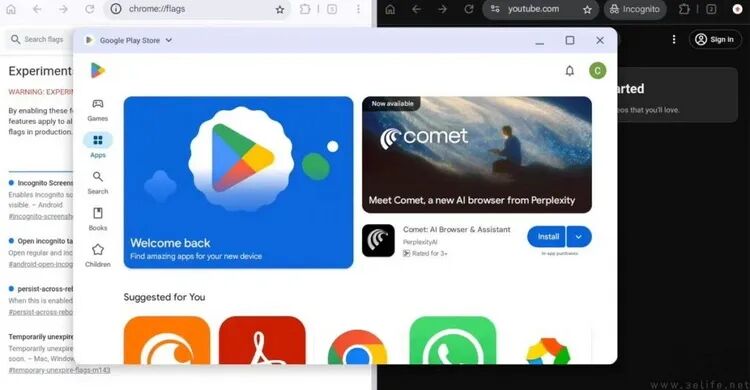
According to the currently leaked screenshots, this new system has access to the Google Play Store
However, it will definitely take a long time for developers to research, develop and adapt apps for this new system. In this process, the existing Chrome OS users will most likely first face the problem that the new "Android PC" system will almost certainly have lower confidentiality and manageability because of its enhanced local storage feature. Even if it may offer a "cloud computer mode", the Android - based underlying system still means that this new system will be more easily "cracked", which may make it less user - friendly or even less secure for "old users".
In this case, Google can certainly say that "Aluminium OS" is part of a "grand plan" and that "everything will get better once all the local productivity apps for the new system are developed". But from the users' perspective, who will be responsible for all the "growing pains" they may have to endure during this "waiting" process?
Of course, we can't completely write off this new system. After all, according to the currently exposed information about the engineering machine, "Aluminium OS" seems to be able to run on x86 hardware. This means that in the process of building the "Android PC" ecosystem in the future, Google may actually help many third - party "Android emulators" optimize their performance on x86 hardware platforms, allowing people to run mobile apps more smoothly on Windows computers. From this perspective, it does have a bit of merit.
[The pictures in this article are from the Internet]
This article is from the WeChat public account "3eLife" (ID: IT - 3eLife), written by 3eLife Editor, and is published by 36Kr with authorization.