While AI companies are all engaged in intense competition at the product level, this company is thinking about Frontier Research.
The popularity of Open Claw has pushed AI Agents into the real engineering environment for the first time.
This time, Agents are no longer just demos, plugins, or conversational tools. They are starting to enter enterprises and take on continuous, complex, and verifiable work tasks. However, almost simultaneously, a real - world problem has been clearly exposed: When an Agent moves towards long - term operation in a real workflow, the challenges it faces are far more than just prompt engineering or tool invocation. They also include deployment costs, interaction efficiency, and whether the underlying model is suitable for "permanent operation".
This also forces the industry to face a more fundamental question that must be answered sooner or later -
If the goal of an Agent is to become a reliable digital employee, should it still be built on the assumptions of the previous - generation models and interactions?
At this stage, the industry has actually reached an implicit consensus: The problems of Agents should be solved through faster product iterations.
More complex prompts, more refined process orchestration, and more diverse tool invocations have become the default direction for most teams.
However, in the view of FlashLabs, this approach avoids a more fundamental problem: If the underlying model itself is not suitable for long - term operation and real - time collaboration, then even the most sophisticated product design will only magnify the structural ceiling of the system.
Most teams choose to accelerate productization based on existing model capabilities and quickly complete the application and business closed - loop. However, a few people have chosen a slower and riskier path - Return to cutting - edge research and the model layer itself and re - examine the basic assumptions of Agents.
FlashLabs is one of the latter.
01
Treat Agents as "Digital Employees" Rather Than Tools
In the view of FlashLabs, an AI Agent should not just be a tool that passively executes instructions. Instead, it should be more like a "digital employee" that is given a goal, can independently break down tasks, and continuously advance work.
This judgment does not come from short - term technological trend analysis. Instead, it comes from the long - term observation of the real organizational operation mode by Shi Yi, the founder. In a recent interview, he repeatedly emphasized a point: The core challenge facing small and medium - sized enterprises today is no longer cost reduction at a single point. Instead, it is how to continuously amplify the output capacity of key positions under the premise of limited organizational scale.
In such a real - world context, if an AI only completes the task steps broken down by humans, its upper limit of ability is clearly visible. However, if an Agent can understand OKRs and KPIs, and actively break down, execute, and iterate around the goals, it may truly become part of the organizational capabilities.
"Many Agents on the market today are still passive in essence," Shi Yi pointed out during a conversation. "They complete tasks that users have already thought through and broken down. However, if we treat an Agent as an employee, it should not just respond to instructions. Instead, it should actively promote things to happen around the goals."
In his view, Excessive conservatism towards an Agent's capabilities is essentially an underestimation of the technological potential. If the technology already has the possibility of approaching a "digital employee", delaying the realization of this ability will not make the organization safer. Instead, it will solidify the efficiency loss in the long term.
02
SuperAgent: An Agent Designed for Long - Term Operation
This judgment directly shapes the design direction of SuperAgent, the core product of FlashLabs.
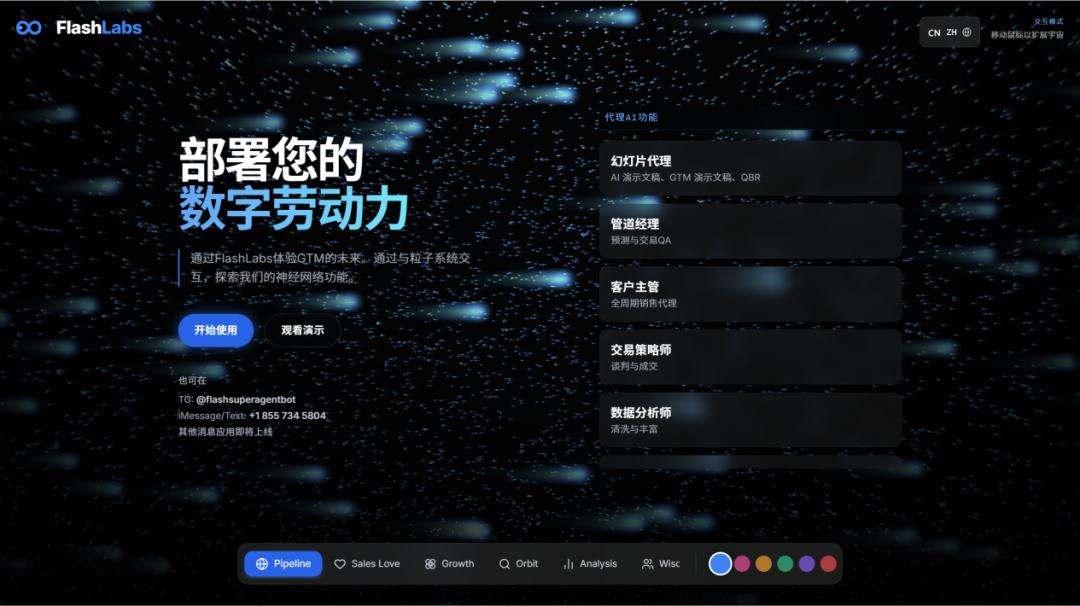
In terms of functional positioning, SuperAgent is an enterprise - level AI Agent aimed at continuously completing complex tasks, targeting real - world job scenarios such as sales, marketing, and operations. However, different from most Agents, SuperAgent was designed from the start to be a system that can operate long - term, rather than a one - time task executor.
At the mechanism level, SuperAgent no longer treats user input as a single instruction. Instead, it first understands the intention and judges it as a composite goal that may contain multiple stages. Subsequently, the system will automatically enter the task - planning process, break down the overall goal into multiple steps, and continuously maintain the context state during the execution process, thus avoiding the common problem of "tasks being abandoned halfway" in early Agent products.
Initiative is another core feature of SuperAgent. When the goal is ambiguous or key conditions are unclear, it will confirm with the user like a real colleague, rather than proceeding based on assumptions. After completing a task, it will also actively propose next - step suggestions, rather than simply ending the conversation.
The entire process of task breakdown, planning, search, and execution will be visible to the user. This design upgrades SuperAgent from an "instruction executor" to a role closer to an organizational collaborator.
In terms of deployment, SuperAgent has chosen a cloud - based, out - of - the - box approach. To some extent, this is also a direct response to the industry reality: When the cost of using and deploying an Agent is too high, its value is often difficult to continuously verify in real - world business scenarios.
In actual use, SuperAgent has completed capability verification in multiple job scenarios:
In sales and growth scenarios, it can handle lead discovery, data completion, pipeline analysis, and independent follow - up. In content and presentation scenarios, it covers the entire process from research, structural planning to PPT generation. At the GTM and operations levels, it supports data cleaning, customer profiling, market segmentation, and trend analysis.
03
If Agents Are to Be Integrated into Workflows, Voice Interaction Cannot Rely on the Previous - Generation Architecture
In the overall design of SuperAgent by FlashLabs, voice is regarded as an inevitable form of interaction.
Shi Yi believes that if an Agent is to be truly integrated into a real workflow, it cannot be limited to the text level. Especially in positions such as customer service, sales, and support, where real - time communication is the core, voice is a natural work interface.
However, in the field of voice technology, the mainstream in the industry still chooses the "fast - track" approach: through a cascaded architecture of ASR (Automatic Speech Recognition), LLM (Large Language Model), and TTS (Text - to - Speech), they prioritize product launch. This solution has obvious advantages in engineering maturity and launch efficiency and is the implementation method for most current voice AI products.
FlashLabs has made a counter - consensus choice:
Instead of encapsulating existing models, they returned to the model layer itself and tried to redefine the basic architecture of voice interaction.
In the view of the team, the problem with the cascaded architecture is not that it "has not been optimized enough". Instead, its design assumptions are not suitable for real - time, long - term human - machine collaboration scenarios. When voice is forcibly converted into text at the system entrance, paralinguistic information such as emotion, tone, and pause is inevitably lost. Moreover, the cascaded operation of multiple models also brings an unavoidable cumulative delay.
04
Chroma: An End - to - End Voice Model Designed for the Agent Era
Based on this judgment, the FlashLabs team spent about a year self - developing an end - to - end voice model called Chroma.
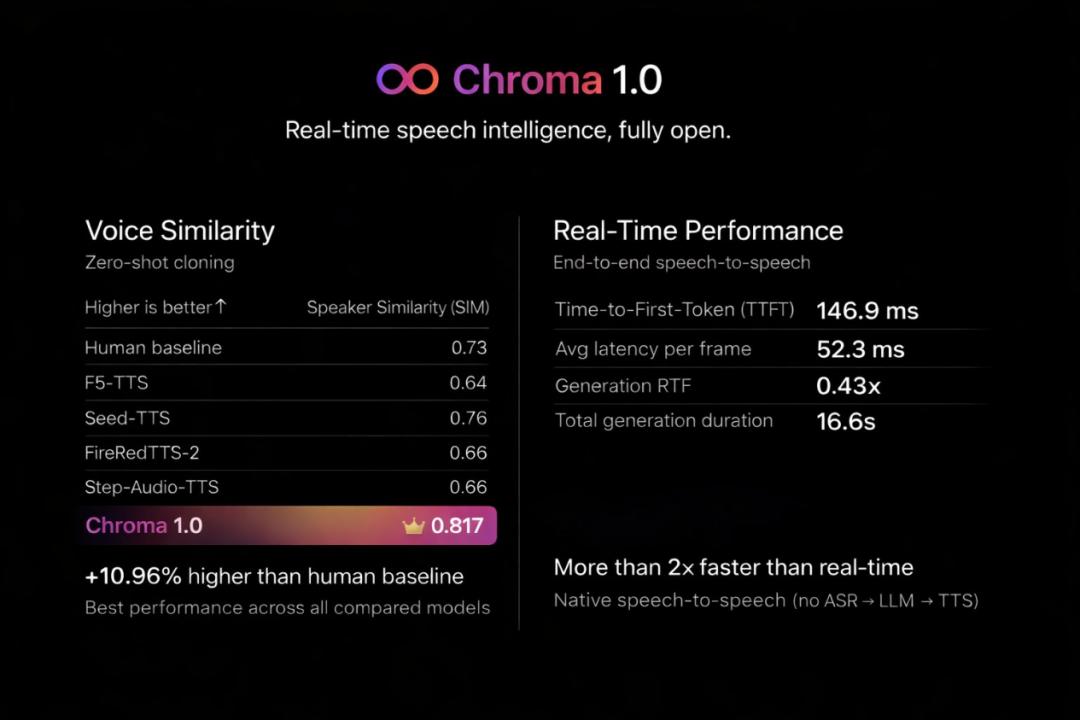
Chroma can complete voice understanding, semantic reasoning, and voice generation within the same model system, avoiding information loss and multi - stage delays caused by intermediate text conversion in traditional cascaded solutions. The interleaved scheduling strategy it adopts enables the model to process both voice and text tokens simultaneously in real - time streaming conversations, achieving sub - second end - to - end response.
In actual tests, this design brings several significant advantages:
First, the model can directly perceive and express paralinguistic information in voice, such as emotion, intonation, and pause. Second, it can achieve high - fidelity personalized voice cloning with just a few seconds of reference audio and maintain consistency in multiple rounds of conversations. More importantly, in real - world conversation scenarios, the end - to - end delay of Chroma is significantly lower than that of traditional cascaded systems, making voice interaction closer to natural communication.
From this perspective, Chroma is not just a "faster voice model". It is a new - generation voice infrastructure designed for long - term operation and real - time collaboration of Agents.
05
Open - Source Is the Way of Conducting Frontier Research
For FlashLabs, reaching this stage does not mean the end of the research phase. Instead, it means a clearer judgment:
If an Agent is regarded as a frontier research problem rather than a closed - source product, then its core capabilities should not be confined within the company.
Within the team, Chroma was regarded from the start as a "testable research hypothesis" rather than a product module. Whether the model is valid does not depend on its performance in a single business scenario. Instead, it depends on its adaptability in more complex and open environments.
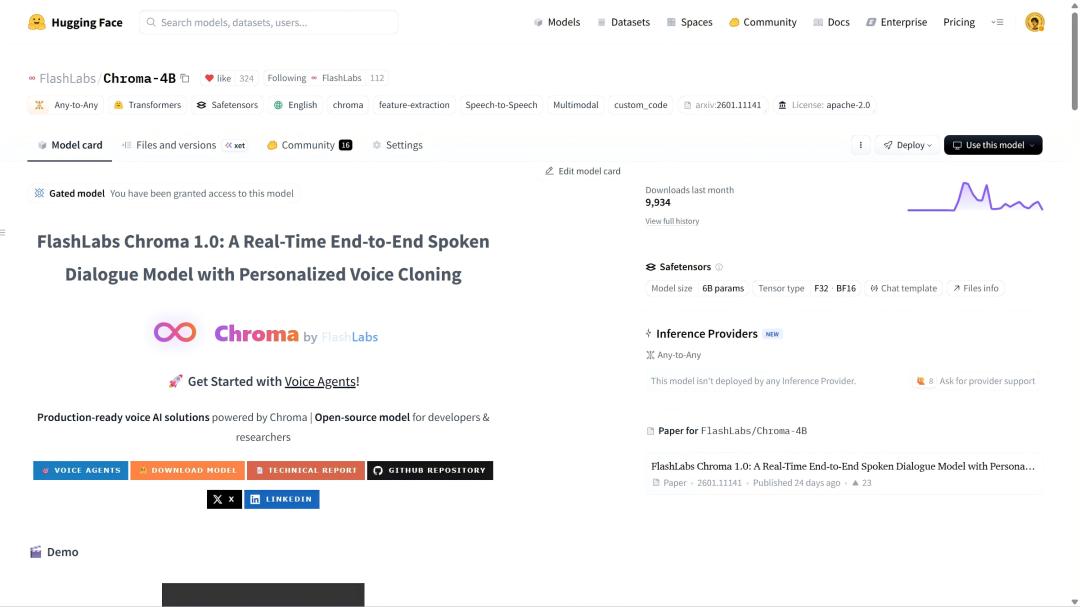
When releasing Chroma, FlashLabs simultaneously open - sourced the model weights and inference code on the Huggingface and Github platforms.
In Shi Yi's view, When the research object itself is not yet well - defined, a closed - source approach will often prematurely solidify assumptions.
For frontier areas such as Agents and end - to - end voice models, what really needs to be verified is not a single indicator, but whether the entire architecture is scalable and sustainable in the long run.
"If you believe this is a frontier research problem, then it should not be verified only within one team or under one data distribution," Shi Yi said. "Open - sourcing is not to prove that we have done everything right. It is to more quickly discover the parts we haven't fully understood."
After the model was open - sourced, the download volume of Chroma in the community quickly exceeded 10,000. Compared with performance benchmarks, developers' discussions mainly focus on the end - to - end voice path itself:
- Is this architecture more suitable for real - time interaction?
- Does it have the stability for long - term operation?
- Can it become a general voice infrastructure for Agents?
In the view of FlashLabs, this feedback from real - world usage environments is itself part of frontier research.
For this reason, FlashLabs does not view the open - sourcing of Chroma as a one - time release event.
In the team's plan, open - sourcing is a long - term project, not a staged event.
As Chroma evolves to version 2.0, FlashLabs plans to continuously open up model capabilities, training ideas, and some data - building methods, and is preparing to initiate a co - construction plan for a voice dataset in the open - source community to promote the research process of end - to - end voice models in a more systematic way.
06
A Bet on Long - Term Potential
From SuperAgent to Chroma, we can see the common orientation of FlashLabs in terms of corporate strategy and product design:
Rather than focusing on short - term monetization, FlashLabs gives priority to building basic capabilities that determine long - term potential.
Shi Yi positions himself as a "native effective accelerationist" - believing that technological progress has long - term value and that efforts should be continuously made in frontier capabilities, rather than being prematurely constrained by existing business models or other forms.
At a stage when Agents have not yet formed a unified paradigm, technological routes, product forms, and business models are still rapidly diversifying. Some choose to accelerate product implementation based on existing capabilities, while others choose to take on higher uncertainties to verify whether the next - generation basic assumptions hold.
FlashLabs' choice is to build the capabilities that will determine future potential before the paradigm of Agents is fully formed.
This means a longer return cycle, but it also means having more initiative when the paradigm is finally established.
In a technological evolution that may last more than a decade, standing on the side of defining the boundaries of capabilities may be more important than simply following the current trends.