Former Feishu Spreadsheet Tech Lead Ventures: Embed Everything with AI Spreadsheets, "Feed" AI | Emerging New Projects
AI spreadsheets should be used by Agents, and AI should deliver the final results for human review.
Text | Deng Yongyi
Editor | Su Jianxun
One-sentence introduction
Univer transforms spreadsheets from complex and inefficient tools into AI-native general computing engines. The implementation path relies entirely on its self-developed spreadsheet SDK (Software Development Kit).
Financing progress
It has currently received seed-round financing, mainly from individual investors.
Team introduction
Liu Yang, the founder and CEO, was formerly the technical leader of Feishu's spreadsheet. He completed the development of core functions such as pivot tables and charts. In his spare time, he developed the open-source spreadsheet project Luckysheet, which has received over 16,000 stars on GitHub.
Shen Weimin, the technical leader of the server side, was a key R & D personnel in Huawei's cloud core network. He was among the top 20 employees in Feishu's Shenzhen office. He helped Feishu's cloud disk DAU exceed one million. He implemented the AI agent process orchestration algorithm for data analysis from scratch and is an expert in distributed systems.
Min Chengcheng, a spreadsheet technology expert, has eight years of experience in spreadsheet R & D. He once worked in Feishu's spreadsheet team and served as the technical leader of GrapeCity's SpreadJS. He has long been focused on researching spreadsheet capabilities, led the construction of core modules such as pivot tables and Shapes, and was deeply involved in the design of the formula engine, data modeling, and graphic rendering systems.
Products and business
In one sentence, Univer is a spreadsheet engine that can be embedded in any system.
Univer's product matrix is divided into two core parts: the underlying Univer engine, various SDK plugins for engineers, and AI applications, such as the spreadsheet editing and analysis product "Capalyze" based on the Univer SDK.
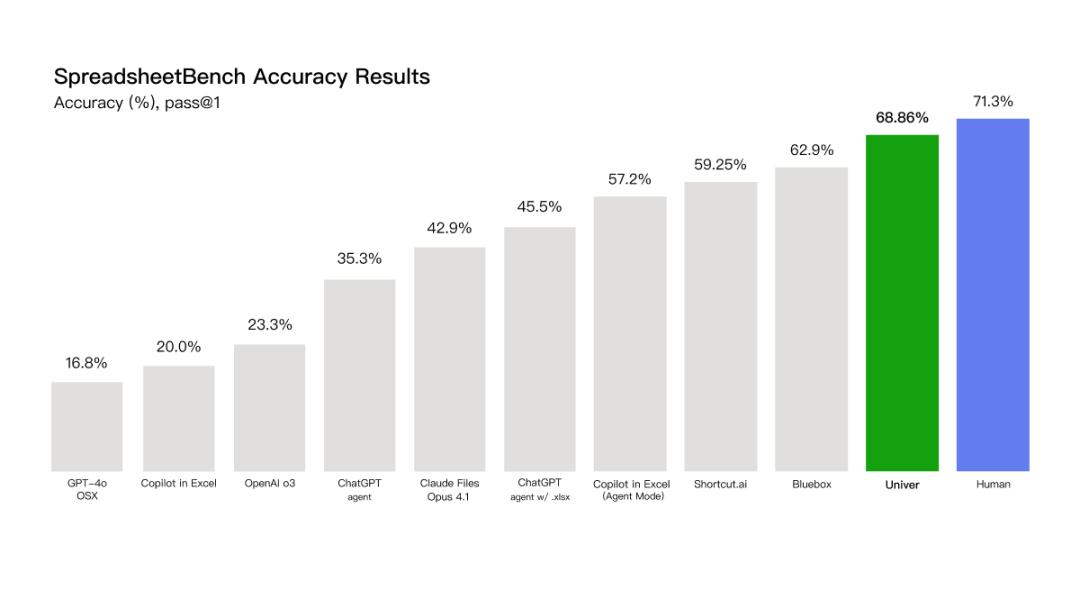
In December 2025, in the global evaluation of SpreadsheetBench, Univer topped the list with a score of 68.86%, surpassing ChatGPT Agent and Excel Copilot.
△Source: SpreadsheetBench
Liu Yang, the founder of Univer, once worked as a data analyst in an insurance company. In his actual work, he found some difficulties in usage scenarios: although enterprises have deployed BI (Business Intelligence) applications, users still prefer to download data to Excel for processing because only Excel can provide sufficient flexibility to complete data cleaning, formula calculation, and visualization.
However, in reality, processing data in Excel is very cumbersome and inefficient. After processing data in Excel, users will continue to do more processing, such as creating PPTs and making more reports. But these processes usually require switching between multiple software, which is not only time-consuming but also easily disrupts the train of thought.
This leads to a large number of spreadsheets being scattered on employees' personal computers. Among them, a large amount of business knowledge and data processing experience are not uniformly managed and fully utilized.
Based on these experiences and observations, Liu Yang developed an open-source project called Luckysheet in his spare time - a web-based spreadsheet that can be embedded in business systems, allowing users to directly process various types of data without switching interfaces.
In early 2023, after ChatGPT triggered the AI wave, many SaaS products were actively applying AI to their products. At that time, the mainstream idea in the industry was the Copilot model - writing AI formulas in cells or allowing users to talk to AI in the sidebar and then modifying the spreadsheet.
But Liu Yang had a different opinion. "The product goal of an AI spreadsheet should not be to create a better Copilot, but to take the fully automatic route: let AI automatically complete actions such as data import, cleaning, and analysis, and directly generate insights." Liu Yang said.
In his view, Copilot is still "humans using tools," while a truly AI-native application should be "AI using tools, and humans making decisions." This is the most fundamental way to solve problems.
The most core ability of formulas in spreadsheets lies in their Turing completeness. In plain language, theoretically, they can achieve any computational logic that a programming language can complete. Univer can extract the dependency graph between formulas (for example, which cells a formula refers to and which cells depend on it).
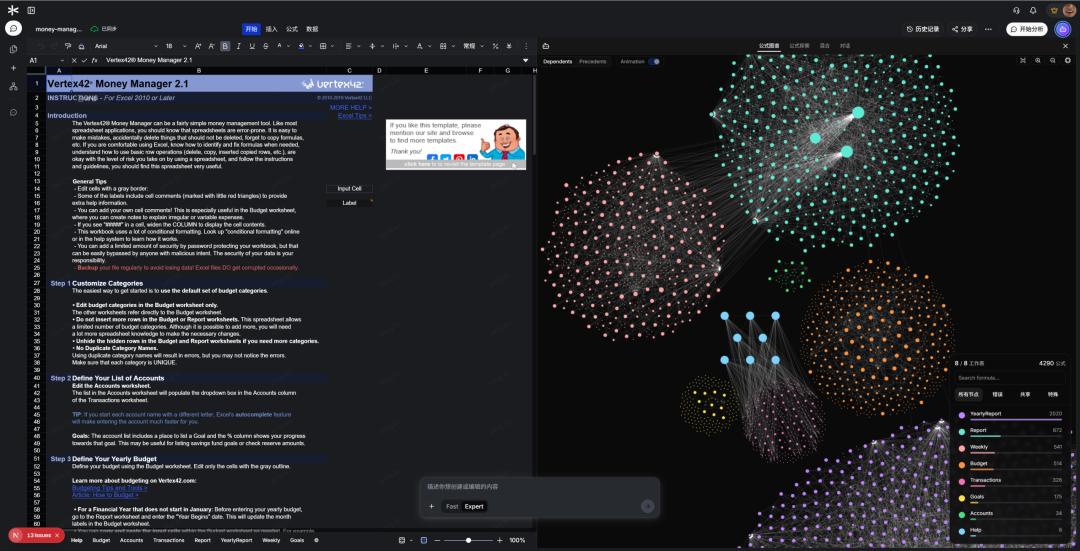
△The product interface of Univer's "Capalyze"
This structured information is the information structure that AI is more familiar with. After all, computers are binary machines. This design allows AI to directly call computational logic without interface interactions like humans (LUI), greatly improving execution efficiency.
From the very beginning, Univer decided to take the SDK route. This choice stems from Liu Yang's years of experience dealing with spreadsheets and his judgment of the industry's development stage.
In the AI field, which is still in the early stage of application, the SDK form is actually a more flexible solution.
"The core difference between SDK and SaaS lies in the usage scenario. A person's computer screen space is limited. If an independent spreadsheet application is developed, it will occupy the user's attention and operation process." Liu Yang said to "Intelligent Emergence."
The SDK-formatted spreadsheet can be seamlessly embedded in the enterprise's existing systems and become part of the workflow, rather than a tool that needs to be opened separately.
Univer hopes to create a product that is simple and easy to use on the front end. For example, spreadsheets are interfaces that all users can fully utilize.
At the bottom layer, large-scale computing and business orchestration are automatically completed by Agents, and humans only need to review the final calculation results.
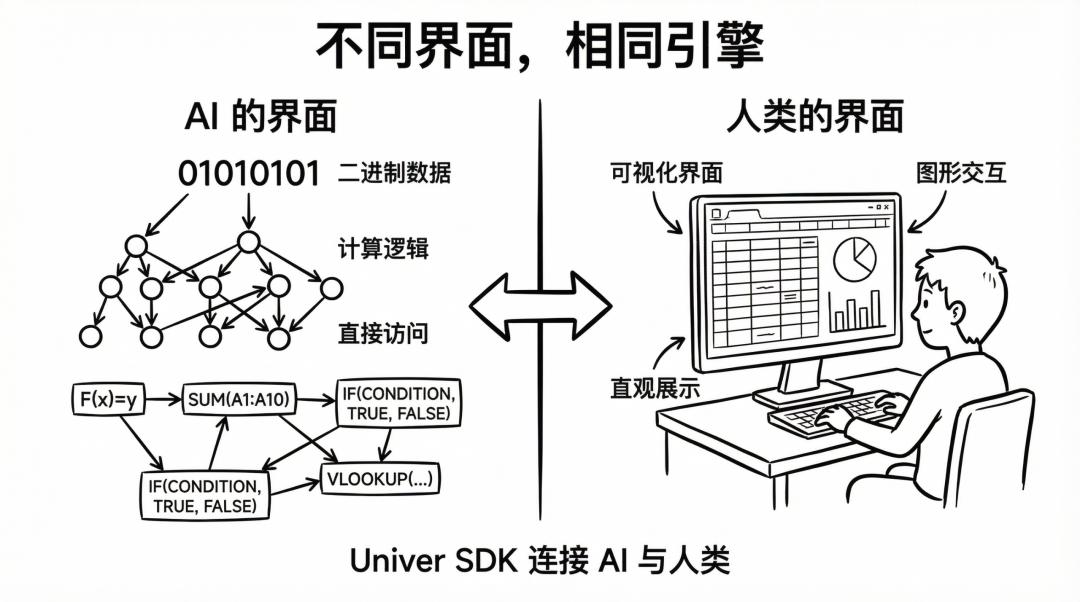
The product structure of Univer
Currently, Univer's products can be roughly divided into two layers.
At the bottom layer, it is Univer's self-developed spreadsheet engine; while at the upper layer, a plug-in architecture (SDK) form is adopted to provide some core capabilities.
Univer has now provided more than 100 plug-ins externally, including core functional modules such as pivot tables, charts, formulas, conditional formatting, data sources, collaborative editing, history records, import and export.
At the bottom layer, Univer chose to self-develop the spreadsheet engine, which is a more difficult route because the technical barriers are extremely high.
For example, the standard for modern spreadsheets is the Open XML specification formulated by Microsoft, which is 5,000 pages long and covers all the logic, relationships, and file architectures of Excel. It took Liu Yang and his team half a year just to read through this document, and they self-developed Univer's underlying engine from scratch.
But the other side of choosing the self-developed route is that it can achieve a better product experience.
Each SDK module of Univer can also be divided into two parts: the front end with an interface and the back end with pure computational logic.
The former can be understood as a lightweight software with a graphical interface that can directly provide services to the C-end; the latter is more like a building block that can be embedded in the enterprise's various core production software, such as OA, ERP, BI, etc.
This allows Univer to discard the interface layer and only retain the computational layer, becoming a "headless spreadsheet" (Headless Spreadsheet without an interactive interface) specifically for AI. AI Agents can read, operate, and analyze spreadsheets at will like "spreadsheet experts."
"This method of forming a closed-loop optimization around the spreadsheet sandbox environment has the opportunity to train a spreadsheet model exclusive to Univer, which significantly outperforms general models in terms of accuracy and cost efficiency." Liu Yang told "Intelligent Emergence." This direction is also consistent with the trend happening in the Coding field: use a stronger model to generate programs, and then verify and iterate in an executable environment to promote the leap of capabilities.
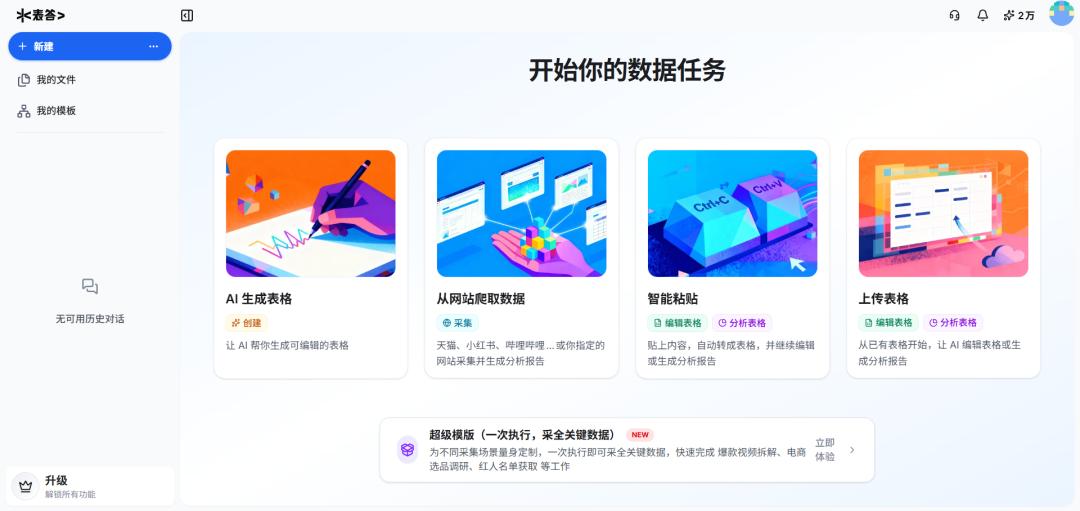
△Picture source: Capalyze
To verify the capabilities of Univer's underlying engine, the team also developed a spreadsheet editing and analysis product "Capalyze" based on Univer.
Capalyze can provide users with web data crawling and analysis services. It automatically converts data, content, or files from any source into structured spreadsheets and completes subsequent cleaning, analysis, visualization, and insight generation. Users can get directly usable analysis results within minutes.
For example, after a user selects all the web content in the Xiaohongshu comment area using Ctrl + A and pastes it directly into Capalyze, the system will automatically extract elements such as pictures, avatars, nicknames, and comments, and accurately import them into the spreadsheet in a structured manner.
In the past, it was also difficult for large models to process spreadsheets, and they easily lost context.
But since Univer's underlying spreadsheet engine is self-developed, the algorithm can accurately locate the spreadsheet structure from diverse web patterns and provide more context, such as the metadata after the structured spreadsheet is disassembled and the descriptive information of composite table headers.
Therefore, for a spreadsheet file larger than 10MB, Univer's processing results will be more accurate than those of general large models.
In actual operation, Univer can also provide a more unified environment.
When using "Capalyze," the product can distinguish between human and AI agent operations. "Capalyze" also allows multiple Agents to operate on the same spreadsheet in parallel and pushes the results to multiple clients through the collaborative engine. The computing capabilities and results obtained on mobile phones and desktops are the same.
Recently, Capalyze also launched a WeChat Mini - Program version.
This is equivalent to moving a portable BI (Business Intelligence) entry into the Mini - Program. Users can quickly convert real - world pictures, lists, and files into structured spreadsheets through photo recognition, voice commands, and the cloud spreadsheet engine, and then use AI for reasoning and analysis.
For example, a retail industry employee can directly use "Capalyze" to take photos of price quotes for comparative analysis, organize contract terms into approval forms, calculate project costs, or directly ask about inventory, gross profit, and abnormal items through voice, and share the results with the team or synchronize them to the business system with one click.
Moreover, the Capalyze Mini - Program can also directly process various spreadsheet files in WeChat messages, becoming a smart analysis entry that business personnel can use at any time.
The overseas version of "Capalyze" has also won the first place in the daily and weekly lists on the world's largest product launch platform, Product Hunt. Currently, it has more than 100,000 C - end users and has paying users globally.
In terms of commercialization, Univer has received paying customers from North America, Europe, East Asia, and China, covering multiple industries. Typical customers include Swiss pharmaceutical giant Novartis, Samsung, and domestic companies such as Faben Information and Digital Horsepower (a wholly - owned subsidiary of Ant Financial). Many domestic and foreign leading intelligent agent products are also conducting POC verification with Univer.
Founder's thoughts
Following Coding, spreadsheets will become the "aha moment" for AI in 2026. The reason why spreadsheets and Coding have similar structures and are very likely to become the next explosive AI super - track is that they are both at the core of the workflow, have an extremely large user base, and naturally lead to a large number of adjacent scenarios.
For example, once Coding enters the daily work of developers, it can spread to testing, deployment, and the entire software production chain. The same is true for spreadsheets. Once empowered by AI, it will extend to finance, operations, analysis, and even application construction. More importantly, both types of tools can spread by themselves through efficiency improvement - users can calculate the ROI, enabling the product to achieve large - scale expansion with very low sales costs. Therefore, Coding has verified this path, and spreadsheets are very likely to be an even larger explosion point in 2026.
The next major battlefield for AI empowerment is spreadsheets.
I believe that every enterprise cannot do without data, and processing data requires four things: connecting data, pre - processing data, analyzing data, and presenting results. This chain determines whether data can truly be transformed into information and knowledge. In reality, most business systems only cover processes but cannot carry out the most critical exploratory calculations in the middle: assumptions, deductions, modeling, and repeated corrections.
Spreadsheets are precisely this "free canvas." Formulas themselves are a set of general computing systems, and business personnel can build their own models and logic in them. Just as design cannot do without Figma or Photoshop, business analysis cannot do without spreadsheets - it is not a reporting tool but the real computing center of an enterprise.
Billions of people around the world use spreadsheets every month, and many enterprise software is essentially just a shell for it. If spreadsheets become an AI - native underlying ability, what will be changed is not only spreadsheets but the entire working mode of enterprise software. In the future, a large number of business deductions will be completed by Agents in spreadsheets, and humans will be responsible for reviewing and making decisions.
AI spreadsheets should be used by Agents and AI. Copilot is not the end - game of Agents. AI should help humans make decisions end - to - end.
We firmly believe that AI spreadsheets are ultimately not for humans but for Agents and AI. Copilot helps humans better understand and operate spreadsheets, but this action should occur automatically, and AI should directly deliver analysis results.
In terms of the external product form, since users still need to interact through prompts and manually confirm results at present, product iteration will still proceed in normal steps.
In the future, we believe that there will be more opportunities for innovation in the underlying architecture due to the changes in Agent interactions in aspects such as SDK, Univer Platform, and MCP protocol.
The essence of spreadsheets is a Turing - complete computing engine, and formulas are of utmost importance.
The reason why Univer chose to self - develop the spreadsheet engine is that the core ability of spreadsheets lies in the formula system, which has "Turing completeness" - theoretically, it can achieve any computational logic that a programming language can complete. Whether it is Python or Java, formulas can do it. Spreadsheets are essentially a powerful computing engine.
The plug - in architecture (SDK) is both an engineering requirement and a commercial consideration.
Excel is an organic whole system, and its functions are interrelated. When we previously developed spreadsheet functions within Feishu, the biggest challenge was that when developing function A, we had to worry about the impact on function B, and there were often chain bugs online - when modifying function A, function B would have problems.
Therefore, Univer hopes to separate these 50 functions through engineering methods so that modifying one function will not affect other functions.
The plug - in architecture is also more conducive to forming an ecosystem. Developers in the open - source community can write their own plug - ins. Modifying plug - in A only affects this plug - in itself