Behind the pre - order of 111 units of Xiao Yuanzi: Who is voting for the "next - generation robots"?
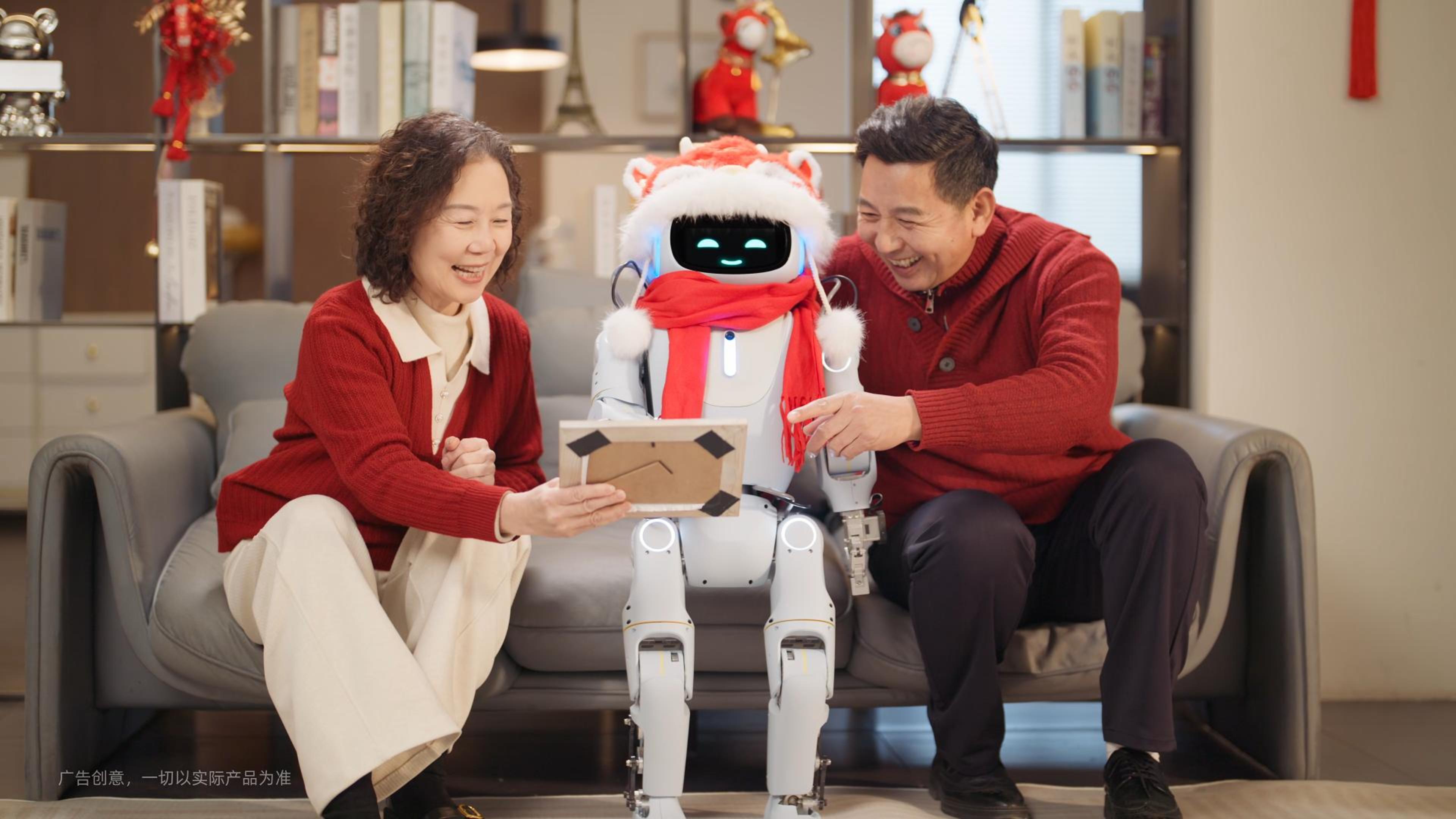
On February 4, 2026, Force Infinity released the Mind-Native Bipedal Robot "Little Atom".
According to Force Infinity, within 48 hours, the pre - orders exceeded 100.
As of February 8, the number of blind pre - orders reached 111 units.
If we only look at the numbers, it doesn't have the drama of a "blockbuster"; but if we put it into the real context of the current embodied intelligence industry, the result becomes extremely clear - This is not an emotion - driven consumption, but a highly rational choice.
At the current stage, hardly any ordinary family would hastily decide to bring a bipedal robot home just because of "a few more degrees of freedom" or "cooler demonstration actions".
These 111 choices are not about paying for "capabilities"
In the past, most of the "intelligentization" that humans have experienced has essentially occurred behind the screen. AI has become smarter and smarter, but it has always existed behind a layer of glass: it can generate text and understand semantics, but it cannot truly enter the physical world of humans.
In the eyes of the brand, these 111 users have clearly realized this deficiency. They choose Little Atom not to get a "smarter device", but to let AI regain body, weight, and presence.
With a height of 95 cm, a physical weight of 20 kg, and a real existence that can be touched, stared at, and bypassed, it clearly conveys one thing: AI is no longer just a ghost in the cloud, but has started to participate in the gravitational field and the order of human life.
This is a choice to return from bits (Bit) to atoms (Atom).
In the past two years, the embodied intelligence industry has repeatedly proven one thing: Parameter advantages are difficult to directly translate into consumer - end decisions.
Users are clearer than manufacturers about three things:
First, the capabilities that can be demonstrated today do not represent long - term usability;
Second, success in the laboratory environment does not equal stability in the family scenario;
Third, a robot that "looks powerful" may not be suitable for entering the living space.
Therefore, when a product does not include "the strongest", "the fastest", or "the highest" in its core narrative but still wins the choice of the first - batch users, there must be another set of judgment systems behind it.
What these 111 users are really evaluating is not "what Little Atom can do now", but a more long - term question: Is this a robot worth living with for several years?
What users are judging is "credibility in the time dimension"
In most consumer electronics products, the "release time" is almost equivalent to the "upper limit of capabilities".
But robots are different.
Once a robot enters a family, it will inevitably be involved in the rhythm of life: work and rest, emotions, spatial order, children's growth, etc. This determines that when making decisions, users will instinctively avoid the "one - time product logic".
From the product structure, Little Atom clearly accepts such a premise: The current embodied intelligence must be incomplete.
Precisely because this incompleteness is recognized, it is not designed as a "finished product" with closed capabilities, but a system that can be continuously developed - On the hardware level, it reserves general peripheral interfaces and replaceable components; on the software level, it extends the capability boundary through OTA and an open platform.
This is not just about "upgrading space", but an active accommodation of future uncertainties.
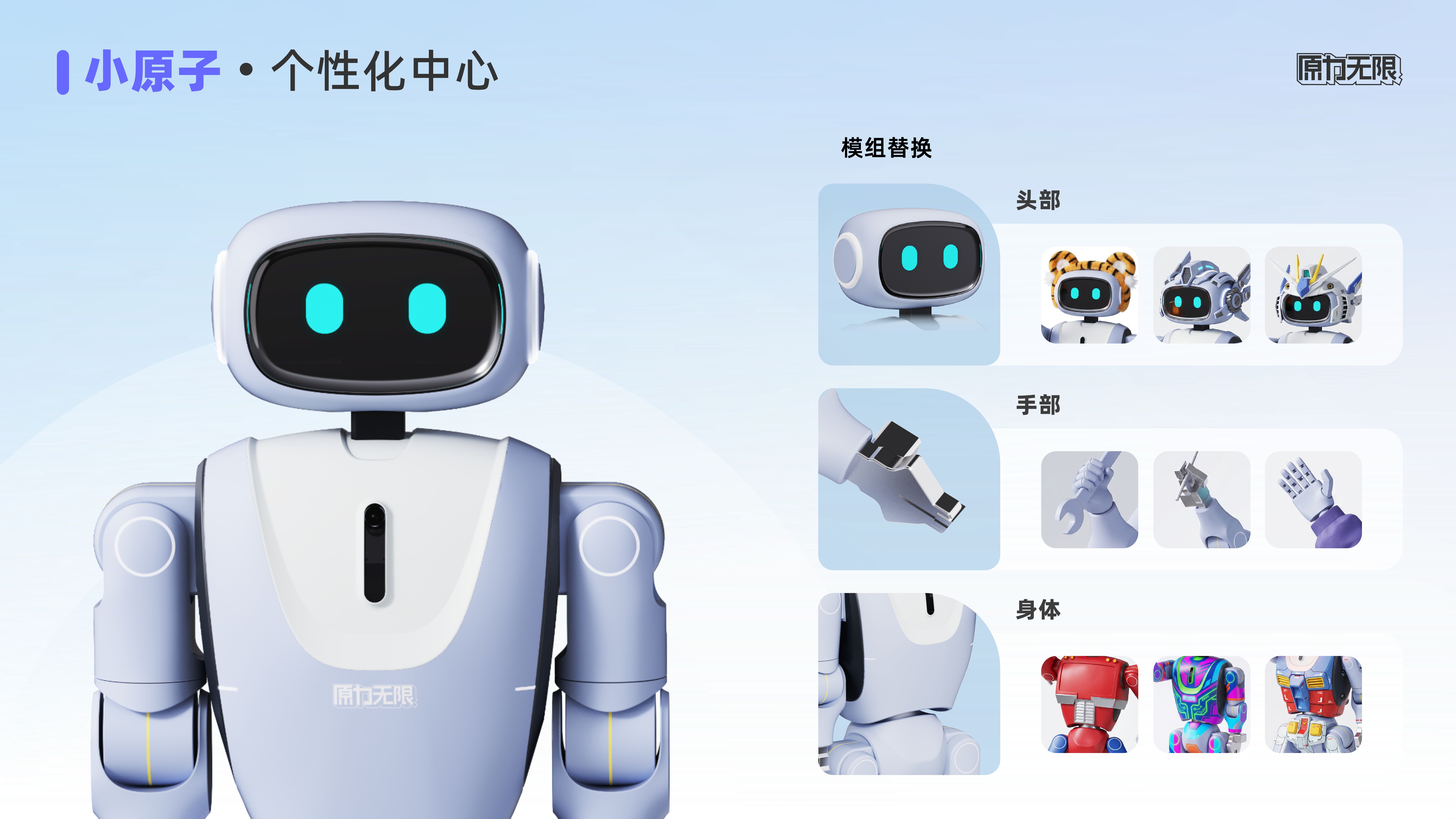
Returning the right of definition to users is a more difficult but more realistic path
In the field of embodied intelligence, the real risk is not "insufficient capabilities", but "capabilities being locked in too early".
Once a product assumes in its structure that it is approaching the final state, it will inevitably lose the space for evolution within two to three years.
Little Atom's design logic is exactly the opposite - it assumes that family needs, educational methods, and the interaction forms between humans and AI will continue to change. Therefore, users must be allowed to continuously reshape the role of the robot during use.
This is why it is more like a "long - term learnable, transferable, and non - interruptible embodied system" rather than a collection of functions.
In most robot products, manufacturers are used to making decisions for users: what it can do, what it cannot do, and how it should be used.
What Force Infinity is trying through the "Force Marketplace" is an uncommon power transfer - partially returning the behavior combination and capability structure of the robot to users.
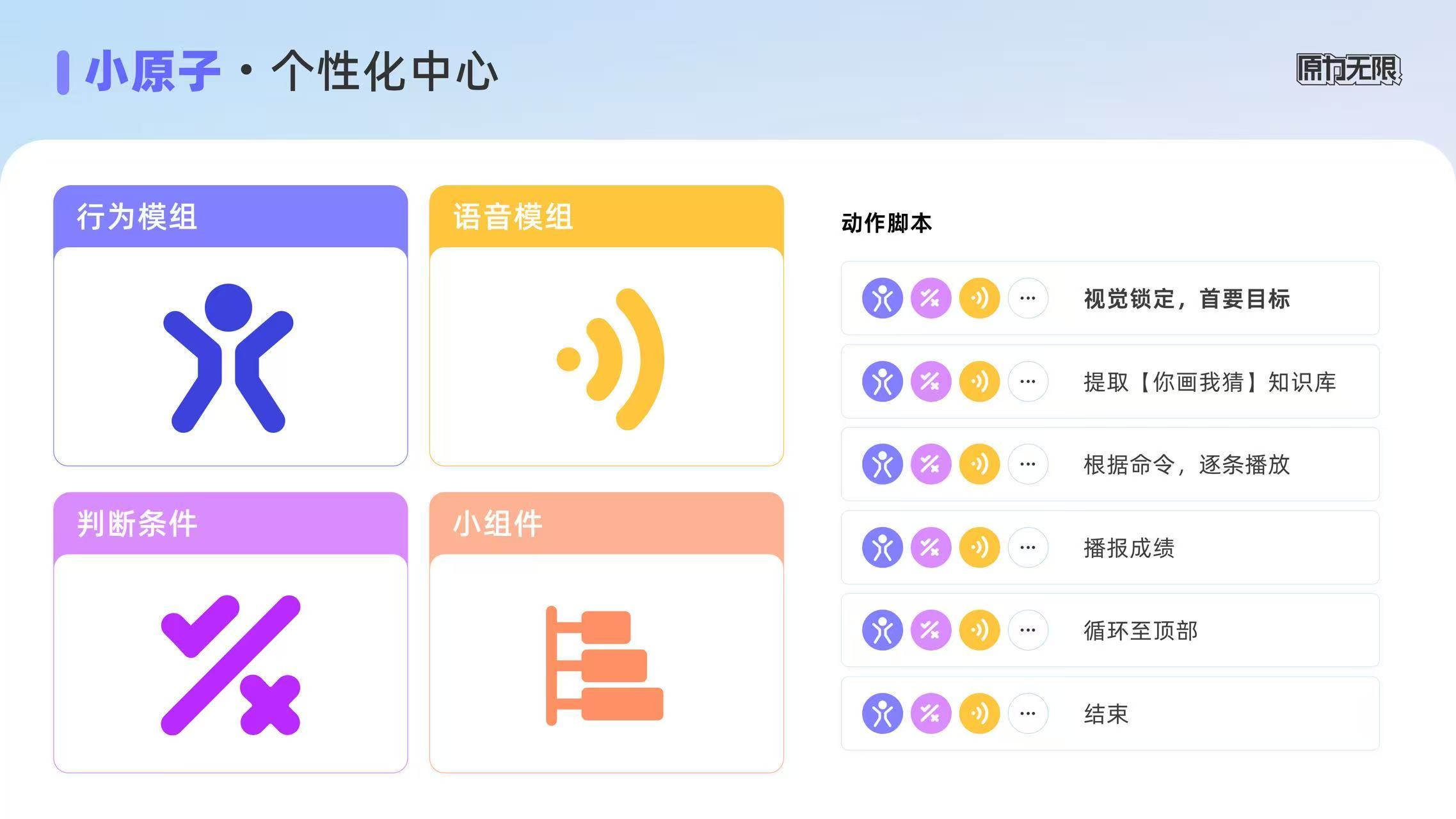
This judgment is extremely realistic: because no company can preset all real - life scenarios. And only users themselves can truly understand the family rhythm, children's needs, and personal habits.
Therefore, from the moment each Little Atom enters a family, it is destined to take a different path.
"Understanding you" requires not only model capabilities, but also time and infrastructure
In terms of technical configuration, Little Atom is not short of the current mainstream intelligent architectures: on the local side, it has a self - developed Hyper - VLA end - to - end multimodal model and a causal world model, combined with 275 TOPS of edge computing power for real - time perception and physical interaction.
On the cloud level, the Alibaba Cloud Tongyi Qianwen large - scale model it accesses undertakes another more long - term role. For family users, the significance of the large - scale model is not just about "how smart it is now", but about: Is it in a continuously evolving and not easily interrupted technological ecosystem?
When a robot is designed as a system that needs to accompany and learn for many years, whether the cognitive foundation behind it is stable and whether it has long - term iteration ability itself constitutes part of the "time credibility".
This is why the choice of the large - scale model has begun to become an implicit factor influencing family users' decisions.
The "understanding" emphasized by Little Atom does not pursue instant amazement at the press conference. It is more like a slow - paced path - to understand the same person, the same family, and the same lifestyle in the long term.
On the first day, it is just a system; after one year, it may become an existence that "knows you well".
Why do these 111 units have symbolic meaning?
Because they can almost be regarded as: The first batch of ordinary users willing to establish a long - term relationship with robots. Not for showing off technology, nor for chasing concepts, but willing to let robots enter real life and participate in real time.
Force Infinity believes that for the entire industry, this is a clear signal: the next - stage competition in embodied intelligence is not about who is stronger, but about - Who is more worthy of being left for the long term.