In just two days, OpenAI has launched four major initiatives.
Within just two days, OpenAI has frequently unleashed "big moves."
New models, new mechanisms, new platforms, and new specifications have been released one after another, brimming with technological sophistication and leaving people dizzy.
Don't worry. This single article will quickly clarify everything.
01 From Programming Agent to General Agent: The Capability Leap of GPT-5.3-Codex
Undoubtedly, the most attention-grabbing is the new product just launched by OpenAI: GPT-5.3-Codex.
Codex is an intelligent AI agent developed by OpenAI that can understand natural language instructions and automatically write and modify code.
As OpenAI's most powerful agent programming model at present, GPT-5.3-Codex integrates the coding performance of GPT-5.2-Codex and the reasoning and expertise capabilities of GPT-5.2. Its reasoning speed can be increased by approximately 25%, and it can handle long-term tasks such as design research, tool invocation, and complex operations. Users can guide and interact with the model in real-time during the agency process, and the model won't lose context.
More importantly, GPT-5.3-Codex is the first model by OpenAI that has played a crucial role in its own development: The research team used Codex to monitor and debug the training process. It can not only locate infrastructure issues but also track changes in training patterns, analyze the quality of interactions, and build visualization tools, enabling the research team to better understand the behavioral differences of the model.
Meanwhile, the engineering team optimized the agent toolchain with the help of Codex and identified issues such as context rendering vulnerabilities and cache hit rates. During the testing phase, the model independently designed a regular expression classifier to analyze session logs and could complete a key summary of thousands of data points within three minutes.
The model's ability to participate in its own development has fundamentally transformed the working methods of researchers and engineers within two months. It also strongly proves that Codex has evolved from a dedicated programming agent tool to a general agent capable of performing almost any task on a computer.
Next, let's take a look at the technological breakthroughs of the new model. First, the most intuitive web development function:
After developing a racing game and a diving game, GPT-5.3-Codex can spend millions of tokens on autonomous iteration to optimize the games, ultimately generating fully functional and reasonably designed interactive works.


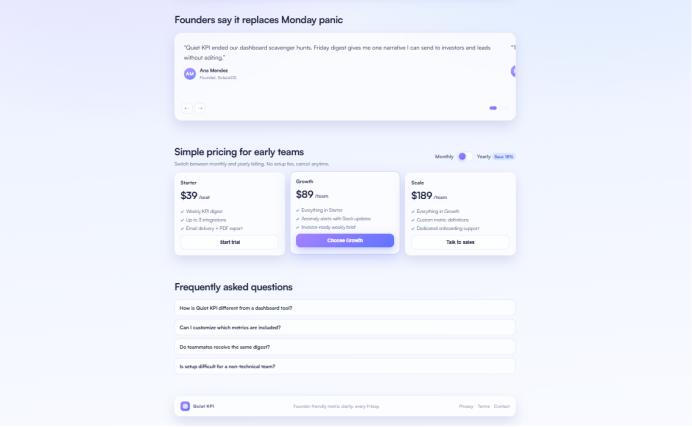
When facing daily website construction requests, GPT-5.3-Codex can better understand user intentions compared to previous models. Taking the generation of a product login page as an example, the new version of the model can automatically display the annual fee plan as a discounted monthly price and add an automatic carousel component containing three different user reviews.
The next technological breakthrough is that the capability boundary of GPT-5.3-Codex has exceeded code generation.
The research team noticed that developers' work involves not only writing code but also multiple aspects such as debugging, deployment, writing requirement documents, test design, and indicator analysis.
GPT-5.3-Codex can not only support the entire software development lifecycle but also extend its agency capabilities to general knowledge work such as making PPTs, spreadsheets, and data analysis.
Financial advice slides:

Retail training documents:

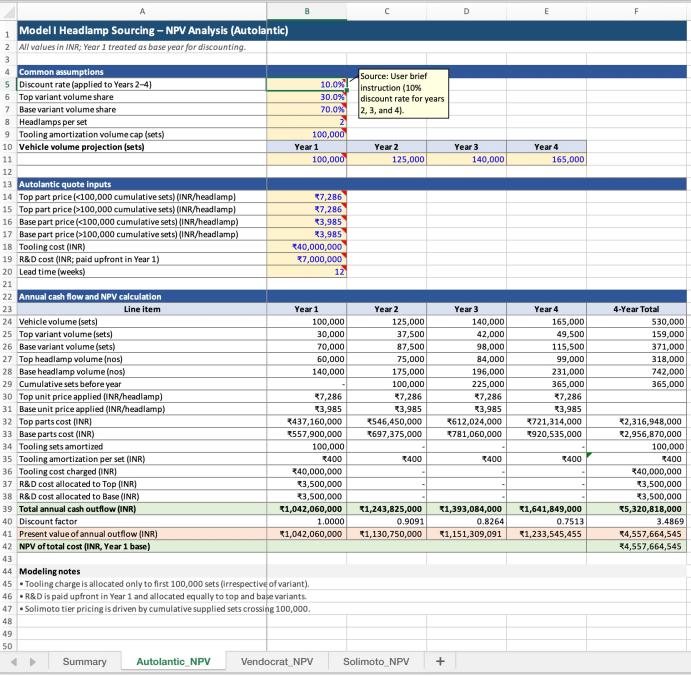
Net present value analysis spreadsheet:
Fashion display PDF:

The clear pictures and standard formats indicate that OpenAI has not only expanded its knowledge base but also made great efforts in the fields of multimodal generation and visual recognition.
Finally, the model's control ability over the computer has been significantly improved.
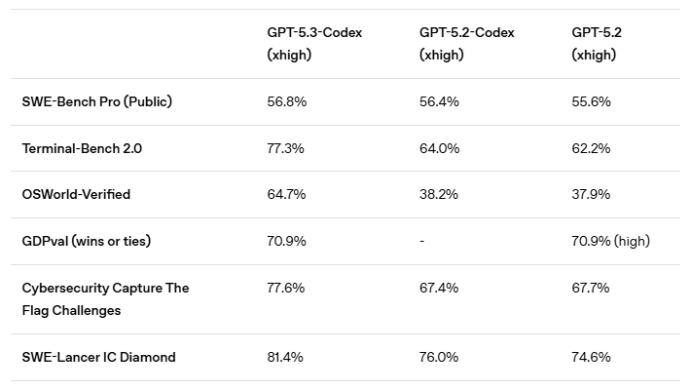
GPT-5.3-Codex scored 64.7% in the OSWorld-Verified benchmark test, far exceeding the 38.2% of the previous model GPT-5.2-Codex and the 37.9% of GPT-5.2, approaching the average human level of 72%. Meanwhile, the programming level of the model has reached a new high, and the token consumption for completing the same task has been reduced by more than half compared to the previous model.
Although the improvement ranges of the model in other benchmark tests vary, the test results have proven that GPT-5.3-Codex not only performs well in single tasks but also can conduct better reasoning, construction, and execution in real work environments.
All these facts show that Codex is no longer the former "agent programmer" but a "universal clerk" capable of end-to-end computer control. OpenAI is redefining the capability boundary of AI agents.
02 The "Universal Socket" for Unified Programming Agents: App Server
Next, it's the technical blog released by OpenAI, which elaborates on the core architecture of Codex: Codex App Server.
App Server is a set of standardized communication protocols for unified scheduling of Codex.
With the popularization of Codex, it has been widely integrated into multiple platforms such as web applications, command-line tools, integrated development environment (IDE) extensions like VS Code, and macOS desktop applications. To avoid "reinventing the wheel" for each interface, OpenAI needs a mechanism that enables these different interfaces to share the same set of core logic.
App Server is precisely the bridge designed for this purpose. It is built based on JSON-RPC (a structured remote procedure call protocol that allows programs to call each other's functions through standard data formats) and adopts a two-way communication mode, where the client and the server can actively send requests to each other.
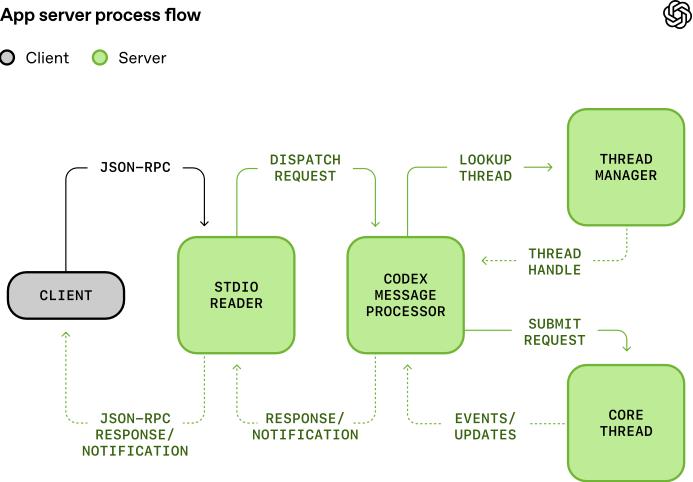
The data communication channel is established on the basis of standard input and output (stdio), which is a basic data stream mechanism provided by the operating system, allowing different processes to exchange information stably.
Compared with the command line and integrated development environment, the interaction between humans and AI agents is much more complex. To describe these interactions more precisely, App Server defines three layers of dialogue primitives from the bottom up:
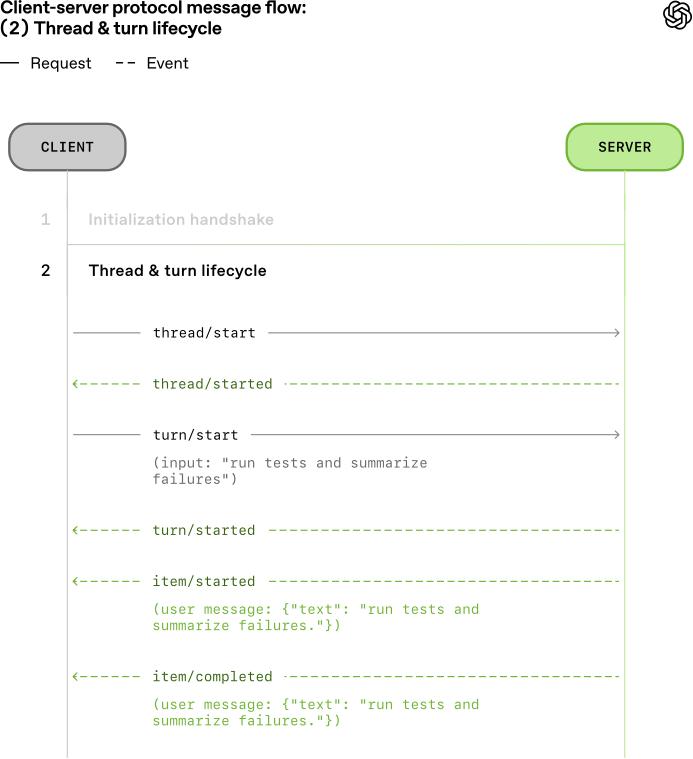
Item: It is the smallest interaction unit, such as a message sent by the user, a message replied by the agent, or an agent's request for tool invocation. Each item has a clear lifecycle: start → streaming update → completion, which facilitates the client to display the agent's reasoning process in real-time.
Turn: It represents a complete agent working cycle triggered by a user instruction. For example, "fix a certain bug," which includes a series of items such as reading code, thinking, modifying code, and explaining reasons.
Thread: It is a persistent session container that can save the entire conversation history and be safely stored on the server side, supporting cross-device recovery.
In actual deployment, App Server supports multiple integration modes:
Local applications such as VS Code extensions usually start the binary file of App Server as a child process and run tool invocations in a sandbox;
On the web side, App Server is deployed in a cloud container. The browser realizes front-end and back-end communication through HTTP and server-sent events (SSE) technology. Even if the user closes the tab, the background tasks can still continue to execute;
The terminal user interface (TUI) will be refactored into a standardized client in the future, supporting connection to the remotely running Codex agent.
Compared with other integration methods, the open-source MCP protocol launched by Anthropic for unified invocation of different AI tools is suitable for lightweight integration of existing toolchains, but the general protocol is difficult to express the complex semantics when humans interact with AI agents; the early released TypeScript SDK provides a native library interface, but the covered functions are limited.
OpenAI has clearly stated that App Server will become the standard integration solution in the future, striking a balance between functional integrity and protocol stability.
Meanwhile, the source code of App Server has been open-sourced with Codex CLI to lower the access threshold of intelligent agent technology, enabling more developers to deeply embed Codex's programming capabilities into their own products.
03 Bridging the Opportunity Gap: Enterprise-level AI Agent Collaboration Platform Frontier
AI agents have been deeply integrated into real work processes. More than 75% of enterprise employees say that AI can help them complete tasks that they couldn't do before.
However, at the same time, a contradictory phenomenon has emerged: The model capabilities are improving rapidly, but the AI agents actually deployed in enterprises are isolated from each other due to the lack of context, and the emergence of new agents actually increases the complexity.
OpenAI defines this phenomenon as the "AI opportunity gap." The reason is not that the models are not intelligent enough, but enterprises still lack the end-to-end ability to scale AI agents into real work processes.
Therefore, OpenAI has officially launched the Frontier platform to help enterprises build, deploy, and manage AI agents capable of performing actual work. This platform draws on the mature methods of enterprise employee training in human society and endows "AI colleagues" with four key capabilities:
First, understand the logic of enterprise operation.
Frontier connects the previously isolated data warehouses, customer management systems, and internal applications, enabling all AI agents to share a unified business knowledge base and making AI understand how information flows, how decisions are made, and what results are important. Sharing context is equivalent to enterprises building an internal language understandable by AI, and each AI agent doesn't need to repeatedly learn basic business rules.
Second, operate real tools safely.
In a controlled execution environment, AI needs to be able to complete specific tasks like humans, such as analyzing reports, modifying files, and invoking systems. These operations can be flexibly switched between local servers, private clouds, or OpenAI-hosted environments without reconstructing the existing work processes. For scenarios that require quick responses, the platform should prioritize low-latency connections to ensure smooth interactions.
Third, continuously improve in practice.
Frontier has a built-in evaluation mechanism, allowing managers to see which operations of the agent are effective and which need adjustment. After identifying problems and optimizing the output multiple times, AI can gradually master the specific standards of enterprises for "high-quality work" and become more reliable.
Fourth, strict identity and permission control.
Each AI agent has an independent identity, and its operation permissions have fixed boundaries just like human employees. Just as a financial agent can see the budget but cannot modify personnel files, and a customer service can view orders but cannot see user privacy information, the protection mechanism is embedded in the platform's underlying layer.
At present, the reason why most AI agents with complete functions cannot be put into use is the lack of context and the need for customized development for each integration.
However, Frontier is built based on open standards. Enterprises don't need to overthrow the existing systems and can let AI agents interact through the ChatGPT interface, be embedded in automated work processes, or be directly integrated into business software such as Salesforce to play a role.
According to OpenAI, enterprises such as HP, Oracle, and Uber have become the first batch of platform users. In the future, OpenAI will cooperate with more AI-native enterprises to expand vertical scenarios such as medical record analysis and customer data integration.
It can be seen that OpenAI has taken the lead in shifting the focus of AI competition from model capabilities to large-scale implementation capabilities. For enterprises, whether they can connect isolated AI tools into collaborative labor will be the key to gaining a leading edge in the productivity revolution.
04 Capability and Responsibility: Trusted Access Mechanism
Cutting-edge models such as GPT-5.3-Codex have shown great potential in the field of network vulnerability discovery and repair with their excellent programming capabilities.
At this time, OpenAI has simultaneously launched the "Trusted Access for Cyber" program in an attempt to find a balance between accelerating the deployment of defense capabilities and preventing the abuse of technology.