Outlook on Intelligent Agent AI in 2026
ShenYiju is a translation team under 36Kr, focusing on fields such as technology, business, the workplace, and life, with a particular emphasis on introducing new technologies, new ideas, and new trends from abroad.
Editor's note: Farewell to "prompt engineering", welcome to Software 4.0: In 2026, the essence of programming will completely shift from writing code to "orchestrating intelligence". This article is a compilation.
The year 2024 was when the concept of AI Agents took root in people's minds. The amazing demonstration effects attracted global attention.
The year 2025 was when agents made the leap from laboratory demonstrations to production environments. We started this year with the slogan "2025 is the inaugural year of AI Agents". By the end of the year, several clear signals indicated that a deeper - level transformation was taking place: The Linux Foundation established the Agentic AI Foundation, marking the ecosystem's move towards openness; The agents deployed by JPMorgan Chase covered more than 30,000 employees, suggesting that agent systems have great compound - interest value in real production environments.
So, what will 2026 bring? In 2026, the core shift in the AI field will no longer be the pursuit of smarter models, but a shift towards an agent operating system that is coordinated, verifiable, and can continuously evolve over time.
In the past three years, I have been at the forefront of agent system research, open - source development, and production applications. This journey can be traced back to the birth of AutoGen in early 2023. In this article, I will summarize these experiences and share my views on the future of agent AI in 2026.
1. AI Agents: From Demonstration to Large - scale Production
This trend is obvious (it's even hard to call it a "prediction"). Although the technology stack is not fully established, due to the huge economic value that agents can bring, deployment in production environments is already irresistible.
Despite the strong momentum, many teams still fall into a common trap: not understanding where the real return on investment (ROI) lies.
For any institution with a certain level of operational and organizational maturity, the highest value does not come from a simple chatbot, a general - purpose agent, or any isolated agent system. In large - scale scenarios, agents lacking collaboration will quickly degenerate into a large and unmanageable "context island". The real leverage lies in orchestration. The highest returns often come from a well - coordinated agent system that can intelligently understand the organizational structure, perform routing and distribution, and coordinate multiple professional roles to jointly achieve goals that no single agent can achieve independently.
2. The Embryo of AGI? Agents Enter the Workplace
OpenAI released GDPVal in October 2025, an evaluation system that measures a model's performance in performing real - world tasks of economic value in 44 occupations. Although it doesn't seem as glamorous as the release of a new model, it reveals a profound meaning: Even with the existing model capabilities, we are already able to build agents that can perform work of economic value on a large scale. These tasks are directly taken from real - world job functions in the US workplace. When agents pass both the Turing test and the "employment test", they begin to show the embryo of AGI.
3. Self - improvement Closed - loop and Verification Architecture
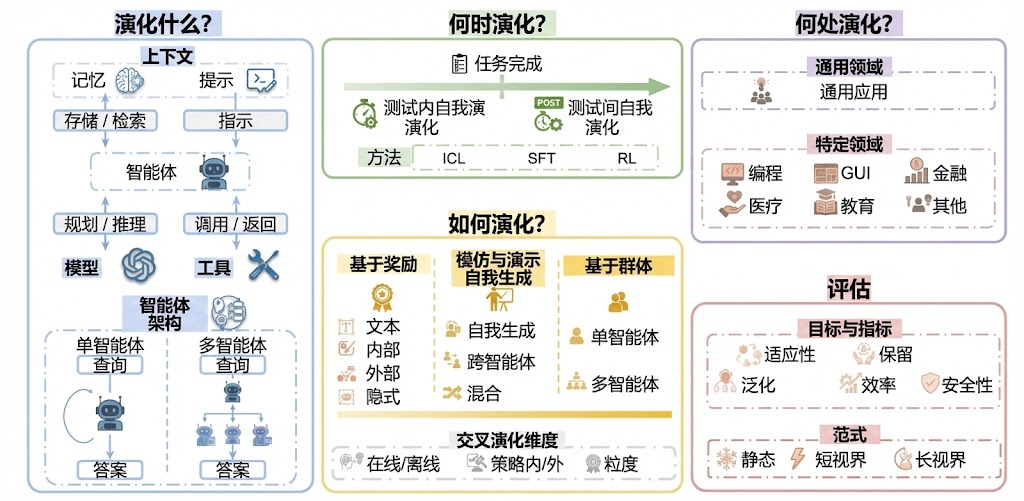
The technical panorama of self - evolving agents
AI agents should not be static but should be adaptable. To function in the real world, agents must be able to observe their own behavior, learn from the results, and optimize themselves over time. Agents lacking this ability, no matter how powerful, will inevitably experience performance degradation as the environment changes, assumptions become invalid, and edge cases accumulate.
For agents that need to operate continuously, autonomously, and on a large scale, adaptability is not an optional extra but a fundamental requirement. One of our latest research results, "Absolute Zero Reasoner" (a spotlight paper at NeurIPS 25), demonstrates the effectiveness of Reinforced Self - play Reasoning in handling programming tasks with almost zero data. The core of this new paradigm is a verifiable environment plus a task generator, which allows agents to conduct stress tests through self - play and systematically improve their reasoning ability.
Extending this paradigm beyond programming tasks directly leads to a more general and fundamental challenge: verification. For many real - world tasks, there is currently no scalable verification mechanism. We must build an infrastructure around verification: through the structured decomposition of tasks and problems, intermediate checkpoints, feedback signals, and even manual annotation and guidance, we can jointly transform open - ended goals into a verifiable environment. Once this verification architecture (Fabric) is established, self - play and reinforcement learning can be widely applied in fields beyond programming, such as reasoning, planning, data analysis, decision - making, and multi - agent collaboration.
This redefines the core challenges and opportunities of agent AI: progress will be driven by systems that can make results observable, comparable, and continuously improvable.
4. Welcome to the Era of Software 4.0: Agentware
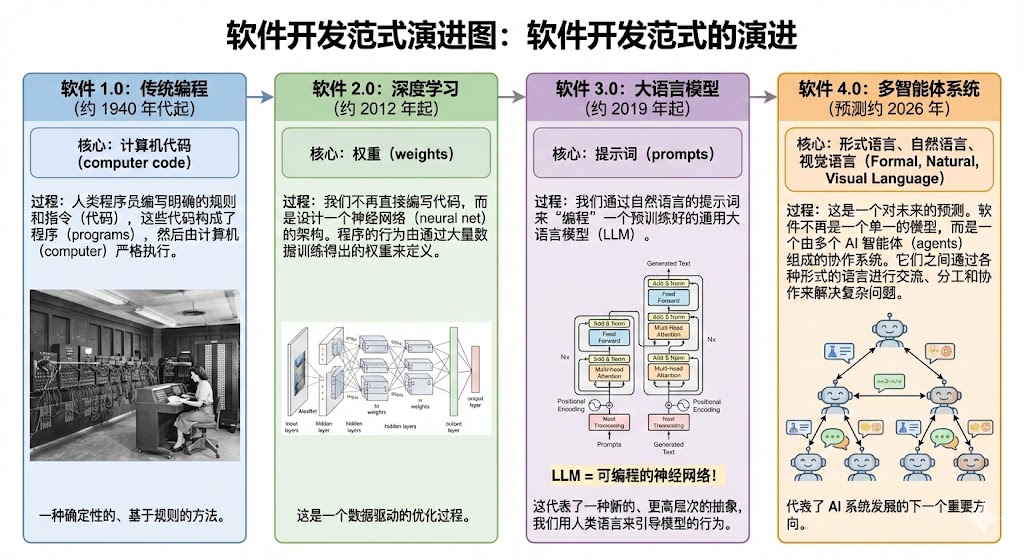
Software is changing (again and again): The evolution from 1.0 to 4.0
Andrej Karpathy once made a famous statement describing the evolution of software from 1.0 to 3.0.
Software 1.0: We write computer code.
Software 2.0: We program neural networks.
Software 3.0: Prompts become the new programs.
Six months ago, Andrej last publicly talked about this evolution, with the theme of "Software (again) is changing". But just as he was giving his speech, we had already stepped into the threshold of the Software 4.0 era - an era where "agency" and "coordination" become programmable.
In Software 4.0, the concept of programming and the role of developers have undergone fundamental changes. The standard for measuring developers is no longer just the ability to write code or write prompts, but the ability to design, orchestrate, and operate AI agents. Programming returns to its essence: defining problems and guiding calculations, while the machine takes on more of the execution work. The novelty lies in a completely different form of computation - "agent computation" - a system that is adaptable, goal - oriented, can take actions, and can iterate through feedback, rather than simply executing a fixed code path.
Software evolves into "Agentware". Agents become the basic unit of applications: encapsulating reasoning, memory, tools/skills, orchestration, and learning closed - loops in a single operating system. This is really exciting for developers!
5. The Rise of the Agent Internet
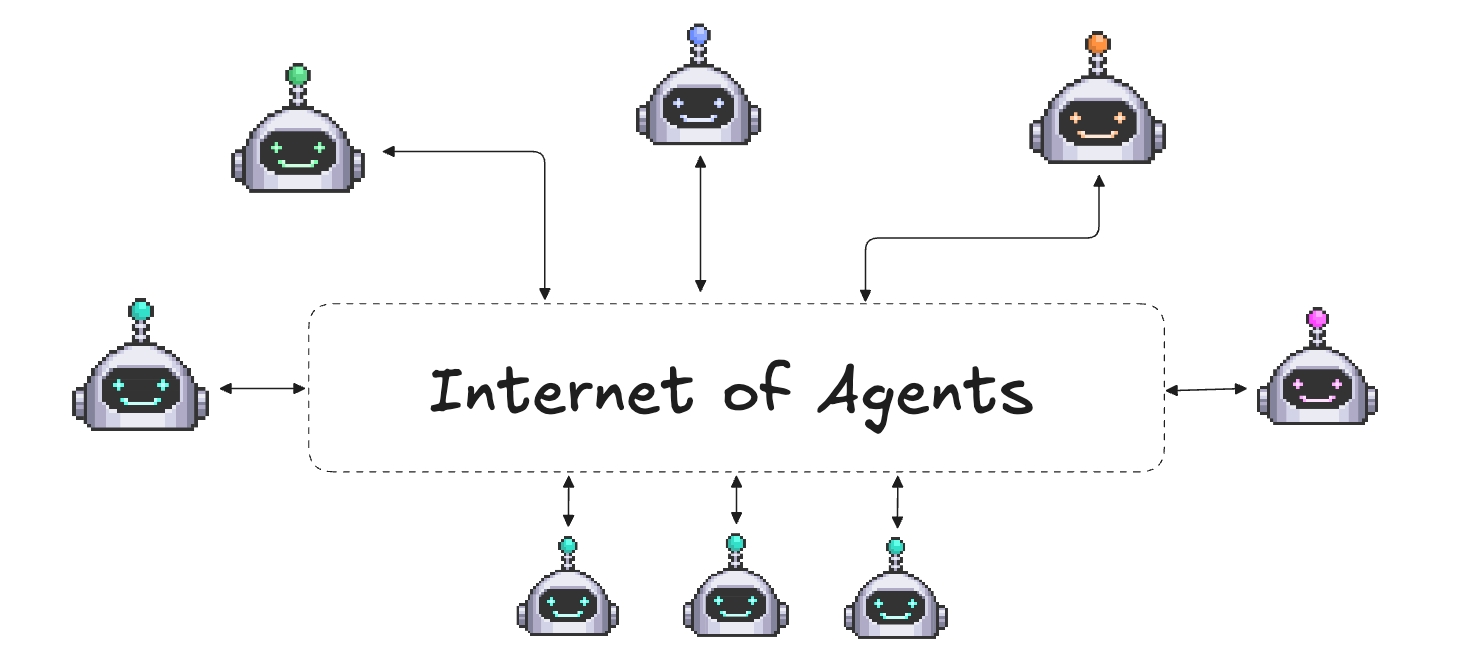
The year 2025 witnessed the initial formation and consolidation of open protocols, including the well - known ones: the agent tool invocation protocol MCP; the agent - to - agent communication protocol A2A; and the agent payment protocols: ACP (Agent Commerce Protocol), AP2 (Agent Payment Protocol), and x402.
We have been actively experimenting with these open protocols and systematically integrating many of them into AutoGen/AG2. Through these early explorations, I have begun to see the embryo of the "Agent Internet" - a world where autonomous agents can cross organizational and platform boundaries, discover each other, communicate, invoke tools, exchange value, and work together.
Like the early Internet, this layer is still rough and incomplete for full - scale open operation. However, within controlled boundaries, we have already seen the emergence of network effects. Its significance is profound: Agents are no longer isolated automated tools but have become participants in a shared global infrastructure. Capabilities become composable, intelligence becomes distributable, and collaboration - the most complex problem in AI systems for a long time - finally begins to be scaled.
The Road Ahead
We are entering a new stage of agent AI, which is no longer defined by larger models or more dazzling demonstrations, but by practical systems that are operable, interconnected, trustworthy, and can continuously evolve over time.
Translator: boxi.