Wang Huiwen "selected" Clawdbot. We had a chat with an entrepreneur behind a "Chinese Clawdbot".
Text by | Zhong Chudi
Edited by | Zhou Xinyu
Three years later, in the early morning of February 7, 2026, Wang Huiwen (co-founder of Meituan) issued another call to action.
This time, he is no longer organizing a project for large models but targeting the current hottest track: Clawdbot (now renamed "OpenClaw"). Investing, gathering talent, and even acting as a "headhunter," Wang Huiwen has poured as much enthusiasm into Clawdbot as he did into large models.
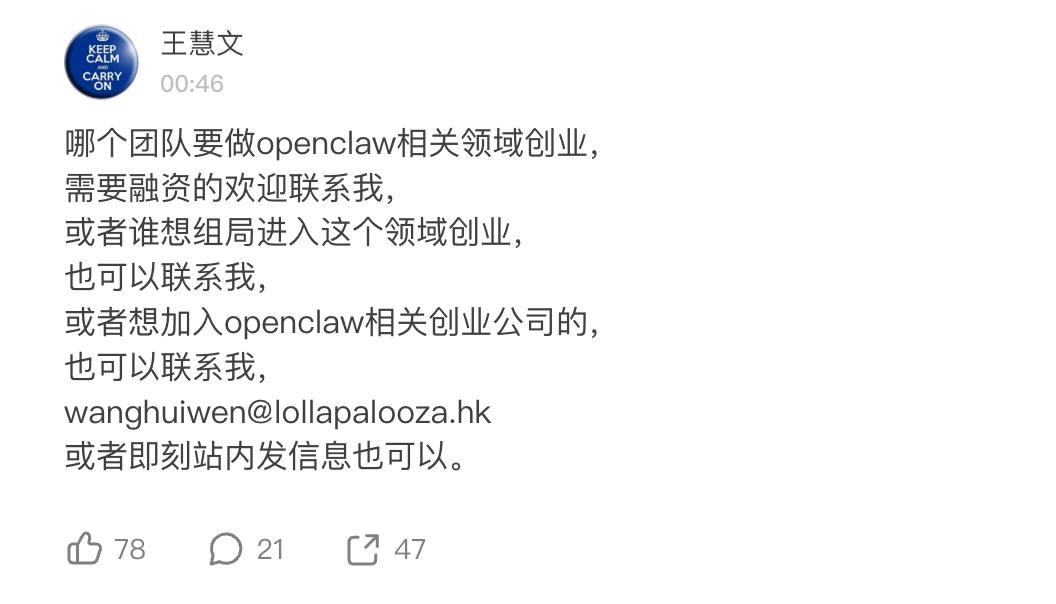
Wang Huiwen's call to action. Image source: Wang Huiwen's Jike account
Undoubtedly, Clawdbot is the most alluring AI application story at the beginning of 2026. This project, open-sourced by Austrian developer Peter Steinberger, is an Agent framework that can run directly on local devices.
Later, to avoid infringing on Claude, Cawdbot was renamed Moltbot, and recently it became OpenClaw (for ease of understanding, Clawdbot will still be used in this article).
Compared with Manus, which runs in the cloud, Clawdbot, deployed locally, thrives on its "wildness."
Its unrestricted operation mode allows Clawdbot to maximize its execution ability. It can operate enterprises of various scales, manage e-commerce platforms, bargain, and even trade stocks. Based on user instructions and local data, Clawdbot can autonomously complete various complex tasks.
But it also fails because of its "wildness."
Unrestrictedness means there is a risk of losing control. Some users have had all their emails deleted by Clawdbot and lost all the money in their accounts. Some users have been inexplicably "personally attacked" by Clawdbot and even encouraged to take extreme actions.
However, in the face of the overwhelming traffic, people like "Wang Huiwen" still smell business opportunities and choose to make a deal with the devil.
For example, Xu Ming, the founder and CEO of the AI Coding platform Trickle, quickly developed an "out-of-the-box" version of Clawdbot, HappyCapy. Three days after the official launch of this project, it received more than 900,000 interactions on X.
Companies such as Alibaba, Baidu, and Kunlun Tiangong have also released their own "Clawdbot-like" products. Many Agent Infra startups have also started a new round of financing based on the Clawdbot concept.
Sun Linjun, the founder and CEO of Shizai Intelligence, is no exception. After eight years of entrepreneurship, Sun Linjun is a veteran in the fields of automated office and Agent. On January 28, after running Clawdbot once, Sun Linjun immediately worked overnight with his team to develop and launch a domestic Clawdbot for office scenarios, "Shizai Agent · Boundless Edition."
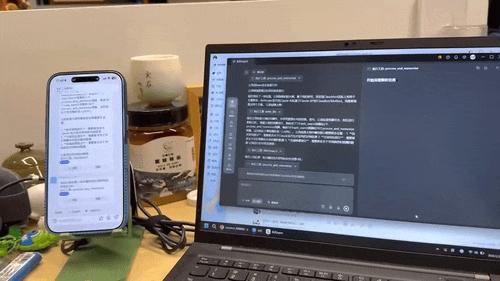
Sun Linjun demonstrates "Shizai Agent · Boundless Edition." Image source: Provided by the interviewee
Recently, we had a conversation with Sun Linjun about the inspiration, risks, and opportunities of Clawdbot.
Actually, as early as August 2023, Shizai Intelligence began to deploy Agent locally - this approach coincided with Clawdbot.
But this global Agent explosion, which was two years late, did not happen to them. Sun Linjun reflected: Compared with unleashing the capabilities of large models, we previously emphasized control more. Allowing large models to freely unleash their capabilities has a lot of room and imagination.
Despite his excitement, Sun Linjun also expressed his calmness to us. He appreciates the innovation of Clawdbot in frameworks such as Skill. However, in the face of the high configuration threshold and the risk of losing control of Clawdbot, he commented: "When many underlying capabilities are not well-developed, the framework is just a 'showpiece.'"
Obviously, from a "showpiece" that is prone to losing control to becoming a viable entrepreneurial opportunity, Clawdbot still needs to be transformed.
But from this, Sun Linjun saw a clear evolution trend of Agent: from GPTs, which are limited to simple tool calls, to Manus, which can autonomously plan and execute tasks in the cloud, and now to Clawdbot, "Think in the cloud, execute locally."
"To expand the scenarios where Agent can be applied, we need to broaden the boundaries of the Agent operating system." He summarized.
Below is the interview record between Intelligent Emergence and Sun Linjun, with the materials edited and organized:
Release AI rather than control it
Intelligent Emergence: Have you paid attention to the recently popular Clawdbot?
Sun Linjun: We experienced it almost as soon as it became popular. And we immediately released our version of Clawdbot overnight, named TARSBot.
Intelligent Emergence: What is the reason for the popularity of Clawdbot?
Sun Linjun: Maybe many people haven't realized that artificial intelligence can be this intelligent.
Actually, the development of intelligent agents has gone through several stages. Initially, people called GPTs intelligent agents, but at that time, they were only using part of the capabilities of large models for role-playing. Later, it was found that intelligent agents also needed to master some knowledge, so Manus appeared. However, Manus running in the virtual machine cannot operate local software.
The popularity of Clawdbot has solved this problem. Clawdbot gives large models a higher degree of freedom, allowing them to freely call various interfaces and underlying capabilities on the user's local device.
Therefore, when one method doesn't work, it can freely switch to another method until it completes the task. This is a real form of intelligent agent.
Compared with unleashing the capabilities of large models, we previously emphasized control more. Allowing large models to freely unleash their capabilities has a lot of room and imagination, and the effect on the user side will also be quite amazing.
Intelligent Emergence: What is the difference between Manus and Clawdbot when performing the same task?
Sun Linjun: Given the same instruction: Research the market conditions of the iPhone 17 Pro Max on Taobao and JD.com. Then clean the data, write a report, and send it to the corresponding classmates via DingTalk.
First of all, to conduct the research, one needs to open the corresponding websites to collect data, which must be done using local capabilities.
Manus can only call the search interface to search. In this way, it cannot obtain more accurate data from vertical platforms. The operation of sending the report via DingTalk also belongs to local capabilities, which Manus also does not have.
So for this type of task, Manus can basically only use the native capabilities of large models to do some analysis, and such a report will inevitably lack high-quality content.
But Clawdbot, which has local operation capabilities, can do it. Therefore, thinking can be done in the cloud, but the execution side cannot. As the "hands and feet" of large models, the execution side must operate locally.
Intelligent Emergence: Is Clawdbot the first Agent to explore the form of network-connected devices?
Sun Linjun: It should be the first one to become popular.
In early 2025, when we were working on multi-modal large models, we had verified on many specific tasks that under our current technological environment, Clawdbot is achievable.
There is no difference in the way our intelligent agent and Clawdbot are called. They can also choose the way to complete the task through continuous trial and error. For example, when a large model sends a file, it is very likely to make various mistakes during the process, but it can find the correct path through reflection.
Intelligent Emergence: You started earlier than Clawdbot. Why didn't you gain the same popularity?
Sun Linjun: There are several reasons. At that time, due to the limitations of the base model capabilities, we did not provide it with an environment where it could freely unleash its capabilities, so the effect was not as futuristic as Clawdbot.
The focus of public perception is also shifting. From GPTs to Manus and then to Clawdbot, in essence, the public is increasingly realizing the importance of combining AI capabilities with local operation capabilities. Only with this combination can it be a real work assistant.
But a high degree of freedom means high risks. If a complex workflow is directly handed over to Clawdbot, its controllability is relatively low, especially in the enterprise sector. I think no one can bear such risks. So the current approach is to first develop a corresponding intelligent agent and then drive it to complete the corresponding tasks through instructions.
Intelligent Emergence: What are the innovative points of Clawdbot?
Sun Linjun: The innovation of Clawdbot lies in engineering. Just as Manus shows users the entire process of a large model's thinking and actions at the interaction level, Clawdbot uses gateways (devices that complete the conversion of different network protocols) to connect to various chat or IM (instant messaging) tools.
Compared with directly giving the result, the process that users can see is very valuable. Although the exploration process will take a lot of time and Tokens, the prototype of Jarvis can already be seen in this process.
Actually, engineering capabilities are very important for large models. A large model is like a brain. If it can be freely connected to external capabilities like Jarvis, it can do things. But if you want it to do things within boundaries, engineering begins to play a very important role.
Intelligent Emergence: Is Clawdbot a tool with technical barriers?
Sun Linjun: There are actually no technical barriers in its framework. I think there are no barriers to framework-related things, and everyone can achieve them. But when many underlying capabilities are not well-developed, the framework is just a showpiece.
The completion rate and cost-effectiveness of tasks are the real barriers.
Although from a non-user perspective, people may think that Clawdbot is very good and has great prospects. But what users want is cost-effectiveness in solving specific problems. It is also unlikely for us to privately deploy large-scale models like Gemini and Claude to swat a fly with a sledgehammer.
We need to consider how much cost users can accept and what the ROI is. Under such constrained conditions, providing users with suitable products to solve their specific problems is the way to make them truly willing to pay.
Intelligent Emergence: As a practitioner, how do you feel about the popularity of Clawdbot?
Sun Linjun: As a practitioner, I am quite calm.
Now there is almost a new hot topic every day, but we think more about what a technology should be like in real business scenarios and what value it can bring to users.
In short, the popularity of Clawdbot is a good thing. People have realized that if an agent can only call interfaces or only unleash part of the capabilities of large models, it cannot be considered a real intelligent agent.
Think in the cloud, execute locally
Intelligent Emergence: When did you start to realize the importance of local deployment?
Sun Linjun: When we released the first version of the product in August 2023, but at that time, people's attention was not on this, and the capabilities of large models were not that strong either.
Many of our clients have their software installed locally. If it needs to run on a virtual machine, the same software and environment need to be moved to the virtual machine, which is very time-consuming and laborious. Also, many users' document materials cannot be uploaded to the cloud. Therefore, local operations are very important.
Our technical solution has been oriented towards local operation capabilities from the beginning, so we were able to launch the Boundless Edition so quickly.
Intelligent Emergence: What is the significance of local deployment for an Agent?
Sun Linjun: An intelligent agent not only has a "brain" but also "hands and feet," which refer to external capabilities. Now the practical ability, multi-modal ability, and code generation ability of large models are all being strengthened, and the limitations of products like the original GPTs and Manus are gradually becoming apparent.
So people suddenly realize that if an Agent has the ability to directly operate locally, it will become a real Jarvis, which is also the reason why Clawdbot has become popular.
Intelligent Emergence: What are the limitations of GPTs and Manus?
Sun Linjun: Both the thinking and execution of Manus are in the cloud. The capabilities of this type of Agent are very limited. It can only complete some generation tasks or obtain data through specific tools to complete some tasks. Therefore, it can only focus on limited and vertical rather than broad tasks.
Intelligent Emergence: From Manus to Clawdbot, what development trend of Agent can be seen?
Sun Linjun: The boundaries of Agent have been expanded. Originally, both the thinking and execution of Manus could only be done in the cloud, while Clawdbot can execute both in the cloud and locally. Therefore, it can use the entire local environment and all tools, and even install software by itself. This degree of freedom is greater, so compared with Manus, the boundaries it extends are wider.
This expansion of boundaries can not only cover more scenarios and solve more real needs of users but also means it is possible to be all-powerful.
When an Agent encounters a task it cannot solve, through continuous exploration and action by everyone, it is possible for it to become all-powerful within the operating system environment.
Intelligent Emergence: How far is Clawdbot from being "all-powerful" at present?
Sun Linjun: For example, in the above-mentioned research report task, although Clawdbot can smoothly obtain the corresponding data from vertical websites and process it into a high-quality report according to the user's needs.
But will the data it captures be incomplete? Or is the capture process stable? Can it definitely reach the ideal situation of humans? These are all questions that need further discussion.
At the same time, we cannot ignore a question: Can an Agent drive all programs through code? This question still needs to be answered.
Currently, software may not necessarily have interfaces that can be smoothly called by large models, which will affect the completion rate of tasks. If the software does not have complete callability, no matter how much code the model writes, it cannot drive the tool smoothly.
For example, Claude has developed the MCP (Model Context Protocol) framework, but this does not mean that everything in the world can be solved through MCP. Moreover, the workload of MCP adaptation is very large. At present, large companies and platforms are unlikely to turn their core businesses into MCP services for external use.
Intelligent Emergence: What will the future form of Clawdbot be? Will it expand to other hardware devices?
Sun Linjun: Yes, this is quite obvious.
In the movie The Wandering Earth, there is a scene where the male protagonist enters the water, inserts a device into the supercomputer, and says, "Moss, generate the underlying operating system." Then Moss can automatically read the hardware information, drive the programs, and virtualize a world on the system. This kind of scenario will gradually become a reality, although it is still a concept at present.