$300 billion evaporated overnight due to Agent. Nadella, the CEO of MongoDB, etc. declared that traditional SaaS has reached an inflection point.
This Tuesday, the market value of investment firms in the SaaS, data, and software sectors evaporated by approximately $300 billion. This wasn't due to under - expected earnings or macroeconomic shocks, but rather the release of an AI product.
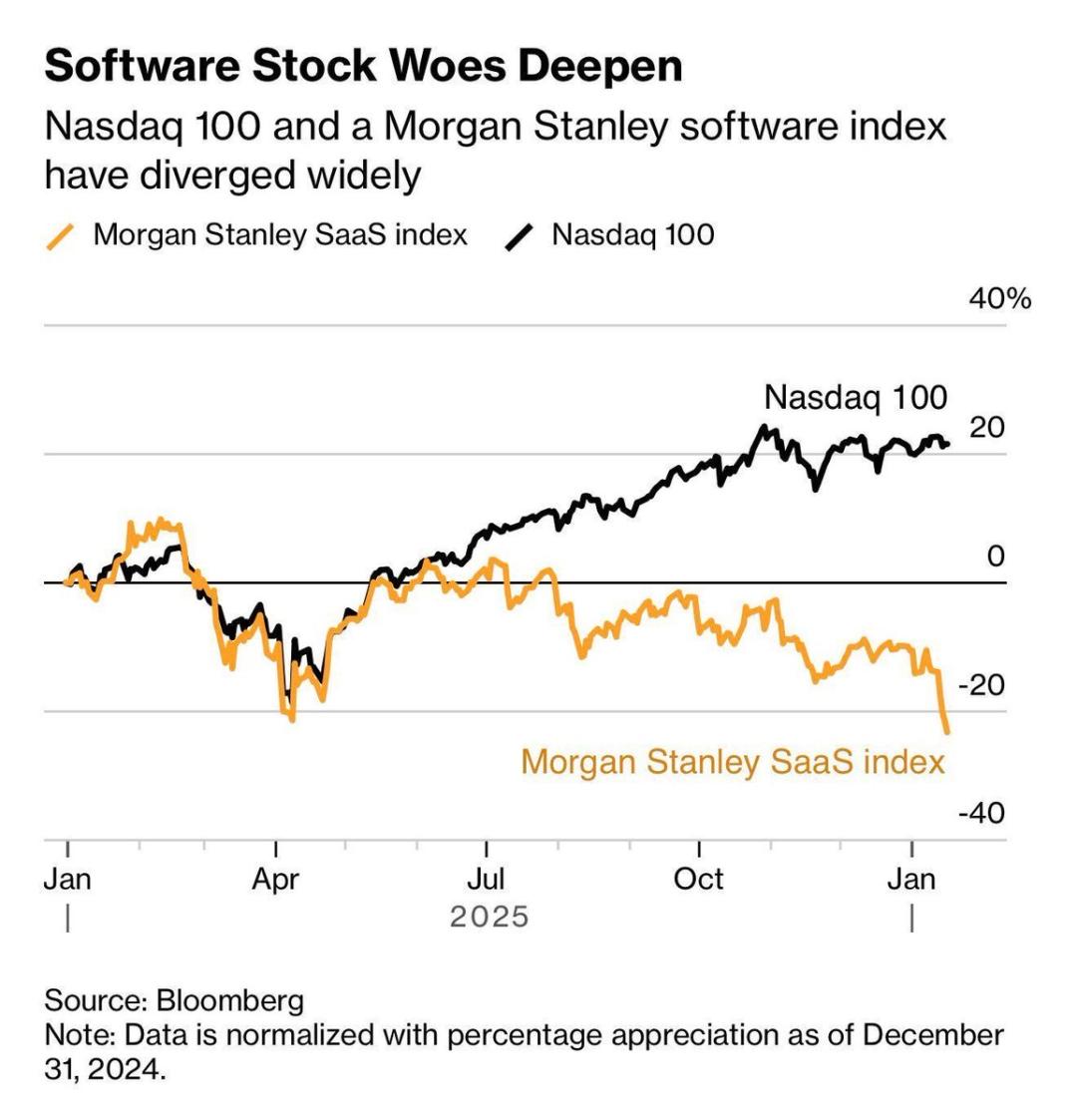
This crisis has been ongoing for months. By the time the market reacted, the IGV Software Index had dropped by around 30% from its late - September peak. What changed last week wasn't the direction but the speed.
The stock prices of several well - established enterprise software companies plummeted within a single day. The shares of Salesforce, ServiceNow, Adobe, and Workday all declined by about 7%. Intuit's stock price tumbled nearly 11%. Meanwhile, the valuation multiples across the entire industry also nosedived. The average forward price - to - earnings ratio of software companies plunged from around 39 times to about 21 times in just a few months. Short sellers have already profited over $20 billion by betting against traditional SaaS businesses in 2026 and are doubling down on their wagers.
The market wouldn't erase such a huge value unless the core assumptions are shattered.
The assumption that has just been broken is the sustainability of the traditional SaaS growth model.
1 Nadella Declares SaaS Dead
For most of the past two decades, enterprise software has benefited from an unusually stable economic environment. Software development is costly, and so are the switching costs, as data is stored in proprietary systems.
Once a platform becomes the system of record, it tends to hold that position. This belief underpins everything from public - market valuation multiples to private - equity acquisitions and private - credit underwriting. Recurring revenue is seen as an indicator of predictability. Contracts are considered sticky, and cash flows are thought to be resilient.
AI is now testing every part of this logic simultaneously.
What spooked investors last week wasn't that AI can generate better features. Software companies have survived feature competition for years. The real change is that modern AI systems can directly replace most human workflows. Research, analysis, drafting, verification, and coordination no longer need to be confined to a single application; they can be executed autonomously across systems.
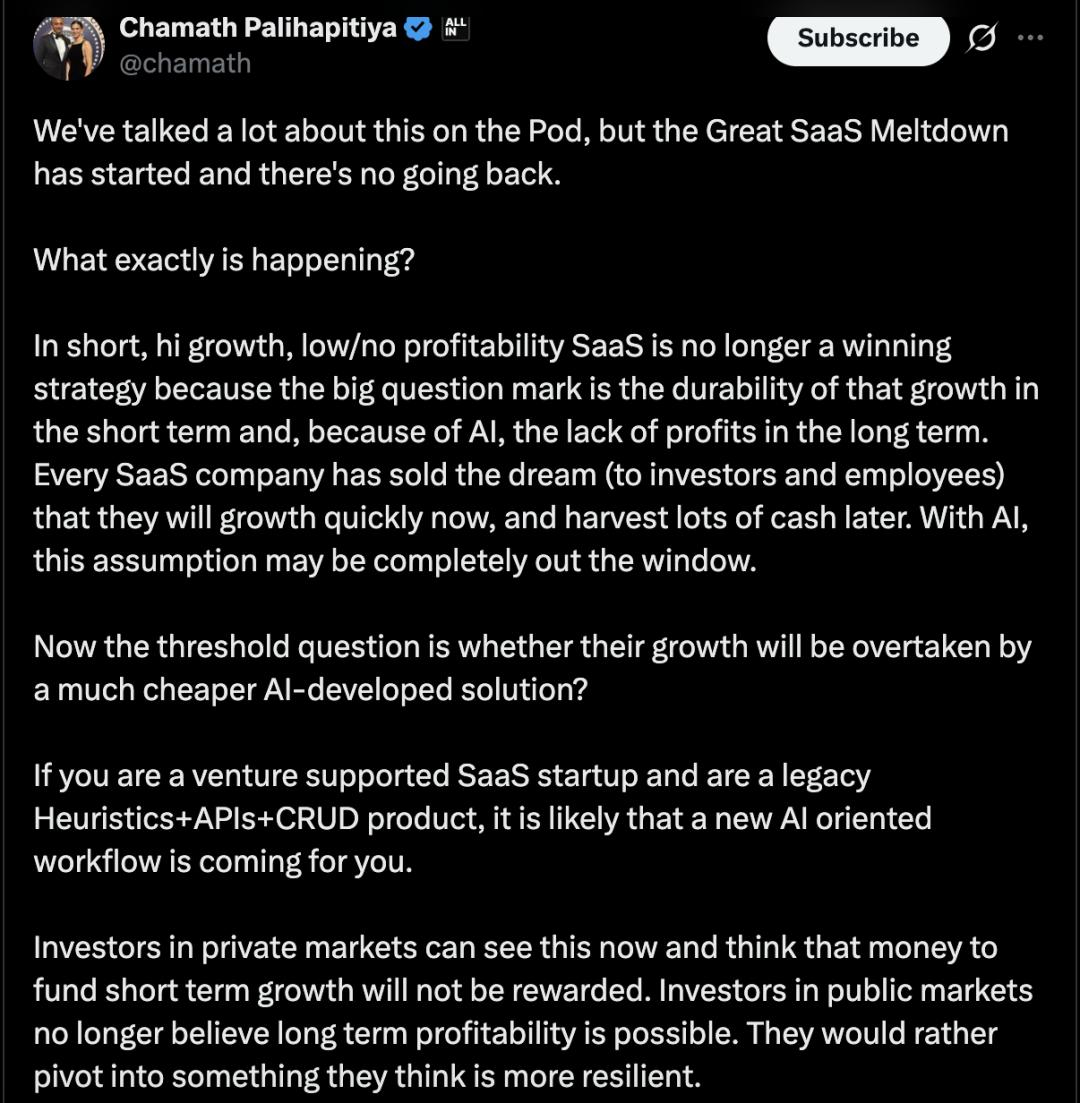
Chamath Palihapitiya, the founder of Social Capital, a well - known venture capitalist & entrepreneur, posted on X, bluntly describing the sentiment behind the sell - off:
"The great SaaS collapse has begun, and there's no turning back... A brand - new AI - oriented workflow is on the way... The great SaaS collapse has begun."
In short, the SaaS development path that relies on high growth but has long - term low or no profitability is losing market trust.
The core contradictions are concentrated in two aspects: In the short term, is the growth truly sustainable? In the long term, is the possibility of profitability becoming slim under the impact of the AI wave?
In the past, almost every SaaS company painted the same picture for investors and employees: capture the market quickly first and then reap huge profits in the future. However, with the rapid development of AI technology, the foundation of this logic may have been overturned. The most crucial question now is: Will the growth of many SaaS enterprises be quickly replaced by new, more cost - effective, AI - centric solutions?
If you're a SaaS startup relying on venture capital and your product is still based on the traditional "heuristic algorithm + API + CRUD" model, then you need to be vigilant—a new AI - oriented workflow may be targeting your market.
Private - market investors have been the first to react. They've realized that injecting capital for short - term growth may not yield corresponding returns. Public - market investors have also changed their expectations, no longer believing in the long - term profitability story and instead looking for more resilient sectors.
Before founding Social Capital, Chamath was an early member of Facebook's senior management team, leading the development and launch of new platforms that drove the company's global growth.
Chamath also emphasized that all these signs mark a profound change: the venture - capital and valuation logic that has prevailed over the past 15 years is being recalibrated. The trend shown in the following chart is a visual manifestation of this shift.
Chamath's judgment echoes what Microsoft CEO Nadella said a year ago.
A year ago, Nadella's remark that "SaaS is dead" caused an uproar online. Subsequently, he appeared on an interview program and explained in detail why he said so.
In the interview, Nadella said that in his view, every real platform migration brings about a fundamental change in the core application architecture. Looking back at history, since the birth of the relational database, people have clearly achieved the logical separation of the data layer and the application for the first time. Before that, applications and databases were often tightly coupled. The emergence of the relational database, by introducing relational algebra and SQL, made data an independent and general layer, allowing flexible construction of business logic on top of it. He continued:
"With the emergence of platforms such as the Internet, people have been constantly exploring new application architectures and ways of organizing business logic. Currently, we are facing a change of comparable or even greater scale, and the core of this change lies in the application logic itself. The key is that future agents will no longer be restricted to any single SaaS application and its private data. We will enter an 'agent - centric' perspective, driven by tasks and intentions. Agents will be able to coordinate and orchestrate business logic across multiple SaaS applications. They achieve cross - system operations by invoking various API tools. More specifically, we can train models at the agent layer to enable them to understand and manage multiple SaaS applications. This is the clear direction for the future."
Therefore, the current SaaS applications can essentially be regarded as a 'CRUD' database integrated with a large amount of customized business logic. The future change lies in that the 'database' layer that holds the core data will be liberated from the closed business logic of the original SaaS applications and become a more independent and general orchestratable layer.
Take my personal workflow as an example: I simply give the instruction of'sales situation' to Copilot, and it can automatically query the dynamic CRM system for customer information, extract relevant data from Office 365, generate a report after integration, and share it with team members. I don't need to log in to any independent system. In the past, although every enterprise deployed CRM, the actual usage rate was very low because the access process was cumbersome. Now, thanks to the agents, querying CRM data has become extremely easy because it seamlessly collaborates with all other workflow agents. This is where the change lies.
As early as 2025, when agents hadn't yet been widely adopted in enterprise applications, Nadella predicted that in the future, when enterprises recruit, they will hire not just individuals but also the 'workflow ecosystems' composed of agents they bring. This can be understood as a cluster of collaborating agents. A proper analogy is that when hiring a data analyst today, you're actually hiring the 'analyst and their spreadsheet library'; in the future, employees will join the workforce with their 'personal agent toolkits'.
In fact, this trend was already emerging at that time. For example, for the large amount of leadership - team meeting documents and core data stored in SharePoint, I can already train a dedicated SharePoint agent to conduct natural - language queries at any time without switching to a separate interface. This has greatly improved efficiency.
Two weeks ago, Nadella appeared on another interview program to discuss the business revolution in the AI era: Where are SaaS, OpenAI, and Microsoft headed?
Nadella emphasized that next - generation SaaS enterprises must actively embrace agents. They need to deeply integrate agents and even open them as first - class citizens to platforms like Copilot, and then innovate their business models accordingly. This is not only a huge market opportunity but also a powerful competitive force against any existing SaaS company, no matter how wide its so - called'moat' is.
2 Behind the SaaS 'Collapse': A Shift in Market Focus
A recent Goldman Sachs study predicts that by the end of this decade, AI agents will significantly expand the entire software market and capture a disproportionately large share of the profits. In their framework, agents don't just enhance application functions; they become the work interface themselves. By 2030, more than 60% of software economic benefits may be realized through Agent systems rather than traditional SaaS services.
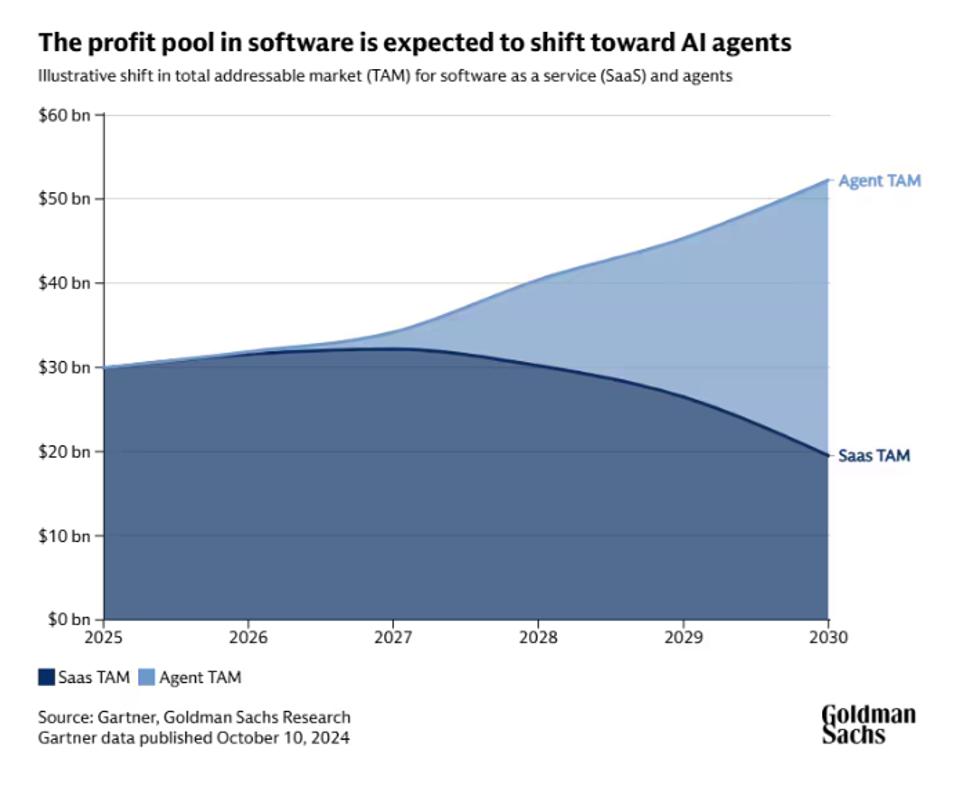
The profit pool in the software industry is expected to shift towards AI agents. Source: Goldman Sachs, Gartner
This is the key difference. The market is growing, not shrinking. But as intelligence, memory, and execution capabilities shift from static applications to adaptive systems that run across tools, the economic benefits of traditional software are being eroded.
In other words, enterprises aren't spending less on software itself but less on license fees and more on the end results.
This shift explains both the sell - off and the opportunities within it. When the flow of the profit pool is faster than the decline in revenue, the public market reacts immediately, and the private market follows suit.
These impacts are particularly significant in the private - equity and private - credit sectors.
Over the past decade, a large amount of capital has flowed into the software industry based on a set of common assumptions: predictable revenue, low customer churn, and high recovery value. These assumptions made high - leverage and covenant structures reasonable choices and regarded the cash flows of the software industry as one of the safest in the economy.
AI won't destroy these investment portfolios overnight. It will have a lag effect. Spending cuts precede customer churn. Margin declines precede defaults. There's a discrepancy between economic reality and reported metrics.
People like Nadella and Chamath who hold the same view on SaaS also include CJ Desai, the CEO of MongoDB.
3 MongoDB CEO: Products Will Be Replaced, Platforms Will Endure
Recently, in the first live recording of the "No Priors" podcast, host Sarah Guo had an in - depth conversation with this software - developer - turned - CEO to analyze why there are only a handful of companies with over $10 billion in pure - software business revenue globally. CJ Desai's answer was: Products will be replaced, while platforms can last.
Host: Since 2022, the future of software has been in question. This comes not only from the investor community but also from customers. This is a very critical turning point for the software stack. When you look at the software stack, you ask: What is bound to exist? How many pure - software companies have revenues of over $10 billion today? Only a few. Why? The software industry has a long history and is founded by many smart people like you. Why are there so few companies with revenues over $10 billion?
CJ Desai: Because truly great platforms are rare. Speed is crucial. When a technological transformation occurs, are you building at the fastest speed? Are you constantly learning during that technological shift? Whether it's the Internet era, the AI era, or the mobile era, are you quickly adapting? You must stay ahead. Once you fall behind, investors or customers will always ask you that question: Where is your company's future?
Host: CJ Desai, you've worked at platform - type enterprises and infrastructure companies and recently became the CEO of MongoDB. I think one question we just discussed that every investor will ask you and everyone in the tech ecosystem is thinking about is: What's the real value of software when you can generate a lot of it? I'd love to hear your thoughts.
CJ Desai: This is a sharp opening question. I like it. It ensures everyone stays awake.
When we think about technological transformations, whether it's the Internet era, the mainframe era, or the current AI era, you really need to figure out what the essence is here. No matter what application you create, like SaaS applications that emerged in the late 90s (I remember Salesforce recently celebrated its 25th anniversary), so from a transformation perspective, SaaS has been around for at least 25 years. Now with AI, the question becomes: What's the future of software? What's the technology stack? Does a company really have a moat?
Some people will say that their moat is good customer relationships or excellent channels and use them as a basis for internal disruption. But from my perspective, speed is crucial. When a technological transformation occurs, are you building at the fastest speed and learning from it? Whether it's the Internet era, the AI era, or Meta's shift to mobile in the early 2010s, are you quickly adapting? If you can quickly adapt to leverage the technology, no matter how the platform changes, I think it's okay. The key is that you must stay ahead. Once you fall behind, investors or customers will always ask you that question: Where is your company's future? You must be at the forefront. Not every bet will succeed. But in my view, the extreme view that the terminal value of some software is zero is an exaggeration. We'll figure it out together.
Host: Part of your career was leading products at ServiceNow, which was once considered one of the most resilient enterprise software companies—at least that's what people thought not too long ago, and now that's up for debate. For many people with an engineering mindset who are considering buying developer tools or using developer infrastructure, terms like 'customer stickiness' or 'distribution channels as a moat' seem very abstract. Can you use ServiceNow as an example to talk about why it's so important to its customers and your thoughts on it?
CJ Desai: One thing is: Platforms are sticky; products aren't. Whether you're in the AI era today or any software company created in the past, products can be replaced. My former hiring manager at ServiceNow, Frank Slootman, often said, "Tools are for fools"—if your software is just a 'tool', that's not a good sign. So, first, products can be replaced because the software market is disruptive. Therefore, you must ensure that what you present to customers is a 'platform', whether the customer is a developer in San Francisco creating a brand - new company for a new use case or a large enterprise selling to a major bank. When you position yourself as a platform, it may lengthen your sales cycle, but it means the customer has made a well - thought - out decision, and the platform is thus sticky.
Second, this may differ from the common advice in the startup and VC circles. Many people talk about needing a 'wedge' (entry point). For ServiceNow, the service desk might be that wedge. Is this a misrepresentation of history?
Host: Many people talk about needing a 'wedge' (entry point). For ServiceNow, the service desk might be that wedge. Is this a misrepresentation of history?
CJ Desai: You need an initial use case, and it has to be a killer use case. Because when you're facing a large bank, a healthcare company, or a manufacturing enterprise, you need to show a disruptive way to handle legal, financial, or service - desk use cases. This is your entry point. But the problem is, if you can easily get in, you can also easily get out because they haven't built an ecosystem around you. This is the key. Today it may help you grow from $0 to $100 million, $1 billion, but it will get increasingly difficult to grow from $1 billion to $5 billion and beyond. How many pure - software companies have revenues over $10 billion today? Only a few. Why? The software industry has a long history and is founded by many smart people. Why are there only a few companies with revenues over $10 billion? Because platforms are rare. Platforms are rare.
So, the dream or aspiration of a software company should be to become a platform. Once it becomes a platform, it means that at least two or more of its products are used by customers, and these products can work together and are truly sticky from a technical perspective. Furthermore, I think all the integrations that customers need to make between your platform and their existing systems are also very crucial. Remember, if you're dealing with a large bank, some banks are over 100 years old; the same goes for large insurance companies and healthcare companies. The Fortune 10, 100,