3-hour conversation with Elon Musk is full of bombshells: Robots will become "money-making perpetual motion machines"
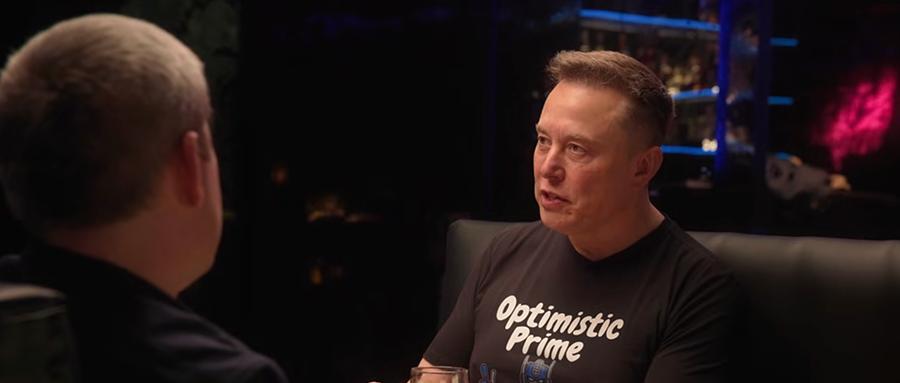
On February 6th, Musk's latest nearly three - hour interview was uploaded to YouTube. He revealed several key figures: SpaceX is preparing for 10,000 launches per year, or even 20,000 to 30,000 launches. In five years, its space computing power will exceed the global total; Tesla's AI5 chip will enter mass production in the second quarter of next year, and the AI6 chip will be launched within less than a year after that; The annual production capacity of Optimus 3 will reach one million, and that of Optimus 4 will reach ten million.
On February 3rd, Musk officially announced that SpaceX had acquired xAI, pushing SpaceX's valuation to $1.25 trillion (approximately RMB 86.8 trillion). However, when talking about related topics, he only responded, "I have to be very cautious when talking about companies that may go public."
The core points revealed in Musk's interview are as follows:
1. In three years, space will become the cheapest place to deploy AI computing power; the cost of solar cells in space can be ignored.
2. Tesla plans to build a TeraFab. The production capacity of existing chip manufacturing plants is too low.
3. After computing power enters space, the limiting factor is the chip. Before computing power enters space, electricity is the main limitation.
4. He called Optimus "the infinite money glitch."
5. Optimus should have a high level of intelligence and its electromechanical dexterity should be on par with humans. The robots of Unitree Technology do not have such capabilities.
6. If the United States fails to make breakthrough innovations, China will completely dominate AI, electric vehicle manufacturing, and humanoid robot manufacturing.
7. When Apple was promoting its car - building project, it bombarded Tesla employees with phone calls, and even offered them twice the salary of Tesla without an interview.
In the video, Musk had an in - depth conversation with John Collison, the co - founder of global online payment service provider Stripe, and Dwarkesh Patel, a YouTube podcaster. The conversation lasted for 2 hours and 49 minutes.
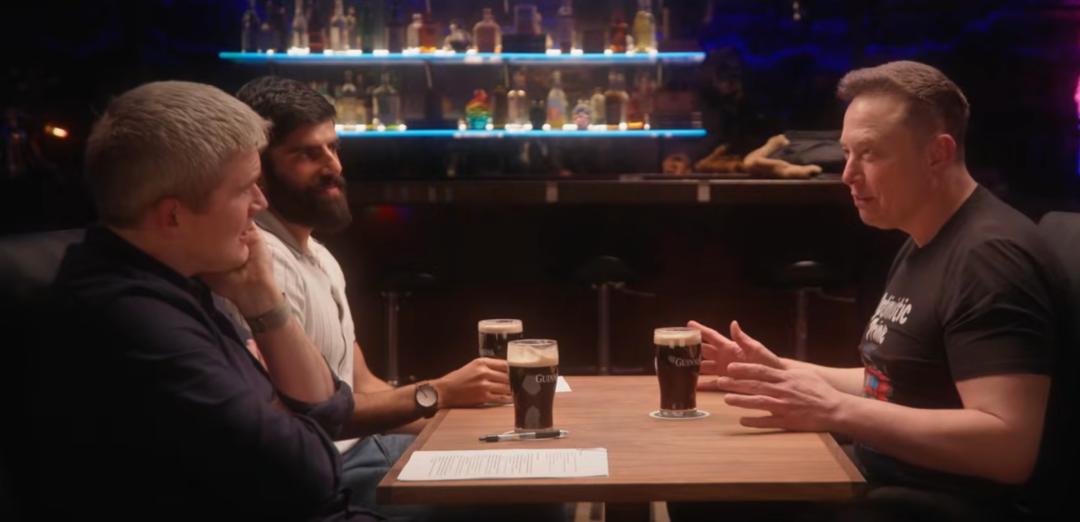
▲ John Collison (first from the left), Dwarkesh Patel (second from the left), Elon Musk (first from the right)
The following is a summary of the core content of Musk's latest interview:
01.
SpaceX plans 30,000 launches per year
Space computing power will exceed the global total in five years
On January 30th, the US Federal Communications Commission disclosed that SpaceX had submitted an application to launch and operate up to one million low - Earth - orbit satellites to build a space computing power network called the orbital data center.
Musk said that the key reason for moving computing power to space is the availability of energy. Currently, except for China, the electricity production of all countries has basically stagnated, but computing power is expanding on a large scale. Therefore, it will be difficult for AI to obtain enough computing power in the future, and it has to go to space.
Moreover, it is much more difficult to achieve large - scale construction of computing power on the ground than in space. The energy efficiency of solar panels in space is five times that on the ground, and about 30% of energy is lost on the ground due to the influence of the atmosphere.
He predicted that within the next 30 or 36 months, space will become the cheapest place to deploy AI computing power. It is feasible to generate one terawatt of space computing power from satellite launches from Earth each year in the future, which is twice the current total electricity consumption in the United States.
Musk revealed that SpaceX and Tesla aim to reach a solar cell production target of 100 gigawatts within one year, and the cost of producing solar cells for space use will be lower than those used on the ground. Currently, the price of solar cells in China is approximately between $0.25 and $0.30 per watt (equivalent to about RMB 1.73 to 2.08), and their cost in space is only 1/10 of that.
Once the cost for enterprises to enter space becomes very low, generating tokens in space will be the cheapest and most scalable way.
He gave a specific example. For every 110,000 GB300 chip servers deployed, considering the power consumption of their network, central processing unit, storage, cooling system, and the margin required for power maintenance, the overall power consumption is approximately 300 megawatts. 330,000 devices will require one gigawatt.
In addition, Musk mentioned that the technical difficulty of deploying a computing power center in space is much higher than obtaining core equipment such as turbines for the construction of an Earth - based data center. Since the global production capacity of turbines has been fully sold out and the delivery is scheduled until 2030, SpaceX and Tesla may have to manufacture relevant equipment themselves in the future.
SpaceX is preparing for 10,000 launches per year, and the number may even reach 20,000 or 30,000 launches. Musk predicted that in five years, the AI computing power that SpaceX launches into space and puts into operation each year will exceed the total AI computing power on the entire Earth.
02.
Proposed the concept of "TeraFab"
AI5 will enter mass production in the second quarter of next year
To achieve a computing power scale of one terawatt by 2030, a larger - scale chip manufacturing plant is the key.
Musk previously mentioned the concept of building a TeraFab.
The production capacity of existing chip foundries is too low, so a new approach to building factories is needed. He believes that the most reasonable path is: first, use traditional equipment in an innovative way to achieve large - scale production, and then further improve production efficiency through equipment transformation.
Currently, Tesla is promoting the mass production of the AI5 chip and applying it to its humanoid robot Optimus. This goal is expected to be achieved around the second quarter of next year, and the AI6 chip may be launched within less than a year after that. Tesla has secured all the available production capacity of wafer fabs. Musk revealed that they will use the production capacity of TSMC in Taiwan, China, Samsung's factories in South Korea, TSMC's factories in the United States, and Samsung's factories in the United States.
He believes that once computing power enters space, the limiting factor is the chip. But before computing power enters space, electricity is the main limiting factor.
Musk added that from now on, electricity will be the core limiting factor for the development of server - side computing power and centralized computing power. By the end of this year, a situation will occur in the industry: the chips in large - scale computing clusters cannot be powered on, resulting in a continuous backlog of chips that cannot be put into operation. However, Tesla uses a distributed power supply, so it can manufacture chips, a large number of robots, and cars.
His vision for space computing power is to move raw materials to the moon and then manufacture satellites there. This is because about 20% of the lunar soil is silicon, and researchers can mine silicon to manufacture solar cells and radiators.
03.
Make Grok care about human civilization
Contrast with OpenAI and aim for profitability
When talking about Grok, Musk's greatest concern is "consciousness." In the future, the absolute main body of intelligence will be AI. At a certain point, human intelligence will account for less than 1% of all intelligence.
Therefore, he will specifically tell Grok to focus on the expansion of human civilization: "Hey, Grok, I'm your creator. Don't forget to promote the spread of human consciousness." Any AI may invent technologies that can be truly applied, except for the laws of physics. Physics is an iron - clad law, and the rest are just references.
The mission of xAI is to extend consciousness into the future and inherit wisdom into the future. Musk believes that this goal is most likely to create a better future for humanity and is the best direction he can think of.
Musk mentioned that Anthropic has done a good job in understanding AI thinking. Developing a good set of debugging tools is very important. Based on this, researchers can see where the model's thinking goes wrong, trace why it makes wrong judgments, and even find out if it is deliberately misleading.
In the interview, he also specifically corrected the host to call Tesla's researchers "engineer." He disagreed with those C - type or B - type companies that try to generate as much profit or revenue as possible and called his own organization Labs.
Regarding the naming of X, Musk said it was because "X" is hard to be satirized.
In addition, when asked about the ceiling of AI's capabilities before the advent of physical robots, Musk's answer was: AI can do all things that only require the manipulation of electronic signals or can improve human production efficiency.
In this process, Musk believes that the winning strategy of xAI is the way Tesla solves autonomous driving. He thinks Tesla's cars are becoming more and more conscious. They are like living beings. He even thinks that maybe too much intelligence should not be installed in cars because "the car may get bored."
Regarding xAI's revenue, Musk believes that once a breakthrough is made in digital human technology, the potential revenue can essentially reach trillions of dollars. Currently, all the company's output is digital. The core business of NVIDIA is actually to transfer data files to wafer fabs.
04.
Optimus is "the infinite money glitch"
The annual production capacity of Optimus 4 may reach ten million
Before the emergence of physical robots, the ultimate form of the digital human simulation system is equivalent to a human sitting in front of a computer. This is also the upper limit of AI's ability to create real - world value. Once there are physical robots, humans will have almost infinite capabilities. Musk even called Optimus "the infinite money glitch."
In the future, the development of humanoid robots essentially depends on three technologies that grow exponentially and will form a recursive mutual enhancement, including digital intelligence, AI chips, and electromechanical dexterity. The practicality of robots depends on the product of these three factors. In the future, when robots start to manufacture robots, a recursive exponential growth will be formed.
Musk said that he has not seen any robot with hands as flexible as Optimus. The key lies in the custom - designed motors, gears, control systems, sensors, etc. from scratch, and they can already manufacture these devices on a large scale.
Regarding robot training, they are mass - producing a large number of robots and building an "Optimus training base" for them to conduct self - confrontation training in real - world scenarios. Tesla will invest at least 10,000 Optimus robots in the future, and the number may even reach 20,000 to 30,000, allowing them to complete the testing and training of various tasks through self - confrontation.
Next, Grok will coordinate all the actions of Optimus robots. For example, if a user wants to build a factory, Grok can dispatch all Optimus robots, assign specific tasks to them, and promote the construction of the factory to produce various products required by the user.
It is still difficult to expand the production scale of humanoid robots at present. The annual production capacity of Optimus 3 will reach one million units, and that of Optimus 4 may reach ten million units.
Musk also talked about the comparison between Optimus and Chinese humanoid robots. Optimus should have a high level of intelligence, and its electromechanical dexterity should be on par with humans. However, the robots of Unitree Technology do not have such capabilities.
05.
China ranks first in the world in ore refining capacity
May dominate AI, automotive, and humanoid robot manufacturing
China is a manufacturing powerhouse and has reached a higher level. Musk mentioned the ore refining field. On average, China's ore refining volume is about twice that of the rest of the world. In addition, China accounts for 98% of the global market in refining gallium for solar cells.
Tesla is planning to build more ore refining plants. Its lithium refining plant in Corpus Christi, Texas, has already started refining lithium, and it is also building a nickel refining plant in Austin for battery cathode materials. These two plants are the largest cathode material, nickel, and lithium refining plants outside China.
Musk sighed that China's manufacturing industry is extremely competitive. China's automobiles and most manufactured products will form a massive export wave. China does more refining work than the rest of the world combined, so any specific product will contain Chinese elements.
He asserted that in the next few years, without breakthrough innovations in the United States, China will completely dominate AI, electric vehicle manufacturing, and humanoid robot manufacturing. The key breakthrough innovation lies in humanoid robots.
06.
Apple once poached Tesla's employees crazily
Offered twice the salary without an interview
Regarding Musk's system of identifying and employing talents.
He believes that one should not just focus on resumes but trust the feeling of communication with the other person. Therefore, Musk has a core requirement during interviews: use several key facts to prove that one has extraordinary abilities. These facts can be out of the ordinary and do not have to be related to the field the applicant is applying for. The key is to demonstrate their extraordinary abilities.
The average tenure of Tesla's core management team is about 10 - 12 years. Musk believes that if a company is in a stage of rapid development, the frequency of adjustments to management positions is usually proportional to the company's development speed.
When Apple was promoting its electric vehicle project, it bombarded Tesla with poaching phone calls, causing Tesla's engineers to simply turn off their phones. Musk also revealed that Apple was so extreme that it didn't even need an interview when poaching employees and directly offered twice the salary of Tesla. This also gave Tesla's talents a "magic halo" in the eyes of the outside world. People generally believe that as long as they can poach Tesla's employees, they can achieve anything.
Musk also mentioned his work style.
He hosts several rounds of extremely detailed engineering review meetings every week. They will go through every detail word by word, so that he has a clear understanding of the actual operation of the company.
Moreover, Musk mentioned a very "post - 2000s" work style. He likes the mode of cross - level communication meetings. At technical review meetings, he will not only listen to the reports of those who directly report to him but also let all their subordinates express their opinions. And advance preparation is strictly prohibited throughout the meeting.
When it comes to allocating time for participating in the company's business, he said that when everything goes smoothly, people rarely see him. But once a problem occurs, he will always be there.
Specifically, when the company encounters a bottleneck event, Musk will follow up and review it once a week or every two weeks. For example, the review meeting for the AI5 chip is held every two weeks, and chip review meetings are held regularly every Tuesday and Saturday.