BrainCo, Racing to Become the First Brain-Computer Interface Stock
NEO belongs to the third technical route outside invasive brain-computer integration and non-invasive brain-computer interfaces - the "semi-invasive" minimally invasive technology. That is, through minimally invasive surgery, a coin-sized electrode is implanted under the skull and outside the dura mater.
On February 5th, according to the information from the CSRC's IPO guidance publicity system, Brain Computer Interface enterprise Borui Kang Technology (Shanghai) Co., Ltd. (hereinafter referred to as "Borui Kang") completed the IPO guidance filing registration on February 4th. The sponsoring brokerage is CITIC Securities, which means that Borui Kang has officially launched the IPO process on the Science and Technology Innovation Board.

Aiming to be the "First Brain-Computer Interface Stock" on A-shares
Borui Kang was established in November 2011. Its core team consists of members from the Tsinghua University Neural Engineering Laboratory, which ranks among the top 5 globally in brain-computer intelligence, and medical market experts in the field of clinical neurology. The company focuses on the "brain-computer interface" technology and is professionally engaged in the research, development, production of brain-computer interface system-related equipment, and related technical services.
Another report states that Xu Honglai, the chairman of Borui Kang, and Huang Xiaoshan, the general manager, both graduated from the Department of Biomedical Engineering of Tsinghua University and studied under Professor Hong Bo of the department.
According to public information, currently Borui Kang's products are mainly divided into two series: clinical diagnosis and treatment, and scientific research and teaching. The former mainly includes digital electroencephalographs, transcranial electrical stimulation systems, etc., while the latter includes multi-modal acquisition systems, multi-modal brain imaging systems, multi-channel physiological signal recorders, etc. Among them, Borui Kang's transcranial electrical stimulator and electroencephalograph have obtained medical device registration certificates and are mainly used for neural regulation, rehabilitation treatment assistance, and monitoring and evaluation of brain functions.
Another representative product of Borui Kang is the NEO Wireless Minimally Invasive Implantable Brain-Computer Interface System (hereinafter referred to as NEO), which was jointly developed with the team of Professor Hong Bo from the Department of Biomedical Engineering of Tsinghua University. This product is the world's first brain-computer interface product adopting an epidural implantation and full wireless transmission design.
Data shows that NEO belongs to the third technical route outside invasive brain-computer integration and non-invasive brain-computer interfaces - the "semi-invasive" minimally invasive technology. That is, through minimally invasive surgery, a coin-sized electrode is implanted under the skull and outside the dura mater. This location is very close to the brain neurons, but it does not directly contact the neuron cells and will not damage the nerve tissue. It uses near-field wireless power supply and signal transmission, eliminating the need to implant a battery in the brain.
In October 2023, NEO successfully conducted its first clinical implantation experiment at Beijing Xuanwu Hospital. Subsequently, it successively carried out clinical feasibility experiments at Beijing Tiantan Hospital, Shanghai Huashan Hospital, Jiangsu Provincial People's Hospital, etc. In August 2024, NEO entered the special review channel for innovative medical devices of the National Medical Products Administration, becoming the first brain-computer interface product in China to enter the special review process for innovative medical devices.
In May 2025, the national multi-center GCP registration clinical trial of NEO was officially launched. As of December, 32 patients with cervical spinal cord injuries had completed NEO implantation surgeries at 11 hospitals across the country. According to the information disclosed at its clinical trial summary meeting, all patients successfully achieved home-based brain-controlled grasping assistance and rehabilitation training, achieving 100% compliance at the main clinical endpoints.
According to Borui Kang's plan, NEO may soon officially submit a registration application for a Class III innovative medical device to the National Medical Products Administration. If it is finally approved, this product is expected to become the first domestic implantable brain-computer interface product to be launched on the market. According to previous disclosures by Borui Kang, the version applying for registration this time is NEO 1.0, and the subsequent 2.0 version will add functions such as language decoding and small limb decoding.
Before initiating the listing guidance, Borui Kang had completed multiple rounds of financing, and many well-known investment institutions supported it.
In December 2015, Borui Kang completed a 12 million yuan angel round of financing. The main investor was Rongtuo Capital, which later participated in the company's Series B and Series C financings. In March 2018, Borui Kang completed a 30 million yuan Pre-A round of financing. Kaifeng Venture Capital and China Capital Investment Group were the main investors.
After that, Borui Kang successively completed five rounds of financing, introducing well-known institutions such as Sequoia Capital China, Songhe Capital, Huakong Fund, Pudong Venture Capital, and Baidu Ventures. The latest round was the Series D+ financing completed in 2025, with investors including Fortune Capital and Zhongguancun Development. The post-investment valuation reached 3.5 - 4 billion yuan.
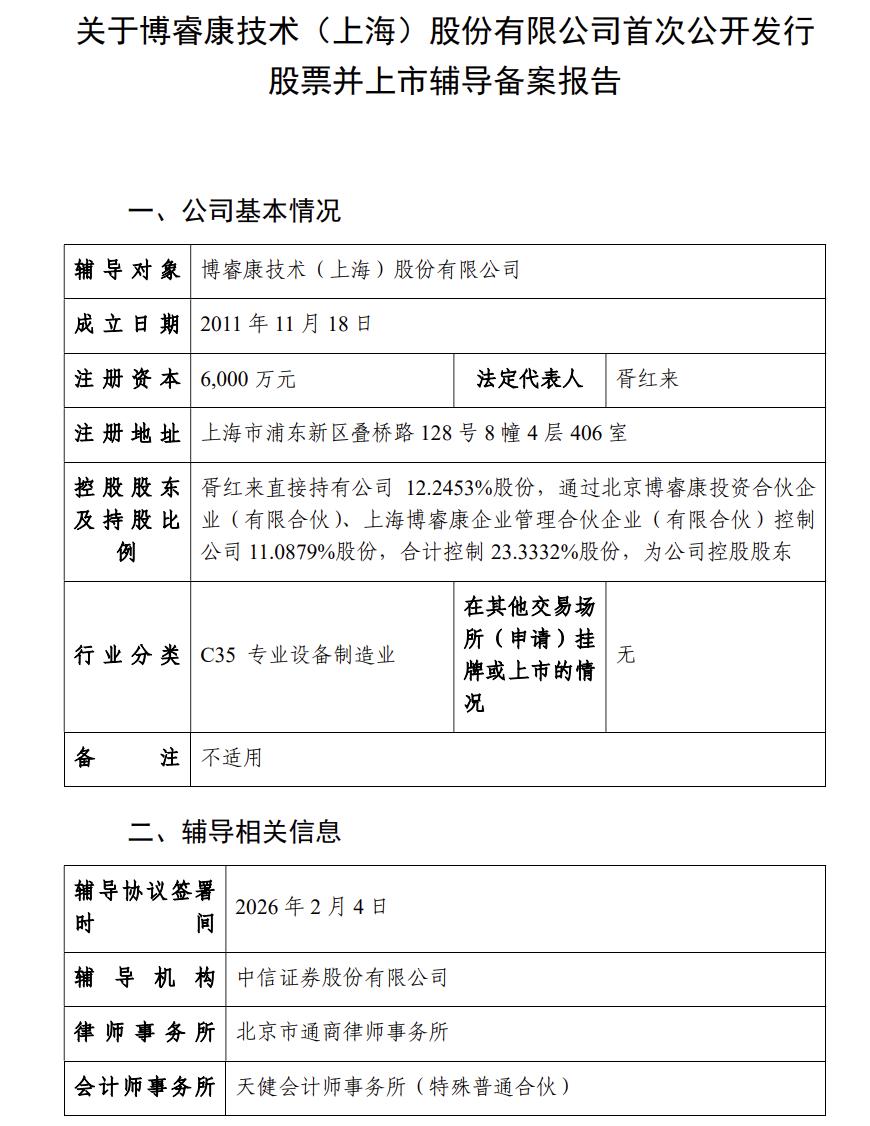
According to the guidance filing report, Xu Honglai directly holds 12.2453% of the company's shares and controls 11.0879% of the company's shares through Beijing Borui Kang Investment Partnership (Limited Partnership) and Shanghai Borui Kang Enterprise Management Partnership (Limited Partnership), with a total control of 23.3332% of the shares. He is the controlling shareholder of Borui Kang.
Qiangnao Technology Secretly Applies for Listing on the Hong Kong Stock Exchange
It is worth noting that before Borui Kang, there were reports that Qiangnao Technology, known as one of the "Six Little Dragons in Hangzhou", had secretly submitted an IPO application in Hong Kong. The company was established in February 2015 and was incubated by its founder Han Bicheng and his team at the Harvard Innovation Laboratory. It is mainly committed to the research and development of non-invasive brain-computer interface technology.
According to Qiangnao Technology's official website, its products cover three aspects: intelligent bionics, intelligent health, and intelligent education. Currently, it has launched multiple products such as intelligent bionic hands, brain-computer intelligent sleep aids, and brain-computer interface attention training systems. Among them, the intelligent bionic hands and intelligent bionic legs have obtained the listing permission from the US FDA, and the medical version of the head-mounted electroencephalogram product "Focus Xin" for children with ADHD (commonly known as "hyperactivity disorder") was also approved for listing in China in January 2026.
As of now, Qiangnao Technology has completed six rounds of financing. It first completed the angel round and Pre-A round of financing in March and June 2016 respectively. The angel round was invested by Hantan Investment, and the financing amount was not disclosed to the public. In subsequent financings, institutions such as China Electronics, Everbright Holdings, Deshun Capital, CDH Investments, Dowstone Technologies, and 37 Interactive Entertainment Venture Capital Fund were introduced.
In January 2026, Qiangnao Technology completed a financing of approximately 2 billion yuan. The investors included IDG, Walden International, Lens Technology, and Lingyi Precision Industry, etc., and several top family offices in Hong Kong, China and the United States also participated. This financing is currently the second-largest single financing in the global brain-computer interface field.
In recent years, as a cutting-edge future industry, the brain-computer interface has witnessed dual development opportunities in terms of policies and the market in China.
In 2025, seven departments including the Ministry of Industry and Information Technology jointly issued the "Implementation Opinions on Promoting the Innovation and Development of the Brain-Computer Interface Industry", clearly including the brain-computer interface in the key areas for future industry cultivation. The "15th Five-Year Plan" proposal of the country lists the "brain-computer interface" as one of the six "future industries". In the 2026 government work report of Shanghai, the brain-computer interface and other industries are also clearly listed as key future industries for cultivation.
Data shows that it is estimated that by 2040, the comprehensive market scale of China's brain-computer interface industry is expected to exceed 120 billion yuan, among which the direct market scale mainly composed of equipment may exceed 50 billion yuan. In the segmented markets, the market scale of the scientific research level is expected to increase by about 10 times, and the market scale of the consumer level will increase by more than 50 times.
However, the industry generally believes that the brain-computer interface technology is still in the early stage of development. To truly achieve large-scale application in medical scenarios, it still needs to overcome multiple thresholds such as standardized and rigorous human clinical verification and ethical norms.
This article is from the WeChat official account "Science and Technology Innovation Board Daily". Author: Shi Shiyun. Republished by 36Kr with permission.