Valuation skyrockets by over 50 billion yuan in one year. The AI startup recommended by Jensen Huang raises 3.5 billion yuan and plans an IPO.
A unicorn worth tens of billions of dollars has emerged in the AI audio track!
According to a report by Zhidx on February 5th, yesterday, British AI audio unicorn ElevenLabs announced the completion of a Series D financing of $500 million (approximately RMB 3.47 billion), with a valuation of $11 billion (approximately RMB 76.35 billion). Its valuation has achieved a rapid growth of over 230% compared to $3.3 billion at the beginning of last year. Mati Staniszewski, co - founder and CEO of ElevenLabs, also revealed that the company is considering an IPO.
This round of financing was led by Sequoia Capital. a16z, which has participated in multiple rounds of financing of ElevenLabs, increased its investment by four times, and ICONIQ increased its investment by three times. This means that these two investment institutions have increased their shareholding ratios in ElevenLabs.

Mati Staniszewski announced the financing in a post (Source: X platform)
ElevenLabs was founded in London, UK in 2022. Initially, it mainly engaged in the development of text - to - speech models, and later gradually developed in areas such as speech - to - text models, AI sound effect models, AI dubbing models, and AI music models.
The company provides voice API services to enterprises, an audio generation platform called ElevenCreative for creators and brands, and also offers AI voice customer service through the ElevenAgents platform. You can even find audio generated by ElevenLabs in the well - known game "Fortnite". By the end of 2025, ElevenLabs' ARR (Annual Recurring Revenue) had exceeded $330 million (approximately RMB 2.29 billion).
Since its establishment, ElevenLabs has completed five rounds of financing, with a total cumulative financing of $781 million (approximately RMB 5.42 billion). NVIDIA previously participated in ElevenLabs' Series C financing. Huang Renxun, founder and CEO of NVIDIA, said that ElevenLabs has created the world's best voice AI products, and he actively recommended ElevenLabs to the NVIDIA team. Now, when Huang Renxun appears as a virtual cartoon character at various conferences, he uses ElevenLabs' tools to replicate his own voice.
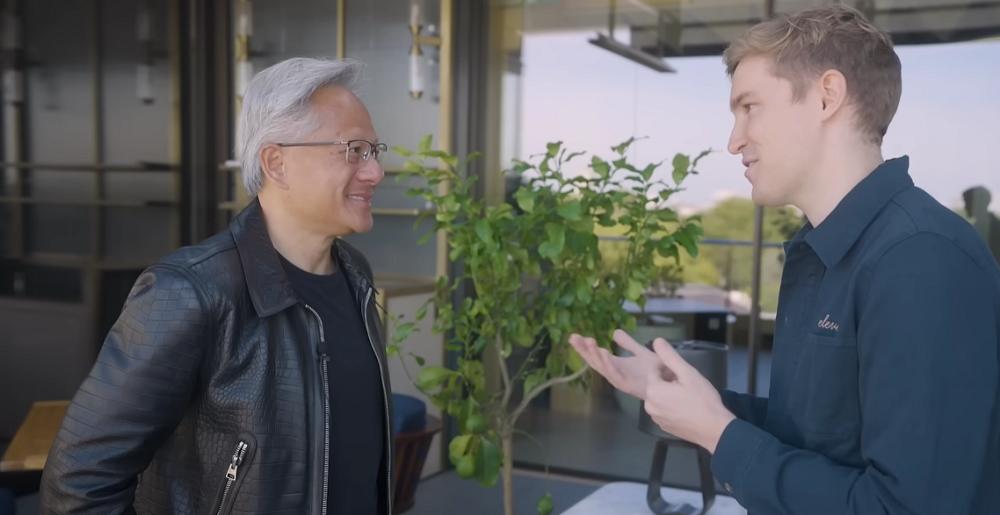
Huang Renxun and Mati Staniszewski (Source: NVIDIA)
In terms of financing scale, revenue growth, and capital lineup, ElevenLabs has firmly established itself in the first echelon of the global AI audio track. A company that has been established for less than 4 years and has quickly distanced itself in the highly competitive voice AI field is obviously not just riding on the wave. The starting point of its entrepreneurship, key decisions, and understanding of products and markets are worth in - depth analysis.
01. Acquired one million users in six months after launch, achieving explosive growth through social media
Both co - founders of ElevenLabs, Mati Staniszewski and Piotr Dabkowski, are from Poland. Inspired by the poorly dubbed American movies they watched in their childhood, they decided to create an AI tool to solve this problem.
Before starting the business, Mati Staniszewski worked at browser company Opera, investment and technology provider BlackRock, and data intelligence listed company Palantir. Piotr Dabkowski, after graduation, worked as a software engineer at Google until he co - founded ElevenLabs with Mati Staniszewski in 2022.
What changes can the fledgling ElevenLabs bring to this industry? When investing in ElevenLabs in 2023, Bryan Kim, an investor at a16z, explained his understanding of ElevenLabs' potential.
Bryan Kim believes that although speech - to - text technology has existed for decades, it has not reached its full potential. Most synthetic voices lack appealing intonation and pronunciation and a sense of personality. While high - end professional voice recording services exist, the lengthy production process and high cost make this technology difficult to implement in most real - time and interactive scenarios.
The emergence of ElevenLabs aims to meet the demand for high - quality voices in these scenarios.
In January 2023, ElevenLabs first launched voice design and cloning products and significantly improved the existing text - to - speech models. Later, it also launched multiple text - to - speech models, expanded multi - language support, and even obtained the voice copyrights of some deceased well - known actors for cloning and commercial services.
Six months after its launch, ElevenLabs had accumulated over one million registered users and created audio content with a total duration of over 10 years. By November 2024, its user base had exceeded 33 million. In 2025, its ARR exceeded the $100 million mark.
In an interview in June 2025, Luke Harries, the growth director of ElevenLabs, revealed that there are two main driving forces behind the company's rapid growth.
On the one hand, the basic model capabilities of ElevenLabs are constantly evolving, with continuous improvements in expressiveness and realism. ElevenLabs believes that unlike other AI models, scale and data volume are not the most important determining factors for voice models. Instead, the model architecture plays an important role.
Piotr Dabkowski, the co - founder leading ElevenLabs' research work, recruited several world - class voice AI researchers with his influence. The company has made some breakthroughs in model architecture. However, since they are developing a closed - source model, the outside world has no way of knowing the specific aspects of these improvements.
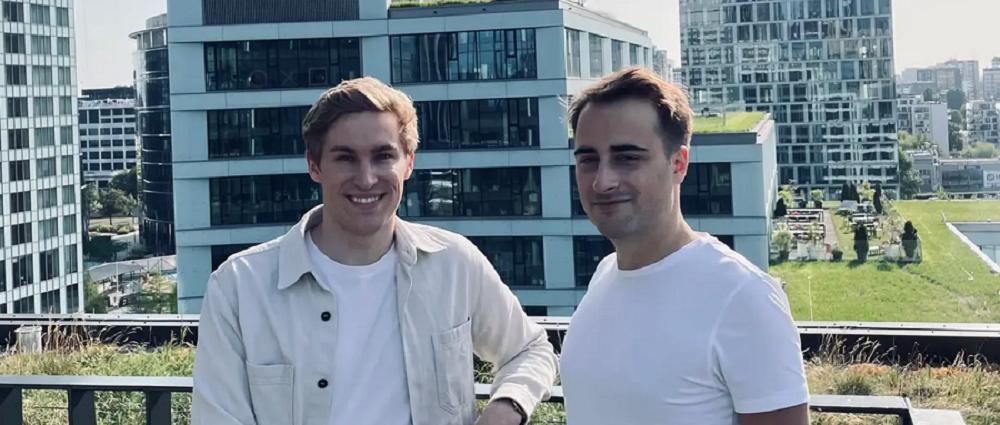
Mati Staniszewski (left) and Piotr Dabkowski (right)
On the other hand, ElevenLabs is also very good at marketing. The company knows how to leverage the power of social media and has achieved explosive growth by hosting hackathons and creating alternative demos.
In terms of enterprise customers, ElevenLabs believes that a bottom - up approach should be adopted in the enterprise - level market. That is, start from the consumer - grade and developer markets, and large - scale customers will naturally come after establishing a reputation and trust.
02. The company's focus has shifted to voice agents, and the founder is not optimistic about the future of audio models
However, ElevenLabs does not want to limit itself to the narrow audio model track. The company is aiming for a larger market.
In a podcast recorded with TechCrunch, Mati Staniszewski said that the fundamental problem that ElevenLabs wants to solve is how humans interact with technology products, which has been the main line of their product development.
Initially, ElevenLabs created text - to - speech models to make the voices in technology products sound more human. But to create a truly excellent experience, realistic human voices alone are not enough. AI also needs to be able to generate sounds and music and have an understanding of speech. Mati Staniszewski believes that this was the company's biggest focus from its establishment to the first half of 2025.
However, in fact, Mati Staniszewski believes that the audio model track itself has little prospect: "This track may still be viable in the next 1 - 2 years, but in a few more years, this technology will be completely commoditized".
Now, the reason ElevenLabs is still developing models is that in the short term, it is still the best way to improve the quality of AI audio products. But as this technology becomes more mature and accessible and becomes a "standard component" that can be purchased in large quantities, audio models may become a widespread underlying basic capability rather than a core competitive advantage.
Therefore, in the second half of 2025, Mati Staniszewski led ElevenLabs to make an important strategic adjustment. Now, ElevenLabs' top priority is to help enterprises deploy conversational agents and interact with users and customers in new ways.
Mati Staniszewski predicts that with the rise of agents, conversational agents, and voice agents, users can talk to devices. But to make these agents truly valuable, a large amount of information and knowledge bases need to be incorporated into the agents so that they can be integrated with existing systems.
After integration, these products also need to be testable, evaluable, and monitorable to gain the trust of enterprise - level customers.
The main application scenarios of these agents are actually AI voice customer services. ElevenLabs' agents are multimodal, capable of understanding oral or written input, listening, reading, and interacting with customers like humans. Enterprises can also customize these agents and create conversation flows in the visualization tools provided by ElevenLabs to precisely define how these agents should interact with customers.
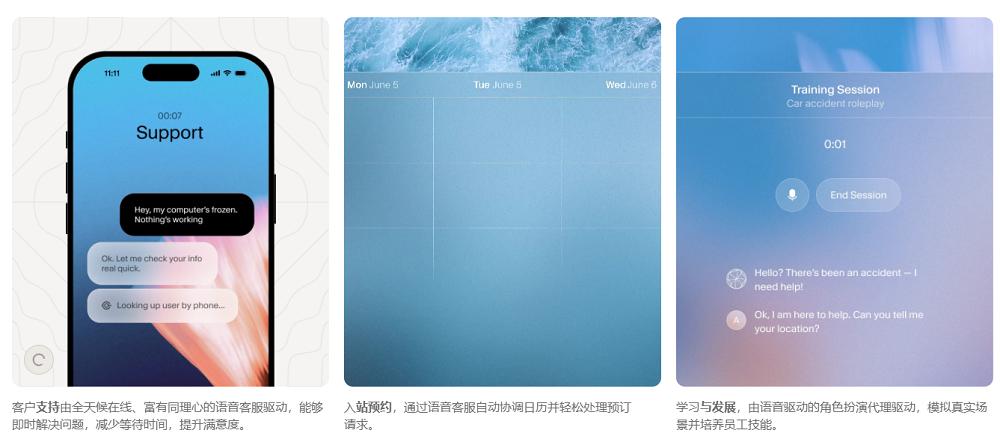
ElevenLabs' agent products (Source: ElevenLabs official website)
This strategic decision has enabled ElevenLabs to gain more ground in the enterprise - level market. Now, in the voice agent track, some of their major customers include Cisco, Meta, Salesforce, etc. In the field of audio creation, film and game production companies such as Disney and Epic are using their products.
Reflected in the ARR, after making this strategic shift, the ARR growth rate of ElevenLabs has significantly accelerated. In early 2025, it took 20 months for ElevenLabs to reach an ARR of $100 million, and it only took 10 months to cross the $200 million ARR mark.
In early 2026, when ElevenLabs announced that its ARR had reached $330 million, only 5 months had passed since they reached an ARR of $200 million.
03. Focus on AI models + products, not just brute - force computing power and data
There is no shortage of excellent models in the voice AI track. Companies such as MiniMax and Alibaba in China, and Google and OpenAI overseas have all created excellent voice products. So, what are ElevenLabs' differential advantages?
Just as the combination of software and hardware is the magic of Apple, Mati Staniszewski believes that the combination of AI models and products can bring out the greatest value.
Although ElevenLabs also conducts research in some cutting - edge directions, such as the combination of open - source video models and voice models, they always focus more on creating better products and will not train computationally or data - intensive models like their competitors.
At the same time, Mati Staniszewski also believes that ElevenLabs has a higher level of focus. They directly focus on solving the problem of human - computer voice interaction. The company's vision is independent of what its competitors are doing.
After obtaining the new financing, ElevenLabs' top priority is to promote the development of its agent products. In the next few days, they will soon launch a new conversational model for the agent platform, which can understand and express emotions faster and more accurately.
Now, ElevenLabs is a company with 400 employees. Compared with other AI startups with similar valuations, this is almost a large - scale company.
ElevenLabs is expanding internationally in cities such as London, New York, San Francisco, Warsaw, Dublin, Tokyo, Seoul, Singapore, Bangalore, Sydney, São Paulo, Berlin, Paris, and Mexico City, and has equipped itself with local marketing teams. This is especially important for the company's voice AI business.
04. Conclusion: Models serving products are ElevenLabs' breakthrough strategy
Looking back at ElevenLabs' growth path, it did not follow the traditional model company route of piling up parameters and competing in computing power. Instead, it always focused on a more fundamental question: How are voice and audio actually used in the real world? At the strategic level, they were sober - minded enough to predict that "audio models will eventually be commoditized" and resolutely shifted their focus to conversational agents and enterprise scenarios.
This is a "product - first, models serving products" approach, which gives ElevenLabs differential features in the crowded voice AI track. This may also be the key reason why leading enterprises and top - tier venture capital firms are willing to invest heavily in ElevenLabs.
This article is from the WeChat official account "Zhidx" (ID: zhidxcom), author: Chen Junda, editor: Xinyuan. Republished by 36Kr with permission.