The valuation soared 625 times. A post - 1985 entrepreneur from Hebei who sells industrial robots got listed on the Hong Kong Stock Exchange.
A super IPO has emerged in the industrial robot sector.
Recently, Tianjin Atomrobot Co., Ltd. (Atomrobot) submitted its prospectus to the Hong Kong Stock Exchange.
Atomrobot started from a laboratory at Tianjin University. In just ten years, it has grown from a small team of 10 people to the second - largest player in the global parallel robot market. Its valuation has soared from 4 million yuan to 2.5 billion yuan, a staggering 625 - fold increase.
- 01 -
Liu Songtao, the founder of Atomrobot, was born in 1987 in Dacheng County, Langfang City, Hebei Province.
In 2006, Liu Songtao was admitted to the School of Mechanical Engineering at Tianjin University. In his junior year, he saw a high - speed parallel robot in the laboratory for the first time. This device, which looks like a "mechanical spider", can complete grasping and sorting actions at an amazing speed, instantly sparking his interest.
At that time, China was becoming the "world's factory", and the manufacturing industry was gradually automating. The demand for high - speed sorting equipment in industries such as food, daily chemicals, and pharmaceuticals was surging. However, the price of a single device was as high as hundreds of thousands of yuan, which small and medium - sized enterprises simply could not afford.
Liu Songtao's goal was to "liberate 300 million blue - collar workers in China". In his senior year, he led the development of a new type of four - degree - of - freedom parallel robot prototype in his undergraduate graduation project. Then, he studied under Professor Huang Tian, an expert in the field of parallel robots worldwide, for his master's degree, turning the laboratory results into industrial products.
At this time, he also met Song Tao, who was also an alumnus of Tianjin University and later went to Beihang University to pursue a master's degree in mechanical engineering. Their similar engineering backgrounds and obsession with technology laid the groundwork for their future joint entrepreneurship.
In September 2012, when Liu Songtao was in his third year of graduate school, he was thinking about his future. Professor Huang Tian half - jokingly asked him, "Songtao, are you interested in establishing a company and selling parallel robots on the market?" He decided to give it a try and immediately found Song Tao. The two hit it off right away. Liu Songtao focused on technological innovation and product direction, while Song Tao was responsible for engineering implementation and operation management.
In 2013, 25 - year - old Liu Songtao and Song Tao founded Chenxing (Tianjin) Automation Equipment Co., Ltd. (the predecessor of Atomrobot). Their office was in a factory building in Wuqing, Tianjin, and the team had about 10 people. They took the self - made prototype to visit their first potential customer, Shijiazhuang No. 4 Pharmaceutical Factory.
At that time, the workers in the No. 4 Factory were still manually sorting medicines, which was inefficient and high - risk. Liu Songtao's team promised to use robots to replace human labor. However, after the prototype was installed and debugged, the mechanical arm frequently broke, and it could not operate stably.
Liu Songtao's team conducted repeated tests for a month. Finally, they found the problem - the material strength did not match the motion trajectory algorithm. By optimizing the mechanical structure and control program, they solved the problem and won the No. 4 Factory as a customer.
In 2015, the company was short of funds and could hardly pay salaries on time. Liu Songtao and Song Tao were looking for investment everywhere. At that time, the capital market was crazily chasing the O2O trend, and no one was willing to pay attention to the "parallel robot" sector. Just when the team was on the verge of collapse, an accidental opportunity came.
Introduced by an investment manager from Shenzhen Capital Group, Liu Songtao met Yang Haoyong, an alumnus of Tianjin University and the founder of Ganji.com. At that time, Yang Haoyong had just stepped down from Ganji.com (after its merger with 58.com) and had a large amount of cash. Everyone thought he would go all - in on Guazi Used Cars, but no one expected him to pay attention to a small company in Tianjin.
In a coffee shop in Tianjin, Liu Songtao held the robot prototype and explained the market logic that his product's performance was approaching that of foreign competitors while the price was only half. Although Yang Haoyong did not understand the technical details, he captured the core value of this business: it had technological barriers, a real - demand market, and definite growth.
"I'll invest 6.66 million yuan!" Yang Haoyong's angel investment not only injected life - saving funds into Atomrobot but also brought resources far beyond capital. Yang Haoyong helped them sort out their business model, introduced supply - chain resources, and even tested the robots in the Guazi Used Cars factory.
Since its establishment, Atomrobot has completed seven rounds of financing, from the angel round in 2015 to the latest D - round financing on October 20, 2025. It has attracted well - known investors such as Shenzhen Capital Group, Guozhong Private Equity, Lenovo Capital, Qingdao Haichuang, and TEDA Science and Technology Investment. Its valuation has increased from 4 million yuan to 2.5 billion yuan.
In 2021, the D3 series of parallel robots were launched, winning orders from Lenovo's intelligent manufacturing production line and becoming the domestic parallel robot self - owned brand with the highest market share.
In 2023, it surpassed foreign brands to become the number one in the Chinese parallel robot market across all brands; in 2024, it ranked second in the global market.
- 02 -
Parallel robots are the earliest and still the core business of Atomrobot.
This type of robot uses several mechanical arms to drive the end - effector together. It is naturally suitable for tasks that require high speed, repetition, and high precision, such as food sorting, medicine boxing, and the handling of 3C electronic parts. Because of its structural advantages, the key lies in whether it can run fast and stably and work continuously without downtime.
Speaking of revenue, parallel robots directly determine the financial strength of Atomrobot. In 2023, the sales of parallel robots reached 60.048 million yuan, accounting for 64.2% of the company's total revenue. In 2024, the revenue increased to 70.477 million yuan, accounting for 52.1%. In the first three quarters of 2025, the revenue further increased to 81.747 million yuan, accounting for 52.0%.
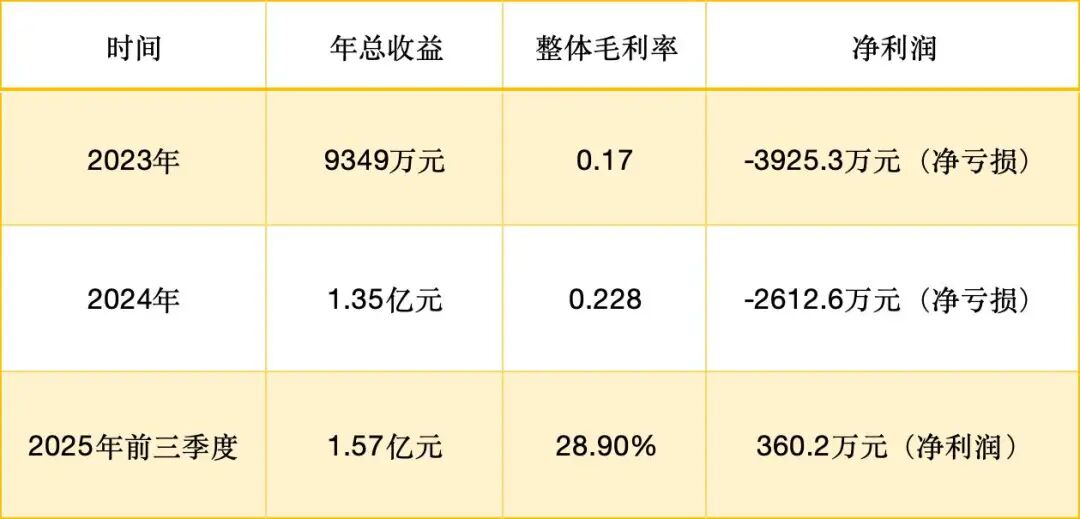
Atomrobot's revenue data chart
Although Atomrobot has now started to develop new products such as high - speed SCARA robots and collaborative robots, and these new products can also generate revenue, parallel robots are still the most reliable "cash cow" and have the largest scale. In addition, the profitability of this type of robot is also getting stronger. The gross profit margin was 22.2% in 2023, increased to 28.2% in 2024, and further increased to 31.9% in the first three quarters of 2025.
Although Atomrobot has developed into an industry leader, the ceiling of the parallel robot sector is obvious.
First, the application scenarios are limited and highly homogeneous.
Currently, parallel robots are mainly concentrated in high - speed sorting and handling scenarios in industries such as food and beverage, daily chemicals, and pharmaceuticals, mostly for simple and repetitive operations. It is difficult to adapt to high - end and complex scenarios such as semiconductor precision assembly and aerospace. Even though Atomrobot has launched high - precision products, most enterprises still remain in the mid - to - low - end field, with fierce homogeneous competition. This is also the core reason for Atomrobot to expand into embodied intelligence and heavy - load collaborative robots in recent years.
Moreover, high requirements for after - sales and operation and maintenance: a large number of customers are located in third - and fourth - tier cities, resulting in high service costs.
Second, there are still short - comings in core technologies and components.
Although Atomrobot has achieved independent control of key technologies, the industry as a whole still faces bottlenecks. Core components such as high - end precision reducers and high - response servo drives still rely on imports. Domestic products have gaps in stability and lifespan. At the same time, the design threshold of parallel robots is high, relying on the experience of designers, and it is difficult to quickly adapt to personalized scenario requirements.
Third, it is difficult to break into the high - end market, and the cost and usage threshold are relatively high.
The global high - end parallel robot market is still monopolized by Swiss and Japanese brands. Although domestic products are affordable, there are still gaps in precision and stability in high - end scenarios. In addition, parallel robots are complex to debug and require professional technicians to operate. With a large number of customers located in third - and fourth - tier cities, the service cost is high.
At the software level, there is still a gap between domestic industrial control underlying software and foreign software, which further limits the popularization. This is also an important consideration for Atomrobot to layout a free incubator and provide supply - chain support.
In the future, integrating visual recognition and AI decision - making capabilities (such as defect detection, dynamic obstacle avoidance, and intelligent grasping) and combining with SaaS/cloud - edge collaboration (to achieve remote diagnosis, cloud - based scheduling optimization, and data closed - loop training) will be new directions.
This article does not constitute any investment advice.
This article is from the WeChat public account "Pencil News" (ID: pencilnews), author: Songe. It is published by 36Kr with authorization.