HSG and Baidu are making bets. The first stock in the brain-computer interface field is coming.
Another brain-computer interface (BCI) company is preparing for an IPO.
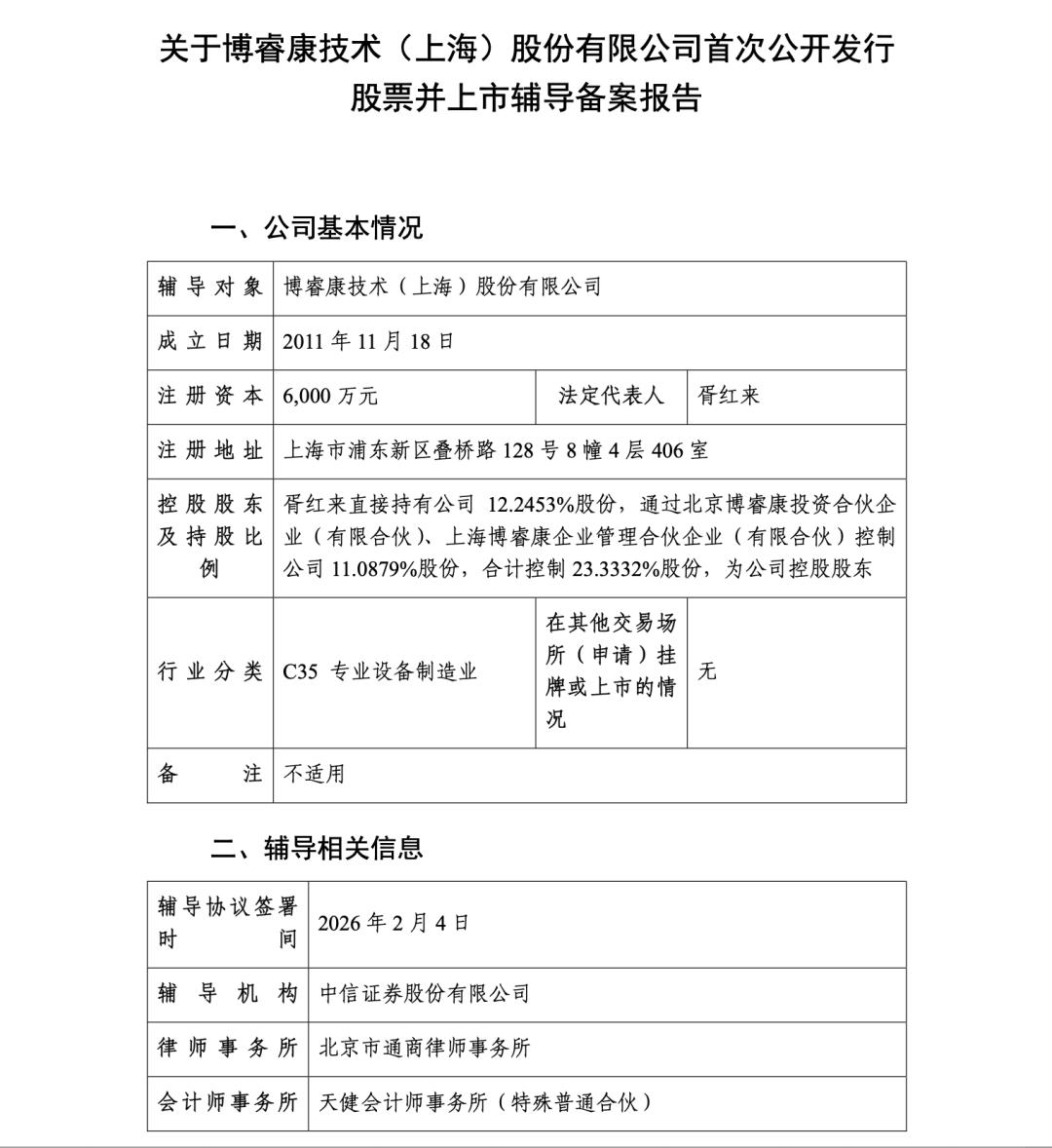
On February 4th, BrainCo Technology (Shanghai) Co., Ltd. (hereinafter referred to as BrainCo), a developer of brain-computer interface technology, filed for listing guidance with the Shanghai Securities Regulatory Bureau. The guidance institution is CITIC Securities.
Source: Screenshot from the official website of the China Securities Regulatory Commission
On January 12th this year, it was reported that NeuroX Technologies had secretly submitted an IPO application in Hong Kong. According to foreign media reports in August 2025, the company was in talks for approximately $100 million in pre-IPO financing at a valuation of over $1.3 billion, possibly paving the way for a subsequent IPO in Hong Kong or the Chinese mainland.
It is worth mentioning that, according to Xinhua News Agency, from the first capture of brain electrical ripples in the laboratory to the Chinese market scale exceeding 3.8 billion yuan in 2025, brain-computer interface in China has completed a crucial leap from "industry-university-research" to "application".
China's 15th Five-Year Plan clearly proposes to promote brain-computer interface as a new economic growth point. Regions such as Shanghai and Shenzhen have directly established special funds worth billions of yuan for brain-computer interface and brain science (core stocks).
It is foreseeable that, with the dual support of policy and market enthusiasm, brain-computer interface may usher in leapfrog development.
The core team is from Tsinghua University, and Sequoia, Baidu, and Songhe Capital have all joined
In fact, as early as 1999, the Neural Engineering Laboratory of the School of Medicine at Tsinghua University began exploring the field of brain-computer interface. The core team members of BrainCo are from the Neural Engineering Laboratory of Tsinghua University, which ranks among the top 5 globally in brain-computer interface, and medical market experts in the field of clinical neurology.
Xu Honglai, the founder and chairman of BrainCo, is a doctor of biomedical engineering from Tsinghua University. He once worked at the Neural Engineering Laboratory of Tsinghua University and participated in many important scientific research projects. He has made remarkable achievements in the fields of brain-computer interface system design and development, and weak signal detection and analysis.
In November 2011, BrainCo was officially registered and established. It is one of the earliest companies in China to engage in the industrialization of brain-computer interface. In 2015, with the entry of angel round financing from Rongtuo Capital and Jiming Investment, BrainCo accelerated the industrialization process of brain-computer interface.
Information from Tianyancha App shows that since its establishment, BrainCo has successively attracted 7 rounds of financing from institutions such as Kaifeng Venture Capital, Huakong Fund, Zhongfa Development Qihang Fund, Zhongfa Development Frontier Fund, BV Baidu Ventures, Sequoia China, and Songhe Capital.
Among them, in March 2021, BrainCo completed over 100 million yuan in Series B financing, led exclusively by Sequoia China. This financing made BrainCo well-known.
Regarding this investment, Yang Yunxia, a partner at Sequoia Capital China Fund, said: "Brain-computer interface technology can be used in many fields such as brain science, clinical medicine, and consumer electronics. Especially in the diagnosis and treatment of brain diseases, brain-computer interface is expected to play a huge role. The BrainCo team is the first in China to industrialize brain-computer interface technology. After more than a decade of development, the company has broken the import monopoly and mastered the underlying core technology of the entire brain-computer interface chain. The product technology features are clear, and Sequoia values its development potential."
BrainCo's most recent financing took place in March 2025. The amount of this Series D+ financing was not disclosed, and the investors included Lianxin Capital, Pudong Capital, Detong Capital, Yuankechuang Investment, and Futeng Capital.
Currently, Xu Honglai directly holds 12.2453% of BrainCo's shares and controls 11.0879% of the company's shares through Beijing BrainCo Investment Partnership (Limited Partnership) and Shanghai BrainCo Enterprise Management Partnership (Limited Partnership), with a total control of 23.3332% of the shares, making him the controlling shareholder of the company. Huang Xiaoshan, the founder and CEO, follows closely with a 11.8484% stake.

Source: Tianyancha
In addition, through continuous multi-round investments, early investor Rongtuo Capital holds a total of 9.3693% of BrainCo's shares, making it the largest external shareholder. Sequoia China holds 8.9362%; Kaifeng Venture Capital holds a total of 8.1216%; Huakong holds a total of 8.0014%; Jiming Investment holds 5.984%, and Liu Xiaoling, the legal representative of the institution, personally holds 1.4635%; Futeng Capital holds 4.2553%; Pudong Capital holds 3.617%; Songhe Capital holds 3.1915%; BV Baidu Ventures holds a total of 1.3254%.
36 surgeries have been completed, and it may become the first domestic implanted brain-computer interface product to be listed
With the support of the primary market, as one of the earliest companies in China to engage in the industrialization of brain-computer interface, BrainCo has experienced development from non-invasive to invasive and from scientific research to medical scenarios.
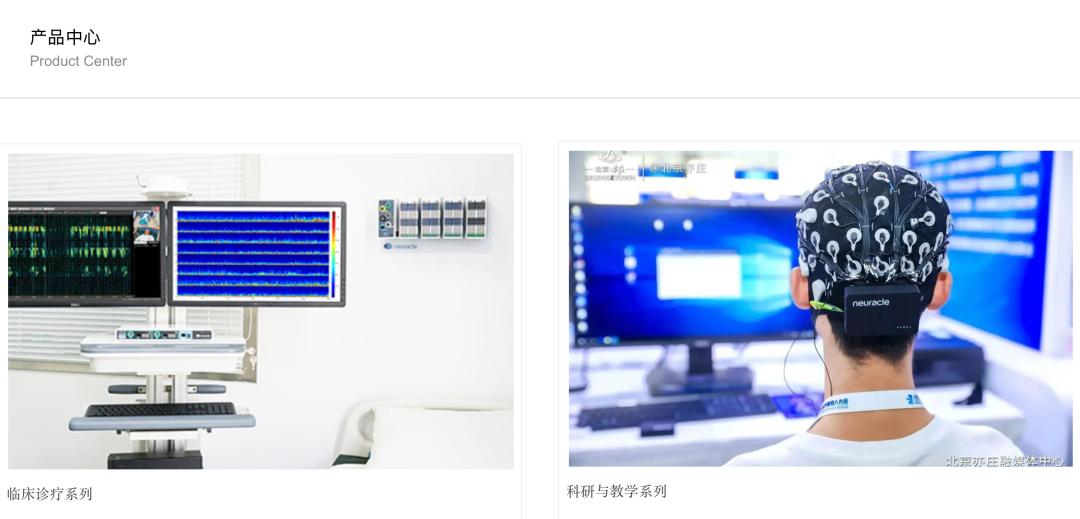
According to the official website, BrainCo is a high-tech enterprise centered on the independently innovative "brain-computer interface" technology. It is specialized in the research, development, production, sales, and technical services of brain-computer interface system-related equipment, and is committed to providing professional and complete solutions for innovative research in neuroscience and the diagnosis, treatment, and rehabilitation research of clinical neurological diseases.
BrainCo's products can be widely used not only in scientific research fields such as neuroscience, psychology, human factors engineering, kinematics, and management but also in clinical medical fields such as the diagnosis, treatment, and rehabilitation engineering of clinical neurological diseases.
Source: Screenshot from the official website
As of now, BrainCo has accumulated 17 technology patents and 9 software copyrights. It has obtained a medical device production license, medical device registration certificates, and multiple high-tech product certification certificates. It has successively undertaken or participated in the "Weak Information Acquisition Technology and Product Development in Brain-Computer Interface" project of the 12th Five-Year National Science and Technology Support Program and the "Research on Key Technologies and Clinical Applications of Neurological Regulation and Intelligent Rehabilitation for Alzheimer's Disease" project of the 13th Five-Year Key R & D Program of the Ministry of Science and Technology.
To date, BrainCo's main customers include well-known universities such as Tsinghua University, the Chinese Academy of Sciences, Beijing Normal University, Beihang University, Zhejiang University, Huazhong University of Science and Technology, Shanghai Jiao Tong University, Xi'an Jiao Tong University, Nankai University, and Nanjing University, as well as medical institutions such as Peking University Third Hospital, Xuanwu Hospital, Huashan Hospital, 301 Hospital, China Rehabilitation Research Center, and Tsinghua Changgeng Hospital.
At the 2025 Brain-Computer Interface Conference, the brain-computer interface system NEO developed by BrainCo achieved a major breakthrough in the world's first multi-center registered clinical trial of an implanted brain-computer interface. The trial lasted 78 days, and a total of 32 patients with cervical spinal cord injuries successfully completed the implantation surgery in 11 hospitals across the country, with no device-related adverse reactions after the surgery.
The success of this clinical trial has initially confirmed the safety of the minimally invasive epidural implantation path and the feasibility of long-term use. Currently, the NEO project is planning to submit a registration application for a Class III innovative medical device to the National Medical Products Administration and is expected to become the first domestic implanted brain-computer interface product to be listed.
After that, BrainCo's clinical trials continued to advance. As of now, the NEO project has completed implantation surgeries on 36 spinal cord injury patients in 11 hospitals across the country. After implanting the NEO system and undergoing training, Dong Hui, a patient with high paraplegia, can not only control a pneumatic glove to grasp with his mind but also has recovered some voluntary motor abilities under the principle of neural plasticity and can grasp a water cup with his bare hands.
It is worth mentioning that in early 2026, after Elon Musk announced that Neuralink planned to mass-produce brain-computer interface devices this year, brain-computer interface concept stocks in the A-share market triggered a wave of daily limit increases.
In the future, whether it is BrainCo or NeuroX Technologies that becomes the first brain-computer interface stock, it will detonate the secondary market again.
This article is from the WeChat official account "Direct Access to IPO", author: Wang Fei. Republished by 36Kr with permission.