Elon Musk Boosts "Space Photovoltaic," Chinese Enterprises Set Sail for the Cosmos
Elon Musk has recently offered a tantalizing prospect to China's photovoltaic (PV) industry.
At the end of last month, Musk stated at the Davos Forum that building a space AI computing power center is a "natural thing to do." On February 2nd, SpaceX officially announced the full acquisition of the artificial intelligence startup xAI, which will accelerate the construction of a space data center. By using solar energy, it aims to make space the place with the lowest AI computing power cost in two to three years.

*Image source: Internet
To effectively utilize solar energy in space, PV technology is essential. On February 4th, according to Jiemian News, Musk's team conducted research on PV companies such as TCL Zhonghuan, JinkoSolar, and Jingsheng M&E last week.
Why is this considered a tantalizing prospect? Because Musk previously disclosed a goal of achieving an annual solar manufacturing capacity of 100GW in the next three years. The industry expects that China's new PV installations in 2026 will be approximately 435.37GW. Musk's plan alone is equivalent to a quarter of the Chinese market.
As a result, the PV sector in the A-share market "went wild." TCL Zhonghuan and JinkoSolar almost hit the daily limit on February 4th, and Jingsheng M&E also saw a significant increase. Previously, although Junda Co., Ltd. admitted that "it has not carried out substantial operations and has not obtained any orders," its stock price still soared by 80% this year. Dongfang Risheng rose nearly 40%, and Maiwei Co., Ltd. rose more than 45%, with its single - share price reaching as high as 300 yuan and its total market value approaching 100 billion yuan.
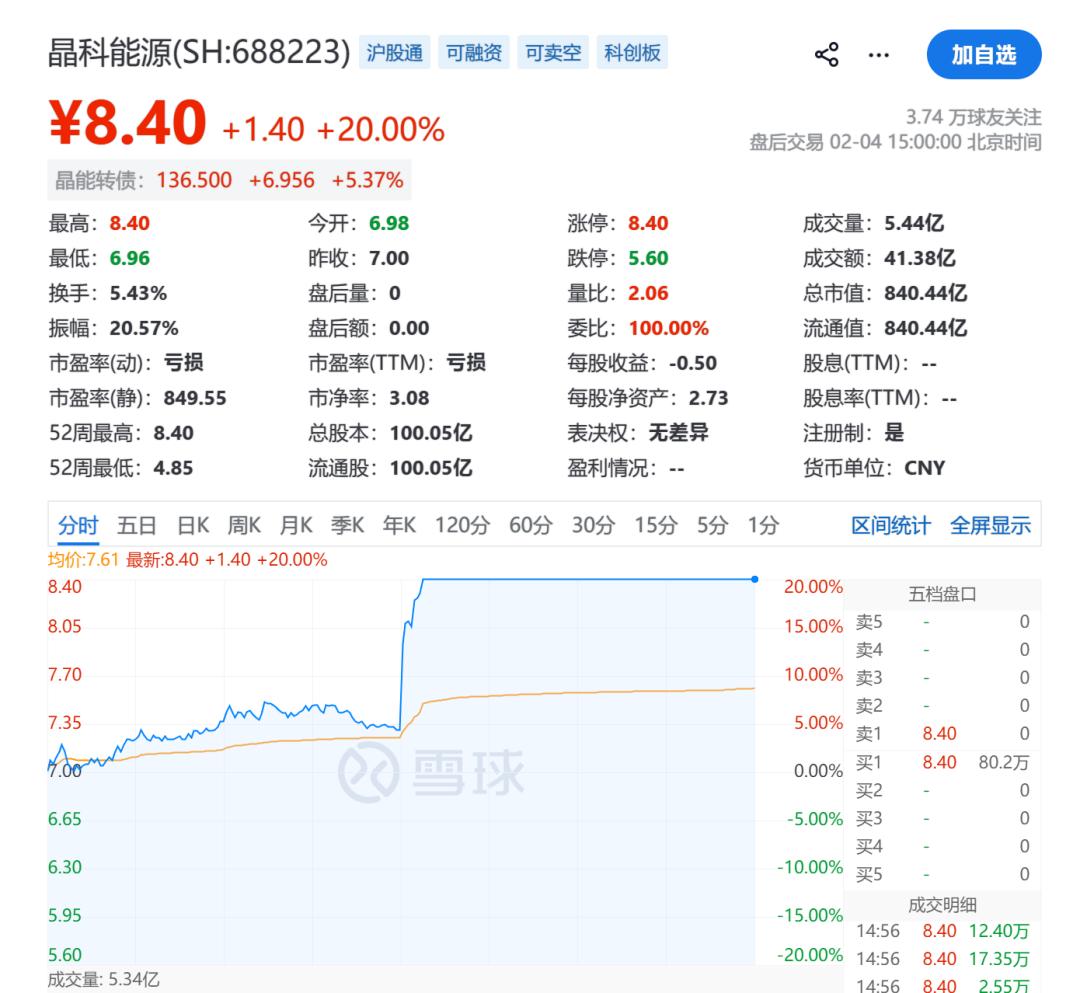
*Image source: Xueqiu
Why has Musk's story caused such a big stir? What exactly does this trillion - level "prospect" mean? To answer these questions, we need to start with the current situation of the PV industry.
01 A Tale of Two Extremes: The PV Industry Seeks Its Future
The "2025 National Electric Power Industry Statistical Annual Report" shows that last year, the installed capacity of solar power generation exceeded 1.2 billion kilowatts, a year - on - year surge of 35.4%, accounting for 58% of the total new installed capacity. However, behind this remarkable growth, the PV industry held another symposium at the end of last month to discuss anti - involution. Despite the meetings held from last year to now, the ultimate means to combat involution has not been determined.
Recently, during the peak period of performance announcements, some investors sighed that the financial reports of PV companies are getting "uglier" one by one.
Currently, the entire industrial chain has suffered continuous losses for 10 quarters. Only three leading companies, LONGi Green Energy, Trina Solar, and JinkoSolar, are expected to incur losses of more than 20 billion yuan in 2025. Tongwei Co., Ltd. is expected to lose between 9 billion and 10 billion yuan, TCL Zhonghuan between 8.2 billion and 9.6 billion yuan, and Trina Solar between 6.5 billion and 7.5 billion yuan. The net assets of Yijing Photovoltaic and Quanwei Technology have become negative.
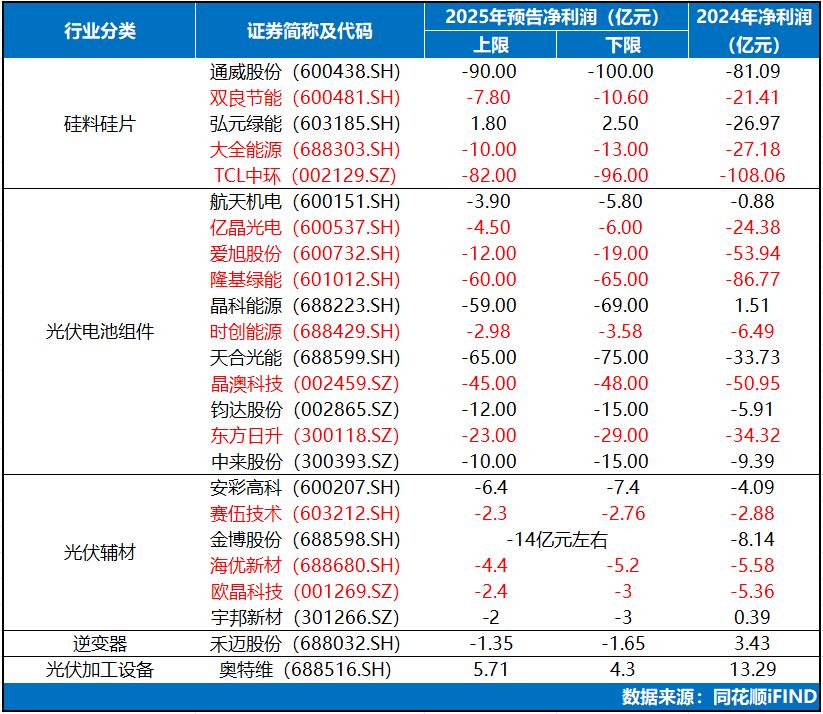
*Image source: Caiwen
When the PV industry is struggling with cost - cutting on the ground with no end in sight, the "trillion - level prospect" thrown by Musk provides a very important emotional outlet. PV companies that have been doing their best to maintain the situation have long been looking forward to positive news and have already shown signs of determination to break out of the deadlock.
LONGi Green Energy proposed in its "2025 Employee Stock Ownership Plan" that the performance assessment target for 2026 requires the annual net profit attributable to shareholders of the listed company to turn positive. Trina Solar, in its "2026 Employee Stock Ownership Plan (Draft)" and "2026 Restricted Stock Incentive Plan (Draft)" introduced on January 23rd, directly set the cumulative performance assessment target for 2026 - 2028 at no less than 9.6 billion yuan.
In fact, these companies may not be sure when the inflection point will truly arrive. However, at this time, Musk's space PV plan has suddenly raised the ceiling of the entire industry.
Compared with ground - based PV, space - based PV can avoid the obstruction of the atmosphere. The sunlight intensity in space is 5 - 10 times higher than that on the ground, and it can break through the limitations of day - night alternation, cloudy, rainy, and snowy weather, achieving 24 - hour continuous power generation and stable output without the need for energy storage facilities.
Institutions such as Galaxy Securities and Industrial Securities believe that space - based PV has high power generation efficiency, can generate electricity continuously for 24 hours, has low costs, and can have an output 7 - 10 times higher. Changjiang Securities pointed out that under a neutral assumption, the market space for PV in space data centers is as high as 1.33 trillion yuan, and under an optimistic assumption, it is as high as 2.38 trillion yuan, corresponding to an annual demand of 600GW of PV modules, with a market space of 600 billion yuan.
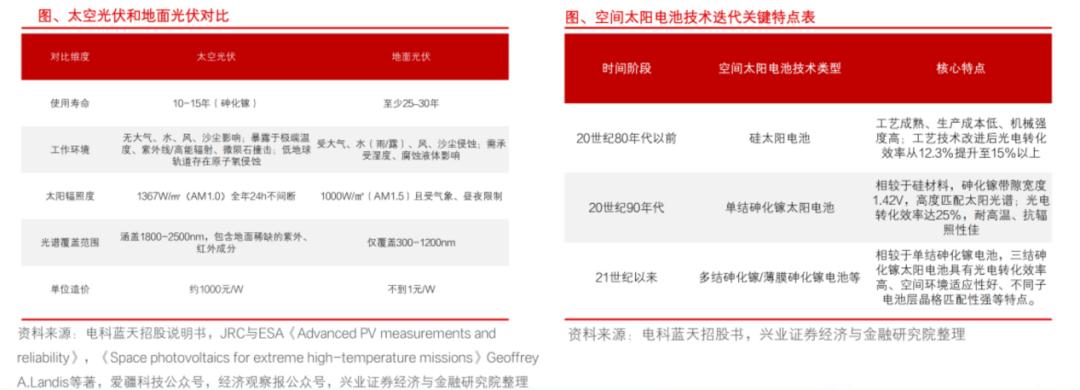
*Image source: Industrial Securities
For industry giants such as LONGi Green Energy and Trina Solar, this is a "high - dimensional" incremental market with large premium space, almost no price war, and only dependent on technological barriers. For other supply - chain companies, this incremental market is the best way to solve the industry's over - capacity problem. The current hottest market has actually left a "big piece of meat" for the PV industry, which naturally excites the market.
02 Will Technology Shuffle the Deck? Can Space - Based PV Reverse the Industry's Fate?
It should be noted that space - based PV does not mean that all companies and technologies can simply be transferred to space. The change in the scenario has altered the competitive logic of the PV industry.
On the ground, the focus is on the cost per kilowatt - hour, that is, how much electricity can be generated with one yuan. In space, the focus is on the "specific power (W/kg)", that is, how much electricity can be generated by one kilogram of the product. Since PV equipment needs to be sent to space by rockets and the launch cost is still high, an additional kilogram of payload may cost thousands or even tens of thousands of dollars.
The traditional crystalline silicon cells in the PV industry, which are the most commonly used glass panels in ground - based PV, are too heavy and costly to launch into space. Assuming that an ordinary ground - based PV module weighs about 20 - 25 kilograms, the cost of transporting a large number of them to space could be as high as hundreds of thousands of dollars. Therefore, their specific power is very low.
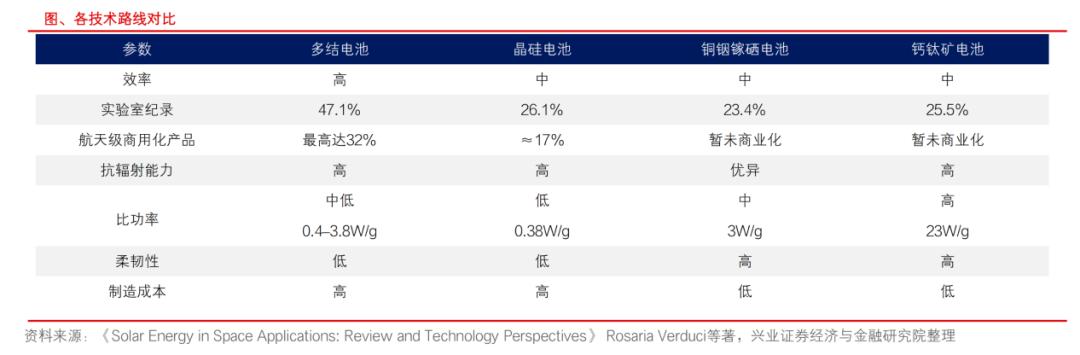
*Image source: Industrial Securities
What should be done? Change the technology. The currently popular technologies in the PV industry, such as perovskite and P - type ultra - thin heterojunction (HJT), are the right solutions.
The most prominent feature of perovskite is that it can be made into a thin film as thin as paper and as flexible as cloth. Its weight is only a fraction of that of traditional crystalline silicon cells, and in theory, it has higher power generation efficiency. Heterojunction technology can cut silicon wafers very thin, equivalent to the thickness of a piece of paper, while maintaining high power generation efficiency. These thin cells can also be stacked with other cells to form tandem technology.
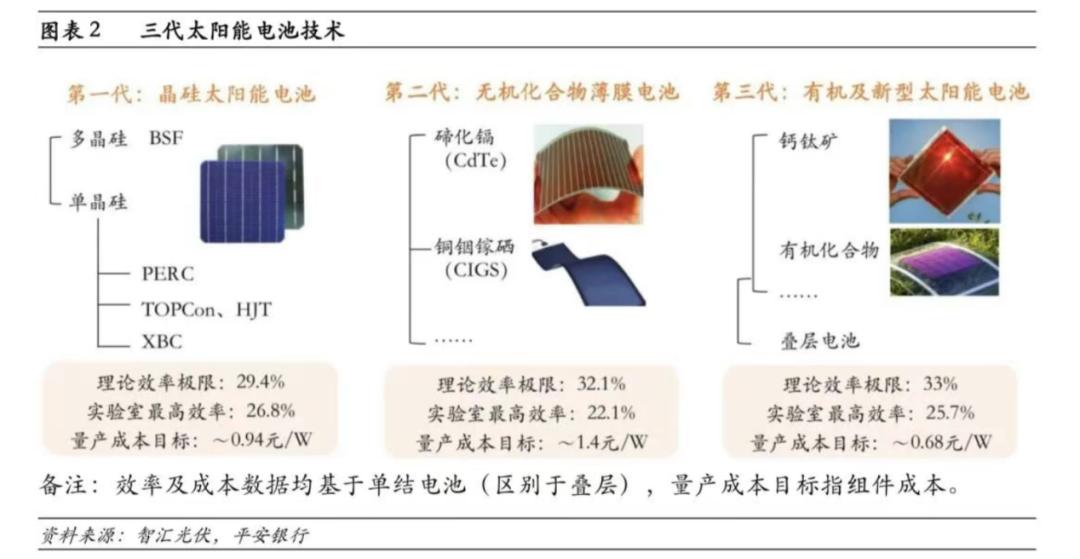
*Image source: Ping An Bank
Why weren't these lightweight and efficient technologies used before? Take perovskite as an example. On the ground, it has always been criticized for its short lifespan and poor stability. An ordinary PV module can be used for 25 - 30 years, while perovskite may only last for a few years, making large - scale commercialization difficult.
However, the low - orbit satellites used in space - based PV typically have a short lifespan of about 5 years, so the limitations on the ground do not need to be considered. As a result, relevant companies have become excited:
Li Xiande, the chairman of JinkoSolar, clearly proposed to explore market opportunities in space - based PV in his New Year's speech "2026: Looking Up at the Stars and Keeping Your Feet on the Ground" and announced a strategic cooperation with Jingtai Technology to jointly build the world's first full - closed - loop perovskite/crystalline silicon tandem experimental line with "AI decision - making and robot execution."
JinkoSolar also issued a rather ambitious declaration, stating that it will gather all the key elements for space - based PV in the next 20 years: Perovskite - TOPCon tandem technology + engineering capabilities + large - scale production + unmanned factories + robot - installed modules. In other words, "We want it all."
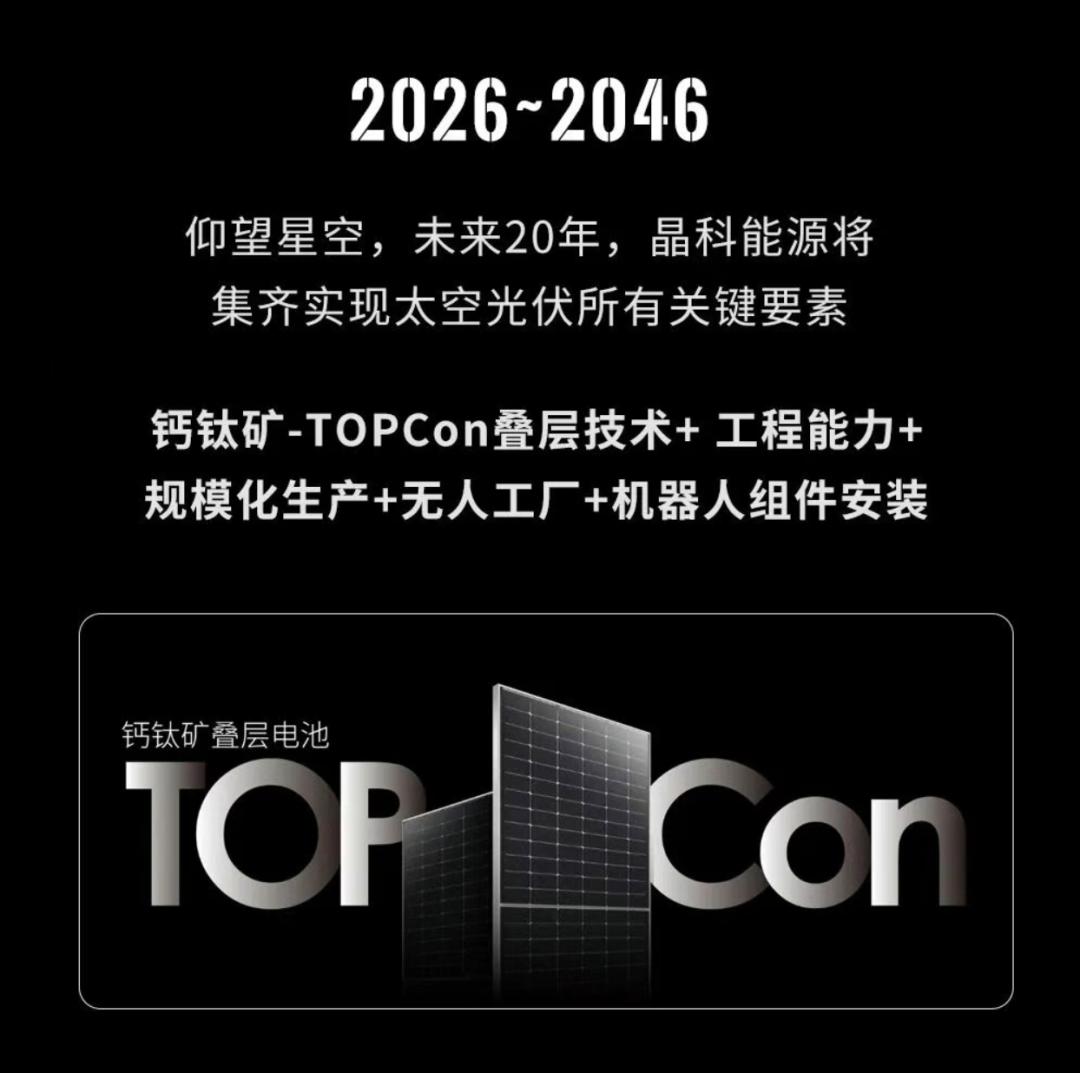
*Image source: JinkoSolar
High - level executives at Trina Solar, such as Chairman Gao Jifan, proposed in the 2026 New Year's speech that in the new year, Trina Solar will accelerate the mass - production and commercialization process of perovskite and open a new era of interstellar computing power for space - based PV. Trina Solar also stated in an investor relations activity that the company has accumulated experience in crystalline silicon cell technology related to space - based PV.
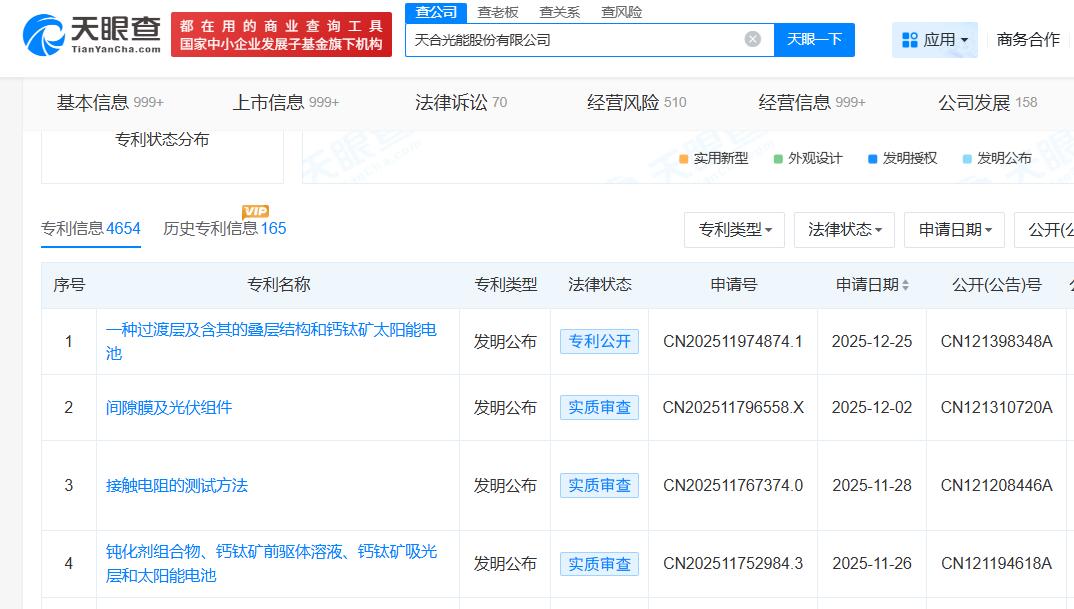
*Image source: Tianyancha
Junda Co., Ltd. plans to invest 30 million yuan in cash to participate in the establishment of Shanghai Xingyi Xineng to develop new products. The first industrialized N - type perovskite tandem cell rolled off the production line in November 2025. Dongfang Risheng said that its P - type ultra - thin heterojunction (HJT) products have comprehensive advantages in specific power and radiation resistance and are re - entering the field of aerospace applications.
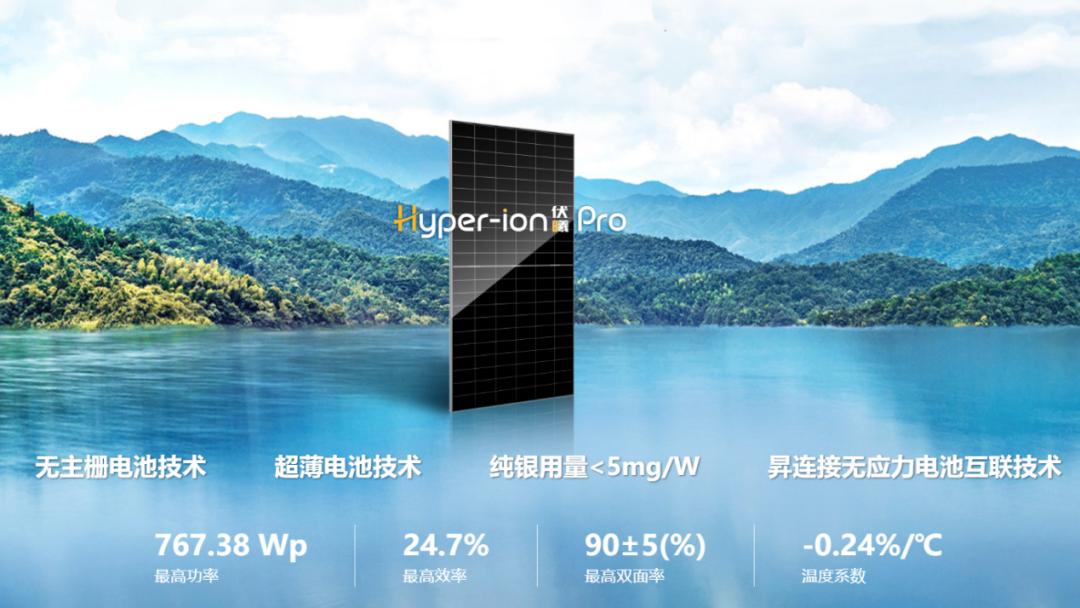
*Image source: Dongfang Risheng
Chinese companies master almost all the technological routes, and they can provide whatever Musk needs. This is also the reason why the current capital market is so excited - No one wants to miss out on a huge market.
Currently, technological solutions such as perovskite have been tested on low - orbit satellites, and some of the results are more than 10 times better than those of traditional batteries. Space is indeed changing the fate of the PV industry.
03 Beyond OEM: Chinese PV Industry Competes for Standards
Although many PV companies have benefited in the capital market, there is still a question facing all PV players: With such a long supply chain, who will benefit the most?
Regarding this question, Goldman Sachs came up with an interesting conclusion: Although Musk announced capacity expansion in the United States, Chinese equipment manufacturers such as Maiwei and Jiejia Weichuang are the core beneficiaries.
Jiemian News' report also confirms this: In addition to the PV companies mentioned earlier, Musk's team did contact these PV equipment manufacturers earlier. To use new technologies, new equipment is naturally required, and this logic is quite straightforward.
Therefore, if nothing unexpected happens, Just as there was the "Apple supply chain" dominated by Apple in the mobile phone industry and the "Nvidia supply chain" needed by Nvidia in the semiconductor industry, now the PV industry may form the "Musk supply chain" popularized by Musk.
Perovskite technology is the most suitable new technology for space - based PV. Maiwei Co., Ltd. and Aotweite, which are technologically leading in perovskite equipment, have recently been rumored in the market to have received orders for space - based PV equipment from SpaceX. Currently, they are the first - tier and second - tier suppliers of equipment for SpaceX respectively, which is also the reason for the recent sharp rise in their stock prices.
