Top automaker executives venture into intelligent RVs, secure 80 million yuan in financing, and have won hundreds of millions of yuan in orders | Exclusive from Yingke
Author | Huang Nan
Editor | Yuan Silai
Yingke learned that Starry Dream House (Chongqing) Technology Co., Ltd. (hereinafter referred to as "Starry Dream House") has successfully completed a total of 80 million yuan in angel round and Pre - A round financing. We have summarized the information of this round of financing and several highlights of the company:
Financing Amount and Investment Institutions
Financing Rounds: Angel Round, Pre - A Round
Financing Scale: 80 million yuan
Investors: Lion City Capital, Sky Workshop Venture Capital Fund
Use of Funds: Mainly used for product R & D and team building, to accelerate the mass production process and global layout of new energy intelligent RVs.
Basic Company Information
Establishment Time: 2024
Registered Address: Yongchuan District, Chongqing City
Enterprise Positioning: Starry Dream House integrates the industrial chain advantages of Chinese intelligent manufacturing, new energy and intelligent driving technologies in the passenger car field, home intelligent solutions, and the mature R & D and manufacturing experience of Europe and the United States. It focuses on R & D and manufacturing intelligent high - end towed RVs for the global market.
Technological Highlights: As the only RV team in the industry that independently develops an electric towed skateboard chassis for passenger cars, Starry Dream House focuses on the native integrated platform and deeply integrates the three major systems of energy, intelligent driving, and vehicle control based on the AI chassis brain.
At the hardware energy level, it is equipped with a high - safety lithium iron phosphate battery pack ranging from 45 kWh to 85 kWh, combined with a solar charging system, which supports 14 - day off - grid endurance. It also has the ability to supply power externally and can be used as a mobile energy storage device to charge electric vehicles or for household emergency power supply.
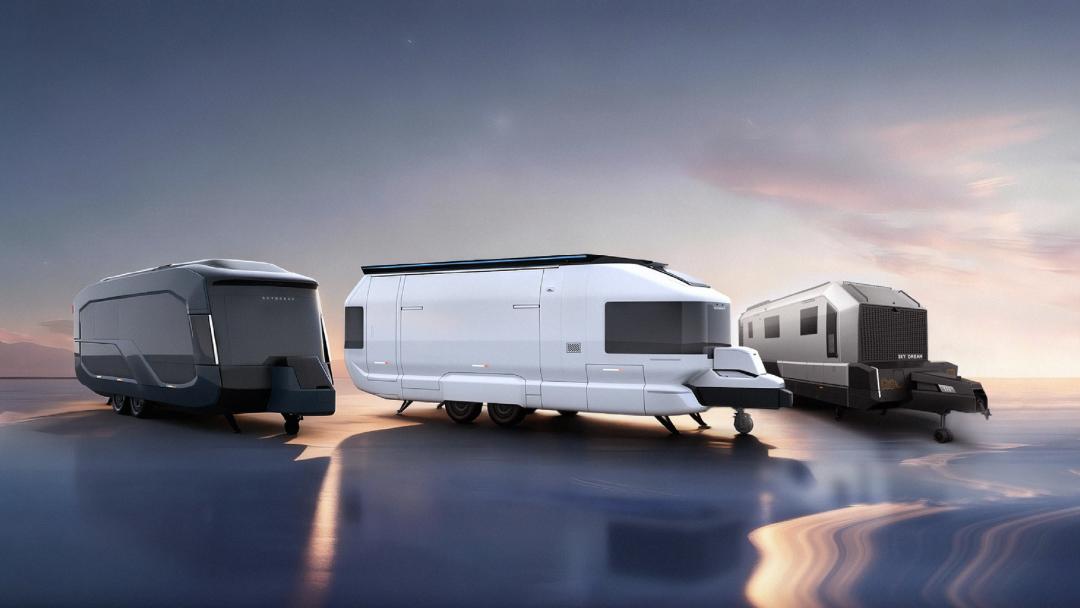
Starry Dream House Intelligent RV (Source/Enterprise)
In terms of algorithms, the team has independently developed the world's first full - scenario intelligent assisted driving system for RVs. Through perception and planning algorithms, it supports functions such as automatic parking and one - key trailer hitching, which can simplify the traditional complex trailer hitching operation to be completed within 60 seconds.
In terms of interactive control, the vehicle's intelligent system replaces the traditional decentralized physical buttons with one - screen touch control and whole - house voice control, realizing the unified scheduling of "people - vehicle - space".
Market Size
According to the Sullivan Report, the global RV ownership in 2024 was approximately 23 million, and the proportion of towed RVs exceeded 70%. It is estimated that the global sales volume will reach 768,000 units in 2026, with sales revenue of nearly 300 billion yuan. The market is still concentrated in mature regions such as North America and Europe.
Although the current mainstream products are still mainly "fuel + mechanical", new energy and intelligent configurations are becoming important growth drivers, and the demand for related models is particularly obvious among young and new consumer groups.
Team Background
The founder, Yang Jie, has more than 20 years of experience in the automotive industry. He has successively worked in several domestic and international mainstream automobile companies such as SAIC Passenger Vehicles, Ford, and Changan Mazda, and served as the core person in charge of product and marketing. He witnessed and was deeply involved in the key process of the electrification and intelligent transformation of the domestic automobile industry and is one of the pioneers who first put "intelligent" functions into mass - produced passenger cars. Many core members come from leading domestic RV, automobile, and smart home enterprises, with an average working experience of more than 12 years and the ability to integrate and innovate across fields.
Business Progress
Starry Dream House has launched three towed RV product lines, namely the A - series all - terrain, the R - series lightweight road, and the F - series off - road, targeting the North American, European, and Australian and New Zealand markets. Currently, the development of a full - function prototype has been completed, and the integration of its energy and electronic and electrical systems has been achieved.
The company plans to launch its first mass - produced models in Australia, New Zealand, North America, and Europe successively starting from 2026. In the Australian market, Starry Dream House has reached a strategic cooperation with a local RV group and obtained an order worth hundreds of millions of yuan. The two parties will cooperate in vehicle model development, technology R & D, local manufacturing, and channels to jointly promote the local implementation of products.
Founder's Thoughts
Yingke: Compared with traditional RV manufacturers and new - force RV manufacturers, in what aspects does the differentiation of Starry Dream House lie?
Yang Jie: Our differentiation is mainly reflected in two dimensions.
From a product perspective, our product is a new - generation intelligent towed RV built on an independently developed electric skateboard chassis for passenger cars. Through the native integrated integration of the energy, intelligent driving, and intelligent control systems, we systematically solve the core pain points of users in terms of safety, off - grid endurance, and ease of use. This enables the RV to evolve from a mere means of transportation into a truly mobile intelligent space.
At the same time, we not only aim to create a good RV product but also strive to promote the transformation and upgrading of the entire industry. This includes forward - looking development using the full - stack capabilities of intelligent cars in terms of technology; introducing a passenger - car - level verification system in terms of quality and replacing experience - based judgment with scientific testing; and establishing a unique "1 + N" modular delivery model in production, that is, through a highly integrated and fully verified intelligent chassis, adapting to a variety of modular superstructures, to promote the transformation of high - end RVs from manual customization to industrialized and agile production.
Yingke: As a mobile embodied intelligent space, how is the technological closed - loop realized?
Yang Jie: The reason why we say our RV is an embodied intelligent mobile space is that it can truly understand the surrounding environment, make independent decisions, and execute relevant actions, while maximizing people's sense of security and convenience. It includes several key functions.
Firstly, there is the AI chassis brain, which integrates algorithms, motors, and domain controllers. It can sense road conditions and vehicle body posture in real - time. By dynamically distributing wheel - end torque, it actively suppresses roll and sway during driving, improving handling stability and safety.
Secondly, there is the AI healthy and comfortable cockpit. Through multi - source sensors, it monitors the in - vehicle environment and can automatically link the air - conditioning, fresh air, and purification systems according to driving and parking states, maintaining a comfortable and healthy physical sensation in the cockpit.
In addition, there is also an intelligent control and energy management system. In traditional RVs, the control systems of water, electricity, energy, and equipment are fragmented. However, our highly integrated intelligent central hub breaks the limitations of the independent operation of each system in the past, enabling the coordinated management and optimization of water, electricity, equipment, and energy, and providing proactive warnings based on the vehicle's status.
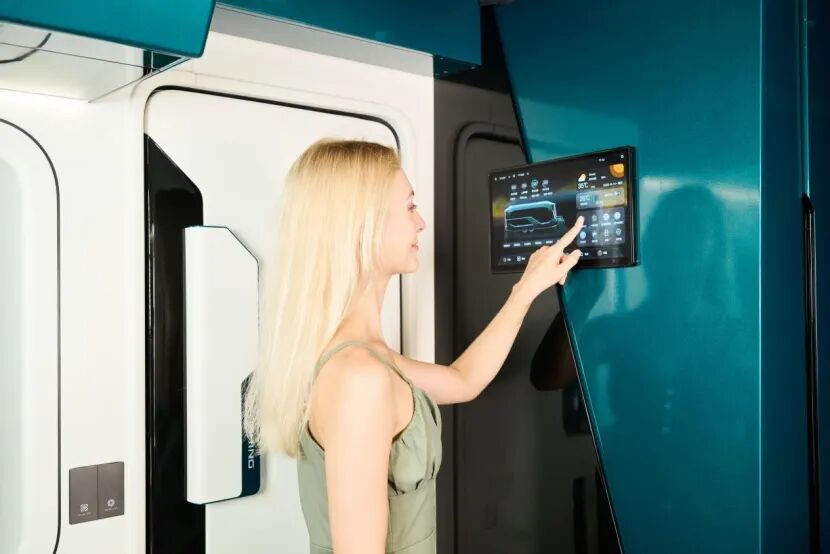
Integrated Intelligent Central Hub (Source/Enterprise)
Yingke: When crossing from the passenger car track to the RV field, have there been any key cognitive changes? What experiences can be reused?
Yang Jie: Although I come from the automotive industry, when I first entered the RV field, I was very clear that we are not building a smarter car but a freely movable intelligent living space.
There have been many challenges since the start - up, but the biggest challenge lies in how to integrate the technological accumulation of Chinese intelligent electric vehicles with the multi - scenario and highly localized characteristics of RVs. The usage environment of passenger cars is mainly standardized roads, while RVs need to cover diverse environments from cities to wilderness and from short - distance to cross - border travels, which are essentially "deeply localized" products.
We adhere to the methodology of centering on user scenarios. In the early stage of product definition, we deeply co - created with overseas users, experts, and dealers to ensure that the design conforms to local regulations, campsite conditions, and actual preferences. By drawing a full - scenario user journey map, we systematically sorted out and quantified the pain points in each link, enabling innovation to always focus on high - frequency and high - demand experiences, which also constitutes our core product logic and differential advantage.
Yingke: For the different - positioned models launched in North America, Europe, Australia, and New Zealand, how are the products designed specifically? What are the differences in vehicle - using scenarios and consumer preferences among different markets?
Yang Jie: Starry Dream House does not use a single product to capture the entire market. Instead, based on in - depth local insights, we make "targeted trade - offs" and "systematic reconstructions" in terms of space, passability, structural strength, energy redundancy, and intelligent configurations.
North American users prefer long - distance family trips and focus on space comfort and stable endurance. Therefore, while ensuring passability, the all - terrain towed RV focuses on expanding living space and energy reserves to support comfortable cross - state travel.
Australian and New Zealand users are keen on off - road exploration and free camping, with higher requirements for passability, structural strength, and off - grid endurance. The off - road RV strengthens the chassis and anti - fatigue design for this purpose and is equipped with a high - performance energy system to ensure its long - term off - grid use in the wilderness environment.
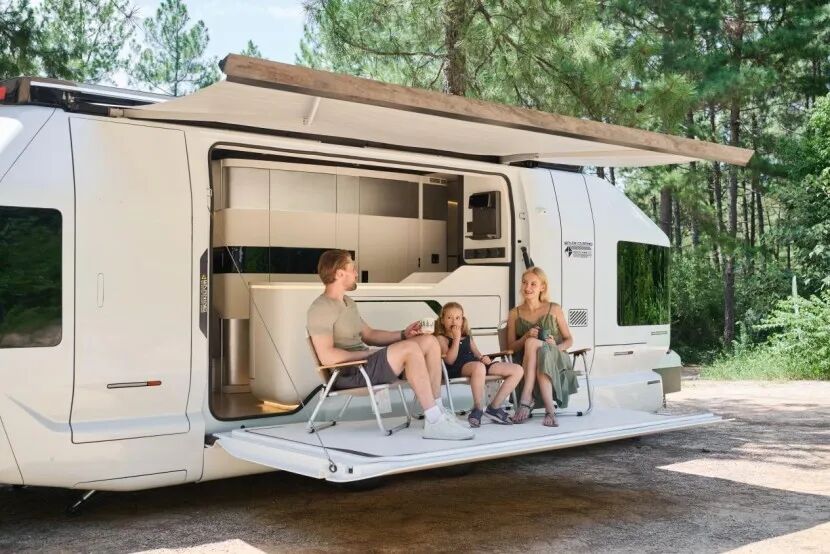
Starry Dream House Intelligent RV (Source/Enterprise)
In the European market, campsites are densely distributed, and regulations are strict (such as the 3.5 - ton license weight limit for the combination of the towing vehicle and the trailer). Travels are mainly short - distance and high - frequency. The road - version towed RV optimizes the space layout under the premise of compliance and reduces the operation threshold with intelligent functions such as one - key trailer hitching and automatic parking to fit the local users' usage habits.
Based on the current resource deployment, we will prioritize entering the Australian, New Zealand, and North American markets.
Yingke: The global new energy intelligent RV market is currently in its early stage. How do you view the future competition pattern?
Yang Jie: We believe that this is a crucial transformation point for the RV industry, which is both the "Tesla moment" of industry reconstruction and the "iPhone moment" of experience subversion.
On the one hand, there is a structural change on the demand side. The global RV users are getting younger, and the average age has dropped from over 50 years old to over 40 years old. The new generation of users has higher requirements for intelligence, ease of use, and off - grid endurance and is willing to pay for high - quality intelligent travel experiences.
On the other hand, the technological foundation on the supply side is already mature. In recent years, the rapid development of China's new energy vehicle industry has enabled technologies such as the three - electric system, intelligent control, and lightweight materials to have cross - industry application conditions, providing support for the intelligentization and energy innovation of RV products. This is similar to the smartphone era when the breakthroughs in mobile Internet, touch - screen, and other technologies paved the way for the emergence of the iPhone.
Although this track is still in the early stage, a number of excellent teams at home and abroad have successively entered the global market. Some start from the energy system, some emphasize the lightweight structure, and others focus on the intelligent experience. However, the key to real competition lies not in local innovation but in the ability of systematic product definition and scenario integration.