Generate a game with a single sentence. OpenAI is also coming to crush game companies.
On February 3rd, OpenAI officially released the macOS desktop application of its programming assistant, Codex. This application is currently available for a trial period to all ChatGPT users, including free users and those on the Go plan. For paid subscribers, OpenAI is also temporarily offering double the usage quota.
The interface design of the Codex application is quite simple. The core is a dialog box similar to that of ChatGPT. After users input their requirements, the application will display the generated code snippets one by one. There is a sidebar next to the dialog box, providing quick access to project file links and other features.
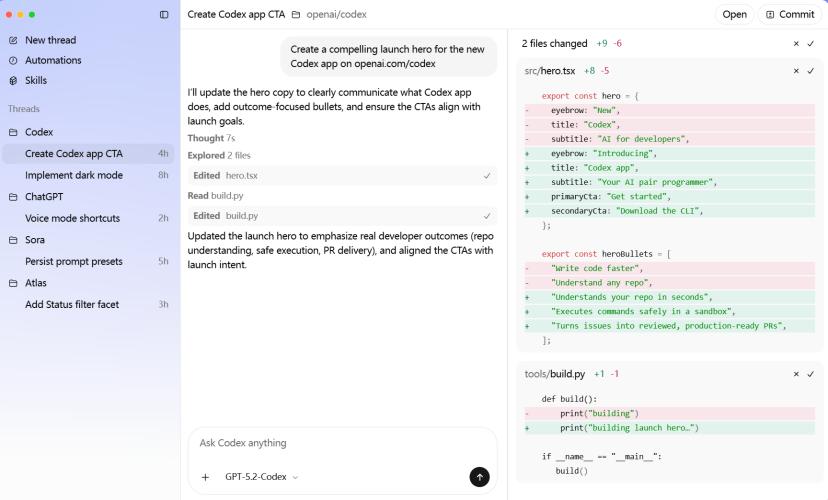
The entire interaction logic revolves around conversations. Developers can describe their requirements in natural language and let the agent complete specific programming tasks.
According to a hands - on test by siliconangle, the underlying model of the Codex desktop application is still the GPT - 5.2 - Codex model released in December 2025. This model can handle up to 400,000 token inputs, equivalent to about 100,000 lines of code, and supports more than 50 programming languages.
In addition to text input, users can also upload multimodal content such as interface sketches as references for development.
01
An important feature of the application is the recently popular "Skills" system. This is a user - customizable extension mechanism used to adjust the output mode of Codex.
For example, if developers want to intuitively understand the progress, they can add a new skill to Codex, which will automatically generate supporting visual explanations every time it suggests code modifications.
The process of creating a skill involves organizing a folder that contains prompts, scripts, and other reference files. These files may include the company's security specifications or code documentation style guides. When a skill is activated, Codex will respond to user requests in a personalized manner based on the contents of the folder.
Another notable feature is "Automations". It allows Codex to automatically execute tasks at user - set time intervals. If a software team often receives feature requests from customers, they can use the automation feature to generate a daily summary of requests.
This feature can also handle more complex tasks. In an internal test at OpenAI, researchers used a single prompt to have Codex create a complete video game. The entire code generation process involved more than 7 million tokens.
Moreover, this game is available on the Codex release page, and users can play it even without a ChatGPT account.

Altman said at a pre - release media briefing that software agents have "crossed the threshold of real practicality" in recent months. He mentioned that more than 1 million people are currently using Codex regularly, but as the capabilities of these agents improve, the team realized that a more suitable interaction interface was needed.
Altman explained that the GPT - 5.2 - Codex model can perform extremely complex tasks, and the team began to feel restricted by the existing interface. Therefore, they developed this application as a way to collaborate with the model and manage long - cycle tasks executed by agents.
OpenAI positions the Codex application as the "command center for agent - based programming". The application has a built - in work tree and cloud environment, allowing multiple AI agents to work in parallel across different projects.
Developers can run agents in independent threads, which are organized by project. Users can review the modifications made by agents within the threads. Agents can run simultaneously, and developers can collaborate while they handle long - term tasks. The purpose of this design is to compress a development cycle that originally took weeks into just a few days.
The direct competitor of the Codex desktop application is Anthropic's Claude Code. After its release in 2025, this product has performed quite strongly, with its annual recurring revenue exceeding $1 billion last year and growing by at least $100 million in December alone.
Codex's advantage lies in its ability to schedule more agents simultaneously, which Claude Code lacks.
02
However, the initial performance of this application doesn't seem to be perfect. A well - known Chinese AI blogger, Guicang, shared his first - hand experience on a social platform. He mentioned that he was very excited to install and use it on the night of the release but encountered continuous error - reporting issues.
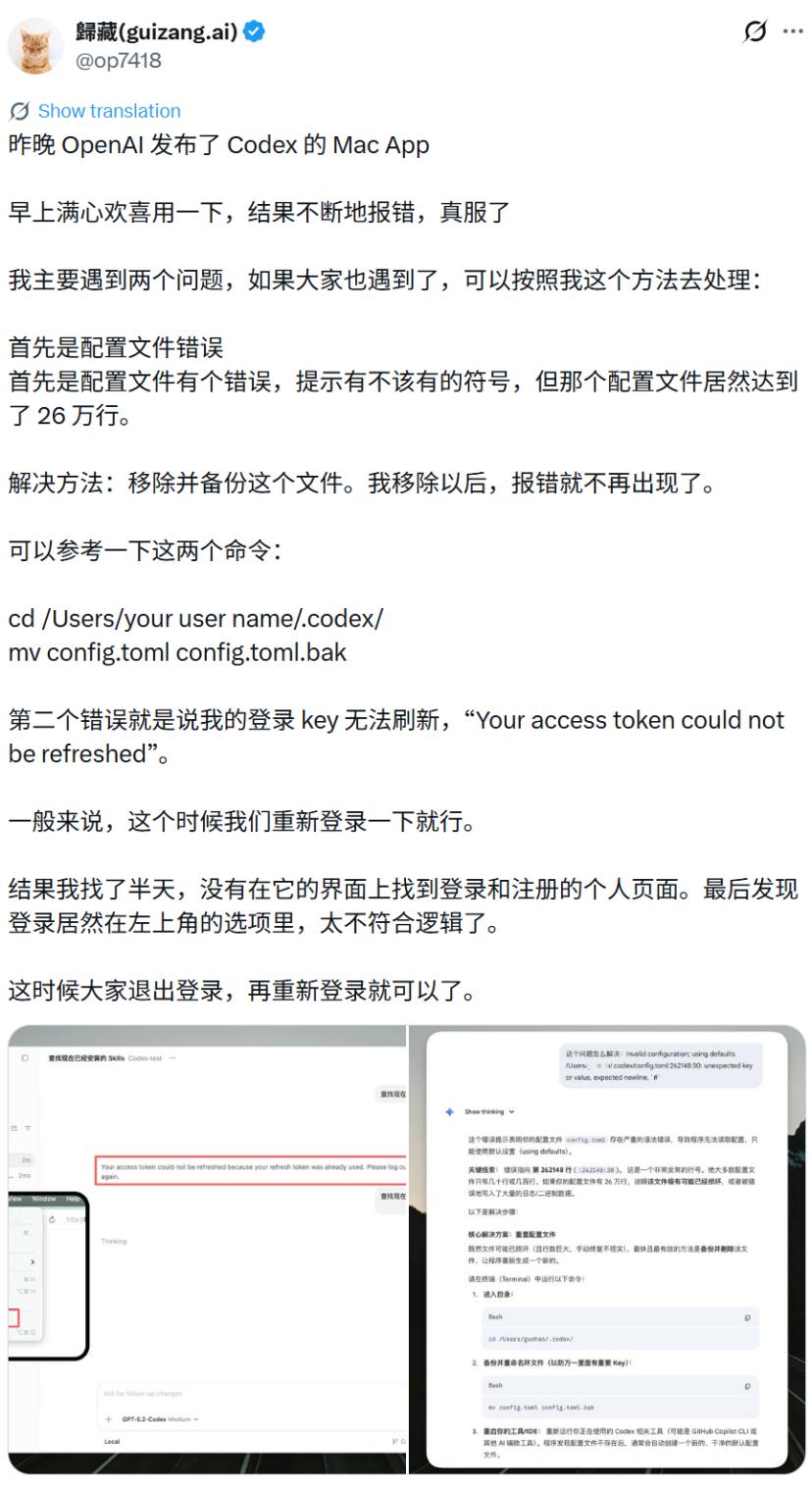
The first problem he encountered was a configuration file error. The system prompted that there were symbols that shouldn't exist, and that configuration file was actually 260,000 lines long. His solution was to remove and back up the file, and then the error disappeared.
The second problem was that the login key couldn't be refreshed, with the prompt "Your access token could not be refreshed".
He found that he needed to log in again, but it took him a long time to find the login option hidden in the menu in the top - left corner. He thought this didn't conform to the conventional interaction logic.
OpenAI plans to bring the Codex application to the Windows platform in the future, but the specific date has not been announced.
The company also plans to improve the speed of the tool and enhance its ability to handle complex coding tasks that require creating multiple agents. Another upcoming upgrade is to allow the automation feature to run even when the application is not open.
Altman expressed his enthusiasm for this product at the media briefing. He said that the Codex application is "our most beloved internal product ever" and that "using it at OpenAI recently has been a great thing for us".
He also mentioned that he has been excitedly using it to build various things late at night recently and sighed, "The limit of how quickly I can complete the construction is how fast I can input new ideas. It's really cool to watch."
This release marks OpenAI's further layout in the developer tools market and reflects the fierce competition in the field of AI programming assistants. As the capabilities of software agents continue to improve, providing more efficient collaboration interfaces for developers is becoming the focus of competition among companies.
This article is from the WeChat official account "Zimu AI", author: Miao Zheng. Republished by 36Kr with permission.