Vibe Coding is killing open source.
In the past year, Vibe Coding has almost completely rewritten the way of programming.
You no longer need to "write" code line by line. Just tell Cursor, Claude, or Copilot what function you want, what technology stack to use, and preferably "it should feel like a certain product", and then leave the rest to AI.
Many people who couldn't write code before now have the ability to "create something" for the first time. From a personal perspective, this is almost the golden age of software development.
However, there is an overlooked premise here: AI doesn't create code out of thin air. Instead, it calls and splices existing human intellectual achievements. When you say "help me build a website", AI is actually silently referencing the logic and structure accumulated in countless open - source projects on GitHub.
The core ability of Vibe Coding is built on the learning and recombination of these open - source code libraries.
Recently, a research team from Central European University and the Kiel Institute for the World Economy published a paper titled "Vibe Coding Kills Open Source" (https://arxiv.org/pdf/2601.15494v1), revealing the hidden crisis behind the prosperity of Vibe Coding.
The paper points out a truth:
Vibe Coding may be fundamentally destroying the open - source ecosystem that supports the entire software world.
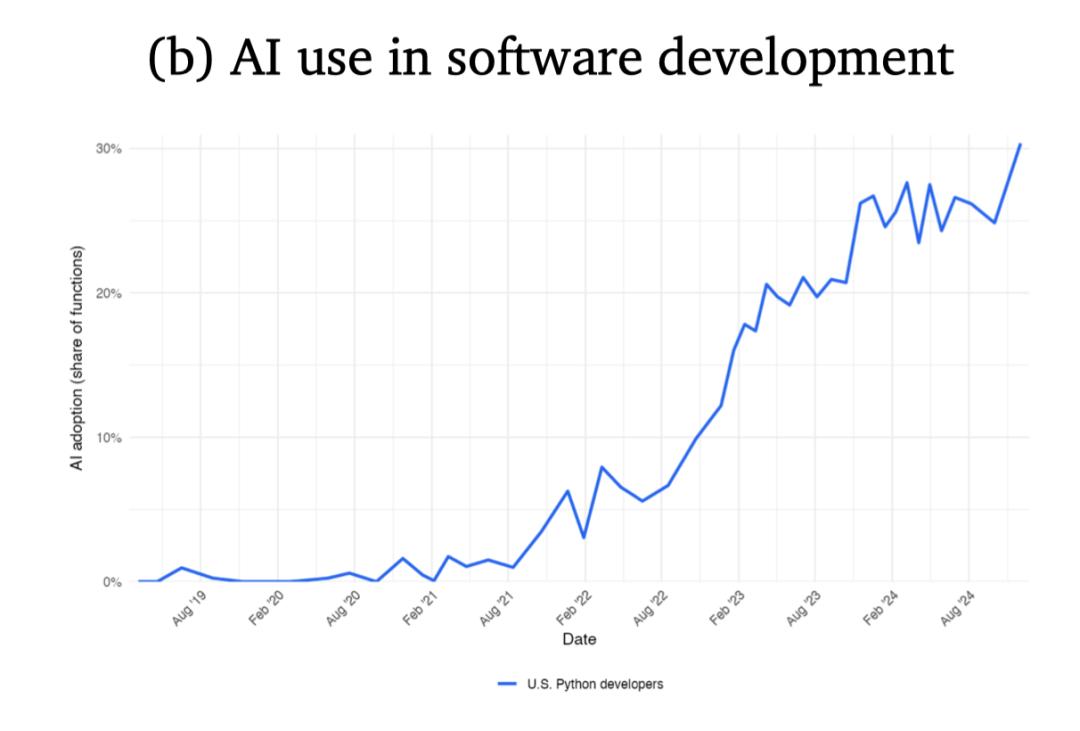
Since August 2022, the proportion of Python developers in the United States using AI for programming has begun to rise significantly.
01 The "Invisible Infrastructure" of the Digital World
To understand what this paper is worried about, we first need to clarify one thing: What is open - source software, and where does it stand in our lives?
Many people may not have a clear perception of open - source software, but in fact, almost all digital products we use every day are built on a foundation of open - source software.
When you wake up in the morning and pick up your Android phone, the Linux operating system running at its core is open - source software.
When you open WeChat to check your chat history, the SQLite database that stores each message is open - source software.
When you browse Douyin or Bilibili during your lunch break, FFmpeg, which is responsible for video decoding and playback in the background, is also open - source software.
Open - source software is like the sewers of the digital age. You use it every day without even noticing.
You only suddenly realize its importance when it goes wrong.
The Log4j vulnerability in 2021 is a typical example. Log4j is the most widely used logging framework in the Java ecosystem, used to record events and information during the operation of applications.
The vast majority of ordinary users have never even heard of its name, but from the cloud servers of Apple and Google to the government affairs systems of various countries, billions of devices around the world are running it in the background.
At the end of 2021, a vulnerability called "Log4Shell" broke out. This vulnerability allowed hackers to remotely control servers around the world as if they were operating their own computers. The entire Internet infrastructure was suddenly exposed, and global security teams were forced to conduct emergency repairs on weekends. Its wide - reaching impact and difficulty in repair made it one of the most serious security crises in Internet history.
This is the essence of open source - it's not a product of a particular company, but a "public good". Since it doesn't have a commercial nature, the maintainers who write the code often can't directly charge for the project.
Their rewards are indirect: they gain fame through the project and get jobs at big companies; they earn income by providing consulting services; or they rely on community donations.
This model has been running for decades, relying on "direct interaction". When users use the software, they read the documentation, submit problems, and give likes and recommendations. This attention flows back to the maintainers, turning into motivation for continuous maintenance.
And this is exactly the connection that Vibe Coding is cutting off.
02 How does AI "starve" open source step by step?
Before the emergence of Vibe Coding, the development model was like this: you download an open - source package, read the documentation; when you encounter a bug, you submit an issue on GitHub; if you think it's good, you give it a star to show your support.
The maintainers get attention in this way, and this attention is converted into income, forming a closed - loop.
After the emergence of Vibe Coding, you just need to tell AI what function you want, and AI will automatically select and combine open - source code in the background to generate a "working implementation".
The code runs, but you don't know which libraries it specifically uses, let alone read their documentation or visit their communities.
The paper calls this change a "mediation" effect - the attention and feedback that were originally directly passed from users to maintainers are now intercepted by the AI middle - layer as a whole.
What will happen if this mechanism continues?
The authors of the paper built an economic model to simulate the open - source ecosystem. They compared developers to entrepreneurs who decide whether to "enter the market" at different quality levels. They first invest in development and then decide whether to share it as open source based on market feedback. Users have to choose among countless software packages and decide whether to "use directly" or through "AI mediation".
The model reveals two opposing forces.
The first is efficiency improvement. AI makes software easier to use and reduces the cost of developing new tools. This should theoretically stimulate more developers to enter and increase the supply.
The second is demand transfer. When users turn to AI mediation, maintainers lose the income from direct interaction, which reduces the developers' rewards.
But in the long run, when the second force (demand transfer) is stronger than the first (efficiency improvement), the entire system will shrink.
Specifically, the threshold for developers to enter becomes higher. Only the highest - quality projects are worth sharing, and medium - quality projects disappear. Eventually, both the quantity and the average quality of software packages in the market decline. Although individual users enjoy the convenience of AI in the short term, their long - term welfare actually decreases because there are fewer high - quality tools to choose from.
In short, the ecosystem falls into a vicious circle. And once the foundation of the open - source ecosystem weakens, the ability of AI will also decline.
This is exactly what the paper emphasizes repeatedly: Vibe Coding improves productivity in the short term, but may reduce the overall level of the system in the long run.
This trend is not just a theoretical assumption but is actually happening in real life.
For example, the traffic of public Q&A on Stack Overflow has significantly declined after the popularization of generative AI. Many questions that would have been discussed in public communities are now moved to private AI conversations.
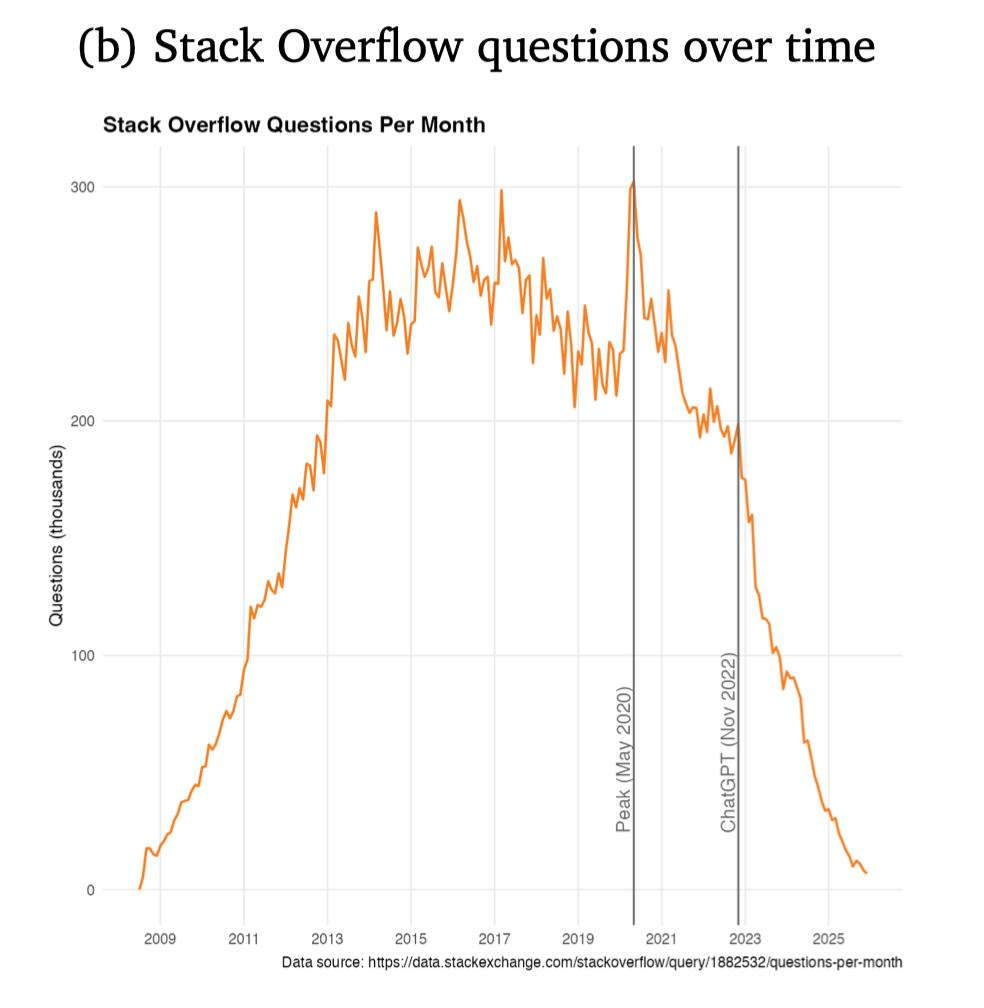
After the launch of ChatGPT, the number of questions on Stack Overflow began to decline significantly.
Another example is a project like Tailwind CSS. Its download volume continues to grow, but the access to its documentation and commercial income have declined.
The project is widely used, but it's becoming increasingly difficult to convert this into meaningful rewards for the maintainers.
03 When will the Spotify of the Coding World Appear?
Although Vibe Coding has such problems, the productivity improvement it brings is real, and no one can go back to a world without AI Coding.
The more fundamental problem is that when AI becomes the new intermediary, the old incentive structure is no longer applicable.
Under the current structure, AI platforms gain great value from the open - source ecosystem but don't need to pay the corresponding price to maintain this ecosystem. Users pay AI, and AI provides convenience, but the open - source projects and maintainers being called often get nothing.
The authors of the paper propose an idea:
Reconstruct the way of profit distribution.
Just as streaming platforms like Spotify in the music industry share revenue with musicians based on the number of plays, AI platforms can completely track which open - source projects they call and return a portion of their income to the maintainers proportionally.
In addition to platform revenue sharing, grants from foundations, corporate sponsorships, and special government funds for digital infrastructure are also important means to make up for the loss of maintainers' income.
This requires the industry to change its perception from regarding open - source software as a "free resource" to a "public infrastructure that requires long - term investment and maintenance".
Open - source software won't disappear. It's deeply embedded in the digital world and can't be easily replaced.
But the open - source era supported by scattered attention, reputation accumulation, and idealism may have reached its limit.
What Vibe Coding brings is not just a faster development experience but also a stress test on "how public technology can be continuously supported".
This article is from the WeChat official account "GeekPark", author: Yitao. It is published by 36Kr with authorization.