The "4-trillion-yuan market" is on the verge of emerging. How can it set an example for the whole province?
With the release of the GDP figures of Guangzhou and Shenzhen, the economic report cards of the first-tier cities in 2025 have all been unveiled.
Beijing's GDP has exceeded 5 trillion yuan, making it the second city in the country after Shanghai to enter the "5-trillion-yuan club". With Beijing and Shanghai firmly at the top, there is currently a gap in the 4-trillion-yuan echelon. Shenzhen, with a GDP of 3.87 trillion yuan, has become the focus of attention due to its "near-miss" distance from the 4-trillion mark.
In 2025, Shenzhen's GDP increased by 5.5% year-on-year, not only 0.5 percentage points higher than the national average, but also ranking first among the four first-tier cities in terms of growth rate. Looking at the development in recent years, during the 14th Five-Year Plan period, Shenzhen had an average annual growth rate of 5.5%, ranking first among first-tier cities. According to this growth trend, it is highly likely to join the "4-trillion-yuan club" in 2026.
In the context of Guangdong Province, Shenzhen's GDP accounts for more than a quarter of the province's total economic output. In 2025, Guangdong's GDP reached 14.58 trillion yuan, ranking first in the country for 37 consecutive years. However, in terms of growth, the annual economic growth rate of 3.9% failed to achieve the goal of "around 5% growth in regional GDP" set at the beginning of 2025 and was also lower than the national average growth rate.
Some analysts pointed out that Guangdong's economic growth fell short of expectations. On the one hand, due to the large GDP base of the province, the economic growth rate will continue to adjust as the scale expands. On the other hand, industrial growth is still in the process of recovery. In 2025, the added value of industrial enterprises above the designated size in the province increased by 3.0% compared with the previous year, failing to reach the target of "around 6% growth".
Industry has always been the "core engine" of Shenzhen's economic growth. As of 2025, Shenzhen's total output value and added value of industrial enterprises above the designated size have ranked first in the country for four consecutive years. Looking ahead to the 15th Five-Year Plan period, Shenzhen has set a new goal - to continue to build a world-leading and important advanced manufacturing center and further optimize the industrial system structure.
As a major economic city, Shenzhen's responsibility lies not only in contributing to the GDP figures but also in providing solutions for high-quality growth. Against the backdrop of Guangdong's economic growth pressure and the persistent regional development imbalance, can the path explored by Shenzhen form a strong driving force for the coordinated development of the whole province?
"Sprint"
In 2025, Shenzhen's regional GDP was 3.87318 trillion yuan. Looking at the annual trend, Shenzhen showed an overall upward curve -
In the first quarter, GDP grew by 5.2%, in the first half of the year by 5.1%, and in the first three quarters, the growth rate increased to 5.5%, finally locking in at 5.5% for the whole year, 0.5 percentage points higher than the national average and ranking first among the four first-tier cities.
Looking at the entire 14th Five-Year Plan period, Shenzhen's economy achieved leapfrog growth: its GDP continuously crossed the thresholds of 3 trillion and 3.5 trillion yuan, with an increment of over 1 trillion yuan. The average annual growth rate reached 5.5%, continuously leading among first-tier cities, effectively proving that megacities still have infinite growth potential.
Firstly, in terms of consumption, in 2025, Shenzhen's total retail sales of consumer goods exceeded 1 trillion yuan for three consecutive years. On the one hand, online retail sales increased by 10.5%. At the same time, offline consumption scenarios continued to recover, with coordinated growth in commodity retail and catering consumption - commodity retail increased by 2.3% year-on-year, and catering revenue increased by 2.5% year-on-year.
Not long ago, the "Three-Year Action Plan for Optimizing the Consumption Environment in Shenzhen (2026 - 2028)" was issued, which mentioned innovating and developing digital consumption, promoting the layout of new business forms such as e-sports, social e-commerce, live e-commerce, and unmanned retail stores, and expanding the multi-scenario application of "digital humans".
In terms of foreign trade, in 2025, Shenzhen's total import and export volume reached 4.55 trillion yuan, continuing to rank first among inland cities. Among them, exports achieved the "33rd consecutive championship". The upgrading of the foreign trade structure driven by innovation is the key driving force for Shenzhen's foreign trade growth -
Shenzhen enterprises continuously launch new products through technological iteration. Products with "strong technology and new products" form a differentiated competitiveness in the international market. Data shows that in 2025, Shenzhen's exports of digital cameras, 3D printers, measurement and testing instruments, medical devices, etc. all ranked first in the country, with a total of 109.77 billion yuan, an increase of 17.4%, accounting for about a quarter of the country's exports of similar products.
In contrast, there was a significant decline in Shenzhen's fixed asset investment. In 2025, the city's fixed asset investment decreased by 21.7% year-on-year. Among them, real estate development investment decreased by 31.0%, and infrastructure investment decreased by 1.9%. This decline is quite prominent among the major cities whose data has been released so far.
However, investment in key industries maintained relatively rapid growth. Investment in industrial technological transformation increased by 19.2%, investment in resident services, repair and other services increased by 88.3%, investment in information transmission, software and information technology services increased by 67.7%, and investment in scientific research and technology services increased by 16.1%.
It is worth mentioning that this year, the 33rd APEC Economic Leaders' Meeting will be held in Shenzhen. As the "third APEC city" in China after Shanghai and Beijing, Shenzhen has ushered in a major opportunity to enhance its core competitiveness -
According to Shenzhen's plan, it will optimize the service system for "buying globally and selling globally", steadily increase the scale of goods trade, and innovate and develop service trade, digital trade, and green trade.
At the same time, it will expand the space for two-way investment cooperation to a greater extent, continuously enhance the brand of "Invest in Shenzhen", improve the comprehensive service system for enterprises to "go global", support enterprises to go global in groups or by hitching a ride, and expand the global market, allocate global resources, and expand the economic territory on a larger scale.
"Trump Card"
In fact, before its GDP approached 4 trillion yuan, Shenzhen's total output value of industrial enterprises above the designated size had already exceeded 5 trillion yuan - reaching 5.4 trillion yuan in 2024, becoming the first "5-trillion-yuan" industrial city in the country. As a "trump card" for Shenzhen's economic growth, to this day, Shenzhen's total output value of industrial enterprises above the designated size has ranked first in the country for seven consecutive years.
It was not easy for Shenzhen to achieve this "first place". As early as 2013, Suzhou's total output value of industrial enterprises above the designated size exceeded 3 trillion yuan, ranking second in the country after Shanghai. At that time, Shenzhen's figure was only 2.3 trillion yuan, with a gap of up to 70 billion yuan compared with Suzhou, ranking as the "third industrial city".
However, since then, Shenzhen has embarked on a path of vigorous "advance". In 2017, it exceeded 3 trillion yuan. During the same period, Suzhou's growth rate slowed down, with the added value of industrial enterprises above the designated size only at 3.2 trillion yuan, and the gap narrowed to less than 20 billion yuan. In the following year, Shenzhen surpassed Suzhou.
Regarding the competition between the two cities, Xu Tianshu, a former researcher at the Urban Development Think Tank of Suzhou University of Science and Technology, once pointed out in an interview that most of Suzhou's foreign-funded enterprises are manufacturing enterprises, which are the result of the global value chain division of labor of multinational corporations. Therefore, although Suzhou has a strong manufacturing industry, the supply chain integration of its enterprises is not high. In contrast, Shenzhen has spawned many original and integrated technological innovations.
Continuously empowering industries with innovation, data shows that in 2025, Shenzhen's R & D investment intensity ranked first in the country. The proportion of enterprise R & D investment exceeded 90%. There were 1,333 specialized, refined, characteristic, and innovative "little giant" enterprises, with both the total number and the increment ranking first in the country. Throughout the 14th Five-Year Plan period, Shenzhen's total social R & D investment increased by an average of 12.9% annually, ranking second among national cities in terms of total amount. The R & D investment intensity reached 6.67%, ranking first among national cities.
Innovation also requires an environment for further implementation. In this regard, Zeng Gang, the dean of the Urban Development Research Institute of East China Normal University, told Urban Evolution that the economic freedom granted to Shenzhen by the special economic zone policy is the biggest characteristic that distinguishes this city from other cities.
Take Shenzhen's Huaqiangbei as an example. With an area of less than 1.5 square kilometers, it has gathered more than 115,000 merchants, including thousands of design, R & D, and testing companies, and thousands of mass production suppliers. It has formed an efficient industrial ecosystem of "design in the morning, make samples in the afternoon, start mass production the next day, and go global in a week", enabling the entire chain from technology incubation, product implementation to market expansion to operate at high speed.
According to local media reports, in 2025, the growth rate of the added value of Shenzhen's industrial enterprises above the designated size was 5.4%, far exceeding the levels of other first-tier cities during the same period. Among them, the general equipment manufacturing industry grew by 13.9%, leading the similar industries in first-tier cities in terms of growth rate. Looking at a longer period, Shenzhen's total output value and added value of industrial enterprises above the designated size have ranked first in the country for four consecutive years.
However, it should be noted that compared with the high growth of 9.7% in 2024, Shenzhen's growth rate of industrial enterprises above the designated size showed a slowdown trend. In this regard, Zeng Gang said that Shenzhen's industrial growth is shifting from a high-speed stage to a stable medium-speed stage, and this trend may continue for a long time. When the integration of science and industry becomes the new trend of industrial development, the logic of urban industrial development has shifted from pursuing scale to improving quality.
According to Shenzhen's suggestions for the 15th Five-Year Plan, it will consolidate its leading position in the industrial sector and maintain a good development momentum, and continuously enhance the competitiveness, appeal, and influence of Shenzhen's manufacturing industry. It will accelerate the development and growth of emerging industries, implement industrial innovation projects, promote the construction of innovation facilities, technological research and development, and product iteration and upgrading in an integrated manner, and implement large-scale application demonstration actions for new technologies, new products, and new scenarios.
"Setting an Example"
Looking at the broader picture, Shenzhen's high growth is also a "supporting" force for Guangdong's economy during the transformation period.
Currently, Guangdong is facing growth pressure. In 2025, Guangdong's regional GDP reached 14.58 trillion yuan, a year-on-year increase of 3.9%, with an absolute increment of 421.2 billion yuan. During the same period, Jiangsu's GDP reached 14.24 trillion yuan, with a growth rate of 5.3% and an increment of 534.3 billion yuan. The gap in economic aggregate between the two provinces has further narrowed.
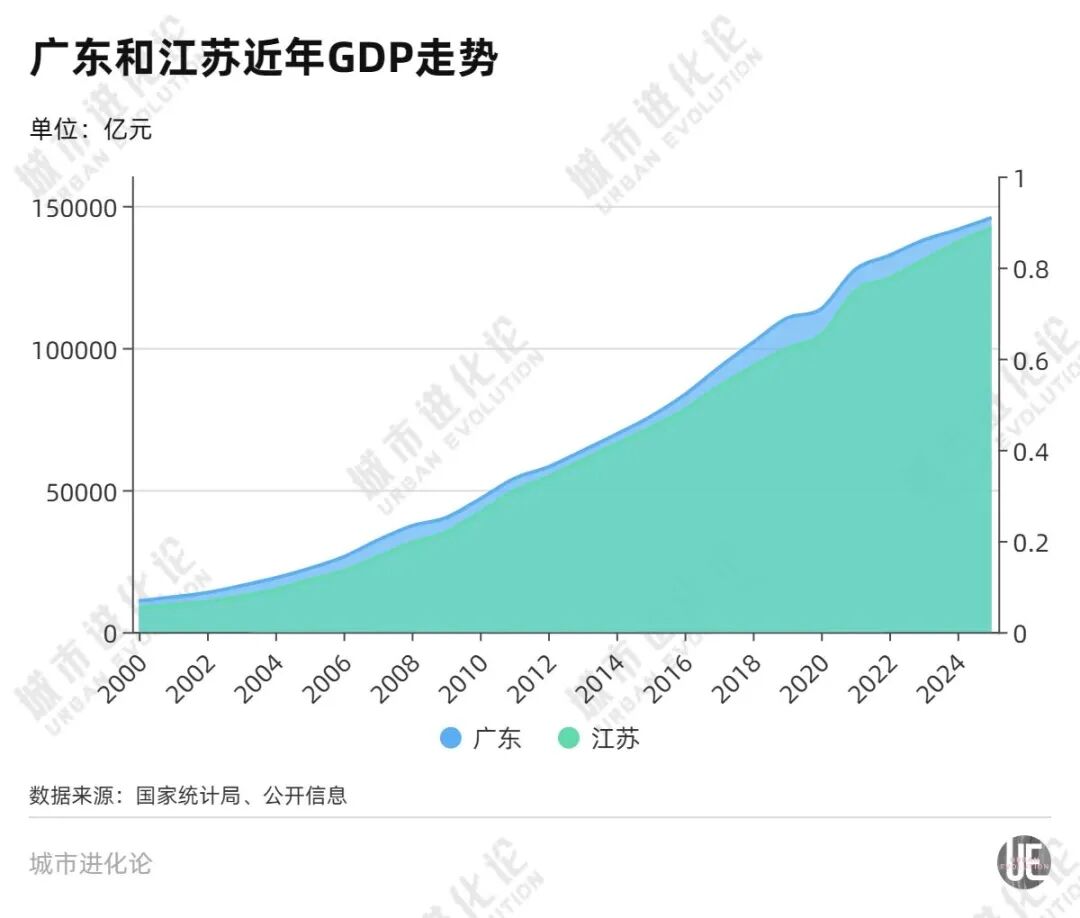
In fact, since 2020, Guangdong's actual GDP growth rate has continuously lagged behind that of Jiangsu. In 2025, this growth rate was not only lower than the national average but also lower than that of Shandong, Zhejiang, and Sichuan among the top five economic provinces in terms of GDP, falling into a relatively low range.
Different from Jiangsu's balanced and gradient development model, Guangdong's growth is more dependent on the "core" driving force. This can be seen from the economic data in 2025: Shenzhen's increment of nearly 200 billion yuan supported nearly half of Guangdong's economic growth. If we add Guangzhou's increment of over 100 billion yuan, the "dual cores" of Guangzhou and Shenzhen together accounted for nearly 70% of the province's increment.
This growth pattern is partly due to the pressure on Guangdong's industrial development. In 2025, the added value of industrial enterprises above the designated size in Guangdong only increased by 3.0% year-on-year, failing to reach the annual target of around 6%. The industrial growth of some cities with a high proportion of traditional industries and a reliance on mature industries was weak, further affecting the province's industrial growth rate.
Facing the actual constraints on industrial growth, the "enclave economy" model explored by Shenzhen is becoming an important means for Guangdong to break through industrial bottlenecks and optimize the provincial productivity spatial layout. The Shenzhen-Shantou Special Cooperation Zone is a representative example.
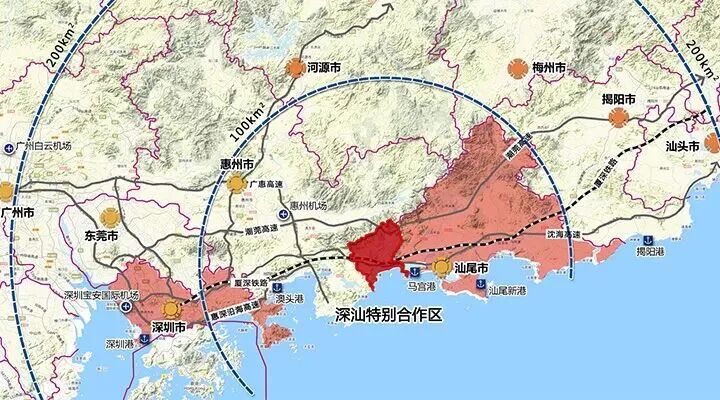
Image source: Official website of the Shenzhen-Shantou Special Cooperation Zone
In 2025, the total electricity consumption of the Shenzhen-Shantou Special Cooperation Zone increased by 26.07% year-on-year, and the core of growth was the BYD Super Factory. In that year, the factory's vehicle production reached 290,000 units, a year-on-year increase of 16%, becoming an indispensable intelligent manufacturing hub in BYD's global layout. This practice extended Shenzhen's industrial advantages to eastern Guangdong and provided a replicable path for the optimization of the provincial industrial spatial layout.
In addition to the driving force of industrial spillover, Shenzhen's empowerment of the whole province has deeper - level value. Zeng Gang said that Shenzhen's greater driving potential lies in its positioning as a scientific and technological innovation power source, systematically exporting the innovation ecosystem to the whole province, which is also the core ability to support Guangdong's transformation.
The effectiveness of this scientific and technological innovation empowerment has gradually emerged. In 2025, the Shenzhen - Hong Kong - Guangzhou innovation cluster jumped to the top in the latest ranking of the "Global Innovation Index". Driven by Shenzhen as the core, the whole province of Guangdong accelerated the layout of emerging industries and future industries. In that year, the added value of advanced manufacturing and high - tech manufacturing increased by 5.1% and 6.2% respectively.
Looking towards long - term development, Guangdong has clear goal guidance. The suggestions for Guangdong's 15th Five - Year Plan clearly state that from the 20th National Congress of the Communist Party of China to 2035, it will take 13 years to basically achieve socialist modernization and double the economic aggregate. In 2026, the provincial GDP growth target is set at 4.5% - 5%.
Under this goal, the coordinated development of Shenzhen and Guangzhou has become the key to reshaping the industrial growth momentum in Guangdong. Zeng Gang suggested that the two cities should further focus on the construction of the national science and technology center and the Greater Bay Area's scientific and technological innovation center, explore a cross - regional coordinated operation mechanism, and strengthen the radiation and driving ability to a wider area of the province, providing continuous support for Guangdong's economic transformation and upgrading.
This article is from the WeChat public account "Urban Evolution", author: Liu Xuqiang. Rep