The start of new forces in 2026: HarmonyOS and Xiaomi reach the top, while NIO, XPeng, and Li Auto hit the brakes
In the first month of 2026, the rankings of Chinese new - force car companies were shuffled again.
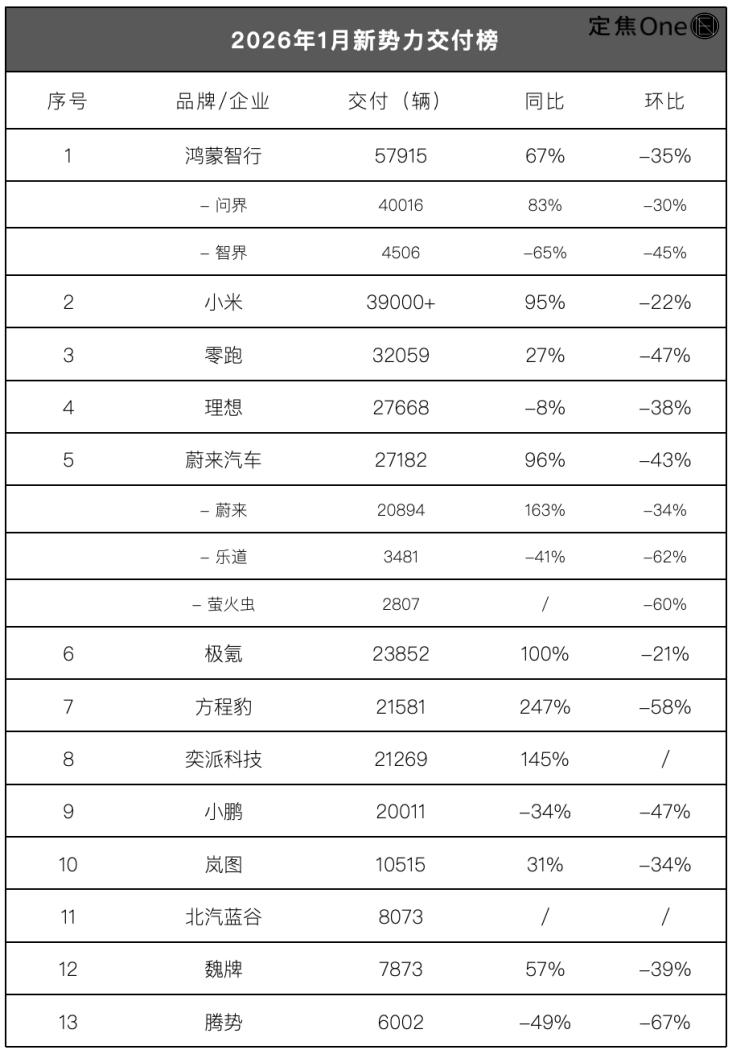
First Echelon (Over 50,000): Hongmeng Zhixing Takes the Lead
Hongmeng Zhixing (57,915 vehicles) became the only player with monthly sales exceeding 50,000 vehicles, topping the list of new - force car companies, relying on the platform strategy of "multiple brands for better competition".
Among them, the core brand, AITO (40,016 vehicles), contributed nearly 70% of the sales, becoming the absolute pillar. However, the sales volume of the Zhijie brand was only over 4,500 vehicles, with a month - on - month decline exceeding the overall industry's callback level. The other three brands (Xiangjie, Zunjie, and Shangjie) had a total of 13,393 vehicles.
Second Echelon (30,000 - 40,000): Xiaomi and Leapmotor Closely Follow
Xiaomi (over 39,000 vehicles), also a cross - border player, reached the second place among new - force car companies for the first time, relying on the strategy of hit products. Its main delivery model is the YU7.
Leapmotor, the annual champion in 2025, saw its delivery volume in January drop to 32,000 vehicles, ranking third.
Third Echelon (Over 20,000): Fierce Competition Among Six Brands
The range of 20,000 - vehicle level is the most intense competitive area. The delivery volumes of Li Auto, NIO, and XPeng are all at the 20,000 - vehicle level, engaging in a fierce battle with new brands from traditional car companies such as ZEEKR, Fangchengbao, and Yipai. Among them, Li Auto and XPeng experienced both year - on - year and month - on - month declines. The sub - brands of the NIO Group, Ledao and Yinghuo, both had significant month - on - month declines.
Fourth Echelon (Under 10,000 Vehicles): Seeking Breakthroughs
VOYAH maintained the threshold of 10,000 vehicles. Brands such as BAIC BluePark, Wei brand, and Denza are still below 10,000 vehicles.
The general "cooling" of sales in January is related to multiple factors, such as the pre - overdraft of demand due to the year - end sales rush last year, the consumption off - season at the beginning of the year, and the reduction of new - energy vehicle purchase tax incentives. According to the data of the Passenger Car Association, the retail sales of passenger cars nationwide in the first 18 days of January decreased by 28% year - on - year.
Facing the pressure, car companies have also changed their promotional methods. At the beginning of January, Tesla took the lead in launching "5 - year zero - interest" and "7 - year ultra - low - interest" financial plans for the Model 3/Y, lowering the threshold for car purchases to a new low. Xiaomi, Li Auto, and XPeng quickly followed up, launching their own long - term low - interest financial plans. A "financial war" testing the financial cooperation ability and capital cost of car companies has quietly begun.
The performance at the beginning of 2026 reflects that the competition among new - force car companies has shifted from "expanding the new - energy market together" to the stage of "fierce competition for the existing market share". Brand, technology, channels, cost control, and even the use of financial tools will all become the key factors determining the final rankings.
AITO Dominates, Xiaomi YU7 Leads the Sales
The top two in the January 2026 list are two "cross - border" players — Hongmeng Zhixing and Xiaomi Auto delivered nearly 58,000 and over 39,000 vehicles respectively.
Although Hongmeng Zhixing topped the list, the problem of unbalanced development among its "Five Jies" remains prominent. AITO delivered 40,000 vehicles in January, accounting for as high as 69.1% of Hongmeng Zhixing's total sales. That is to say, nearly 7 out of every 10 vehicles sold by Hongmeng Zhixing are AITO.
The performance of the other four "Jies" is not very optimistic.
Zhijie delivered 4,506 vehicles, a year - on - year decrease of 65.3% and a month - on - month decrease of 44.7%. The decline far exceeded the overall industry's callback level.
The other three brands (Xiangjie, Zunjie, and Shangjie) have not announced their sales as of press time. Judging from the total, they only sold 13,393 vehicles in total. On average, each brand sold only over 4,000 vehicles.
According to Hongmeng Zhixing's goal of delivering 1 million - 1.3 million vehicles in 2026, it needs to deliver 83,000 - 108,000 vehicles per month on average. This requires AITO to continue to maintain significant growth and the other four "Jies" to increase their sales rapidly.
The success of AITO is because it has enjoyed the most concentrated resources from Huawei — the earliest cooperation, in - depth empowerment, and full - scale support from channels. However, when this model is replicated to the other "Jies", the pattern of new - force car companies has changed significantly.
Take Zhijie as an example. It achieved monthly deliveries of over 10,000 vehicles for three consecutive months at the end of 2025, but its overall scale is small and its growth is unstable. Each of its products faces fierce competition: the S7 has to compete head - on with the Tesla Model 3 and the Xiaomi SU7, while the R7 has to compete with the Tesla Model Y and the AITO M7 and other strong models. In March 2026, Zhijie plans to launch the V9, targeting the high - end MPV market dominated by models such as the Denza D9. In these highly competitive niche markets, Zhijie must come up with differentiated advantages, otherwise, it will easily get into a tough battle.
To support the goal of one million vehicles, in addition to Zhijie in Hongmeng Zhixing, the AITO product line needs to be fully updated, Xiangjie needs to launch SUVs and MPVs, and Shangjie needs to launch at least two new models.
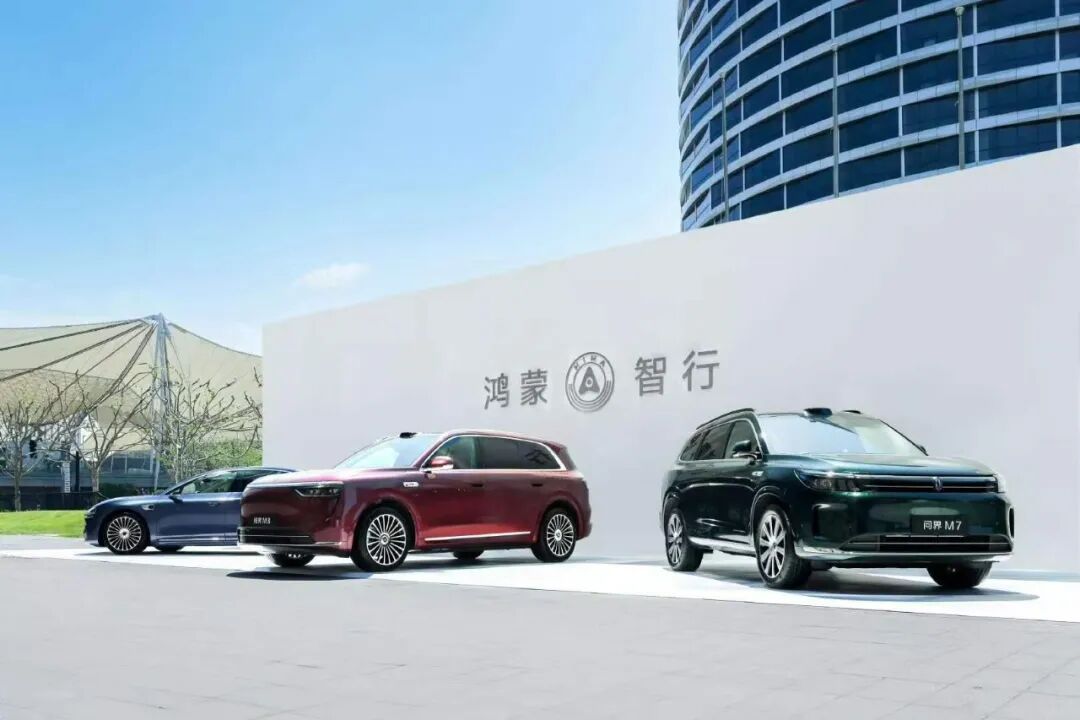
Image source / AITO Auto's official Weibo
In addition to new vehicles, Hongmeng Zhixing also needs to make efforts in ecological synergy as soon as possible. The ecological construction it promotes, such as unified service standards and shared energy - replenishment networks, must achieve quick results to improve user experience and brand loyalty and reduce internal operating costs.
Hongmeng Zhixing needs to enable the "Five Jies" to share the dividends of Huawei's empowerment as soon as possible. Xiaomi Auto, which ranks behind it, is in the product transition period. The SU7 is about to be upgraded, and the YU7 alone is shouldering the sales responsibility.
Xiaomi's delivery volume in January decreased by about 22% compared with "over 50,000" in December last year. However, this figure needs to be viewed in the context of Xiaomi's product cycle.
According to Xiaomi's official statement and Lei Jun himself, the SU7 is undergoing its first upgrade since its launch 21 months ago, and the new model will not be officially delivered until April this year. Therefore, the main delivery model in January was the YU7, and the contribution of the SU7 was limited. Its main task was to digest the inventory of the old models.
Since its launch in June last year, the YU7 has accumulated over 150,000 deliveries in half a year, 2.3 times that of the SU7 during the same period, effectively alleviating Xiaomi's excessive dependence on a single sedan model. In December last year, the delivery volume of the YU7 was close to 40,000 vehicles, accounting for nearly 80% of the total.
In 2026, Xiaomi's delivery target is 550,000 vehicles, which means it needs to deliver 45,800 vehicles per month on average. Considering the seasonal factors and the product transition period, the January performance is slightly lower than this target, which is still reasonable.
Xiaomi Auto's real test is yet to come.
Firstly, can the YU7 continue to shoulder the sales responsibility? At the beginning of January, Xiaomi launched a "7 - year low - interest" policy for the YU7. Goldman Sachs predicts that the YU7 series will deliver about 400,000 vehicles in 2026, being the absolute sales leader.
Secondly, can the new SU7 make a splash in April?
The success of the first - generation SU7 benefited greatly from the marketing halo of "Xiaomi's first car" and the founder's IP. However, in 2026, this strategy may not work anymore. Zhou De, an investor who focuses on new - force car companies, pointed out that "competitors have completed a pixel - level study of the SU7 and have launched products that directly compete in terms of price, configuration, and intelligence."
Xiaomi's new SU7 chooses "upgrading the configuration and increasing the price": all models are standard - equipped with lidar and high - level intelligent driving hardware, and the starting price has also increased to 229,900 yuan.
Regarding this, Zhou De analyzed that this is not only a test of Xiaomi's brand premium ability and the loyalty of Xiaomi fans but also a test of whether Xiaomi Auto can break away from the "traffic model" and rely on the "systematic ability" of products, technology, and channels to grow.
According to a Goldman Sachs research report, after the new SU7 started pre - sales at the beginning of January, it received nearly 100,000 pre - orders in two weeks. Of course, the final result depends on the user reviews after the delivery in April.
In addition to the new SU7, Xiaomi has a backup plan. The market generally expects that Xiaomi will launch its first extended - range SUV model (internally codenamed YU9, or named "Kunlun") in the third quarter of this year. This will determine whether Xiaomi can enter the extended - range market.
Leapmotor Hits the Brakes, Li Auto Struggles
The third and fourth places are Leapmotor, the sales champion in 2025, and Li Auto, the former "top student".
Leapmotor delivered 32,059 vehicles in January, a year - on - year increase of 27%, but a nearly "halved" month - on - month decline compared with over 60,000 vehicles in December 2025.
Regarding the significant decline in January's delivery volume, Li Zhang, a supply - chain insider, said that Leapmotor rushed too hard in the fourth quarter of last year, and the entire system, especially the supply chain and terminals, was under high pressure. The decline in January can be regarded as an active adjustment of the rhythm.
Leapmotor's plan for 2026 mainly focuses on two aspects: new vehicle launches and industrial cooperation.
In terms of the product line, Leapmotor will launch at least four new models. For the lower - end market, the new A - series models will target the entry - level market of 60,000 - 120,000 yuan, aiming to increase sales volume. For the high - end market, the flagship D - series models will target the price range above 300,000 yuan, aiming to enhance the brand image and increase profits.
In terms of industrial cooperation, after reaching a cooperation with the Stellantis Group earlier, at the end of 2025, Leapmotor also introduced an equity investment of 3.744 billion yuan from FAW Group. This is interpreted by the outside world as a major positive for Leapmotor — it not only has funds but also the endorsement of the "national team" and can make up for its shortcomings in hybrid technology and the supply chain. According to the plan, the first model in cooperation with FAW will be mass - produced in the second half of this year. This means that in the short term, sales will still rely on the existing B and C series, as well as the unlaunched A and D series.
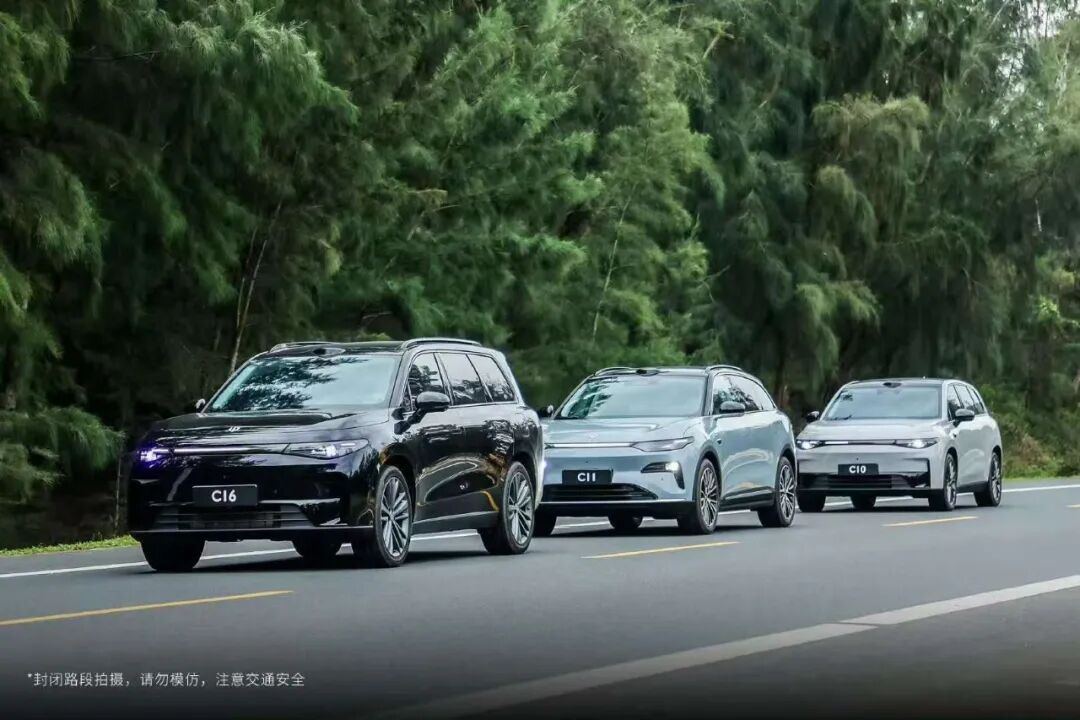
Image source / Leapmotor's official Weibo
To achieve the goal of "annual sales of one million vehicles" is not easy for a new - force car company that has just reached the 600,000 - vehicle mark. This is not only a matter of products and marketing but also places higher requirements on supply - chain management, production and manufacturing, quality control, channel services, and organizational capabilities. Leapmotor has exposed some problems in delivery and services in 2025. If these problems are magnified during the scale - expansion process, it may affect the brand's reputation.
Compared with Leapmotor, which needs to solve the problem of scale expansion, Li Auto's problem is more difficult — how to regain the growth rhythm in the face of increasing competition.
In January, Li Auto delivered 27,668 new vehicles, a year - on - year decline of 7.8% and a month - on - month decline of nearly 38%. This opening - year data is considered a continuation of a series of difficulties the company has faced since 2025.
In Zhou De's view, the root cause of Li Auto's problem lies in the imbalance of its product strategy. It used to rely on extended - range models, and in 2025, it shifted its focus to pure - electric models. However, the market feedback of the MEGA was not good, the orders for the i8 were insufficient, and only the i6 performed well. At the same time, the sales of extended - range models declined, and the L series became outdated.
While facing a shortage of new products, the pattern of new - force car companies has changed. Li Auto used to be firmly at the top, but its sales ranking in 2025 has fallen behind Leapmotor, Hongmeng Zhixing, and XPeng.
In 2026, Li Auto tries to deal with the sales decline by "consolidating the extended - range basic market, increasing pure - electric production capacity, and optimizing channel efficiency", and at the same time, it stimulates motivation by "going all - in on AI and restarting the entrepreneurial model".
In terms of products, it will re - allocate resources to extended - range models and plans to launch a new - generation L9 with a new chassis and self - developed intelligent driving chips. In terms of channels, it starts to close some under - performing mall stores.
Strategically, it bets on AI and embodied intelligence. Li Xiang, the founder, said in an internal all - staff meeting that "2026 is the last window for AI companies to enter the automotive industry" and "Li Auto will clearly enter the field of humanoid robots".
According to media reports, this has caused confusion among some employees. Compared with betting on the more uncertain directions of AI and robots, they are more concerned about how to solve the current sales problem.
Judging from the sales data in January, whether the new - generation L9 can be a hit and whether the production - capacity problem of the i6 can be solved smoothly are the key factors determining Li Auto's development in 2026. As for the stories about AI and humanoid robots