NOR FLASH has become popular.
Flash memory includes NOR Flash (OR-NOT flash) and NAND Flash (AND-NOT flash), among which NAND Flash occupies more than 95% of the flash memory market share. NOR Flash (OR-NOT flash) has carved out a niche in professional fields such as industry and automotive thanks to its unique technical characteristics. As one of the two core technological paths for non-volatile flash memory, NOR Flash has developed over several decades. Driven by emerging scenarios such as the Internet of Things, automotive electronics, and AI servers, it is moving from a "niche market" to a "high-growth track".
In this wave, the layout of domestic MCU enterprises is particularly crucial. Domestic enterprises represented by CM32 Semiconductor are leveraging their technological and customer advantages in the MCU track to accelerate their entry into this high-growth field, promoting the transformation of NOR Flash from a "niche necessity" to "large-scale application".
What is NOR Flash?
The development of NOR Flash began in the 1980s. In 1988, the relevant technology was first developed by Fujio Masuoka of Toshiba and later industrialized by Intel, completely breaking the previous situation where EPROM (Erasable Programmable Read-Only Memory) and EEPROM (Electrically Erasable Programmable Read-Only Memory) dominated the read-only memory market. In 1989, Toshiba launched NAND Flash, and the two form a distinct complement: NOR focuses on code storage, while NAND Flash has the advantages of high storage density and low cost, dominating large-capacity data storage.
NOR Flash features a parallel addressing structure and in-chip execution (XIP, eXecute In Place). This allows applications to run directly in the flash memory without being loaded into the system RAM. It also has characteristics such as long data retention time, heat resistance, low power consumption, and a long erase/write lifespan (about 100,000 times). Although it has low storage density, high unit capacity cost, and slow write and erase speeds, it is irreplaceable in scenarios requiring small capacity, high reliability, and fast response. Initially, it was mainly used for firmware storage in feature phones and other devices, and now it has gradually expanded to a wider range of professional fields.
NAND, due to its extremely high storage cell density, can achieve high storage density and has excellent write and erase speeds. The difficulty in its implementation lies in the need for a dedicated system interface to efficiently manage the flash memory. In terms of read and write performance, NOR has a slightly faster read speed than NAND, while NAND's write speed far surpasses that of NOR.
Multi-field demand drives both volume and price growth of NOR Flash
With the rapid development of industries such as the Internet of Things, automotive electronics, and artificial intelligence, the application scenarios of NOR Flash continue to expand, and the market demand has witnessed explosive growth, driving it from niche segments to large-scale applications.
In the fields of the Internet of Things and AIoT, the application of MCUs (Microcontrollers) is becoming more and more widespread. Initially, MCUs could meet the requirements by using built-in EEPROM or external small-capacity NOR Flash. However, as the functions of smart devices continue to expand, the needs for system upgrades, audio storage, GUI image display, video caching, and protocol stacks have given rise to a demand for larger-capacity storage. The NOR Flash supporting MCUs has also gradually upgraded to higher capacities.
Under the trend of artificial intelligence, the explosion of edge-side AI demand has further amplified this trend. Terminal products such as AI headphones, smart bracelets, AR/VR devices, smart speakers, embodied intelligent robots, and AI toys have extremely high requirements for the fast response ability and reliability of storage, and most scenarios do not require large-capacity storage, which happens to match the technical advantages of NOR Flash. For example, the rapid development of the market for wearable devices such as TWS headphones (with 1 NOR inside to store system code), smart watches/bracelets (with 1 NOR inside/outside), and AR/VR (usually equipped with 1 NOR) has brought huge potential demand for NOR Flash.
The growth in the automotive electronics field is also rapid. The rapid development of digital cockpits and autonomous driving (ADAS) has driven the continuous increase in in-vehicle storage demand. The instant-on characteristic of NOR Flash makes it an ideal choice for automotive dashboards. Compared with NAND Flash, its advantages of long data retention, heat resistance, and fast code startup perfectly match the strict requirements of in-vehicle scenarios.
The demand for NOR Flash in the entire ADAS system is even greater. As the complexity of ADAS functions is promoting the popularization of intelligent sensors, such as front cameras, imaging radars, and even lidars, a large amount of high-density NOR Flash is required. Especially after entering the era of autonomous driving, each camera and radar needs a storage chip to support it. Cameras and radars will write the perceived road surface information into the storage chip and perform operations and analyses on the written data through a proprietary algorithm to quickly make emergency avoidance, braking, and other operations. Only NOR Flash can meet this demand.
The explosive growth of AI servers has become the "super engine" for NOR Flash demand. The innovation of the HBM4 (High Bandwidth Memory) technical architecture has increased the number of DRAM stacking layers from 12 in HBM3 to 16 - 20, making its physical structure and power management logic more complex. NOR Flash undertakes the core functions of AI server system initialization, secure startup, and firmware storage, and can meet the requirements of independent power management and initialization for each layer of DRAM in HBM4. As AI servers upgrade from HBM3E to HBM4, the usage of NOR Flash per device has increased from 1 - 2 to 3 - 5, and industry data shows that the usage has increased by 50%. In AI training clusters, the system needs to frequently and reliably call underlying instructions, and the low latency and high reliability of NOR Flash make it an irreplaceable component.
The continuous booming demand has also triggered a price increase wave. On January 27th, CM32 Semiconductor issued a price increase notice letter stating that affected by factors such as the current tight supply of chips in the entire industry and rising costs, the delivery cycle of packaged finished products has become longer, and the cost has increased significantly compared to before. The costs of frames, packaging and testing fees, etc. have also continued to rise. In view of the current severe supply - demand situation and huge cost pressure, after careful consideration, it has been decided to adjust the prices of products such as MCUs and Nor flash starting from now, with a price increase range of 15% - 50%.
The strategic logic of domestic MCU enterprises' layout of NOR Flash
Recently, CM32 Semiconductor, the leading domestic MCU enterprise, officially announced its first non-volatile memory chip, CMS25Q40A, opening the door to the storage field with a 4M bit low-power SPI NOR Flash product and initiating the "MCU + storage" layout.
MCU and NOR Flash are a natural "golden combination". Most embedded devices equipped with MCUs need an external NOR Flash to store programs. This natural synergy has also prompted domestic MCU enterprises to enter the NOR Flash field, becoming an important trend in the industry's development.
NOR Flash and MCU have natural commonalities in semiconductor design and manufacturing processes. Both belong to the core chips of embedded systems and need to overcome key technologies such as low-power design, high-reliability guarantee, and embedded storage optimization. Enterprises can rely on the process experience, IP resource reserves, and customer channel advantages accumulated in the NOR Flash field to efficiently promote the R & D of MCU products and implement the "storage + control" platform strategy, significantly reducing R & D costs and market risks. This strategy has been verified by the practices of many enterprises: GD32 and Alwinner Technology have both clearly positioned themselves as service providers in the "storage + control" field, leveraging the channel synergy effect of NOR Flash to expand their MCU business; PRANXX implements a dual-drive strategy of "storage" and "storage +". On the one hand, it continues to improve the full-series layout of its original storage product line, strengthening its leading advantage in process performance, focusing on the expansion of mid - to high - end industrial control and automotive customers and incremental opportunities in new fields, and laying a solid product foundation for market share improvement; on the other hand, the MCU and VCM Driver products under the "storage +" segment have quickly built brand awareness and achieved continuous high - speed business growth.
There are three main reasons for domestic MCU enterprises to layout NOR Flash:
Firstly, to improve the product ecosystem and enhance customer stickiness. As the core control chip of smart devices, MCUs usually need an external storage chip to store program codes, configuration parameters, and other key data. If MCU enterprises can achieve self - supply of NOR Flash, they can build a one - stop "MCU + Flash" solution, which can not only effectively reduce customers' procurement costs and supply chain management difficulties but also bind customers' needs through product synergy, significantly enhancing customer stickiness.
Secondly, to expand business boundaries and explore new growth points. Although the market scale of NOR Flash is smaller than that of DRAM and NAND Flash, it is irreplaceable in fields such as automotive electronics, industrial control, and Internet of Things devices, especially suitable for small - capacity and low - power consumption application scenarios. MCU enterprises can leverage their existing customer resources and technological accumulation to enter this field, break through their original business boundaries, and explore new growth points in niche markets.
Thirdly, to seize the opportunity of localization and capture niche market shares. The global NOR Flash market has long been dominated by international manufacturers such as Winbond and Macronix. In recent years, the market share of domestic enterprises has gradually increased, and the trend of domestic substitution is significant. MCU enterprises can take advantage of this trend, start with small - to medium - capacity products, avoid direct competition with leading manufacturers in high - density and automotive - grade products, and precisely capture niche market shares.
Of course, new entrants also face significant challenges: The NOR Flash market is already dominated by leading enterprises such as GD32 and PRANXX, and new players need to make breakthroughs in performance, cost, and reliability; Serializing products requires continuous investment of a large amount of R & D resources, which may affect the iteration speed of traditional MCU business; at the same time, the market is greatly affected by fluctuations in production capacity and demand, and price fluctuations may impact enterprises' profitability.
It is not difficult to see that the layout of NOR Flash by MCU enterprises is a strategic choice based on technological synergy and seizing the opportunity of localization. It has become an important development trend in the semiconductor industry in recent years and also requires enterprises to face multiple challenges such as market competition and resource allocation.
3D NOR Flash: The revolution of non-volatile storage
To adapt to the development of industries such as artificial intelligence and intelligent vehicles, various stacking solutions such as HBM, HBF, and HBS have emerged in an endless stream. In the NOR Flash field, these applications also put forward higher requirements for flash memory with higher density, faster access speed, and higher reliability. Traditional 2D NOR Flash is approaching its physical and performance limits, and its planar architecture limits its scalability.
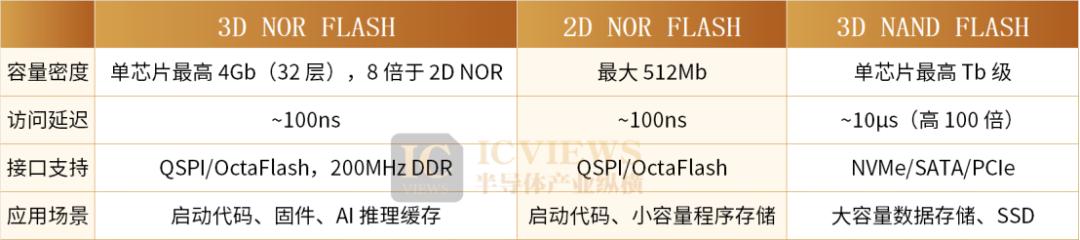
3D NOR Flash solves the scalability problem of the 2D architecture by vertically stacking storage cells. Taking the product line of Macronix as an example, the maximum capacity of a single die of 2D NOR Flash is only 512Mb. If higher density is required, a multi - die system - level package (SiP) is needed; while the capacity of a single die of 3D NOR Flash can reach 4Gb, achieving a leap - forward increase in storage density. This characteristic makes it an ideal choice for scenarios requiring a large amount of non - volatile storage in limited physical space and can reduce the terminal device's dependence on multiple storage devices such as eMMC and NAND.
In addition to the increase in storage density, 3D NOR Flash also has shorter access latency, significantly optimizing the device startup performance. This is crucial for applications such as automotive dashboards and AI servers that require almost instant access to stored data. With the maturity and mass production of 3D NOR technology, it will further meet the high - performance requirements of high - end scenarios such as automotive electronics and AI servers.
From technological iteration to demand explosion, from domestic breakthrough to industrial upgrading, driven by the rigid demand in multiple fields, NOR Flash has become a golden track with great growth potential in the semiconductor industry. In the future, with continuous breakthroughs in technologies such as 3D NOR and the acceleration of the localization process, the NOR Flash market will have a broader development space.
This article is from the WeChat official account "Semiconductor Industry Insights" (ID: ICViews), author: Peng Cheng, published by 36Kr with permission.