Cathie Wood's 2026 AI Outlook: Lobster Robots Transform Agents into Digital Workforce, Revolutionizing Personal Earning Logic
On January 30th, well - known American investor and founder of ARK Invest, Cathie Wood, was interviewed on a podcast. She provided a detailed interpretation of ARK's newly released "Big Ideas 2026" report, which covers the development trends in multiple fields such as AI Agents, autonomous driving, and the macro - economy.
Data shows that the success rate of AI Agents in long - term tasks has currently reached 80%. Although this figure is still sub - par for human employees, if 100 Agents are deployed to work in parallel, the probability of problem - solving will increase exponentially.
Recently, the open - source intelligent agent MoltBot (formerly known as Clawdbot, renamed due to trademark issues) has gone viral on the global internet. Moltbot can connect to users' social media, email, and local files, and autonomously complete tasks like a personal assistant.
Cathie Wood believes that the popularity of Moltbot represents the rise of the power of personal Agents. Individuals can use open - source tools to achieve high productivity without fully relying on the closed ecosystems of large companies. As the task success rate of AI Agents increases, intelligent agents will evolve from simple chatbots to digital assistants capable of autonomously performing complex tasks. This is one of the key driving forces for the explosive growth of GDP and productivity in the future.
Regarding the competition among large - model companies, Cathie Wood believes that although OpenAI has a first - mover advantage with 900 million users, the huge computing power cost forces it to pursue commercialization. OpenAI is planning to launch a CPM (Cost per Mille) advertising quote as high as $60, which is three times the current price of Facebook and comparable to the pricing level of Super Bowl ads.
In contrast, Google seems to be more at ease. Google has a large cash flow from its search business as a backing and has strong strategic endurance. It doesn't need to extract user value through high prices urgently. Instead, it can use its price advantage to seize OpenAI's market share.
In the field of autonomous driving, Cathie Wood is extremely optimistic about the future of Robotaxis and predicts that this market will completely disrupt the traditional automobile manufacturing industry.
ARK's research predicts that Tesla will be the biggest winner in the Robotaxi field, followed by Waymo. Although Waymo leads in technology, it lacks manufacturing capabilities and must rely on automobile manufacturers to provide vehicle platforms. This assembled supply - chain model means that it is difficult to minimize costs. Tesla, on the other hand, has a fully vertically integrated ecosystem. From battery manufacturing, chip design, data centers to vehicle manufacturing, with its vertically integrated supply chain, Tesla's operating cost per mile is expected to be only 20 cents, 50% lower than that of Waymo.
Cathie Wood said that traditional automobile manufacturers will find it difficult to survive or succeed in this wave. Robotaxi is a combination of three major fields: robotics, AI, and energy storage technology. Traditional automobile manufacturers focus on internal combustion engines and lack the accumulation and integration ability of these three key technologies. The internal combustion engine technology is mature and no longer follows the cost - reduction curve brought by Wright's Law. In contrast, electric vehicle and AI technologies are in a phase of rapid cost decline, which makes traditional automobile manufacturers unable to compete in the future price war. On the other hand, traditional automobile manufacturers rely heavily on suppliers and cannot respond quickly to exponentially growing demand like Tesla through a fully automated internal supply chain.
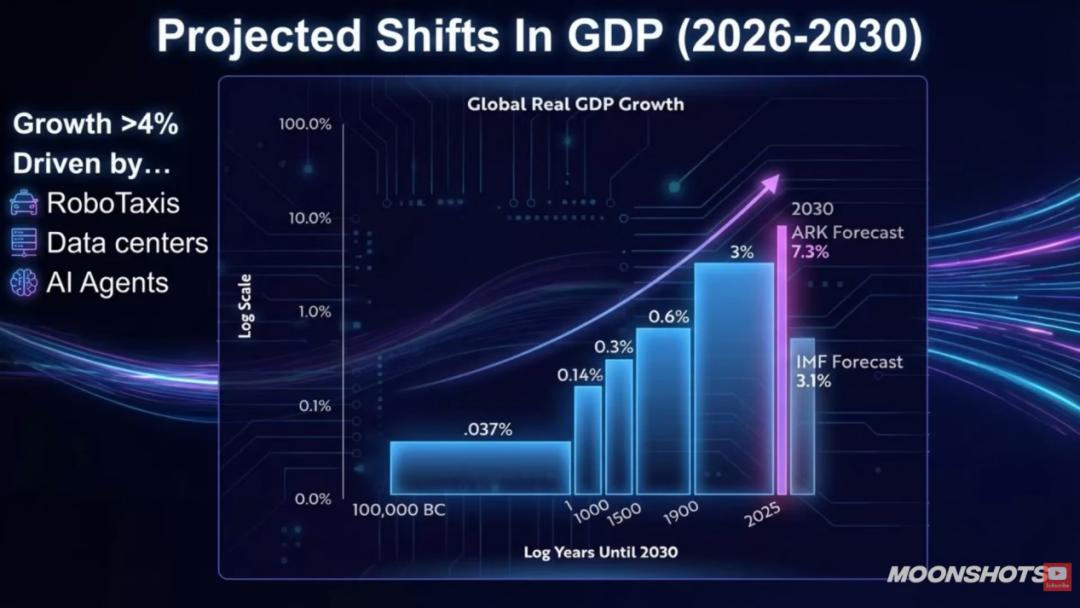
Regarding the macro - economy in the AI era, Cathie Wood predicts that the global GDP growth rate will jump from the historical average of 3% to 7%. Currently, it is the integration period of five major technology platforms: robotics, energy storage, AI, blockchain, and multi - omics sequencing. The 7% prediction may even be conservative. Although technology has a deflationary nature of reducing costs, the resulting unit demand will increase explosively, greatly promoting the expansion of the total economic volume.
Regarding the problem of the rapid decline in inference costs, Cathie Wood believes that this will not lead to a market contraction. On the contrary, human demand for intelligence is essentially infinite. Even if the inference cost approaches zero, enterprises and individuals will still invest huge costs to obtain intelligent agent services with longer thinking chains.
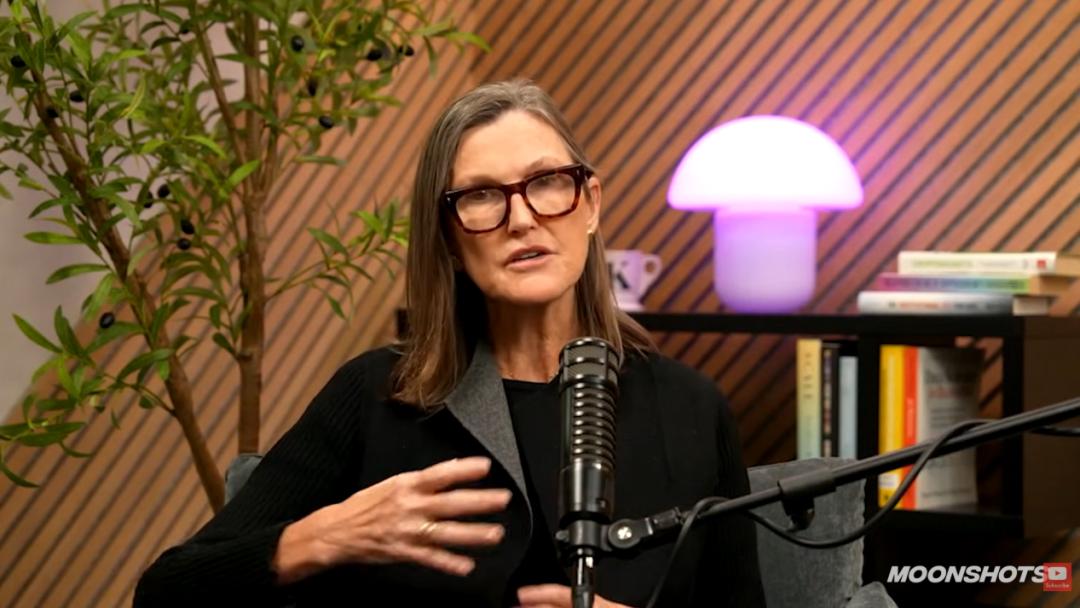
Key points from Cathie Wood's interview:
1. Infinite demand for intelligence
The inference cost is approaching zero, but human desire for intelligence is infinite. People will exhaust all their budgets to obtain more intelligence. Even if a single inference becomes cheaper, the explosive growth of the total demand will make the market size huge. Currently, the success rate of AI Agents in long - term tasks is about 80%.
2. Productivity leap of personal AI Agents
The open - source Moltbot can run on personal computers, helping to organize work, connect to social media and emails, and even automatically complete tasks while you sleep. This is not only a technological breakthrough but has also become a cultural phenomenon. This tool can bring a qualitative leap in work efficiency, but it is also destructive. If it malfunctions, it may disrupt or even damage the computer system within two seconds.
3. Overwhelming advantages of Tesla's Robotaxis
In the field of autonomous driving, Tesla will be the biggest winner, and Waymo will rank second. Tesla's advantage lies in its vertically integrated cost structure and manufacturing capabilities, which can reduce the cost per mile to 20 cents, while the current cost of services like Uber is over $2. Traditional automobile manufacturers, due to their reliance on external supply chains, limitations imposed by unions, and lack of corporate genes in robotics and AI, will find it difficult to survive in this transformation because future cars are essentially mobile inference engines and energy storage devices.
4. Cars will evolve into mobile inference engines and energy storage devices
Future cars will not only be means of transportation but also millions of mobile inference engines and energy storage devices. Autonomous vehicles will become part of a distributed energy ecosystem, using idle time to balance the power grid (for example, charging during low - utilization hours at night and supplying power back during the day). This in - depth integration is difficult for traditional automobile manufacturers to understand and replicate.
5. Orbital data centers and vertical integration
SpaceX is building an orbital data center, and the launch cost of reusable rockets has dropped significantly. In space, the efficiency of solar energy is six times that on the ground, and there is no land limitation. Elon Musk intends to bypass the mark - ups in the traditional supply chain through high - level vertical integration, which will completely change the cost structure of computing power infrastructure.
Here is the full transcript of Cathie Wood's interview:
1. Acceleration of AI and GDP growth
Peter: Welcome everyone to the "Moonshots" program. We have invited Cathie Wood, the founder, CEO, and CIO of ARK Invest. Cathie, you predicted a 7% global GDP growth, which is like a singularity event, considering that the development of artificial intelligence is much faster than we expected. Today, we are also honored to have my "moonshot" partners, Dave Blundin and Salim Ismail. This is the world's number - one technology podcast, aiming to prepare everyone for the upcoming major changes in the future. Good morning, Cathie.
Cathie Wood: Good morning, Peter.
Peter: You released an amazing "2026 Big Ideas" report. We selected about 20 slides from it and want to discuss them with the team. This is really important. Can you imagine how fast the world is changing? Is it still shocking to you?
Cathie Wood: Even though we always expected the world to change faster than people thought, the development speed of AI still exceeded our expectations. You know, we were already quite advanced in this area, but this still indicates a certain trend.
Peter: Okay, let's talk about this huge acceleration. Cathie, I've put the first slide on the screen, which is about the expected change in GDP in 2030. These figures are quite astonishing. You predicted a 7% global GDP growth, which is like a singularity event and twice the prediction of the International Monetary Fund (IMF). We just talked with Elon Musk, and he also believes that the GDP may increase five - fold in the next two years and experience triple - digit growth in the next decade. What's your view, Cathie?
Cathie Wood: This chart is very well - done. You can see that in history, every technological revolution has been accompanied by a step - up in GDP growth. Looking back at the few hundred years from 1500 to 1900, there weren't many new technologies except for the railways at the end. According to the research conducted by Brett Winton in collaboration with academia, the global real GDP growth rate only increased from about 0.6% to 6%. Then, when we experienced the technological revolution of railways, telephones, electricity, and internal combustion engines, the growth rate increased five - fold in the next 125 years and stabilized at around 3%.
Now, we are facing five core platforms: robotics, energy storage, artificial intelligence (the biggest catalyst), blockchain technology, and multi - omics sequencing. The integration of these five technologies makes us believe that the growth rate will increase two - and - a - half times, reaching around 7%. In fact, I think this is still a conservative estimate. When we first proposed this figure a few years ago, people thought we were crazy. After hearing Elon's view, you'll find that our views on the explosive growth of global real GDP are the same. This is truly a sight that no one alive today has ever seen.
Dave Blundin: Let me play the role of the devil's advocate. Although I don't really believe in this opposing view myself, someone has to bring it up for the sake of discussion. Alex and I just came back from the Davos Forum. If you randomly survey the bankers and politicians there, only about 20% of them believe in this kind of growth, and 80% don't. Those 80% would say, "Look, when the computer revolution took off, the GDP growth rate still remained stable at 3% per year. No matter what breakthroughs there are, whether it's fusion or computing, they will ultimately be contained within that 3% growth rate, and we can't break out of this trap." This mindset stems from the historical experience of the past 125 years. How would you respond to these non - believers, Cathie?
Cathie Wood: Interestingly, people alive today really haven't experienced anything else. In the 1980s and 1990s, productivity growth did increase, and it was a golden age of investment, but the global GDP growth generally remained at 3%. But I think the fundamental reason why those in the financial sector don't believe this lies in their research framework.
Cathie Wood: Traditional financial institutions conduct research in isolation by department, industry, or sub - industry. However, current technologies are penetrating into every field and blurring these boundaries. You must establish a research system like ours, which is centered around these 15 core technologies (summarized into 5 major platforms). Each of our analysts is studying when and how these technologies will expand in various industries. We have broken down internal silos, and analysts work together. Only in this way can we truly understand the major technological integration that is taking place today.
Peter: This is truly a perfect integration. As you can see in the slide, we are witnessing the combination of reusable low - cost space launch technology and space data centers. Six months ago, when I was communicating with Elon Musk and Dave, no one was talking about building data centers in space, but now everyone is discussing it.
Cathie Wood: We collaborated with Mach 33 to launch an open - source SpaceX model. We released this model as early as the middle of last year, without considering the "orbital data center" at that time. Now, we and Mach 33 have redesigned the plan, and the early results show that the cost is significantly decreasing, which will further promote unit growth.
This is exactly the core of Wright's Law: as the cumulative production doubles each time, in this case, the reusable rocket technology, the cost will decline by a stable percentage. For rockets, the cost decline is quite significant. Believe it or not, in the field of industrial robots, every time the cumulative production doubles, the cost drops by about 50%. The decline in the rocket field may not be that high, but I believe it will be in the twenties percentile range.
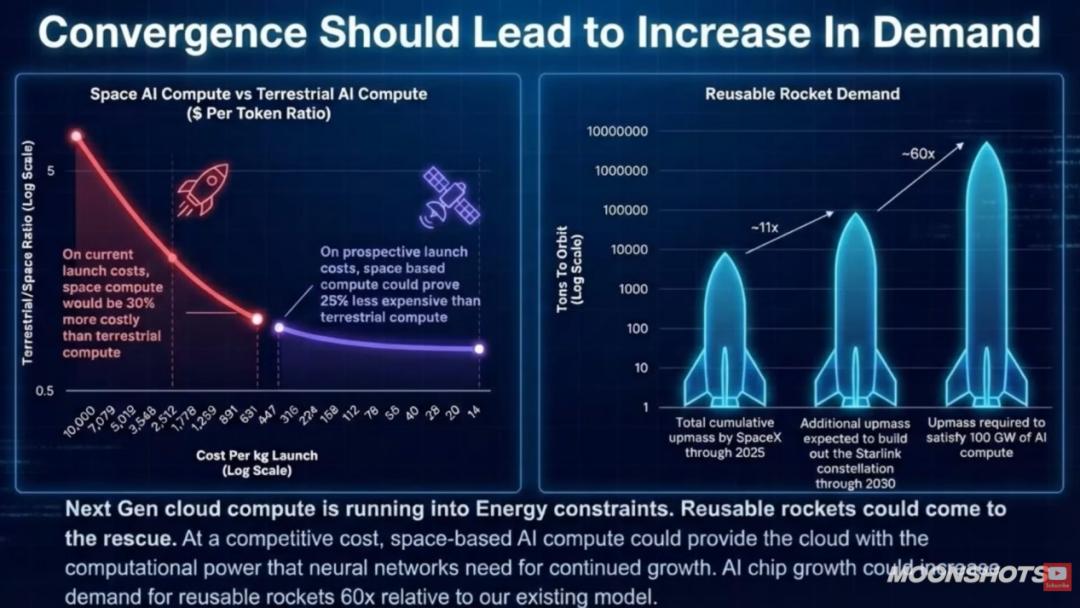
Dave Blundin: Actually, I want to ask a question about the chart on the left. Since the launch cost is dropping significantly, I'm surprised that the curve isn't dropping more. One of the important takeaways from my meeting with Elon was that, to be honest, I went in half - skeptical about the "space data center" and came out completely convinced. He is actively and secretly working on something: bypassing the existing supply chain. Currently, when manufacturing GPU chips, TSMC has a profit margin of about 50%, and NVIDIA has an 80% profit margin. The value chain is full of mark - ups. Elon plans to bypass all this and build his own wafer factory.
He always asks: What are the fundamental constraints? What are the real physical obstacles? Actually, it's very simple: obtaining sand (silicon) is very cheap; as for electricity, the efficiency of solar panels in space is six times that on the ground, and the cost is extremely low. So I think if we only look at the decline in launch cost today without considering the convergent disruption of GPU cost, electricity cost, and solar panel production cost, we are underestimating the trend. If Elon is right, all these will happen in parallel in just a few years, and the cost curve will drop sharply.
Cathie Wood: That's right. Let's look at the application of Wright's Law in the semiconductor industry. Now the question is, what will hinder this growth? I don't think regulation will be an obstacle because we are in a space race. Since Elon's company is highly vertically integrated, let's assume he can handle the chip supply.
Dr. Alexander: Cathie, if we naively extrapolate from past data, will we reach the scale of a "Dyson swarm"? At some point in the future, to build orbital data centers, will we need to obtain enough raw materials from the Moon, other planets, or the asteroid belt? I know you usually make five - year predictions, but if you look 50 years ahead, will we see a Dyson swarm, or will there be multiple competing Dyson swarms?
Cathie Wood: Although I'm not professional enough to answer specific questions about the Dyson swarm, our model has indeed extrapolated SpaceX's plans beyond five years, taking into account factors such as Optimus robots, Tesla, The Boring Company, and even Mars colonization. We think this is technically feasible. However, orbital debris is indeed the biggest stumbling - block in the near future. Once a chain reaction occurs, the consequences will be unimaginable.
Peter: Let's turn the topic back to AI infrastructure. As shown in the slide, the inference cost is dropping at an astonishing speed, and its impact is huge. I don't think people have fully realized this yet.
Salim Ismail: There's a paradox here: when technology is as deflationary as we've seen, for example, the rocket launch cost has dropped from $600 million for the Space Shuttle to $60 million for SpaceX and will drop another 10 - fold, this is a huge reduction for GDP. When technology so thoroughly reduces all costs, how can we predict GDP growth? This is one of my biggest concerns.
Cathie Wood: The other side of the cost decline is the explosive growth in the number of units, which is the Jevons Paradox. Many people laughed at me for predicting that prices would start to fall. They thought inflation would be stuck in the range of 2