Exclusive from 36Kr: He Xiaopeng's Internal Sharing: Intelligent Cockpit and Intelligent Driving Technologies Will Converge to Form a "Super Intelligent Agent"
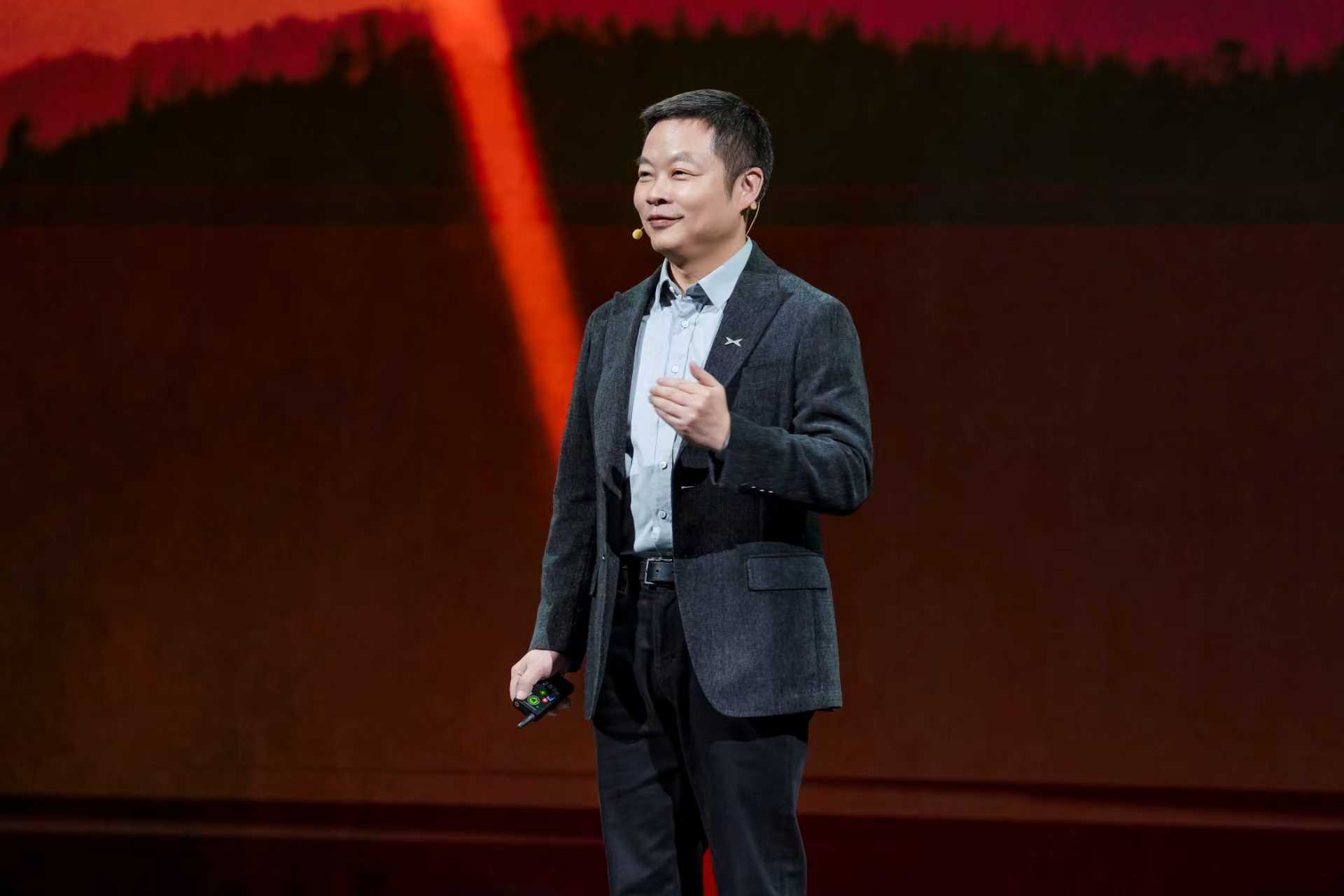
He Xiaopeng, Chairman and CEO of XPeng Motors
Text | Xiao Man
Editor | Li Qin
36Kr Auto exclusively learned that at the XPeng Motors 2026 annual meeting, He Xiaopeng systematically elaborated on the company's technological path and growth direction for the next stage around AI, autonomous driving, and humanoid robots.
XPeng Motors has established 2026 as "a crucial year for the commercialization of physical AI." He Xiaopeng believes that the automotive industry is entering a new stage of deep integration with AI: the intelligent cockpit and intelligent driving will achieve technological convergence to form a super intelligent agent. Against this backdrop, he proposed that XPeng is confident to be the first company to seize the "DeepSeek moment" in autonomous driving.
In response to the outside world's doubts that "there is uncertainty about the large-scale generalization of humanoid robots within two to three years," He Xiaopeng put forward four new strategic guidelines at the annual meeting, responding to XPeng's thinking on business model upgrading and long-term valuation logic.
Among them, scale growth is clearly placed in the primary position, focusing on three core growth curves of automobiles, robots, and globalization. XPeng will do a good job in full-stack self-research of physical AI-related technologies to achieve technological premium. Through innovation, XPeng hopes to establish a new business model with an Agent effect.
He Xiaopeng believes that 2026 - 2028 is a crucial stage. The core task of this stage is to solidify scale, globalization, and AI capabilities simultaneously, especially to truly improve the business quality.
The automotive and AI industries officially enter the era of cross-domain integration
"In the next few decades, the most certain and longest-lasting technological wave will be AI. In his opinion, AI will become one of the main waves in the next 30 or even 50 years." He Xiaopeng shared at the internal annual meeting.
He Xiaopeng mentioned at the 2025 National Two Sessions that there will be two key changes in the automotive industry - firstly, AI will promote the accelerated arrival of autonomous driving and driverless technology; secondly, the automotive industry will start to deeply integrate with robots. Now, he further judges that the automotive and AI industries officially enter the era of cross-domain integration, and the intelligent cockpit and intelligent driving will achieve technological convergence to form a super intelligent agent.
"Autonomous driving" has always been regarded as the most recognizable technological label of XPeng. In the past two years, XPeng Motors has shifted from defense to offense.
In He Xiaopeng's view, the second-generation VLA is the most important technological node for XPeng Motors in the field of autonomous driving this year. At the annual meeting, He Xiaopeng mentioned several times that he is full of confidence in the second-generation VLA. Empowered by the combination of the second-generation VLA + VLM, technological convergence will form a super intelligent agent.
He Xiaopeng said, "The DeepSeek moment of autonomous driving is coming, and XPeng must seize the opportunity to be the first in China. We are confident to achieve this."
In the field of embodied intelligent robots, He Xiaopeng set clear goals for the team. Based on XPeng's technological accumulation in autonomous driving and world models, XPeng will mass-produce L3-level humanoid robots for industrial use in 2026, and the mass-produced robots will enter commercial scenarios.
"XPeng robots are expected to make breakthroughs in 12 - 18 months and drive up XPeng's market value." He Xiaopeng said.
He Xiaopeng proposed four new strategic guidelines
Regarding the deep integration of the physical world and AI, He Xiaopeng believes that there are two most strategically valuable directions -
Firstly, it is to evolve cars into driverless cars that are safe, can be used with confidence in the whole process and all scenarios. This is a large enough market opportunity that has not been truly realized;
Secondly, it is the integration of robots in the physical world and agents in the digital world.
He revealed that when communicating with several CEOs of leading domestic enterprises recently, they generally believed that there was still uncertainty about the large-scale generalization of humanoid robots within two to three years. But in He Xiaopeng's view, this just means the existence of a window period. "XPeng is investing in both physics and AI, computing power and data in the field of physical AI. With this full-stack investment, I think we have a great opportunity."
He mentioned at the annual meeting that in the past year, many overseas enterprises and domestic industrial partners have feedback to him that XPeng's layout rhythm in the field of physical AI is at least five years ahead of other companies in the industry.
XPeng once again clarified that the core goal in 2026 is to do a good job in physical AI + globalization and put forward four new strategic guidelines, systematically responding to XPeng's thinking on business model upgrading and long-term valuation logic:
Firstly, take scale growth as the top priority and promote business innovation at the same time. There must be new innovations and value in the business model, business organization, business strategy, and business results;
Secondly, focus on three core growth curves of automobiles, robots, and globalization;
Thirdly, do a good job in full-stack self-research of physical AI-related technologies to achieve technological premium;
Fourthly, through innovation, establish a new business model with an Agent effect. In the future, there will be new production relationships among people, robots, and driverless cars, as well as between robots, which will give rise to a new model for the next era.
Increase investment in talent to prepare for the new three-year cycle
In terms of time rhythm, He Xiaopeng regards 2026 - 2028 as a crucial stage. He believes that the core task of the first stage is to solidify scale, globalization, and AI capabilities simultaneously, especially to truly improve the business quality. Around 2030, the proportion of physical AI in the AI industry will continue to increase.
"From 2026 to 2028, XPeng needs to achieve stable progress and break through the situation. Stable progress does not rely on luck but on careful planning. Go slower and more steadily. Breaking through the situation does not rely on miracles but on the unity of knowledge and action." He Xiaopeng said. 2026 - 2028 has been defined by XPeng as a new three-year cycle.
Corresponding to this judgment is XPeng's concentrated discussion on organizational and talent issues. Data shows that currently, the total number of XPeng employees has exceeded 29,000, and the proportion of postgraduate and doctoral students among R & D personnel exceeds 40%. He Xiaopeng mentioned at the annual meeting that the number of doctoral graduates approved by him recently has exceeded 100.
XPeng will also continue to increase human resources investment in core technological directions. At this annual meeting, He Xiaopeng revealed that according to the plan, XPeng plans to recruit another 5,000 campus talents in 2026, and the annual salary of some AI-related positions has reached the million-level.
He Xiaopeng pointed out that as the enterprise scale expands, the internal training mechanism will become the key to organizational stability. He said that in the future, the backbone, middle-level, and senior management of XPeng will come more from the internal growth path.
After entering the new cycle of deep integration of AI and the physical world, XPeng is trying to answer a more long-term question: Under the certain AI technological wave, how can an enterprise establish a sustainable evolutionary system and organizational capabilities.