China's telecommunications industry report card for 2025: Revenue remained flat, while the supply of intelligent computing power soared by 87.6%.
0.7%. This is the growth rate of telecom service revenue achieved by China's telecommunications industry in 2025.
The "2025 Telecommunications Industry Statistical Bulletin" recently released by the Ministry of Industry and Information Technology shows that the cumulative telecom service revenue in 2025 reached 1.75 trillion yuan, with only a slight year - on - year increase of 0.7%. Looking back at the data of the past five years, this growth curve has nearly flattened. However, calculated at the previous year's prices, the total volume of telecom services increased by 9.1% year - on - year.
Looking at several major segments, the revenue from fixed Internet broadband access services reached 289.6 billion yuan, a year - on - year increase of 5.9%. Its proportion in the total telecom service revenue rose from 15.9% in the previous year to 16.5%. The revenue from mobile data traffic services was 609.7 billion yuan, a year - on - year decrease of 3.1%. The voice revenue reached 125.3 billion yuan, and its share in the total telecom revenue dropped by 0.1 percentage points. In terms of emerging services, the revenue reached 450.8 billion yuan, a year - on - year increase of 4.7%, driving the growth of telecom service revenue by 1.2 percentage points.
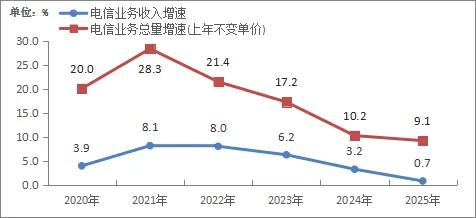
The growth of telecom service revenue and total telecom service volume from 2020 to 2025. Image source: Official website of the Ministry of Industry and Information Technology
It is worth noting that in the current stock market of traditional services, the telecommunications industry is trapped in a situation of "increasing volume but not increasing revenue": the traffic is still expanding, but the revenue has not increased.
In 2025, the mobile Internet access traffic reached 395.8 billion GB, and the monthly per - user mobile Internet traffic (DOU) reached 20.74 GB/user·month, with year - on - year increases of 17.3% and 14.1% respectively. In contrast, the annual revenue from mobile data traffic services in 2025 decreased by 3.1% compared with the previous year, marking the third consecutive year of negative growth for this indicator.
Jiemian News' review found that in the past three years, the mobile Internet access traffic has always maintained double - digit growth, but the growth rate of service revenue has been hovering in the negative growth range, at - 0.6%, - 1.5%, and - 3.1% respectively. The logic of traffic monetization is no longer straightforward.
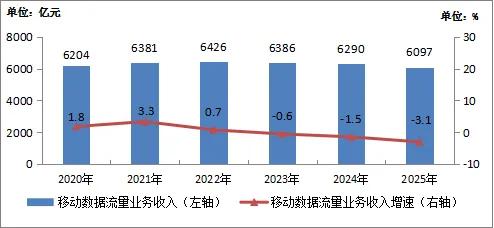
The revenue from mobile data traffic services from 2020 to 2025. Image source: Official website of the Ministry of Industry and Information Technology
The growth of the user scale has reached its peak. By the end of 2025, the total number of telephone users nationwide reached 1.987 billion, with a net increase of 30.91 million throughout the year. The total number of fixed Internet broadband access users of the three major operators reached 691 million, with a net increase of only 20.99 million throughout the year.
In addition, the trends of voice and SMS services are similar. In 2025, the volume of national mobile SMS services increased by 14.2% compared with the previous year, but the service revenue decreased by 2.4% year - on - year. Meanwhile, affected by factors such as instant messaging software, the total outgoing call duration of national mobile phones was 2.02 trillion minutes, a year - on - year decrease of 5.1%. The revenues from fixed - voice and mobile - voice services were 16.09 billion yuan and 109.2 billion yuan respectively, with a year - on - year increase of 2.3% and a decrease of 1.7% respectively.
The fixed Internet broadband access service is the only traditional service that has seen growth. In 2025, the revenue reached 289.6 billion yuan, a year - on - year increase of 5.9%, and its proportion in the total revenue rose to 16.5%. The total number of fixed Internet broadband access users of the three basic telecom enterprises reached 691 million, of which 34.5% were users with an access speed of 1000 Mbps or higher.
Against this background, operators are focusing on exploring new business growth points. Emerging services such as cloud computing, big data, mobile Internet of Things, and data centers are regarded as new engines to drive revenue growth.
In 2025, the revenue from emerging services reached 450.8 billion yuan, a year - on - year increase of 4.7%. Its proportion in the total telecom service revenue rose from 25% in the previous year to 25.7%, driving the growth of telecom service revenue by 1.2 percentage points. Among them, the revenues from cloud computing, big data, and mobile Internet of Things services increased by 2.9%, 7.8%, and 4.9% respectively.
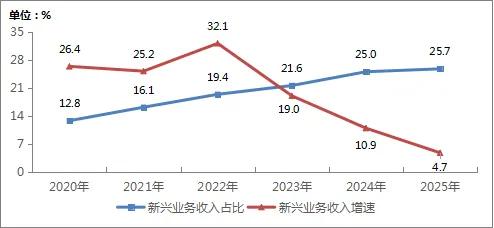
The development of emerging service revenue from 2020 to 2025. Image source: Official website of the Ministry of Industry and Information Technology
However, the growth of emerging services has also shown a relatively obvious decline. After reaching a peak of 32.1% in 2022, the growth rate has been declining all the way and suddenly dropped to single - digits this year.
The investment in communication infrastructure construction has maintained its scale. Data shows that by the end of 2025, the total number of 5G base stations nationwide reached 4.838 million, accounting for 37.6% of the total number of mobile phone base stations. Among them, the number of base stations with 5G RedCap (lightweight 5G) access capabilities reached 2.064 million.
Simultaneous with network construction is the expansion of computing facilities and computing networks.
In 2025, the number of racks provided for external services by the three basic telecom enterprises reached 938,000, an increase of 108,000 compared with the previous year. The scalable intelligent computing power scale exceeded 94.4 EFlops (quadrillion floating - point operations per second, FP16), a year - on - year increase of 87.6%. Meanwhile, the length of newly built optical cable lines was 2.113 million kilometers, and the total length of optical cable lines nationwide reached 74.99 million kilometers. Among them, the lengths of long - distance optical cable lines and local network relay optical cable lines were 1.143 million and 30.06 million kilometers respectively, with year - on - year increases of 1.4% and 8.5% respectively.
For telecom operators, a more long - term consideration is to pave the way for the next - generation traffic form. The "Proposal of the Central Committee of the Communist Party of China for Formulating the 15th Five - Year Plan for National Economic and Social Development" released at the end of 2025 clearly stated that it is necessary to moderately and proactively build new - type infrastructure, promote the construction and intensive and efficient utilization of information and communication networks, the national integrated computing network, and major scientific and technological infrastructure, and promote the renewal and digital and intelligent transformation of traditional infrastructure.
Wang Haobo, CTO of Ericsson China, previously pointed out in an interview with Jiemian News and other media that operators need to build a "data - centric infrastructure (DCI)" during the transformation period. Future network computing will no longer be limited to the traditional concept of "network elements" but will shift to computing based on agents. This architectural adjustment aims to leverage operators' unique advantages in data nodes to provide more efficient computing power support for future machine traffic and AI services. According to Ericsson's calculations, if the penetration rate of smart glasses reaches 20% of mobile phone users, the network upstream traffic will increase by 100%.
Standing at the threshold of the 15th Five - Year Plan, when the computing network is implemented on a large scale, how to break the dilemma of "increasing volume but not increasing revenue" relying on AI technology and big - data scenarios will be the core issue that the communication industry will continue to face.
This article is from "Jiemian News". Reporter: Zhou Mo. Republished by 36Kr with permission.