HomeArticle

At the beginning of the year, the semiconductor industry has been "bombarded" by price hikes.

半导体产业纵横2026-01-30 19:34
Rising, rising, rising! At the beginning of 2026, semiconductor price increase notices have been intensively issued.

At the beginning of 2026, the semiconductor industry was given an "acceleration boost" by a flurry of price increase notices.

Among them, three core domestic chip companies successively issued price adjustment letters, becoming the most notable industry signal in the price increase wave at the start of the year.

Three chip companies issue consecutive price increase letters

Bieasy Micro issues a price increase notice today

On January 30th, Bieasy Micro, a domestic enterprise engaged in the design of analog and analog-digital hybrid integrated circuits, issued a product price adjustment notice. Affected by the continuous price increase of upstream raw materials and the shortage of production capacity, to ensure the stability of the supply chain and product delivery, Bieasy Micro will increase the prices of its entire product series from now on. The specific models and price increase ranges will be communicated one-on-one with customers by the sales team.

Guoke Micro raises prices by up to 80%

On January 20th, Guoke Micro sent a formal price increase notice letter to its customers, announcing that it would adjust the prices of multiple packaged KGD (Known Good Die) storage products starting from January 2026 to cope with the pressure of the tight supply chain and rising costs across the industry.

According to the notice letter, this price adjustment is mainly affected by the tight supply of storage chips, the significant increase in raw material costs, and the continuous rise in fees for components such as substrates, frames, and packaging and testing. The company said that the supply gap of packaged KGD chips is expected to further widen, and the cost pressure will intensify. Therefore, after careful consideration, it has decided to adjust the prices.

The specific price adjustment ranges for products are as follows:

  • The price of packaged 512Mb KGD products will be increased by 40%;
  • The price of packaged 1Gb KGD products will be increased by 60%;
  • The price of packaged 2Gb KGD products will be increased by 80%.

In addition, the price adjustment for products with external DDR will be notified separately. Guoke Micro also mentioned in the letter that the price increase of products in the second quarter of 2026 will be adjusted accordingly based on the price fluctuations in the KGD market at that time, and the specific implementation strategy will be announced later.

It is worth noting that recently, Guoke Micro released a profit warning for 2025, forecasting a loss.

The announcement shows that the net profit attributable to shareholders of the listed company is expected to be a loss of 180 million to 250 million yuan, while the same period last year was a profit of approximately 97.15 million yuan; the net profit after deducting non-recurring gains and losses is expected to be a loss of 210 million to 280 million yuan. Regarding the reasons for the performance change, the company previously explained that the significant increase in R & D and period expenses and the decline in gross profit of some products due to the failure to increase prices accordingly were the main factors. This comprehensive price increase may aim to reverse the situation of the company's product gross profit under pressure and improve its future profitability.

AMEC raises prices by up to 50%

On January 27th, AMEC issued a "price increase notice letter", announcing that it would adjust the prices of products such as MCUs and Nor flash from now on, with a price increase range of 15% - 50%. The reasons for the price increase given by AMEC are similar to those of Guoke Micro.

The performance forecast released by AMEC on the evening of January 25th showed that according to the preliminary calculation of the finance department, the company is expected to achieve an operating income of approximately 1.122 billion yuan in 2025, a year-on-year increase of approximately 23.07%. It is expected to achieve a net profit attributable to the owners of the parent company of approximately 284 million yuan in 2025, a year-on-year increase of approximately 107.55%; the net profit attributable to the owners of the parent company after deducting non-recurring gains and losses is approximately 169 million yuan, a year-on-year increase of approximately 85.36%.

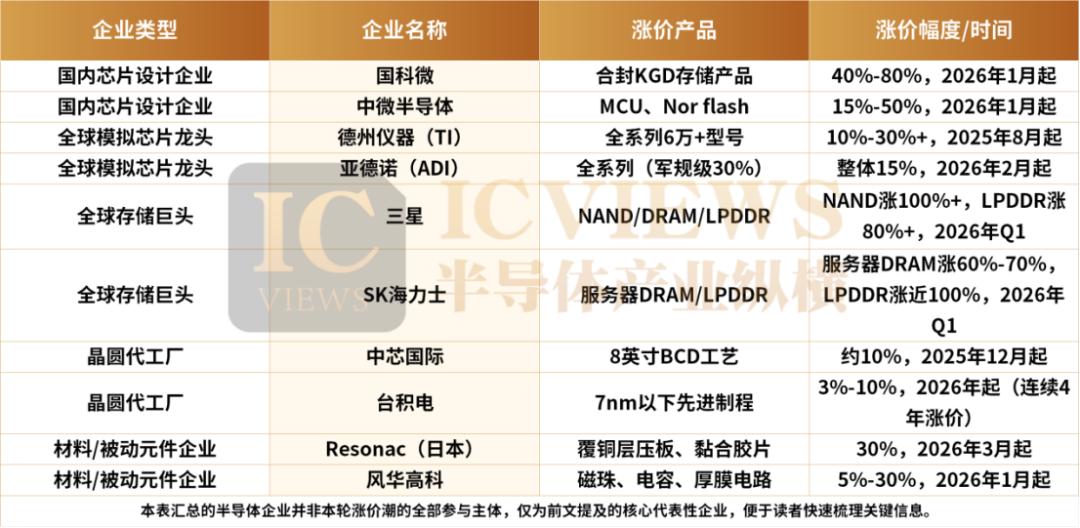
The price increases of domestic enterprises are not isolated events. Global semiconductor giants have already started the price increase mode, especially in the field of analog chips. The frequent actions of the two leading companies have indicated that the market has entered a strong recovery period.

As the global leader in analog chips, Texas Instruments (TI) took the lead in starting the price increase mode in August 2025, covering more than 60,000 models, with a general price increase of more than 10% - 30%, covering multiple downstream fields such as consumer electronics and industrial control. Following closely, Analog Devices (ADI) issued a price increase notice in December 2025, planning to adjust the prices of its entire product series starting from February 1st, 2026, using a differentiated plan: the overall price increase is about 15%, and the price of nearly a thousand military-grade MPNs products (suffix / 883) will increase by as much as 30%. Currently, the specific implementation details are in the final stage of being finalized.

More notably, the price increase wave has spread from the chip design stage to the upstream and downstream links such as foundry, packaging and testing, and passive components, forming a resonance across the entire industry chain.

The semiconductor price increase goes beyond this

In the storage field, global storage giant Samsung Electronics has officially raised the supply price of NAND flash memory in the first quarter of 2026 by more than 100%. This significant price adjustment follows a nearly 70% increase in the price of its DRAM memory. SK Hynix plans to increase the price of server DRAM in the first quarter of 2026 by 60% to 70% compared with the fourth quarter of 2025. Meanwhile, Samsung Electronics and SK Hynix have completed negotiations with Apple and will significantly raise the price of low-power DRAM (LPDDR) supplied to Apple's iPhones in the first quarter of this year. Among them, Samsung's quoted price has increased by more than 80% compared with the previous quarter, and the increase given by SK Hynix is close to 100%.

In the foundry segment, driven by the growing demand for AI-related power chips and production cuts by major manufacturers, the supply - demand pattern of 8 - inch wafers has changed. Against the backdrop of production cuts by giants such as TSMC and Samsung, global wafer foundries are all brewing price increases. In December last year, SMIC, China's largest wafer foundry, sent a price increase notice to some customers, raising the price of some production capacities by about 10%. This price increase is not a full - scale one but is mainly concentrated on the 8 - inch BCD process platform. A platform - type chip design enterprise revealed that it also received a price increase notice from VIS at the same time, and the price increase range of the latter on the BCD platform also reached 10%.

The news of price increases for advanced processes came much earlier. In November last year, TSMC announced that it would continue to raise the quotation for advanced processes (below 7nm) this year, and the price increase for advanced processes is expected to reach 3% to 10%. This is already the fourth consecutive year that the world's largest wafer foundry has raised its prices.

In the packaging and testing segment, the price increase trend is even more intense. The price of back - end wafer packaging and testing services of leading enterprise ASE is expected to increase by 5% - 20% in 2026. The price increase of memory packaging and testing factories such as Powertech Technology and Huadong is as high as 30%. Currently, the capacity utilization rate of leading packaging and testing enterprises has almost reached full capacity, and the order scheduling has been continuously extended.

Passive components have not escaped either. Against the background of the "epic" surge in the prices of raw materials such as silver, copper, and tin, a price - increase cycle covering key categories such as tantalum capacitors, resistors, inductors, and MLCCs has been established. In January, Resonac, a major Japanese semiconductor material company, announced that due to the tight supply - demand situation and soaring prices of raw materials such as copper foil and glass cloth, coupled with the significant increase in labor costs and transportation fees, it will raise the prices of copper - clad laminates and adhesive films by 30% starting from March 1st, 2026.

Fenghua Hi - Tech issued a price adjustment notice, pointing out that the significant increase in the prices of metal materials such as silver, tin, copper, bismuth, and cobalt has brought huge cost pressure to the company. The company has raised the prices of bead products of sizes such as 1608, 2012, and 3216 by 5 - 25%; for varistor and ceramic capacitor products in the silver - electrode series, the prices have been raised by 10 - 20%, and at the same time, new materials and processes of copper - electrode substitutes are recommended; the prices of thick - film circuit products have been raised by 15 - 30%. In addition to listed companies, many small and medium - sized enterprises have also joined the ranks of price adjustments. A group of small and medium - sized manufacturers such as Xiamen Hongfa, Nanchong Yihui Electronics, Zhejiang Jiuwei Electronics, Anhui Fujie Electronics, Ningbo Dingsheng Microelectronics, Jiangxi Changlong Technology, and Shenzhen Heketai Electronics have successively announced price adjustments, with an adjustment range generally between 5% - 20%, covering multiple categories such as thick - film chip resistors, special wafer resistors, and semiconductor devices.

Analysis of three core logics behind the price increase wave

The semiconductor price increase wave at the beginning of 2026 seems to be fierce, but upon closer examination, the price increase logics of different categories are completely different. The author divides them into three types.

The first type is the cyclical bottom - rebound type, mainly covering storage chips and analog ICs. The core logic is the natural recovery of the industry after inventory reduction and the elimination of bubbles.

The storage industry has experienced a two - year downward cycle. Leading manufacturers such as Samsung and Micron have gradually reduced the inventory level to a reasonable range through proactive production cuts. Coupled with the explosion of the computing power demand of AI servers and the arrival of the peak season for stocking flagship smartphone models, the prices of storage chips such as DRAM and NAND have been directly pushed up significantly under the resonance of these two factors. In the field of analog ICs, the leading companies dominate. Industry giants such as Texas Instruments and ADI, with a high market concentration, took the lead in starting price adjustments at the beginning of the demand recovery - not only to repair profits and make up for previous losses but also to squeeze the market share of small and medium - sized manufacturers. This type of price increase has strong sustainability and is likely to continue the upward trend in the first half of 2026.

The second type is the cost - driven type, mainly covering power semiconductors (such as MOSFETs and IGBTs) and passive components (such as MLCCs and resistors). The core is that enterprises are forced to adjust prices passively due to the pressure of upstream costs.

The continuous rise in the prices of core materials such as upstream silicon wafers and copper foils, as well as precious metals such as silver and tantalum, coupled with the price increase of 8 - inch wafer foundry services by foundries such as SMIC, have directly led to a significant increase in the production costs of enterprises, and the profit margins have been significantly squeezed. However, the downstream demand support is weak, and the orders in the consumer electronics and general industrial fields are mediocre. To control costs, downstream customers are actively promoting low - cost material substitution plans (such as using copper electrodes to replace silver electrodes), which may lead to obstacles in the transmission of price increases.

The third type is the event - driven type, focusing on advanced processes (below 7nm) and AI - related chips (such as HBMs and GPUs). The core logic is the superposition of the dividends of technological upgrading and short - term production capacity bottlenecks.

Currently, only TSMC and Samsung in the world have the mass - production capacity for advanced processes below 7nm, and the production capacities of 3nm and 2nm are basically locked by leading customers such as Apple and NVIDIA. These manufacturers have absolute pricing power with their scarce production capacities, which drives the prices to continue rising. At the same time, the intensification of the computing power competition in the AI industry has directly detonated the demand for supporting chips such as HBMs, driving the prices to rise significantly. It should be noted that this type of demand is concentrated in parts of the AI industry chain and highly depends on orders from leading manufacturers, and the price volatility is significantly higher than that of cyclical products.

Recently, the semiconductor market size forecast data for 2025 and 2026 released by the World Semiconductor Trade Statistics (WSTS) showed that the global semiconductor revenue in 2025 will increase by 22.5% year - on - year to 772 billion US dollars, and will further increase by 26.3% in 2026, reaching 975 billion US dollars, approaching the 1 - trillion - dollar mark.

The growth of global semiconductor revenue in 2025 mainly benefited from the strong demand for artificial intelligence applications and data center infrastructure, which promoted the growth of demand for logic chips and storage chips. Specifically, the revenue of logic chips in 2025 is expected to increase by 37.1% year - on - year, which is the product category with the largest increase; followed by storage chips, with the revenue increasing by 27.8% year - on - year; the revenue of sensors will increase by 10.4% year - on - year; the revenue of microprocessors will increase by 7.9% year - on - year; the revenue of analog chips will increase by 7.5% year - on - year; the revenue of optoelectronic components will increase by 3.7% year - on - year; affected by the weak demand in the automotive field, the revenue of discrete components will decline by 0.4% year - on - year.

WSTS also pointed out that storage and logic ICs will still be the main growth drivers in 2026, with their growth rates both exceeding 30%, increasing by 39.4% and 32.1% respectively. Combining the market forecast with the three types of price increase logics, it is not difficult to see that the high - growth of the semiconductor industry in 2026 is not a full - scale price increase but a concentrated release of structural opportunities.

This article is from the WeChat official account "Semiconductor Industry Insights" (ID: ICViews), author: Feng Ning. It is published by 36Kr with authorization.