Investing $20 billion, Tesla quietly kicks off a new round of "entrepreneurship".
Tesla is entering an interesting "transition period".
On the one hand, its automotive business has declined for two consecutive years. In the just - past 2025, Tesla's overall vehicle deliveries decreased by 153,000 units, and its automotive revenue shrank by 10% year - on - year. Tesla has officially lost its crown as the world's top - selling pure - electric vehicle brand to BYD, and the gap may further widen in the future.
On the other hand, Elon Musk himself doesn't seem worried about this decline. When talking about the 2026 plan, he ignored almost all topics related to car sales. Instead, he announced a capital expenditure plan of up to $20 billion. This expenditure will be used for six new production lines, including those for the humanoid robot Optimus and the autonomous vehicle Cybercab, as well as for computing power construction related to model training.
Bloomberg estimates that with the stagnant growth of the automotive business, Tesla's accounts are expected to shrink by $6 billion in 2026.
Over the years, the outside world has been divided on Musk's claim that "Tesla is an AI company". The controversy largely stems from his repeated delays in fulfilling various promises regarding autonomous driving and robots, and the market has yet to see a relatively complete and clear business model. This time, in the $20 - billion capital plan, Musk has clearly revealed more "paths" and "clues" on how to realize his dreams.
While the mainstream narrative of global automakers has converged on the final - stage competition, Tesla, which is good at going against the consensus, has quietly entered a new cycle of "money - burning entrepreneurship".
01 Car Sales Are No Longer the Focus
From a recent decision and an expression, we can clearly feel that Musk is not interested in the "final - stage competition".
The decision is that Tesla will stop producing the high - end models Model S and Model X starting from the second quarter of this year and will convert the production line at the California factory for mass - producing the Optimus robot.
The expression is that when analysts asked again about the "affordable models" (the rumored Model 2/Model Q) in the face of a 10% decline in deliveries in 2025, Lars Moravy, the vice - president of Tesla's vehicle engineering, replied that it depends on our time and energy.
The implication is that our management bandwidth is limited, and the autonomous vehicle Cybercab and FSD are more important. Developing new, more affordable models and continuing to compete in the global automotive market's final - stage competition are clearly not Tesla's goals at this stage.
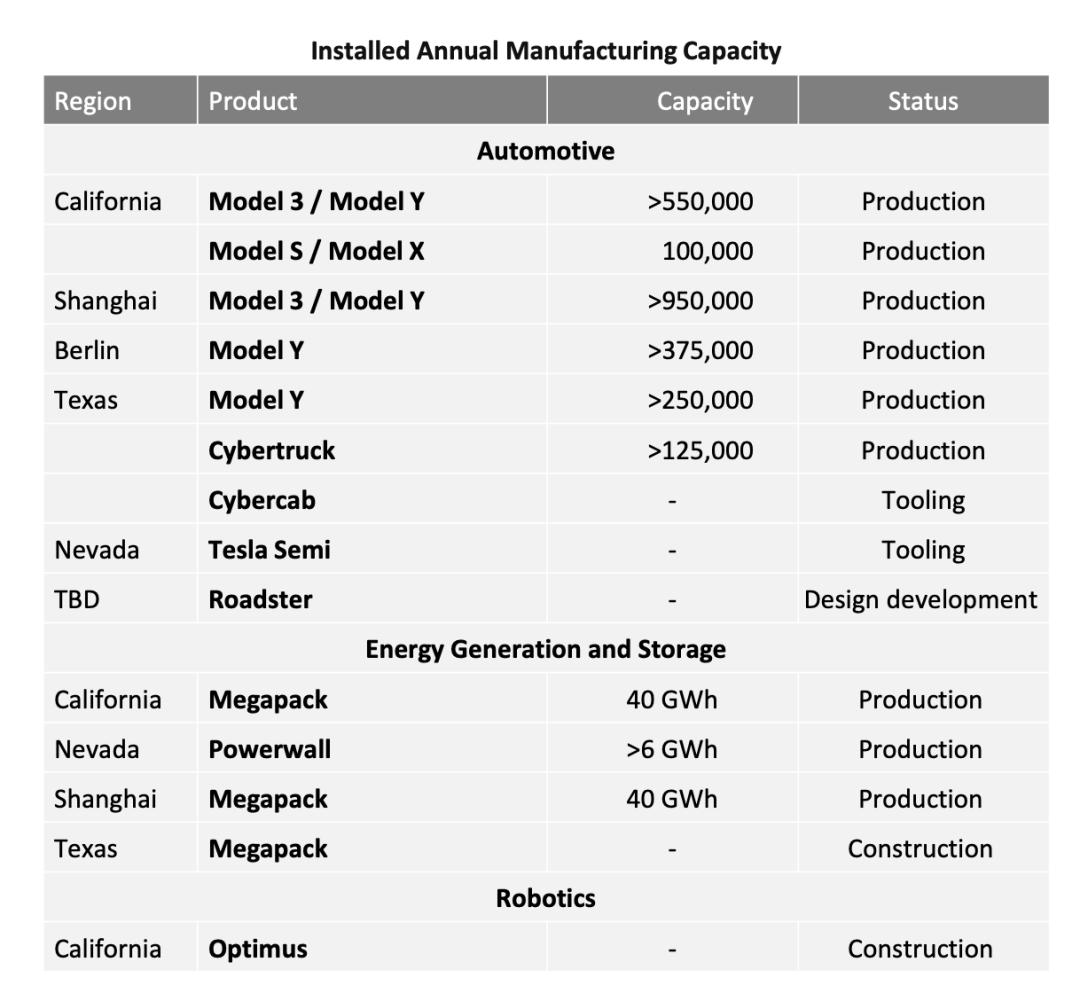
Tesla's current production capacity plan | Source: Earnings report
I believe many automakers around the world that are desperately trying to gain an edge can breathe a sigh of relief after hearing this.
Actually, there have been early signs of Musk's lack of focus on car sales.
Due to its minimalist SKU and design style, many consumers compare Tesla to the "Apple of the electric - vehicle field". However, Tesla doesn't seem to share Apple's extreme pursuit of user experience. For example, after Apple removed the 3.5mm headphone jack, it immediately offered consumers a new choice, AirPods (and also made some extra money). In contrast, Tesla's "minimalist design" has forced users to adapt to awkward screen - based gear shifting and button - operated turn signals.
Therefore, Tesla is not a completely "user - oriented" enterprise but a "technology - oriented" company. Compared with an extreme user experience, Musk cares more about the cost changes brought by technology.
This approach once gave Tesla a huge first - mover advantage in the early years. In Q1 2022, Tesla's gross profit margin in the automotive business (excluding carbon credit sales) exceeded 30%.
However, it also left a lot of opportunities for competitors. Automakers in China and Europe can meet more specific needs of users by refining product details. At the same time, since the configuration of Tesla's existing models can hardly be further reduced, and as technologies such as integrated die - casting have been caught up with, and the 4680 battery, which was supposed to reduce costs by 50%, has made little progress, it's not surprising that Tesla's market share outside the United States has been gradually eroded by competitors such as BYD, Chinese new - energy vehicle startups, and Volkswagen.
The good news for Tesla is that even in the face of intensified competition and price cuts, Tesla's annual gross profit margin in the automotive business (excluding carbon credits) remained the same as in 2024, at 15.4% (it returned to 17.9% in Q4). Throughout the year, the automotive business brought Tesla a total gross profit of $12.38 billion, of which $10.38 billion came from "car sales" and $1.99 billion came from "credit sales". It is expected that in 2026, the automotive business will still be Tesla's largest business segment in terms of finance.
Building a business that allows the CEO to "earn easily" over more than a decade is what the automotive business currently means to Tesla.
02 Energy Storage: The Overlooked "Cash Relay Baton"
In Tesla's annual earnings report, the energy business was the biggest surprise.
In 2025, thanks to a 49% surge in energy - storage deployment to 46.7 GWh, Tesla's total annual revenue from the energy business reached $12.8 billion, a 27% increase from the previous year. The gross profit margin rose to 29.8%, hitting a record high for five consecutive quarters, significantly higher than that of the automotive business.
What drove the significant growth of the energy business was Megapack, an energy - storage product for B2B scenarios. In fact, Megapack was launched in the market as early as 2019. However, in that "pre - large - model era", electricity was not yet a hard - core need and a prominent field of study. So, its narrative of energy - storage economics (making money by balancing peak and off - peak electricity prices) was regarded as a burden for a long time.
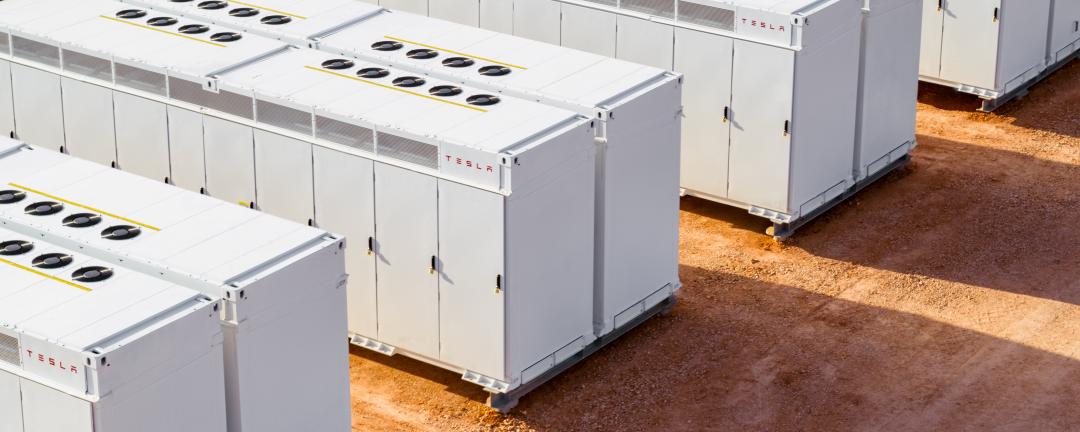
Tesla's Megapack energy - storage system | Source: Tesla Energy
However, with the advent of the large - model era, there have been two key changes in electricity demand: the electricity consumption has increased rapidly, and it is expected that the electricity consumption of data centers in the United States will double by 2030. In addition, the power grid requires extremely strict "zero interruption" because any voltage fluctuation may invalidate a training process that lasts for weeks.
There are two main core reasons why Megapack can ride on the wave of the large - model era:
First, policy - driven demand and price advantages, which are generally similar to the logic of tariff wars in car sales. For US customers, buying Megapack products at this stage can enjoy tax credits, making them cheaper than directly purchasing energy - storage products from BYD or CATL. Coupled with the "green - electricity" policies launched by some states, the demand for solar energy and energy storage in public services will also increase.
Second, and more importantly, Megapack's integrated design saves more time. Tesla officially promotes that Megapack can be installed four times faster than traditional assembled energy - storage systems, reducing the deployment cycle from "months" to "weeks". This is like being able to buy "ready - made products" instead of "futures" when building a training center, which also supports a certain "spot - price premium".
Recently, Tesla announced that it had sold an energy - storage order worth about $430 million to xAI, another company under Elon Musk. At the same time, US media generally believe that in addition to Amazon, technology giants such as Google, Microsoft, and Meta have also deployed Megapack products in their AI data centers through indirect purchases.
According to the factory production capacity disclosed in the financial report, the two energy - storage factories in California and Shanghai can contribute an annual production capacity of 80 GWh when operating at full capacity. This means that with the still - strong AI demand at present, Tesla's energy business is likely to continue its high - speed growth in 2026.
However, energy - storage facilities still require production and construction similar to that of cars, and they do not have the characteristic of zero marginal cost like Amazon Web Services. Therefore, after the market matures, their gross profit margin will probably return to the level appropriate for public services and it is difficult to maintain at 30% for a long time or become the so - called "second growth curve".
But at least before the large - scale commercialization of FSD and robots, it is expected to provide key funds and financial support for Tesla's innovation exploration process.
03 Musk Is Ready to "Burn Money"
In terms of autonomous driving and robots, Tesla's development last year seemed a bit disappointing in reality.
In 2025, FSD entered the Chinese market amid high expectations, but the rumored "incomplete version" didn't lead to an increase in sales or subscriptions.
According to official data, the current number of active FSD users globally has reached 1.1 million, an increase of 300,000 from the previous year, with a penetration rate of about 12.3%. However, although the latest V14 version has received unanimous praise from the industry, and even Jim Fan, the head of Nvidia's robotics business, praised it as "passing the robot Turing test", as long as it remains a "regulated version", it's difficult to get a large number of users to pay a monthly subscription fee of $99.
Currently, the two core bottlenecks in autonomous driving are technology and policy. On the one hand, at the technical level, the ability to handle corner cases needs to be further improved. Domestic autonomous - driving companies and teams also proposed new architectures such as VLA and world models in 2025. On the other hand, only truly driverless products will have viable commercial potential.
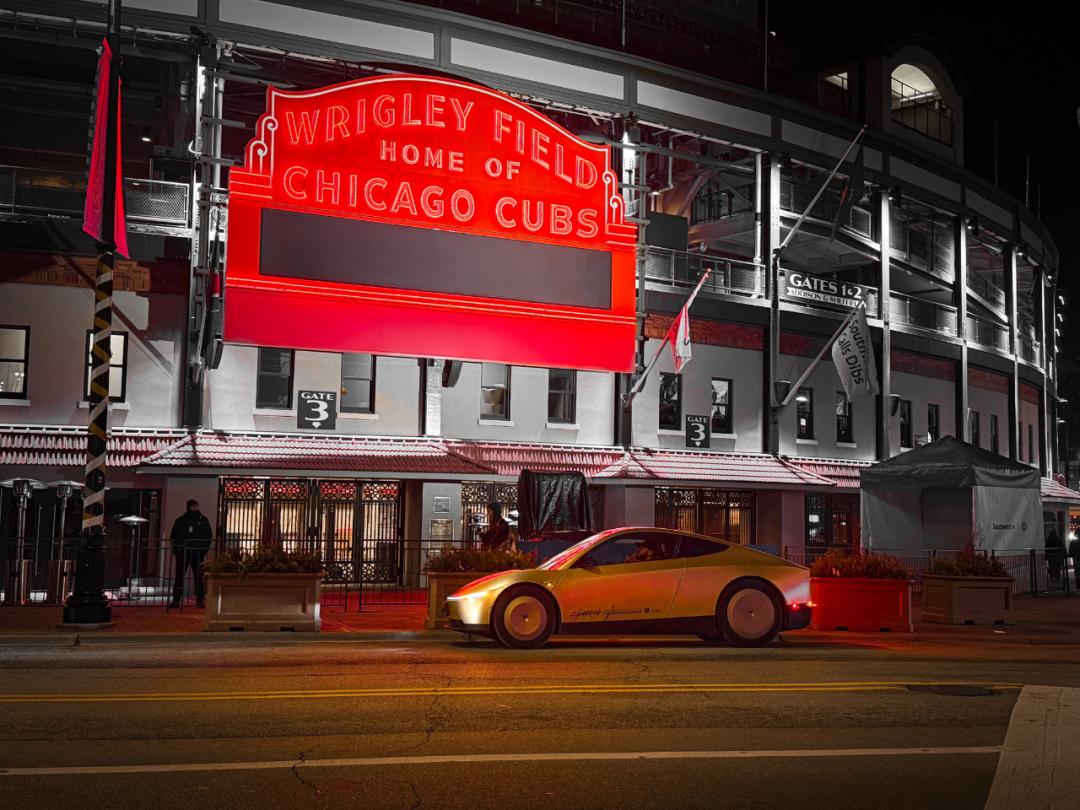
The two - door, two - seat autonomous vehicle Cybercab is scheduled to start production in the first half of this year | Source: Tesla
This time, Musk, unusually, didn't make too many grand promises or set various flags for mass production, driverless operation, and commercialization. However, we can find some clues about technological development from his $20 - billion capital expenditure plan and Tesla's next - generation product plan.
First, part of the $20 billion will be used for AI training.
In the financial report, Tesla clearly disclosed a plan to expand its computing power: in the first half of 2026, it will double the scale of the Cortex AI training center in Texas. Given that Cortex 1 currently has more than 100,000 H100 - equivalent computing power units, if we roughly estimate based on the cost of adding 100,000 computing cards and the high - cost supporting liquid - cooling and power infrastructure, the investment in this single item will be as high as about $3 billion.
The core motivation for this investment is the hunger for computing power. When describing the reasons for the expansion, Tesla emphasized the existing "training backlog". This directly proves that in Tesla's view, the Scaling Law in the field of autonomous driving is far from reaching its limit. The current bottleneck is not that data cannot be fed in, but that the computing power cannot handle it. In other words, Tesla firmly believes that as long as the computing power catches up, the emergence of model intelligence will continue.
This judgment is perfectly corroborated by the design of the next - generation in - vehicle inference chip, AI5. The design goal of this chip, which is expected to go into production in 2027, is astonishing: a 10 - fold increase in computing power, a 9 - fold increase in memory, and a 50 - fold increase in overall performance.
Therefore, if a giant model with 10 times more parameters cannot be trained in the cloud, the 9 - fold increase in memory of the in - vehicle AI5 will be meaningless. Therefore, the cloud - side expansion of Cortex is not only to solve the current backlog but also to prepare in advance for the AI5 and even the next - generation AI6 chips in two years.
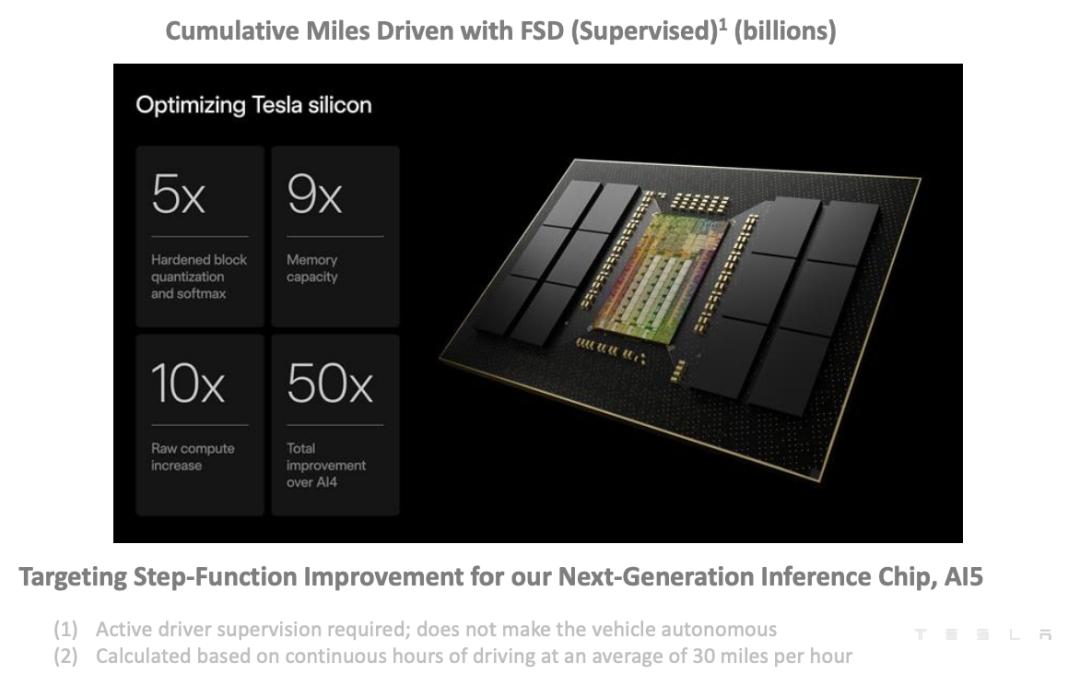
The design goals of Tesla's next - generation autonomous - driving in - vehicle chip AI5 | Source: Earnings report
Another major part of the $20 billion is the investment in manufacturing. Tesla will make a clear investment in the production lines of the Cybercab and the Optimus robot this year. Although in 2026, the Cybercab will probably only be produced on a small scale, and the Optimus is more likely to be in the "testing" phase of mass production rather than "delivery", it's obvious that Musk is betting on the next era in advance. This is a period of high investment with possibly no immediate output.
At the beginning of 2026, the idea that "automotive companies will inevitably move towards embodied intelligence" has gradually become a prominent view, and the bold Musk has used $20 billion to announce that he is raising the stakes again at the table of the future.
This article is from the WeChat official account “GeekPark” (ID: geekpark), author: Cao Siqi. It is reprinted by 36Kr with permission.