As AI glasses move towards large-scale adoption, how does Guangna Siwei reconstruct the optical track?
At the recently concluded "Tech Spring Festival Gala," the Consumer Electronics Show (CES), AI glasses have undoubtedly emerged as one of the hottest sectors under the spotlight.
From Meta kickstarting the era of AI glasses in 2023 to the product explosion in 2025, the industry has witnessed a "hundred-glasses contention" scenario. A large number of players, including XR technology companies, AI glasses startups, internet giants, major smartphone manufacturers, and cross - border enterprises, have flocked to the sector. As a result, AI glasses have evolved from geeky toys to products in the mass consumer market.
Meanwhile, the industry has officially entered the scale - up phase, and "explosive orders" have become the most tangible experience. During CES 2026, tech giant Meta announced that its international market expansion plan, originally scheduled to start at the beginning of the year, had to be postponed because the Meta Ray - Ban series launched last year sold extremely well. In China, there has also been a shortage of supply for the best - selling models of various manufacturers.
AI glasses have become a new growth pole in the consumer electronics field. According to IDC's prediction, in 2026, the global shipment of smart glasses is expected to exceed 23.687 million units, marking a turning point for the market to achieve scale.
For participants in the sector, this is not only a challenge to product innovation and scenario adaptation capabilities but also a test of the ability to break through production capacity bottlenecks. This has also propelled the AR industry to officially enter the phase of large - scale explosion.
As a core supplier of optical waveguide devices upstream in the sector, "Guangna Siwei" was the first to sense the industry trend. After completing hundreds of millions of yuan in financing, it accelerated the expansion of production.
Currently, this company, founded in 2021 and dedicated to the R & D and production of AR diffractive optical waveguide micro - nano optical devices, has built a production line with an annual capacity of nearly one million sets. It will exceed one million sets of production capacity in 2026, leveraging its full - chain technological advantages and large - scale delivery capabilities to meet the surging global market demand.
Behind the Explosive Orders: An "Arms Race" Concerning the Upstream Core Technological Strength
The in - depth integration of AI and AR is the most core technological trend in current smart glasses.
However, when AI has become a "standard feature" of tech products, the key factor that makes 2026 a turning point for AI glasses, widely recognized in the industry, focuses on another core: optical waveguide devices, which directly determine the upper limit of the product.
Looking back at the development of AR glasses, from Google's launch of the first - generation Google Glass in 2012 to the widespread layout by global giants and startups, it wasn't until 2019, when there was a significant advancement in the field of optical display technology, that the optical waveguide technology emerged. This technology can provide higher light efficiency, a larger field of view, and a better yield rate, promoting the products to become lighter, have better display effects, and lower costs. It truly laid the foundation for the explosion of AI glasses.
As the industry moves towards scale, the competition is no longer confined to the terminal but has evolved into an "arms race" of upstream core technological strength. In the field of optical waveguide devices, only manufacturers with the capabilities of independent design, self - developed equipment, core materials, and rapid process iteration can help terminals gain advantages in delivery speed, cost control, and customization capabilities.
On one hand, in the field of smart hardware, the most expensive cost is not materials but "uncertainty" - repeated R & D cycles, fluctuations in mass - production yield rates, and interruptions in the supply of key components, which can potentially undermine an excellent product definition at any time. On the other hand, under the industry's common model of "R & D order - product adaptation - mass production transfer," the time cycle of the industrial chain is often long, posing a great challenge to the rapid response to market demand.
"Speed" and "stability" have become the rarest capabilities in the industry. "Guangna Siwei" is precisely a company with these dual capabilities. Although this optical waveguide device supplier, founded in 2021, is not an early entrant in the industry, it has achieved a several - ten - fold increase in revenue in four years, with a 61.4% global market share of waveguide sheets and the world's highest single - product shipment volume.
The key lies in the two keywords, "speed" and "stability."
In 2023, "Guangna Siwei" started contacting its first AR glasses mass - production customer. Compared with other suppliers of this customer, this was half a year later. However, thanks to its rapid iteration ability, "Guangna Siwei"'s samples were the first to meet all the customer's design requirements. Relying on its stable mass - production ability, it became the customer's primary supplier.
This challenge was comprehensive, especially when the industry mainly focused on increasing the FOV and creating immersive AR glasses. At that time, this customer was one of the few in the industry to propose that the product should eliminate rainbow patterns, increase transmittance, and reduce weight and thickness. This required comprehensive consideration in many aspects, such as the grating layout of optical waveguide devices, the selection of refractive materials, parameter design, and geometric layout.
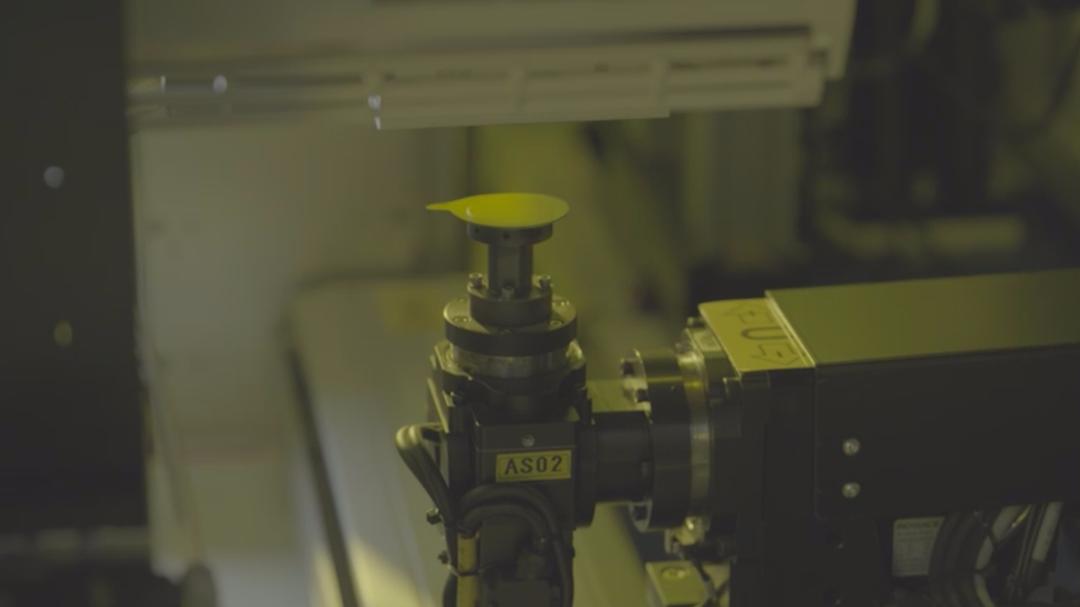
Behind "Guangna Siwei"'s path from design to mass production is an IDM (Integrated Device Manufacturer) model that it chose from the beginning of its entrepreneurship. This model involves self - research and self - control in all aspects, from the design and manufacturing of diffractive optical waveguide chips to packaging and testing, enabling it to overcome the core challenges in terms of performance, consistency, and cost of optical waveguide chips.
For example, through innovation and accumulation of core algorithms, "Guangna Siwei" self - developed the optical design software SEEVerse, achieving an operation efficiency ten times higher than similar software on the market. Relying on this software, "Guangna Siwei" set an industry record of delivering samples within 68 hours after demand docking, having an absolute leading advantage over the industry's common several - week iteration cycle. This has also become its greatest support to "catch up from behind."
It's worth mentioning that in 2023, the AR glasses project still had to deal with the huge gap between excellent optical performance and a price acceptable to the general public. The industry often found itself in the embarrassing situation of having to "choose one of the two." However, "Guangna Siwei" achieved a "both - and" dimensionality - reduction strike through full - chain technology layout and underlying technology innovation.
In the single - green display sector, "Guangna Siwei" globally introduced metasurface technology for the first time in its new production line, SEEFab. This not only increased the performance by 30% - 50% but also reduced the overall cost to 50% of the industry level. Moreover, by achieving 100% localization of equipment and raw materials, the production cost was further reduced.
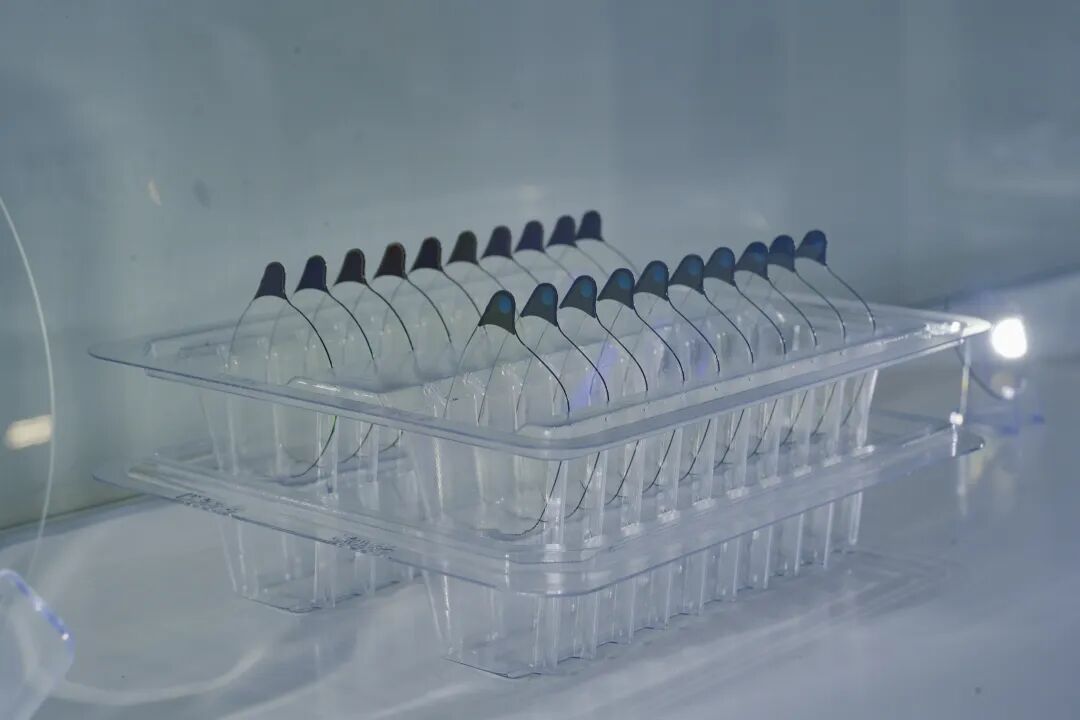
With continuous in - depth technological research, in the field of monochromatic nano - imprinting, "Guangna Siwei"'s products have created waveguide lenses with a thickness of only 0.5mm and a weight of only 2.2g, achieving a 99% ultra - high transmittance and a visual effect without rainbow patterns and ghost images, perfectly meeting the daily wearing needs of consumer - grade products.
From Monochromatic to Full - Color: The Experience Revolution of Always On
"Guangna Siwei"'s "both - and" choice is not to stage an expensive "technology show" but to make good optics a standard feature of smart devices.
In fact, even though AI glasses have moved from being just geeky toys to the mass market, obtaining better performance at a lower price remains the most core demand of consumers.
Focusing on optical display, full - color display is recognized as the future direction of the industry. The realization of full - color display is a necessary condition for AI glasses to become an "Always On" device. This technology can not only significantly improve information acquisition efficiency but also fundamentally enhance the user experience.
Meanwhile, full - color display is also regarded as a key turning point for the industry to achieve popularization. It follows a clear development path, from no display to single - green display on a small screen, then to full - color display on a small screen, and finally to full - color display on a large screen.
However, while monochromatic optical waveguide technology is approaching maturity, full - color waveguides still face the challenge of balancing color reproduction, brightness, and lens thickness. To reduce the iteration cycle of processes and equipment, the industry generally relies on the existing mature semiconductor process, namely "photolithography + titanium oxide etching," to implement full - color waveguide solutions. However, this has also made cost an insurmountable obstacle.
This is an "invisible burden" faced by the entire industry: either sacrifice cost for performance, resulting in high - priced products, or compromise on performance for cost, leading to a poor user experience.
"Guangna Siwei" did not choose to compromise. Through the innovative nano - imprinting 3.0 technology, which uses a high - refractive glass substrate coated with titanium oxide nanoparticle materials, it obtained products with almost no performance difference from the etching scheme using a high - refractive glass substrate coated with titanium oxide materials.
The real - world result is that, on the premise of no difference in optical effects, since expensive equipment such as lithography machines and etching machines are not required, the cost is significantly reduced to 30% of the traditional route, bringing the full - color experience, which was originally only available in high - end products, to a price range more suitable for the general public.
Currently, "Guangna Siwei" has taken the lead in completing the technical reserve for the third - generation single - chip full - color technology and achieved mass production.
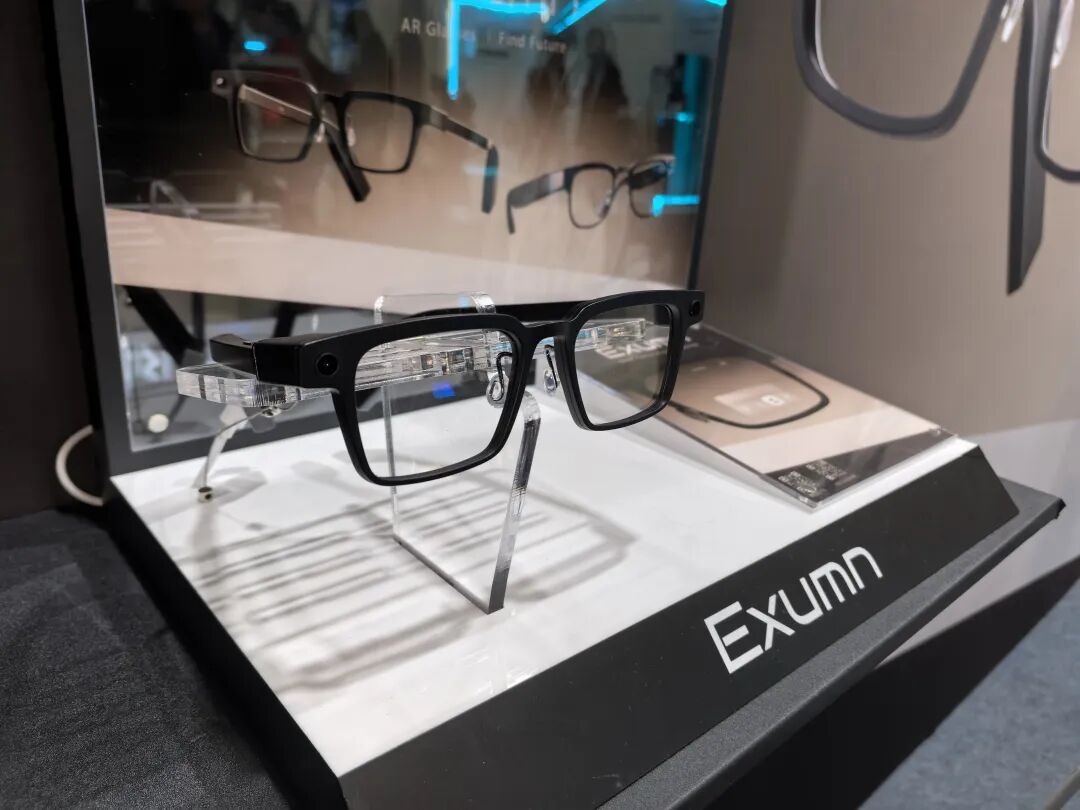
At CES 2026, the AI glasses equipped with "Guangna Siwei"'s C25C nano - imprinted single - layer full - color optical waveguide stole the show. With a 25° field of view, an ultra - high brightness of 2000 nits, a 92% transmittance in the grating area and 99% in the non - grating area, and excellent performance in effectively suppressing the rainbow pattern effect, it won the "CES Design Excellence Award." The product's ultimate display effect and mass - production stability have been highly recognized in the international market.
The C25C nano - imprinted single - layer full - color optical waveguide is a typical example of "Guangna Siwei"'s continuous pursuit of lightweight diffractive optical waveguides. With a thickness of 0.7mm and a weight of 3.5g, it has once again refreshed the industry record for full - color optical waveguides. The C25C nano - imprinting also uses the "optical tunneling" technology for the first time in the industry, significantly improving the production yield and reducing the production cost.
Such an uncompromising spirit has been integrated into the company's genes.
To completely solve the problem of stray light, "Guangna Siwei" has achieved clear display of optical waveguides without after - images and halos through extreme process control in all aspects of the manufacturing end, including nano - level optimization of template accuracy, complete solution to the nano - imprinting demolding problem, and strict management of cleanliness in the entire process.
To solve the problem of multi - layer lens stacking, "Guangna Siwei" has integrated the optical waveguide lens and the electrochromic lens into a single lens through full - bonding technology, significantly reducing the overall thickness of the lens. At the same time, the whole device can pass the FDA ball - drop test, truly meeting the reliability requirements of consumer electronic products.
"Guangna Siwei" has also proposed four "experience innovation" projects, including the Invisible Aesthetics Project, the Pure Display Project, the Full - Color Etching Project, and the Reliable Integration Project, to break through the bottlenecks in AR optical development.
For "Guangna Siwei," the goal is not to develop technologies that only exist in laboratory parameter tables but to transform top - notch optical technologies into "standard components" that every smart terminal can afford and use well through extreme engineering innovation and cost control.
Making AR truly accessible to the general public has also become the technological belief and commercial origin of "Guangna Siwei."
Deciding the Next Generation: How Does SiC Etching Define the Ultimate Form of AR Optics?
Although the "iPhone moment" of smart glasses is approaching and there is a feasible solution for full - color display at this stage, the exploration of the full - color display technology path by optical waveguide devices continues.
As mentioned earlier, the ultimate form of the development path of optical display is large - screen full - color display. Although nano - imprinting technology can help consumer - grade products achieve rapid scale - up with its high - efficiency and low - cost advantages, it is difficult to significantly increase the FOV (field of view) without sacrificing other optical parameters because it is challenging to achieve a higher refractive index in the imprinting adhesive layer.
Only the ultra - high refractive index of silicon carbide (SiC) can achieve a truly immersive large - screen display.
On one hand, compared with glass, SiC materials have a higher refractive index, with a typical refractive index of 2.7, higher than the level of less than 2.0 for resin and glass. Therefore, it has a wider field of view and is an ideal material for AR glasses lenses. On the other hand, SiC materials have full - color integration characteristics, which can better achieve single - layer integration of RGB color channels, solve the rainbow pattern effect, and significantly reduce the weight and thickness of the device while achieving full - color display.
However, even though it is a common consensus in the industry that SiC is the future, processing it into nano - level optical waveguides is commonly regarded as having a "cost black hole" and being a "technological no - go zone."
When the entire industry was watching, "Guangna Siwei" made a seemingly crazy decision at the beginning of its establishment: starting from the laboratory of the National Nanotechnology Innovation Research Institute in the Guangdong - Hong Kong - Macao Greater Bay Area, it pre - ordered a DUV lithography machine that was not used for optical waveguides in China at that time, betting on SiC, a hard nut to crack regarded as the "optical diamond."
Without ready - made equipment, "Guangna Siwei" established a joint laboratory with partners to develop dedicated RIBE etching equipment from scratch. Without process standards, "Guangna Siwei" accumulated a full - set of mass - production "Know - How" from wafer arrival to ghost image elimination through repeated tests.
In 2022, "Guangna Siwei" innovatively adopted the semiconductor - grade process of DUV lithography + ICP etching, taking the lead in breaking through the AR waveguide etching process preparation technology. In 2023, it achieved a breakthrough in the ultra - wide field of view of 110°. A more important turning point came in 2024 when "Guangna Siwei" achieved in - depth manufacturing process collaboration with strategic partners on silicon carbide wafers, successfully reducing the cost curve of SiC optical waveguides. It not only overcame the "diamond carving" process but also made it commercially priced, directly giving birth to the world's first mass - produced SiC full - color AR glasses.
It's worth mentioning that "Guangna Siwei" was the first in the industry to upgrade the process node of diffractive optical waveguide chips to 65 nanometers, achieving nanometer - level precise control of the grating period, with an etching depth error of less than 2nm and a yield rate of over 95%.
The significance behind this is that the data, process, and cost advantages accumulated by "Guangna Siwei" in the field of SiC etching are