Apple's earnings report is excellent, but a price increase for the iPhone 18 is inevitable.
iPhone Sales Volume
Record-Breaking
The iPhone 17 series has truly sold like hotcakes.
In the fourth quarter of 2025, Apple's revenue reached $143.756 billion, a year-on-year increase of 16%, hitting a record high; the net profit reached $42.097 billion, a year-on-year increase of 16%; and the gross profit margin also rose to an unprecedented 48.2%.
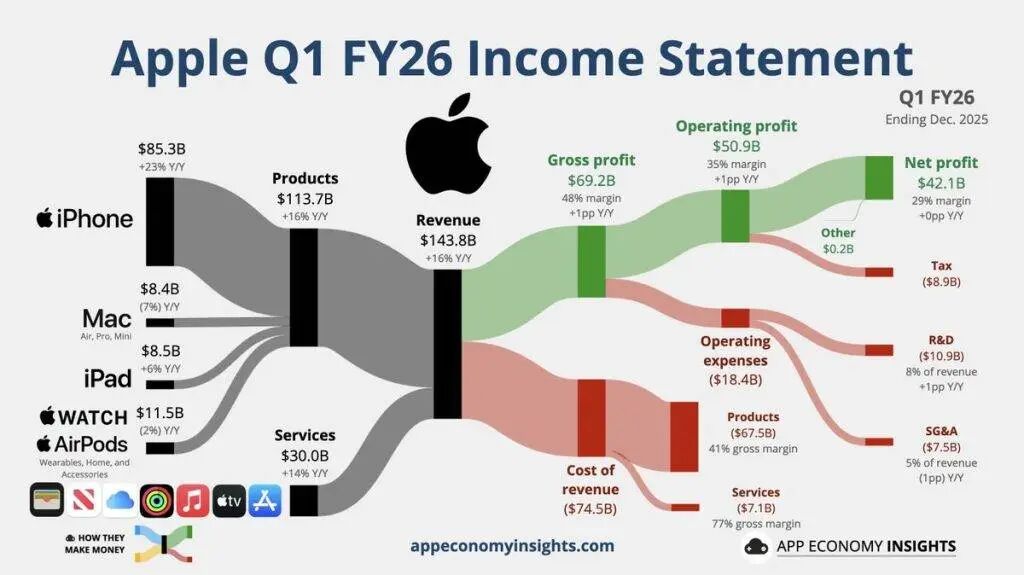
▲ Image Source: App Economy Insights
Among this, the sales revenue of the iPhone soared by 23% year-on-year to $85.27 billion, exceeding both the market and Apple's own expectations, and setting a new single-quarter revenue record. Although Apple rarely announces iPhone sales volume, based on an average price of $1,000 per iPhone, since the release of the new iPhone, nearly one million iPhones have been sold almost every day.
Everyone expected the new iPhone to sell well, but no one expected it to sell this well. Apple's stock price was boosted and rose by more than 2% in after-hours trading.
Even for a powerful company like Apple, the rising memory prices still pose a major challenge. The market's attitude towards this is relatively negative, and Apple's stock price closed with a 0.72% increase.
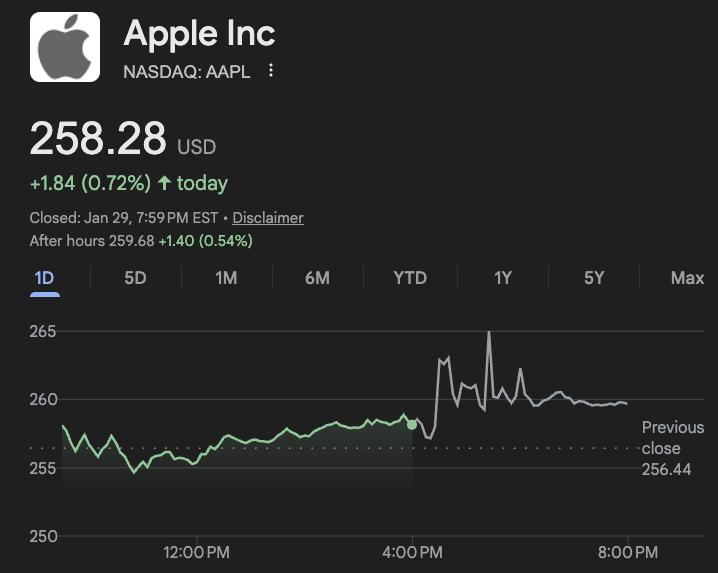
iPhone Sells Like Crazy, Facing Price Hikes
During the subsequent conference call, Apple CEO Tim Cook also praised the iPhone's sales performance, using words like "fantastic" and "extraordinary" to describe it:
The iPhone achieved its best quarterly performance ever. Thanks to unprecedented demand, it set new records in every geographical segment.
It's worth mentioning that the Greater China region, which had been performing mediocrely for several consecutive quarters, finally staged a comeback after the launch of the new iPhone: the revenue reached $25.526 billion, a year-on-year surge of 38% — Did everyone manage to grab the popular iPhones, the iPhone 17 and iPhone Air?
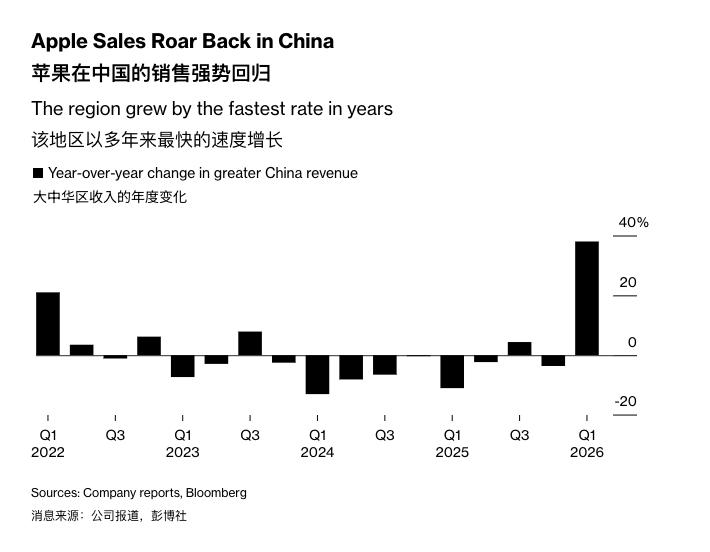
▲ Image Source: Bloomberg
Cook said that in the Greater China region last quarter, the number of people upgrading or switching to the new iPhone both set new records.
In addition, Apple's Chief Financial Officer Kevan Parekh said that the iPhone set sales records in the United States, Latin America, Western Europe, South Asia, the Middle East, and Australia. The number of active iPhones reached a record high — 2.5 billion, and the number of people switching from other phones to the iPhone also broke records in multiple markets.
The iPhone 17 series has sold very well, but the outside world is more concerned about how Apple can maintain its profit margin under the soaring memory prices. Previously, the market was generally pessimistic, and Apple's stock price fell for eight consecutive weeks.
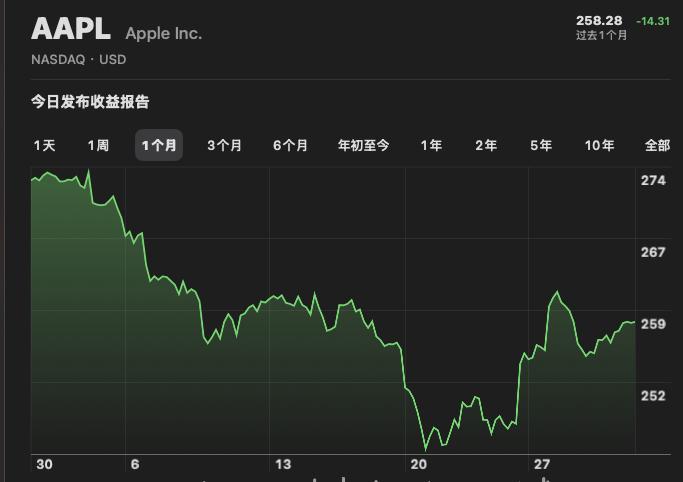
Analyst Ming-Chi Kuo also said that for the iPhone 18 series to be launched in the second half of this year, Apple's pricing strategy is set to "avoid price hikes as much as possible", at least keeping the starting price unchanged, to maintain the product's market share.
The iPhone's memory procurement has changed from "negotiating once every six months" to "negotiating quarterly". In the second quarter of this year, the quoted price of iPhone memory will experience another significant increase. South Korean media ZDNET Korea reported that Samsung Electronics and SK Hynix have negotiated with Apple and decided to significantly increase the price of the LPDDR memory used in iPhones, with a maximum increase of up to 100%.
Someone asked Cook during the earnings conference call whether Apple would raise the product price due to the rising memory cost. Cook said he "didn't want to speculate".
However, regarding the issues of memory, pricing, and profit margin, Cook said that at the end of last quarter, the channel inventory was very lean. Currently, Apple is in a state of "chasing after suppliers" to meet the demand, but it is still restricted by the supply.

▲ Tim Cook, Image Source: Getty Images
Last quarter, the impact of memory prices on the product's gross profit margin was relatively small, but it is expected to be more obvious in the next quarter. Apple is currently evaluating countermeasures against the continuously rising memory prices.
In addition to the pressure of rising memory prices, Apple is also currently facing the problem of limited supply of the 3nm chips used in the iPhone.
Although Apple has presented a quite excellent report card, it still cannot escape the shadow of rising component costs. Cook's "precautionary remarks" have also made the outside world cautiously optimistic about Apple. The stock price has been fluctuating and finally rose slightly by 0.72%.
The iPhone remains the cornerstone of Apple's revenue, contributing more than half of the total revenue. Apple expects the demand for the new iPhone to remain strong in the next quarter, but the gross profit margin will be threatened by the rising component costs.

Mixed Results Outside the iPhone
Outside the iPhone, the performance of Apple's other businesses is mixed:
The revenue of the Mac business was $8.386 billion, a year-on-year decrease of 7%.
The revenue of the iPad business was $8.595 billion, a year-on-year increase of 6%.
The revenue of the wearables, home, and accessories business was $11.493 billion, a year-on-year decrease of 2%.
The revenue of the services business was $30.013 billion, a year-on-year increase of 14%.
Among them, the growth of the services business generally met the market expectations, and it finally reached a revenue of $30 billion, becoming another major revenue pillar for Apple outside the iPhone.
Since Apple only launched the M5 MacBook Pro as a new product at the end of last year, there was an obvious gap compared with the multiple M4 product launches in the same period of the previous year. The decline in revenue was also within expectations.
According to previous multiple reports, the M5 series of chips will make a strong impact in the next quarter. Multiple new products such as the MacBook Air with the M5 chip, the MacBook Pro with the M5 Pro/Max chip, the Mac mini, and even a budget MacBook using the iPhone chip have all been put on the agenda. It is highly likely that the Mac sales will pick up.
Interestingly, the iPad business, which had been experiencing a slowdown in growth for several consecutive quarters, was stimulated by the holiday season last quarter, and its revenue soared, slightly exceeding analysts' expectations.
As for the decline in the growth of wearables, Apple attributes it to the supply chain restrictions of the AirPods Pro 3. The new generation of AirPods Pro uses a new mold design and integrates a heart rate sensor. Higher integration also means higher requirements for the supply chain, and it is obviously still in the running-in period.

Apple Spends $2 Billion for the Next iPhone
Since around 2024, the topic of AI has been unavoidable in every Apple earnings conference. However, this time, due to the outstanding performance of the iPhone, the outside world's attention to Apple's AI has been diverted.
In January, which is about to end, Apple has announced several major news in the field of AI: officially announcing a cooperation with Google to jointly develop AI Siri; entering the ChatBot field to further upgrade Siri; and even developing AI hardware, an AI Pin.

▲ Image Source: Inc.com
Cook said that Google will provide the optimal foundation for Apple's foundation models. Apple's AI will continue to run on the device side and Apple's private cloud to maintain its privacy standards.
He also emphasized that Apple's cooperation with Google is mainly focused on the Siri function, and Apple will continue to do some "its own things" independently.
According to Bloomberg, Apple will debut AI Siri in the iOS 26.4 beta version as early as February.

While Meta and Tesla are talking about AI and robots to boost their stock prices, Apple has successfully reversed its continuously falling stock price with just the outstanding performance of the iPhone.
This just shows that although "tomorrow's technologies" like artificial intelligence and AI are highly favored by the industry, the position of the iPhone as a personal computing terminal is difficult to shake, both now and for a long time to come.
For Apple, 2026 will be a year full of uncertainties.
This year, the sales volume of the iPhone is expected to remain strong. Not only does the iPhone 18 Pro provide a solid foundation, but there may also be a brand - new foldable iPhone. The iPhone 17e, expected to be released at the beginning of the year, can also absorb some of the cost pressure.
However, Apple's proud profitability will be impacted by the rising costs of components led by memory. Whether it can absorb these costs with its huge market share requires long - term observation.
According to Wall Street Insights, a supply chain source said that Apple has only completed the negotiation of the memory unit price for the first half of this year, which means that the cost of the iPhone 18 in the second half of the year will face another wave of price hikes — It is highly likely that the iPhone 18 series will see a price increase.
In addition, it is highly likely that the iPhone 18 will use TSMC's 2nm process chips this year. The supply itself is quite limited, and Apple also has to compete with OpenAI and NVIDIA for production capacity, so the cost will naturally rise.
Although Apple will definitely try its best to maintain the iPhone price, with the continuous increase in memory costs, it is more likely that only the starting price will remain unchanged, while the higher - storage versions will see a price increase to maintain a high profit margin.
After Microsoft released its earnings report, its stock price directly fell by 5%. One reason is that the rising memory prices have made PCs difficult to sell, and the number of incremental users that services such as Windows and Office can reach has also decreased accordingly.
This means that the entire chain from the terminal to the services will be affected by the rising memory prices, and these are exactly Apple's two major revenue pillars.
Therefore, Apple is actively adjusting its overall corporate strategy. It is not only seeking cooperation in AI to ensure a steady progress but also taking actions in the development of other new product categories.
Just before the release of the earnings report, the Financial Times reported that Apple acquired the Israeli AI startup Q.ai, valued at nearly $2 billion. This is also Apple's largest acquisition since it bought Beats for $3 billion