Five books to help entrepreneurs understand the AI era
In the current era, AI is advancing at full steam. However, while everyone is talking about AI, how many people truly understand it? Faced with the complex and diverse information, entrepreneurs concerned about AI developments may inevitably feel overwhelmed. The following five newly published AI - related books are selected to help entrepreneurs comprehensively grasp AI issues, from technical operations, decision - making management, innovation implementation to deeper political and philosophical reflections and the evolution of the history of civilization.
#1
Amid the global frenzy brought about by generative AI, the most pressing practical question for entrepreneurs is always: How can AI actually generate profits? "The Profitable AI Advantage: A Business Leader’s Guide to Designing and Delivering AI Roadmaps for Measurable Results" (hereinafter referred to as "The Profitable AI Advantage") by German data scientist Tobias Zwingmann is a practical guide tailored for corporate managers. The author has led data analysis and artificial intelligence projects in several European companies and has long been concerned about the business effectiveness of AI implementation. This book aims to help enterprises build AI projects that can bring measurable results from concept to implementation.
Different from many best - selling AI books that emphasize technological breakthroughs, "The Profitable AI Advantage" sets a clear starting point from the very beginning - AI projects must serve business strategies and profit goals. Zwingmann has repeatedly emphasized in his blog that in the past decade, a large number of AI projects were shelved at the "proof of concept" (PoC) stage. This was not because the technology was infeasible, but because these projects had no connection with the company's profitability. Therefore, he advocates that enterprises should first focus on whether AI applications can demonstrate value on the financial statements.
The whole book is structured gradually, from identifying business value, laying a solid data foundation, conducting small - scale prototype experiments, organizing collaboration, to measuring performance and continuous optimization. Zwingmann compares this closed - loop process from value identification to result measurement to the "AI advantage flywheel". The book is interspersed with multiple cases from corporate practices, showing how AI can create economic returns in different fields. For example, an insurance company improved its premium model by using AI to predict customer churn rate, thus significantly increasing customer retention; a large pharmaceutical company used AI to optimize the clinical trial process and shorten the R & D cycle. These examples reflect Zwingmann's core argument - the AI that can truly bring benefits often relies on process re - engineering rather than algorithm breakthroughs.
The most insightful part of Zwingmann's work lies in the analysis of organizational culture. He believes that the biggest enemy of AI projects is not algorithm errors but "managerial inertia". Too many companies regard AI as an outsourced task, allowing the technology and business departments to operate independently. Therefore, he advocates cultivating middle - level leaders who understand both business and data in key departments, making AI an integral part of daily business rather than just a technical experiment. In addition, he also proposes that quantifiable indicators should be established at the beginning of AI projects to ensure that the results can be tracked and the return on investment can be evaluated. These indicators include not only financial dimensions such as cost savings and revenue growth but also business dimensions such as operational efficiency, prediction accuracy, and customer satisfaction. In his view, an AI project without a measurement system is just an expensive experiment.
Compared with those AI books with grand narratives, "The Profitable AI Advantage" does not discuss how AI will change the world but only focuses on how AI can create value on the budget sheet. The writing style of the whole book is clear and well - organized, similar to a business consulting report. Its limitation also lies here - it is more focused on the operational level and pays less attention to the reflections on AI at the organizational, ethical, or social levels. However, for entrepreneurs who are in the stage of AI implementation and hope to bridge the last mile "from project to profit", "The Profitable AI Advantage" is undoubtedly a reliable action guide.
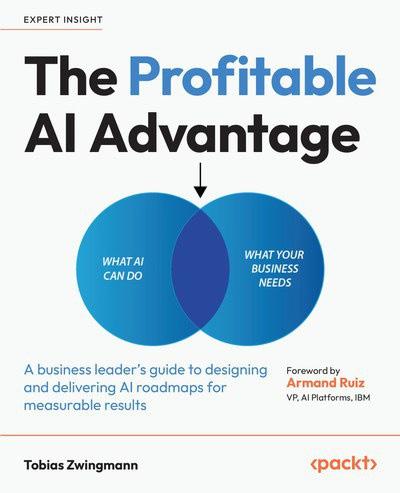
The Profitable AI Advantage: A Business Leader’s Guide to Designing and Delivering AI Roadmaps for Measurable Results
The Profitable AI Advantage: A Business Leader’s Guide to Designing and Delivering AI Roadmaps for Measurable Results
Author: Tobias Zwingmann
#2
In 2024, management consultant Geoff Woods published "The AI - Driven Leader: Harnessing AI to Make Faster, Smarter Decisions" (hereinafter referred to as "The AI - Driven Leader"). The core theme of this book is "how leaders should think in the AI era". Woods himself was the Chief Growth Officer of Jindal Steel & Power in India and has long served as a strategic consultant for multinational companies. The so - called "AI - driven" in the book title does not mean that algorithms should replace humans, but rather that leaders should achieve cognitive upgrades in their decision - making methods.
Woods emphasizes that AI should be regarded as a "thought partner" rather than a cold - blooded automated tool or an all - knowing answer machine. The real value of AI lies not in replacing human thinking but in expanding the radius of human thinking. Therefore, leaders should not only use AI but also learn to communicate and co - think with it. Woods points out that excellent leaders will integrate AI into their decision - making chain to accelerate information analysis, reveal potential patterns, and help themselves gain insights into complex business situations.
In this process, the way of asking questions determines whether AI can generate truly valuable insights. AI is like a mirror, and the answers it gives depend on the questions you ask. If a leader only asks "which solution is the best", AI will mostly return an average answer in a statistical sense. However, if a leader can break down the question into "which solution can balance long - term benefits and risks under the conditions of limited resources and market fluctuations", the answer generated by AI will be more in - depth. Through this interactive way, AI can liberate leaders from the flood of information and enable them to focus on high - level strategic issues instead of getting caught up in trivial details.
Meanwhile, this book also expands its perspective to the role of AI in corporate governance and ethics. In terms of data quality, leaders need to ensure that the information sources are real, updated in a timely manner, and structurally balanced. Otherwise, no matter how sophisticated the AI model is, it will only be a case of "garbage in, garbage out". In terms of algorithm goals, leaders should carefully define the meaning of "success" - is it maximizing profits, or improving social impact and brand trust? Once the indicator setting deviates from the value orientation, AI may, under the guise of the "optimal solution", replicate old biases or create new risks. More importantly, although AI has strong computing power, it lacks value perception - it cannot distinguish between "effective" and "right". In other words, AI can make analysis faster and information more comprehensive, but it cannot decide "what is worth pursuing" for you. For example, when evaluating overseas market expansion, AI can simulate risks and benefits under different scenarios, but the final choice still needs to be made by leaders based on the company's mission and values. This also reminds leaders that the most important thing is a sense of responsibility: even if AI provides analysis suggestions and prediction results, the final decision still has to be made by humans, and the responsibility cannot be shifted to the algorithm. Based on this governance concept, AI can truly become a tool to enhance leaders' decision - making ability, and at the same time, ensure the compliance and ethics of organizational decisions while pursuing efficiency and innovation.
For entrepreneurs, "The AI - Driven Leader" provides a calm and unique perspective: the development of AI technology forces leaders to understand more clearly the unique parts of human beings - judgment, value, and responsibility. A real leader is not someone who masters more data but someone who gives more meaning to data.

The AI - Driven Leader: Harnessing AI to Make Faster, Smarter Decisions
The AI - Driven Leader: Harnessing AI to Make Faster, Smarter Decisions
Author: Geoff Woods
Publisher: AI Thought Leadership
#3
Discussions linking AI with innovation are quite common these days. However, although most corporate managers can feel the potential of AI, they often struggle to answer a more fundamental question: How can AI truly become a source of growth and innovation? In the new book "Artificial Intelligence for Business: Harness AI for Value, Growth and Innovation" (hereinafter referred to as "Artificial Intelligence for Business"), Swiss digital consultant Kamales Lardi attempts to establish a systematic framework to answer this question. For corporate managers, "Artificial Intelligence for Business" is a guide on how enterprises can reshape their value - creation methods using AI.
Lardi has more than twenty years of experience in corporate digital transformation and is currently the CEO of Lardi & Partner consulting company. The core concept throughout the book is that AI should not be simply regarded as a technical project but as a value strategy. If an enterprise treats AI as an automated tool, it can only improve efficiency locally. Only when AI is integrated into the business model and organizational culture can it bring a structural competitive advantage.
The structure of the whole book can be roughly divided into three parts. The first part focuses on the core concepts and business potential of artificial intelligence, introducing the operating mechanisms of key technologies such as AI, machine learning, natural language processing, and generative AI in the corporate environment, and how they can be combined with business strategies. The second part focuses on the business application scenarios of AI, using cross - industry cases to show the specific ways AI creates value. For example, in the retail industry, it can be used for customer insight and personalized marketing; in the manufacturing industry, for intelligent supply chains and predictive maintenance; in the financial service industry, for fraud detection and risk assessment. It emphasizes the role of AI in terms of efficiency, customer experience, and innovation. The third part turns to the implementation conditions and ethical challenges at the organizational level, discussing the leadership, data and technical infrastructure, cultural transformation, and a responsible AI governance framework required for the successful deployment of AI.
The most inspiring part of this book is that it brings "innovation" back to management reality. Lardi points out that the real value of AI lies in expanding human capabilities and reshaping the collaborative logic of organizations. She emphasizes that AI should not be regarded as an isolated technology but needs to be embedded in a broader digital ecosystem. Only when AI works in tandem with technologies such as the Internet of Things, cloud computing, and blockchain can enterprises form the ability for continuous innovation and a competitive advantage. At present, AI has clear application paths in multiple industries: in the retail industry, it helps enterprises create personalized customer experiences; in the manufacturing industry, it supports predictive maintenance and efficiency optimization; in the medical field, it promotes the innovation of diagnostic assistance and patient services; in financial services, it enables risk management and automated processes through real - time analysis. This also inspires us to think about how AI can create greater value through collaboration with other digital technologies and management systems in these industries. For example, in the retail industry, AI can combine AR fitting mirrors, voice assistants, and supply - chain data to create an end - to - end experience from demand prediction to fulfillment response; in the manufacturing industry, AI can combine IoT sensors and digital twin technology to detect and prevent equipment failures in advance and continuously optimize the operation efficiency of the entire production line through virtual simulation and real - time feedback; in the medical field, AI can work in tandem with wearable devices and electronic medical record systems to build a closed - loop health - management system covering both in - hospital and out - of - hospital scenarios; in financial services, the risk - warning mechanism of AI can be integrated with the transaction transparency of blockchain to further strengthen the accuracy of trust and supervision.
Different from many best - selling books that hype up the "AI revolution", the thinking in "Artificial Intelligence for Business" is quite practical. Lardi reminds managers that the primary reason for the failure of AI projects is often not the technology but the lack of organizational preparedness - for example, the lack of data quality, cross - departmental collaboration, and a learning culture. She advocates that enterprises should establish a systematic AI governance structure and introduce ethical review and responsibility assessment mechanisms into the decision - making process to ensure that technological innovation and social trust go hand in hand. Responsible AI is the cornerstone of trust and long - term value.
Artificial Intelligence for Business: Harness AI for Value, Growth and Innovation
Artificial Intelligence for Business: Harness AI for Value, Growth and Innovation
Author: Kamales Lardi
Publisher: Kogan Page
#4
In the current era, entrepreneurs may be more concerned about how to use artificial intelligence to create greater business value. However, Mark Coeckelbergh, a professor of the philosophy of technology at the University of Vienna, puts forward a deeper view: AI is not just a pure technological tool but a political force - it not only shapes our choices but also reorganizes the social power structure. His new book "The Political Philosophy of AI: An Introduction" (hereinafter referred to as "The Introduction") reveals the political logic behind AI technology.
Coeckelbergh's starting point for argument is very clear - technology is not value - neutral. The design, deployment, and use of every technology imply a setting of "who can act and who can decide". This is especially true for AI because it transfers decision - making from visible people to invisible algorithms. The whole book is based on real - world cases and analyzes around four important concepts in political philosophy.
First, freedom is redefined in the algorithmic era. In the past, freedom meant individual choices based on free will. However, when algorithms start to predict and shape human behavior, choices are no longer within the scope of free will. Algorithms analyze data to predict your next move and subtly guide your decisions through seemingly neutral recommendations and prompts. Thus, freedom is transformed into a "predictable controllability".
Second, equality in machine - learning systems is often distorted by historical biases. Algorithms are based on existing data, which often carry gender, racial, and geographical biases. In the process of extracting patterns, machine learning not only fails to eliminate these biases but also solidifies them, packaging them into an "objective judgment". As a result, AI institutionalizes biases in a more efficient way.
Third, democracy loses its original public nature under the filtering mechanism of algorithms. When the flow of information is controlled by platform algorithms, the public discussion space gives way to the logic of attention. Algorithms are guided by click - through rates and time spent, and as a result, public discourse becomes entertainment - oriented and fragmented. Democracy is no longer a practice of rational dialogue among citizens but a by - product of the attention economy.
Finally, power is redistributed in the AI governance system. As enterprises and governments generally adopt algorithmic decision - making systems, the form of power shifts from person - to - person domination to code - to - person shaping. The judgments of decision - makers are embedded in algorithms, forming an invisible rule structure, while ordinary people change from decision - makers to "data objects" to be calculated and predicted. This "algorithmic power" does not rely on explicit coercion but subtly shapes people's choices and desires through ubiquitous recommendations and evaluations.
Furthermore, Coeckelbergh points out that as AI takes on more and more social functions, the chain of responsibility becomes blurred. Who should be responsible for the decisions of algorithms? Is it the programmers, the enterprises, the users, or the invisible training data? In this uncertainty, a paradox of modern politics emerges: the higher the efficiency, the weaker the responsibility. The author uses the term "algorithmic bureaucracy" to describe this phenomenon - we thought we had escaped the slowness of human bureaucracy, but we have welcomed the coldness of automated bureaucracy. Therefore, if entrepreneurs defend themselves by claiming "technological neutrality", they are actually avoiding political issues. Coeckelbergh reminds us that every application and deployment of AI is not a purely technical decision but a value choice, specifically, the manifestation and redistribution of social values at the algorithmic level. For example, when the government decides to deploy face - recognition algorithms in the police field, it is not only introducing a new tool but also making a value choice between "security and privacy". Similarly, when an enterprise decides to use AI to screen resumes, it is also making a value choice between efficiency priority and fairness priority.
For entrepreneurs, the most important inspiration from "The Introduction" is that AI is not only a business tool but also has a "governance philosophy" behind it. Therefore, corporate leaders need to establish a "reflective technological culture". When applying AI, we must think about several key questions: What does our algorithm optimize, and who does it exclude? Once the system makes a mistake, who has the right to explain? These questions bring technological governance back to the ethical and institutional levels - we should not only ask "can we" but also "should we". Only in this way can entrepreneurs be upgraded from "AI users" to "AI governors".