In 2026, these three major trends are booming.
As we step into 2026, we witness history almost every day.
Since the beginning of the year, the A-share market has recorded an unprecedented 17 consecutive positive sessions, setting the longest winning streak since its inception in 1990. This is a market spectacle that occurs only once in three decades.
2026 is a year of accelerated transformation from old to new growth drivers. On one hand, traditional industries such as real estate have entered a cold winter. On the other hand, new productive forces led by hard technology are booming.
"For most investors, the wisest choice is to hold low-cost S&P 500 index funds." The stock god has mentioned more than once in his will that 90% of the trust funds should be allocated to index funds.
As China's capital market matures, the concept of index investing is gaining popularity.
In the past five years, China's ETF market has experienced explosive growth. Its scale has soared from 1.42 trillion yuan in 2021 to 6.25 trillion yuan at the beginning of 2026, with a compound annual growth rate of 35%. It has become one of the fastest-growing ETF markets in the world.
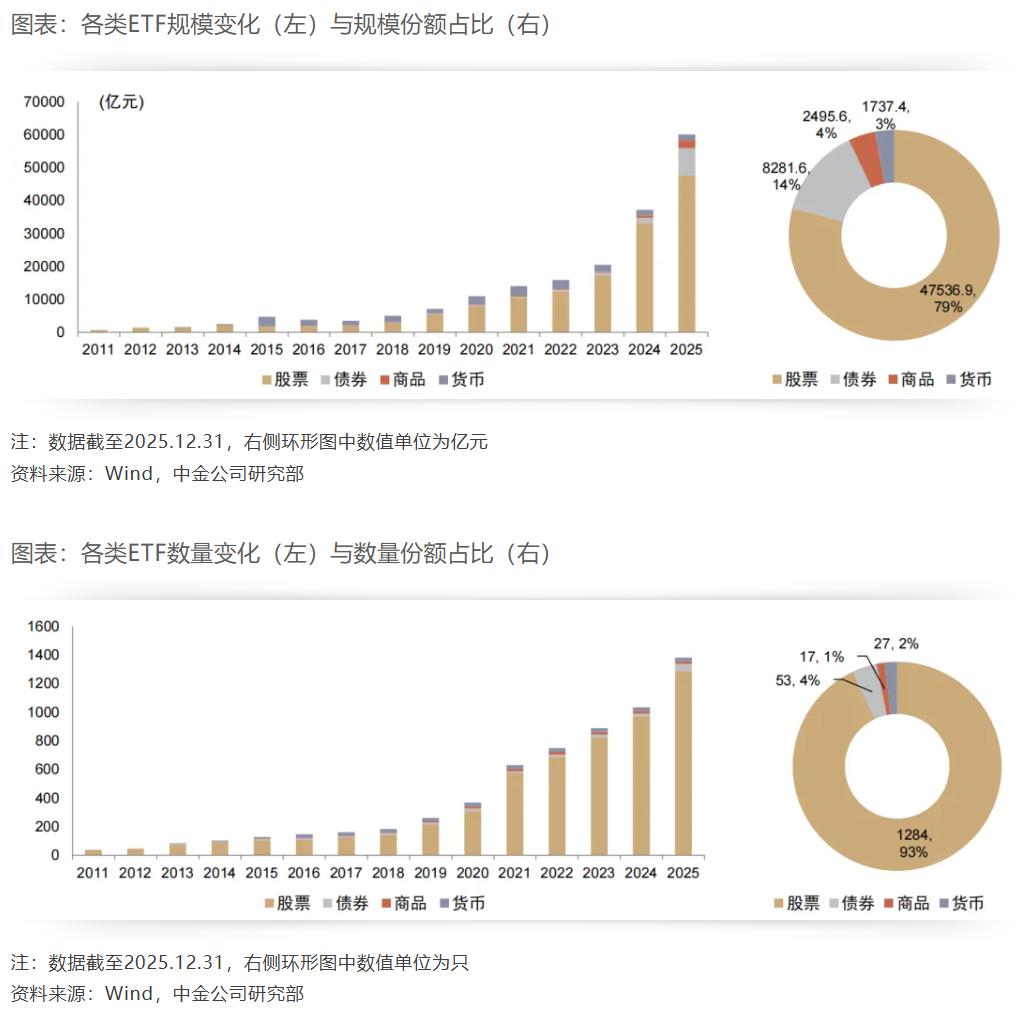
The essence of an ETF is to buy a basket of stocks (or assets) in one go, allowing ordinary investors to participate in the main trends of the era at a low cost.
How to participate? The answer may lie in three clear tracks: AI hardware is on the table, big consumption is unleashing dividends, and innovative drugs are realizing their value.
1. AI Hardware on the Table: Farewell to "Paper Narratives"
This year's Davos Forum has been quite bold in its statements.
"AI may surpass human intelligence by the end of the year." "Large companies are more likely to be disrupted in the AI era." "AI is the largest infrastructure project in human history."... The topic of artificial intelligence has run through every conversation.
Therefore, it is impossible to discuss 2026 without mentioning AI, especially AI hardware. Relying on "new devices" and "new computing power", it is regarded as the first area to realize its value. Mobile phones, smart glasses, PCs, humanoid robots, and smart cars are all competing fiercely for the interaction entrance in the AI era.
Among them, AI glasses and humanoid robots deserve special attention.
Let's start with AI glasses. Although Google was the first to launch Google Glass, it was not until the capabilities of large models matured that AI glasses truly gained the ability to understand, generate, and remember in real time, and their value was redefined.
Currently, the players can be divided into two camps. One is represented by startups such as Rokid and Thunderbird Innovation, which focus on optical solutions, wearing experiences, and scenario implementation. The other camp includes companies like Meta, Huawei, and Alibaba, which are continuously deploying from the perspectives of ecological collaboration and platform access.
It is worth noting that Meta plans to increase the annual production capacity of AI glasses to over 20 million pairs by the end of 2026.
This move not only demonstrates its determination to bet on the next-generation terminals but also indicates that the industry is approaching the critical point of moving from "niche experimentation" to "mass adoption".
In terms of humanoid robots, if 2025 was the "Year of Embodied Intelligence", then 2026 is the "Year of Mass Production". Products are starting to leave the laboratory and enter real industrial scenarios, and the idea of "going to work in factories" has become a reality.
Whether it is AI glasses or humanoid robots, all of this is supported by the full maturity of AI infrastructure. Computing power, algorithms, and terminals work together to build a deliverable AI era.
In the secondary market, products such as the Science and Technology Innovation Artificial Intelligence ETF, the Hong Kong Stock Connect Internet ETF, and the Robot ETF have been actively traded in the past year, with continuous capital inflows.
For ordinary investors, instead of betting on individual stocks, it is better to participate in this "AI industrialization" wave through ETFs.
2. Consumption Reactivated: Stable and Slow Growth
Big consumption is regarded as "one of the biggest investment opportunities in 2026".
Although most consumer segments have remained stable since the beginning of 2026 and it is difficult to achieve explosive growth, it does not mean that there are no opportunities.
On one hand, there is an extreme form of "consumption downgrading". There are long queues at supermarkets selling near-expired food, and the trading volume on second-hand platforms has increased significantly. On the other hand, there are sporadic and almost irrational "hot-spot frenzies".
People seize a moment, a symbol, or a scarce entry point that can create collective resonance to conduct intense self-confirmation.
Take the "Guzi economy" as an example. According to the "2024 - 2025 China Guzi Economy Market Analysis Report" released by iiMedia Research, the market size of the "Guzi economy" in China reached 168.9 billion yuan in 2024, and it is expected to exceed 300 billion yuan in 2029.
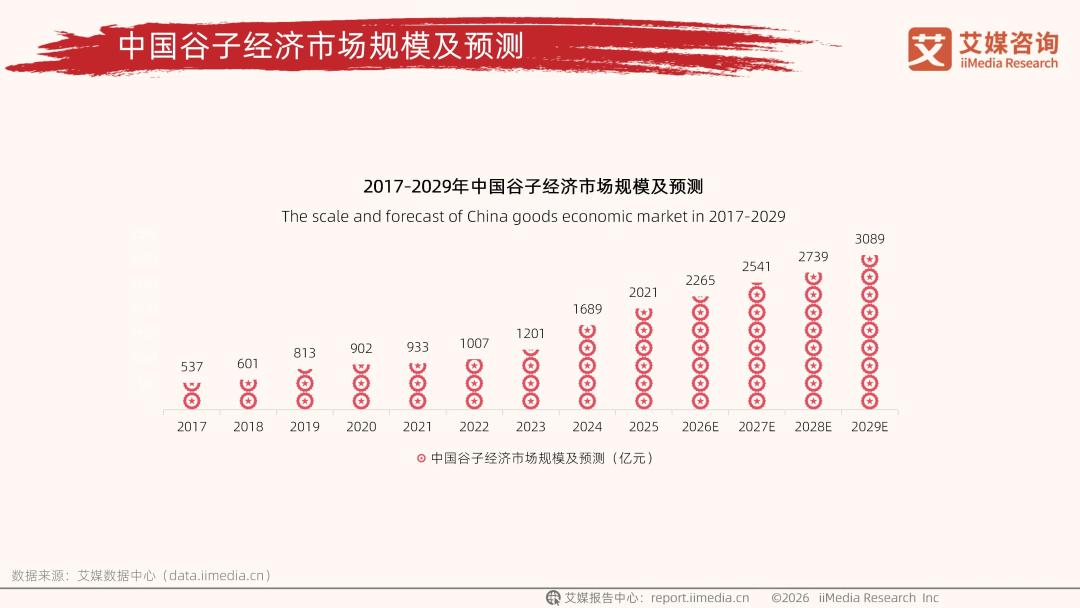
An investor in the consumer sector said that the IP consumption completed the "from 0 to 1" process in 2025, breaking out of the niche hobby circle and becoming a mass consumption trend. In 2026, it will enter the stage of in-depth industrial development from "1 to N".
Greater certainty comes from the macro environment. For example, boosting consumption will be the top priority among the ten tasks in 2026. In 2027, three trillion-level consumer sectors and ten billion-level consumer hotspots will be cultivated, and Hainan will be fully closed off for customs operations.
Currently, China's economy is transitioning from the "incremental era" of high-speed growth to the "era of stock optimization and structural adjustment" centered on high-quality development. In fact, the consumer market is undergoing a quiet value reconstruction.
In 2026, big consumption still has hidden growth potential.
3. Innovative Drug R & D: Entering the "Value Realization" Stage
Different from the rapid iteration of AI or the cyclical fluctuations of consumption, the pharmaceutical industry is a typical long-term and profitable track.
At the beginning of 2026, Chinese innovative drugs have achieved frequent successes in going global. Before the middle of January, there have been 10 overseas licensing deals, covering multiple cutting-edge fields such as small nucleic acids, ADCs, bispecific antibodies, inflammatory immune small molecules, and AI drug development.
This is not a coincidence but the result of long-term accumulation.
According to data from the National Medical Products Administration, the total amount of overseas licensing of Chinese innovative drugs exceeded 130 billion US dollars in 2025, reaching a new historical high and continuously increasing its global appeal. This trend has continued into 2026.
Why are Chinese innovative drugs in high demand? It is due to their strong capabilities.
The clinical enrollment speed in China is 4 - 5 times faster than that in the United States, but the cost is only one-third. China has a large patient base, high enthusiasm from hospitals, and the clinical standards of top-tier hospitals are in line with international standards, which are recognized by the FDA. The advantages of "good, fast, and cheap" make it difficult for multinational pharmaceutical companies to resist.
In 2026, Chinese innovative drugs are not just having "another bumper year". It is also a turning point from "quantitative change" to "qualitative change". When the upfront payments exceed the financing amount, when clinical resources become global benchmarks, and when industry giants actively knock on the door, China is transforming from a "participant" to a "rule-maker".
The listed companies mentioned in this article are only for research and analysis reference and do not constitute any investment advice.
There are risks in the market, and investment should be made with caution.
This article is from the WeChat official account "Caixin Wuji". The author is Xiao Tian. It is published by 36Kr with permission.