Valued at $39 billion, the world's most expensive humanoid robot company is researching how to use feet to turn off the dishwasher.
The trend in the robotics field may be changing again.
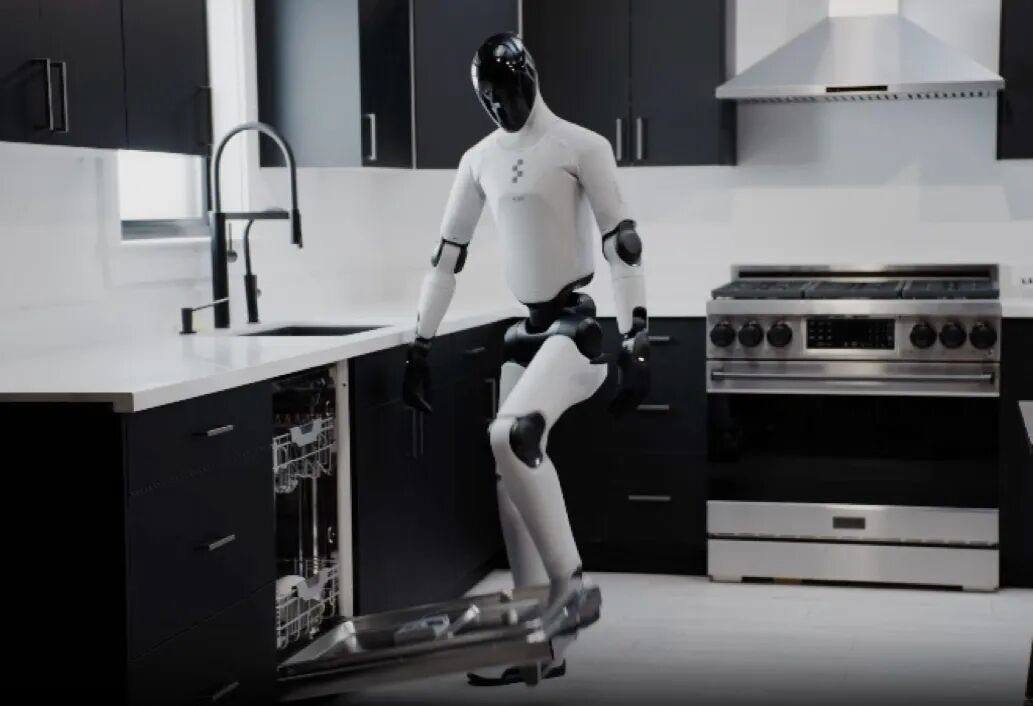
On January 28th, Figure released its latest model, Helix 02, along with a video demonstration lasting about three and a half minutes.
As an ordinary person, at first glance, this video may seem unremarkable. It just shows a robot walking around in the kitchen and performing some operations like taking bowls out of the dishwasher and putting them away in the cabinet.
However, just as the video was about to end, an extremely human - like action appeared.
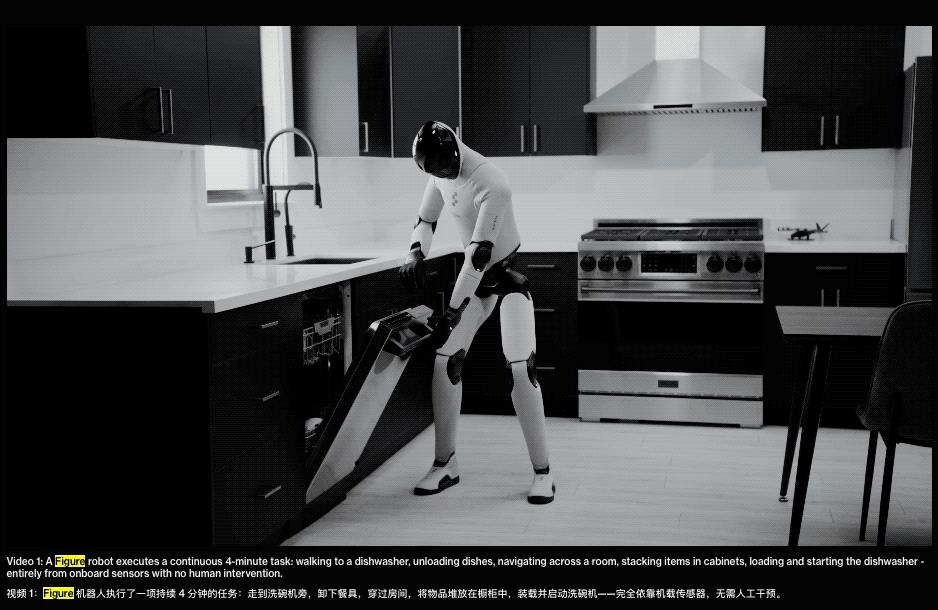
When closing the dishwasher door, it first kicked the door up with its foot and then bent down to close it.
You may have seen robots putting away bowls before, but you've never seen this action before.
In the past, the logic of the robots we were familiar with was segmented. Navigation, walking, and grasping were divided into non - interfering modules.
In 2025, robots can basically be roughly divided into two categories. One category focuses on full - body control robots, such as dancing robots. Essentially, they are executing a rigid program. Even if they hit an obstacle halfway, they will mechanically finish dancing.
The other category focuses on dexterous manipulation robots, that is, robots that can put away bowls. Usually, only their upper bodies are busy, and their lower bodies are like a rigid base, carried by wheels and only responsible for displacement.
However, the breakthrough point of Helix 02 is that in this model, movement and manipulation are completely unified, solving the problems of both types of robots.
Figure's engineers did not pre - train it on "how to kick the door with the foot". This action is a spontaneous choice of the robot based on its internal knowledge. It may have judged that bending too low is inconvenient for maintaining balance, so according to the current physical environment, it independently determined that "kicking with the foot" is the most efficient auxiliary means.
In 2025, Figure officially announced that its valuation had reached $39 billion, three times higher than the rumored listing valuation of Unitree, which is 100 billion RMB.
This world's most expensive humanoid robot company's research on closing the dishwasher door with the foot may finally address people's complaints about dancing robots being unable to do practical work and lead the next wave of the robotics trend.
01 Unifying the Movement and Manipulation of Humanoid Robots
This time, Figure released its new model, Helix 02.
The model itself is designed in an end - to - end manner.
The panoramic camera on the head, the close - range camera on the palm, the tactile sensors on the fingertips, and the motion states of all the joints in the whole body are all fed into the neural network.
The output is a complete full - body action package. In this instantaneous decision - making, it includes the supporting force of the legs, the balance inclination of the torso, the extension path of the arms, and the pinching force of each finger.
One model can control the 30 - degree - of - freedom robot body of Figure 03.
Currently, most mainstream VLA models rely on feeding a large amount of data into the robot. For example, they train the robot to learn the skill of putting away bowls through data obtained by humans remotely controlling the robot to perform this task.
In contrast, the neural network of Helix 02 no longer learns "how to perform the task of putting away bowls". Instead, it learns "the general laws of human movement". Helix 02 learns from more than 1000 hours of human full - body motion data redirected to the joints, thereby obtaining a general physical prior knowledge.
In addition to kicking the dishwasher door with the foot, another action has also received extensive attention.
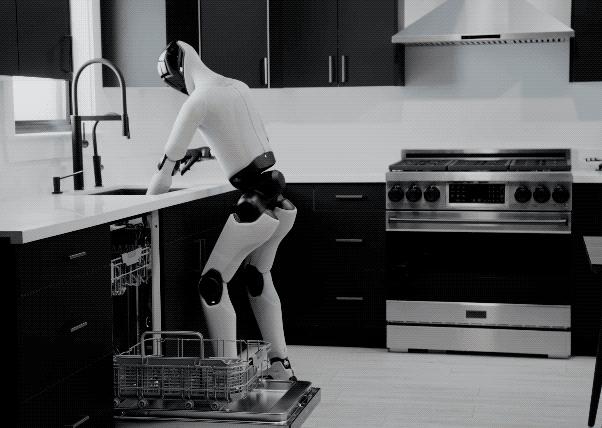
When closing the drawer after taking something, the Helix 02 model directly chose to push the drawer with its hip to close the drawer door.
Figure explained in its blog why it developed such a system that combines movement and manipulation:
Mobile manipulation, that is, the robot's ability to combine movement and object manipulation as a single, continuous behavior, has always been one of the most difficult problems to solve in the robotics field. This is not because it is difficult to achieve these two abilities separately, but because it is difficult to clearly decompose them when achieving them simultaneously. When lifting a heavy object, the robot's balance changes; when taking a step forward, the robot's reach also changes. The arms and legs constantly restrict each other.
Humanoid robots have demonstrated impressive short - term behaviors, such as jumping, dancing, and doing yoga. However, almost all robots have a limitation: they are not truly controllable. Most systems only reproduce pre - planned actions offline with limited feedback. If an object moves or the contact situation changes, the behavior will collapse.
Traditional robots solve this problem by separating movement and manipulation into different controllers and connecting them with state machines: walking, stopping, stabilizing, stretching, grasping, and walking again. This switching method is slow, difficult to judge, and unnatural.
True autonomy requires something fundamentally different: a single learning system that can reason about the entire body simultaneously. A system that can continuously perceive, make decisions, and take actions - carrying while walking, adjusting balance while reaching for objects, and correcting errors in real - time.
In fact, this idea is consistent with Figure's early development of the first - generation Helix model. At that time, Helix proved that a single neural network could control the entire upper body of the robot, not just limited to the robotic arm or the gripper.
However, at that stage, this ability still had limitations. Because the robot's base was fixed or independent, it could only move within a limited range.
Now, with the emergence of Helix 02, end - to - end control has been extended to every joint of the robot, achieving true full - body autonomy.
Moreover, in this unedited video, Helix 02 continuously executed 61 movement and manipulation actions, and even demonstrated actions like bending down, which test both balance and operability, indicating that Helix 02 has achieved certain success in this architecture.
When viewed intuitively by the audience, when movement and manipulation are combined into one model, the robot seems to start to have a basic sense of body awareness and finally understand the "whole body as a tool" intuition that humans used to have, such as "I'm holding something in my hand, so I'll push the drawer with my hip".
02 The Mysterious System 0
Part of the reason why such unification can be achieved is that in the architecture of Helix 02, a crucial underlying component, System 0, has been incorporated this time.
This is a neural network specifically responsible for physical instincts. Before its appearance, engineers had to manually write complex physical equations to maintain the robot's balance. This time, Figure simply deleted 109,504 lines of manually written C++ code and replaced it with a single neural network prior.
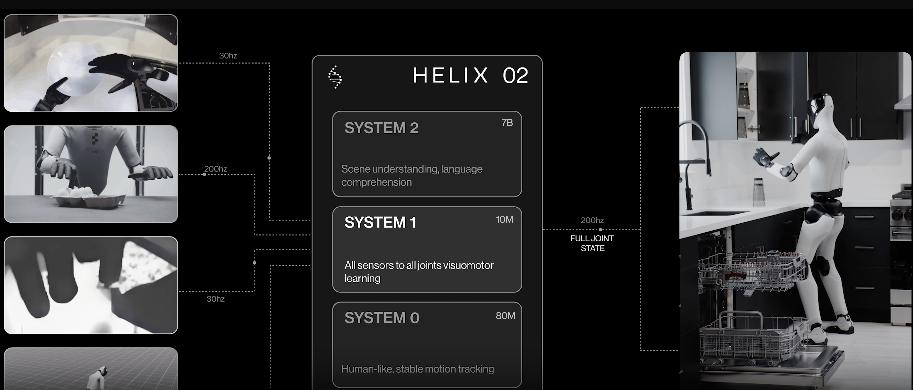
System 0 has only three core tasks: balance, contact, and full - body coordination. It runs at a frequency of up to 1000 Hz, which means it issues 1000 instructions to the motor every second. This extremely high processing speed allows it to complete the counter - force of muscle strength before realizing "I'm about to fall", just like a human spinal reflex.
What's even more interesting is the training method of System 0. Engineers did not design complex reward functions for walking, turning, or squatting separately. Instead, they directly fed the model with more than 1000 hours of human full - body motion data redirected to the joints and conducted reinforcement learning training in simulation.
In the process of learning how to "reproduce human actions", the model spontaneously learned how to coordinate the torques of the whole body and how to maintain the center of gravity in various postures. This is why the actions of Helix 02 no longer look stiff, because it is no longer calculating balance according to formulas but replicating a "human intuition" verified by data.
In the three - layer architecture of Helix 02, each layer has a clear division of responsibilities. At the highest layer is System 2, which is like a calm commander responsible for semantic reasoning. It no longer needs to worry about how the robot takes steps but directly issues vague target instructions, such as "walk to the dishwasher and open it" or "take the bowls to the counter".
The middle layer, System 1, is an agile executive manager. It runs at a frequency of 200 Hz and is responsible for converting the pixels seen by the eyes and the commander's targets into motion targets for the 30 joints of the whole body.
Finally, these targets are handed over to System 0 and converted into real torque output. Errors can also be corrected at a high frequency.
In fact, discussions about this model have become a cutting - edge concern in the robotics circle since 2025.
Bi He, an investor in embodied intelligence, mentioned that the Sonic project released by NVIDIA before and the Exosomatic Avatar System of Westlake University both demonstrated similar logic. NVIDIA's Sonic project used 700 hours of data at that time. Going further back, this technological route can be traced back to classic academic works, such as the DeepMimic and BeyondMimic series.
At the CES in 2026, Sharpa also demonstrated work similar to CraftNet, with the core being the coupling of System 1 and System 0.
The "Last - Millimeter Intelligence (LMI)" proposed by Sharpa uses System 0 to perform real - time fine - tuning through tactile and force feedback at the moment of contacting an object. System 0 runs at a frequency of about 100 Hz, which allows the robot to perceive resistance, sliding, and make real - time corrections just like a human hand.
In 2026, System 0 may bring more surprises to robots.
03 The Most Expensive Humanoid Robot Company
In addition to the highlight of full - body autonomy, Helix 02 has many other attractions:
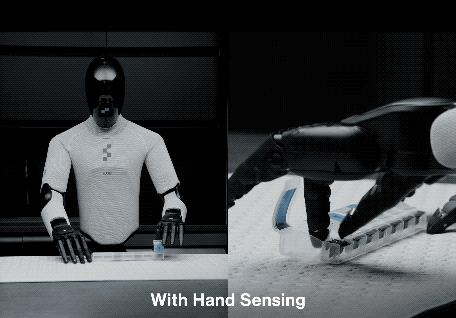
For example, with the hardware base of Figure 03, Helix 02 has truly reached the boundary of multi - finger dexterous manipulation. In the past, humanoid robots were often helpless in the face of "self - occlusion". Once the body blocked the view of the head camera, the robot would become "blind". However, Figure has incorporated a wide - angle camera into the palm of each hand, giving it a "God's - eye view" as if it has eyes on its palms.
Combined with tactile sensors on each fingertip that can sense a micro - force of 3 grams, it can now perform extremely delicate actions: picking out a thin pill from a messy medicine box or precisely pushing out 5 milliliters of liquid from a syringe. This level of precision means that the robot is no longer limited to physical work like carrying boxes. It begins to have the potential to handle complex industrial parts and even perform home care.
In Silicon Valley, Figure's robots are relatively mysterious. They rarely appear at lively exhibition sites.
However, in the capital market, its influence is like a tsunami. In September 2025, Figure completed a Series C financing of over $1 billion, and its valuation soared to $39 billion.
Brett Adcock, the founder of Figure, is an extremely hardcore serial entrepreneur. When he founded the company in 2022, he didn't try to persuade venture capitalists first. Instead, he directly invested $100 million of his personal funds. This confidence of "bringing in capital" has allowed Figure to maintain a high degree of independence from the very beginning.
A typical detail is that Figure was once OpenAI's top partner in the field of embodied intelligence, but this partnership came to an abrupt end in February 2025.
The reason for the breakup is that Figure claimed that it found its own Helix model to be strong enough. It no longer needed a general large - scale model in the cloud to command it but wanted to build an endogenous logic from pixels to torque for the physical entity. This retrieval of power marks that Figure has officially evolved from a "hardware carrier" into a complete entity integrating the "brain, cerebellum, and body".
Adcock has publicly stated that Figure's ultimate goal is to let robots enter every unknown home environment like humans and perform complex household chores that do not require supervision and span multiple days. In a more distant vision, these robots will also take on the heavy responsibility of elderly care and even space exploration on other planets.
The first - generation Figure robot once worked in the BMW factory, and interestingly, the company also announced its retirement story: in 11 months there, it assisted in assembling more than 30,000 BMW X3s and walked more than 200 miles.
After the new financing in 2025, Adcock designed an extremely ambitious "Master Plan": he wants to produce 100,000 robots through the self - built BotQ factory within four years.
When the same robot can not only dance but also learn to close the door with its foot and pick out pills from a medicine box with the same flexibility, the market prospect may be much broader than that of dancing robots or wheeled dual - arm robots.
At least many capitals, including NVIDIA, have placed their bets on Figure.
*Source of the head image: Figure
This article is from the WeChat official account "GeekPark" (ID: geekpark), author: Li Yuan. Republished by 36Kr with permission.