64 financings exceeding $100 million. Understand the new logic of Silicon Valley through these 16 "new AI superstars".
In 2025, the keyword for AI venture capital investment in the United States was no longer "scatter - gun approach" but "heavy bets".
According to TechCrunch statistics, in 2025, U.S. AI startups completed a total of 64 financing rounds with a single - deal amount exceeding $100 million. Among them, 8 companies received multiple rounds of large - scale additional investments, and their valuations continued to rise. For example, the valuation of Cognition AI reached $10.2 billion, and Sierra also joined the club of companies valued at over $10 billion.
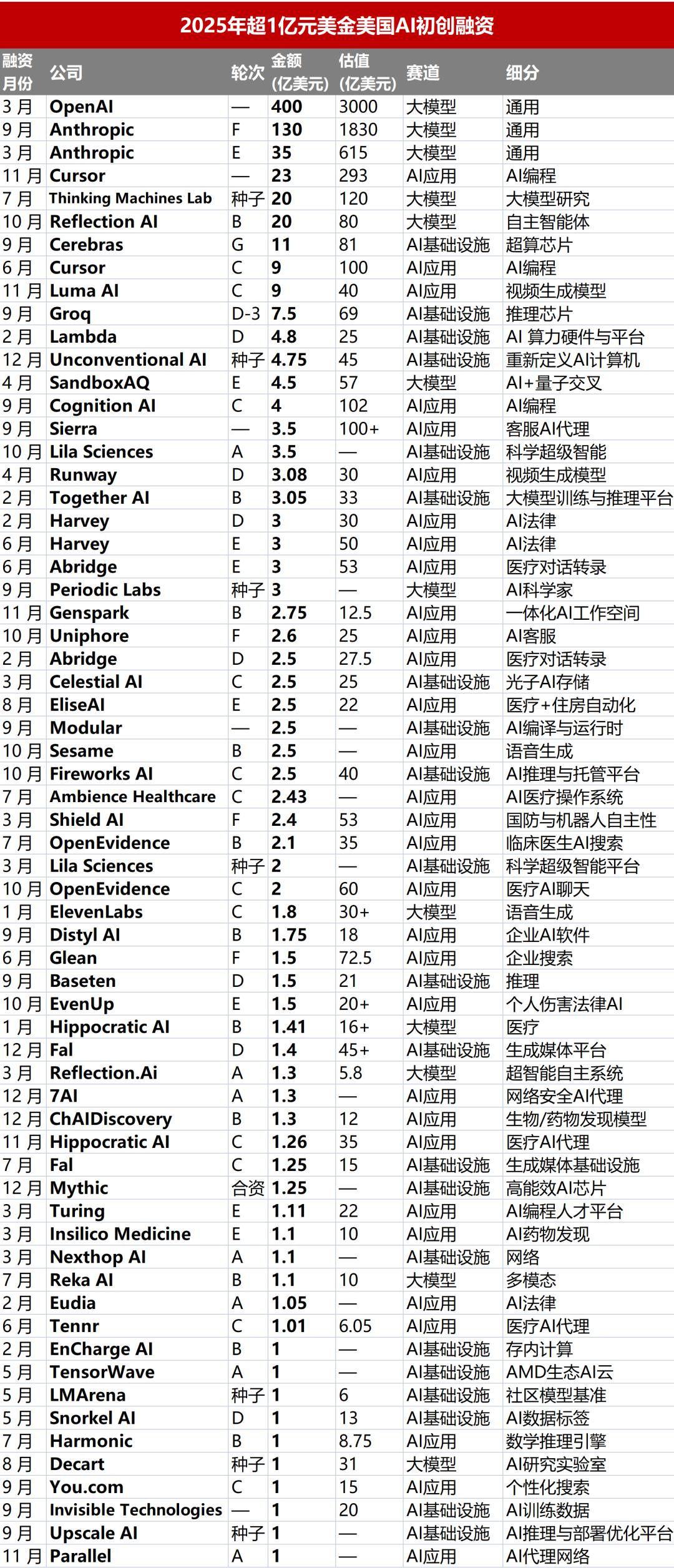
In these projects with over - $100 - million financings, the trend of polarization towards the top was particularly obvious. In this year alone, there were 35 transactions with a single - deal financing amount exceeding $200 million, covering 29 companies.
From the data, these "smartest" funds globally mainly flowed into two main lines:
One main line is to reshape the physical foundation of AI: from chips and compilers to inference systems and computing power scheduling, funds are constantly converging towards more fundamental and system - level barrier - building aspects.
The other main line targets the core business processes of high - value industries. AI is no longer limited to the level of auxiliary tools. It has started to attempt to replace top programmers, participate in scientific discoveries, and enter clinical decision - making. It has even been introduced into military and security scenarios, taking on key decision - making roles.
Putting aside those well - known star companies, Silicon - based Observer has selected 16 AI startups worthy of in - depth observation and dissected their product logics and business models one by one.
Arms Race in Computing Power: Comprehensive Reconstruction from Chips to the Compilation Layer
Among the 18 listed financing rounds, 7 were in the AI infrastructure track, and the single - deal amounts were huge. For example, Cerebras raised $1.1 billion, and Unconventional AI raised $475 million in its seed round. The investment directions are extremely cutting - edge, such as photonic computing at Celestial AI, "redefining AI computers" at Unconventional AI, and compilation and runtime at Modular.
(1) Unconventional AI
Unconventional AI announced a massive $475 - million seed - round financing led by Lightspeed Venture Partners and a16z on December 8. The valuation of this round was nearly $4.5 billion. This startup, founded only one year ago, is rethinking the fundamentals of computers in the AI era.
Unconventional AI is a startup in bio - inspired analog computing, founded in 2025. Its founder is Naveen Rao (former head of AI at Databricks), and its co - founders include Michael Carbin, an associate professor at MIT, Sara Achour, an assistant professor at Stanford, and MeeLan Lee, a former Google engineer.
The company's core product is an analog/mixed - signal AI chip + server system. Drawing on the energy - efficiency principle of the human brain, through physical - layer probabilistic computing and neuromorphic dynamics, the theoretical energy efficiency is 1000 times higher than that of traditional GPUs. It is specially designed for large - model training and inference.
The business model mainly consists of chip sales, system integration, and customized services. It provides high - energy - efficiency computing power solutions for cloud providers, supercomputing centers, and AI companies.
In 2025, the core team was assembled, and the technical route was verified. Chip design and tape - out preparations were initiated. There is no public revenue yet. It is expected to achieve tens of millions of dollars in revenue in 2026, focusing on energy - efficiency breakthroughs and large - scale implementation.
(2) Cerebras
The AI infrastructure company Cerebras Systems raised an $1.1 - billion Series G financing, with a valuation of $8.1 billion. This financing round was announced on September 30 and was co - led by Fidelity and Atreides Management.
Cerebras is a hardware company focusing on wafer - scale AI computing, founded in 2016. Its founders are Andrew Feldman (CEO) and Gary Lauterbach (CTO). Its core product is the CS - 3 supercomputer (equipped with the WSE - 3 wafer - scale engine), which integrates 4 trillion transistors on a single chip. It is specially designed for large - model training and low - latency inference, achieving more than 10 times the training acceleration and lower latency compared to GPU clusters.
The business model mainly consists of hardware sales, computing power services, and software subscriptions. It provides whole - machine and computing power leasing services for cloud providers, scientific research institutions, and AI companies.
In 2025, the CS - 3 was deployed on a large scale, serving core customers such as G42 and contributing over 87% of the revenue. At the same time, it reached a 750 - megawatt computing power cooperation agreement with OpenAI (to be deployed in stages starting from 2026), reducing the risk of over - concentration of customers.
The revenue in 2025 exceeded $1.4 billion, and the target for 2026 is to exceed $2.5 billion.
(3) Celestial AI
The AI infrastructure company Celestial AI completed a $250 - million Series C financing, with a valuation of $2.5 billion.
Celestial AI is a company focusing on photonic computing and AI acceleration, founded in 2020. Its founders are Alex Wright - Gladstein (CEO) and David Wright (CTO). Its core product is the Photonic AI Accelerator, which uses optical signals instead of electrical signals for matrix operations, achieving low - power, high - bandwidth AI inference. It is specially designed for large models, edge computing, and data centers, with an energy efficiency more than 100 times higher than that of traditional GPUs and a 90% reduction in latency.
The business model mainly consists of chip sales, IP licensing, and customized integration. It provides photonic acceleration chips and solutions for cloud providers, edge device manufacturers, and autonomous driving companies. The core of its revenue comes from chip sales and IP licensing. The revenue in 2025 was approximately $80 million, and the target for 2026 is $200 million.
In 2025, chip mass production was completed, and the first batch of products was delivered to customers, landing in data - center inference and edge AI scenarios, with a customer renewal rate of over 90%. In 2026, it will expand into the fields of autonomous driving and industrial automation, launch the second - generation photonic chips, and strengthen multi - model support and security compliance.
(4) Modular
Modular announced a $250 - million financing round on September 24.
Modular is a company focusing on unified AI computing infrastructure, founded in 2022. Its founders are Chris Lattner (founder of LLVM/Clang, former head of Apple's Swift) and Tim Davis (former core member of Google's TensorFlow).
The core products are the Mojo programming language (with Python syntax and C/CUDA - level performance), the MAX inference engine (optimized across hardware, supporting NVIDIA/AMD/Apple Silicon), and the Mammoth scheduler (K8s - native, increasing GPU utilization to over 90%), forming a full - stack of "development - compilation - deployment - scheduling" and enabling "write once, run on multiple hardware".
The business model is to charge by computing power/inference volume and share revenue with cloud providers. It provides unified AI runtime and optimization services for enterprise developers, cloud service providers, and chip manufacturers.
The ARR in 2025 was approximately $80 million, and the target for 2026 is $150 million, focusing on large - scale implementation at the enterprise level.
(5) Fireworks AI
Fireworks AI announced a $250 - million Series C financing on October 28. The company's valuation in this round was $4 billion.
Fireworks AI is an enterprise - level open - source large - model cloud platform, founded in 2022. Its founders include Lin Qiao (former head of Meta's AI platform architecture, core member of PyTorch) and James Reed (former Meta engineer).
The core product is the AICloud platform, which provides one - click deployment, LoRA fine - tuning, multi - LoRA parallel processing, and private model upload (up to 405 billion parameters) for hundreds of open - source models (such as Llama 3.1, DeepSeek, Stable Diffusion). Its self - developed FireAttention and speculative decoding technologies can speed up inference by 30 - 40 times and reduce costs by 80%.
The business model is to charge by token, computing power, or fine - tuning tasks. It provides production - level AI infrastructure for technology companies (such as Uber, DoorDash, Notion) and AI startups.
In 2025, it served over 10,000 enterprises and hundreds of thousands of developers, processing over 10 trillion tokens per day, with customers including Samsung and Shopify. The ARR in 2025 exceeded $280 million, and the target for 2026 is $450 million, aiming to remain at the top of the open - source model cloud service market.
Penetrating into Core Business Processes: "Replacement" and "Enhancement" of AI in Vertical Fields
AI application financing is concentrated in vertical fields with clear payment capabilities and high barriers, such as healthcare, enterprise services, national defense, and programming.
(1) Cognition AI
Cognition AI announced a $400 - million Series C financing on September 8. This financing round was led by the Founders Fund, and the company's valuation was $10.2 billion.
Cognition AI is a company focusing on AI - powered autonomous programming and software development. Its founder, Scott Wu, is a former programming competition champion. Its core product is Devin, the world's first AI engineer capable of independently completing full - scale software development tasks. Devin can independently plan projects, write code, debug and fix issues, and deploy and launch applications. It can also collaborate with developers for iteration, significantly improving R & D efficiency.
The business model mainly consists of enterprise subscriptions and customized services. It charges by seat and functional module for technology companies, financial institutions, and software outsourcing providers.
The ARR in 2025 exceeded $50 million, and the target for 2026 is $120 million, focusing on large - scale implementation and industry - specific customization.
(2) Sierra
Bret Taylor's customer - service AI agent platform, Sierra, raised $350 million in a new financing round. This financing was announced on September 4, and its valuation exceeded $10 billion.
Sierra is an AI - driven enterprise - level conversational interaction platform. Its founders are former core members of Google Assistant. Its core product is SierraAI, a multi - modal intelligent interaction system that can build highly anthropomorphic customer service, sales, and employee assistants, enabling full - channel automated interaction.
The product has the capabilities of intent understanding, context memory, and complex task processing, and can be seamlessly integrated with enterprise systems such as CRM and ERP.
The business model is SaaS subscription and charging by interaction volume. It provides standardized platforms and customized solutions for industries such as retail, finance, healthcare, and telecommunications.
The revenue in 2025 was $80 million, and the target for 2026 is $150 million.
(3) Ambience Healthcare
Ambience Healthcare, a five - year - old company, is building an AI - powered healthcare operating system and has received a $243 - million Series C financing.
Ambience Healthcare is an AI - driven clinical documentation automation company. Its founder team comes from the fields of medical AI and NLP. Its core product is the Ambience AI platform, which uses environmental - sensing voice technology to capture doctor - patient conversations in real - time, automatically generate structured clinical notes and ICD - 10/CPT codes, support customization for over 200 specialties, and can be seamlessly integrated with mainstream EHR systems such as Epic and Cerner.
The platform can reduce doctors' documentation time by 45% and improve coding accuracy and compliance.
The business model is SaaS subscription and charging by provider. It charges by the number of clinical users and functional modules for hospitals, clinics, and medical groups. In 2025, it was deployed in many large - scale medical systems (such as John Muir Health), expanding specialty coverage from emergency and oncology to psychiatry and anesthesiology, with a customer renewal rate of over 90%.
In 2025, the ARR exceeded $80 million, and the target for 2026 is $150 million.
(4) OpenEvidence
OpenEvidence, a company specialized in building AI chatbots for the medical field, received its second - round financing in 2025. On October 20, the company announced the completion of a $200 - million Series C financing, with a valuation of $6 billion.
OpenEvidence is an AI - powered clinical decision - support company, founded in 2021. Its founders are Daniel Nadler (founder of Kensho) and Zachary Ziegler. Its core product is the OpenEvidence platform, an AI Q&A system for doctors. Based on authoritative medical literature such as NEJM and JAMA, it can answer clinical questions in real - time and attach literature references, supporting USMLE - level accuracy (reaching 100% in 2025), covering scenarios such as diagnosis, treatment, medication, and coding.
The platform is free for certified doctors and is integrated with EHR and clinical calculators.
The business model consists of pharmaceutical/medical device advertising and enterprise subscriptions. It monetizes through high - value medical advertising and provides customized deployment and data - insight services for hospitals.
In 2025, it covered over 10,000 hospitals/clinics in the United States, supporting an average of 18 million clinical consultations per month and serving over 100 million patients. The revenue in 2025 was $50 million (with a 30% month - on - month growth), and the target for 2026 is $120 million.
(5) EliseAI
The healthcare and housing automation platform EliseAI raised $250 million in a Series E financing, with a valuation of $2.2 billion. This financing round was announced on August 20.
EliseAI is a vertical - field AI automation platform, founded in 2017. Its founders are Minna Song and Tony Stoyanov. Its core product is a multi - modal AI assistant, focusing on two main scenarios: property management and medical outpatient services:
In the property sector, it automates rental consultations, viewing appointments, maintenance responses, and rent collection. In the medical sector, it automates appointment registration, insurance verification, pre - operative notifications, and bill consultations, supporting text interaction in 51 languages and voice interaction in 7 languages.
The business model is SaaS subscription and charging by unit or outpatient volume. It charges by scale and function for large - scale apartment operators and medical chain institutions in the United States.
In 2025, it covered over 10% of the apartment market in the United States, and its medical business grew rapidly. The ARR exceeded $100 million, with a year - on - year growth of over 100%. In 2026, it will expand into the European property market and more medical specialties in North America, strengthen private deployment and compliance capabilities, with a target of $200 million.
(6) Uniphore
The enterprise AI startup Uniphore was valued at $2.5 billion after a $260 - million Series F financing announced on October 22. This round of investment included Snowflake Ventures, NVIDIA, Databricks Ventures, and AMD.
Uniphore is an enterprise - level conversational AI and automation platform, founded in 2008. Its founders are Umesh Sachdev and Ravi Saraogi.
The core product is the Business AI Cloud, which integrates voice/text analysis, AI agents, and process automation, covering scenarios such as customer service, sales, marketing, and HR, supporting multi - language interaction and real - time insights. The product has the capabilities of zero - code deployment, data security and compliance, and full - link automation, and can be deeply integrated with existing enterprise systems.
The business model is SaaS subscription and charging by seat or interaction volume. It provides standardized platforms and vertical solutions for industries such as finance, retail, telecommunications, and