SoftBank's Masayoshi Son aims to secure a record-breaking $200 billion single investment in AI.

On January 28th, according to the latest disclosures from Bloomberg and The Wall Street Journal, SoftBank Group is in talks with OpenAI about a potential additional investment of up to $30 billion (approximately RMB 208.38 billion).
Foreign media reported that if this deal is finalized, it will become one of the largest single - round financings in the global AI field to date. It also means that Masayoshi Son is putting almost all his chips on OpenAI.
After the news broke, SoftBank's stock price soared by 8.8% at one point yesterday, and then the increase narrowed. Today, it rose by about 3.7% during the Tokyo trading session.
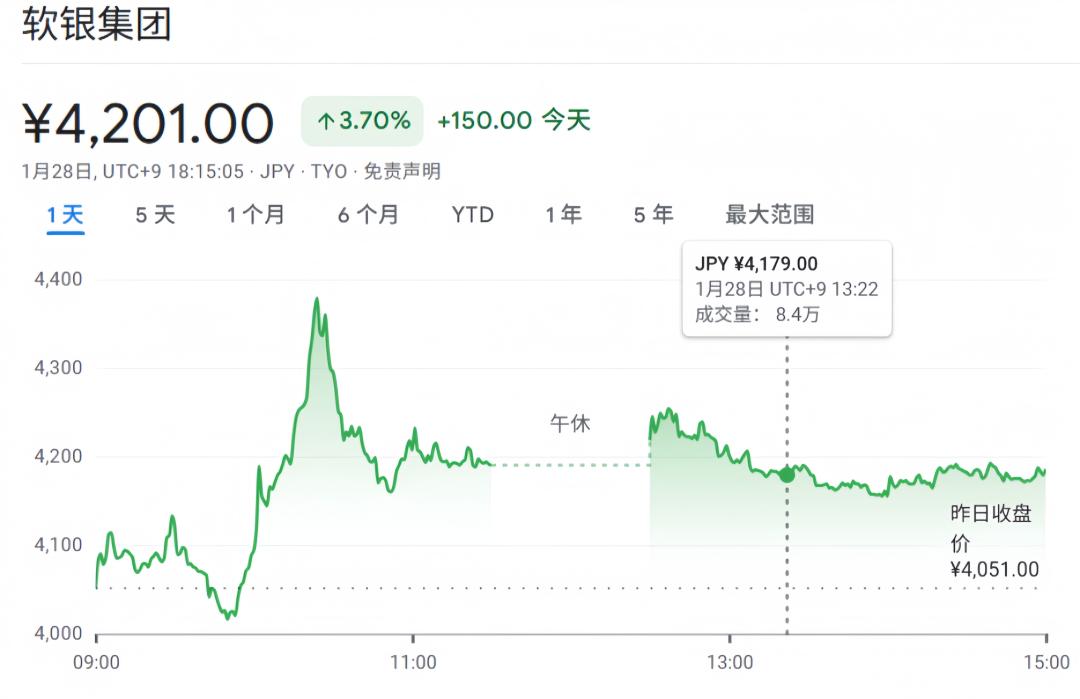
▲SoftBank's latest stock price (Source: Google Finance)
Meanwhile, OpenAI is also accelerating its product development. Yesterday, OpenAI launched a new AI tool called Prism for researchers, aiming to upgrade ChatGPT from a "general assistant" to an "infrastructure for scientific discovery".
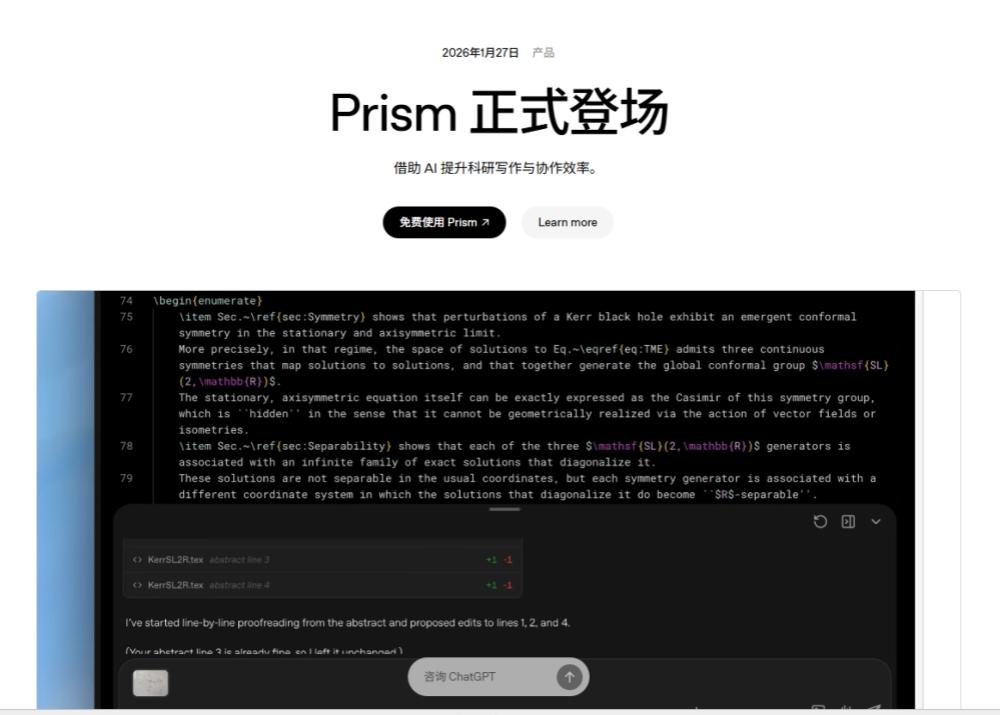
▲Yesterday, OpenAI announced the launch of the Prism tool (Source: OpenAI's official website)
Japanese stock strategist Amir Anvarzadeh said, "Masayoshi Son has clearly gone all - in and bet all his chips on ChatGPT."
01. A $30 - billion additional investment: Masayoshi Son is turning OpenAI into a 'second Arm'
According to several people familiar with the matter, SoftBank is currently evaluating the possibility of making an additional investment of up to $30 billion in OpenAI. The relevant negotiations are still ongoing, and the final amount and terms have not been finalized.
If this deal is completed, SoftBank's stake in OpenAI will further increase. In December last year, SoftBank invested $22.5 billion (approximately RMB 156.28 billion) in OpenAI, raising its stake to about 11% and becoming one of OpenAI's largest external shareholders.
According to a report in The Wall Street Journal yesterday, this additional investment is part of OpenAI's larger - scale financing plan. The company is trying to raise $50 - 100 billion (approximately RMB 347.3 - 694.59 billion) from global investors, with a target valuation of up to $750 - 830 billion (approximately RMB 5.2 - 5.8 trillion).
OpenAI is considering an initial public offering (IPO) and plans to raise funds from Middle Eastern sovereign - wealth funds and other venture capital funds. The company's existing investors include Thrive Capital, Khosla Ventures, and the UAE fund MGX.
For SoftBank, this is not only a financial investment but also a strategic bet. In the past few years, Masayoshi Son has repeatedly emphasized that "AI will reshape all industries", and he regards OpenAI as the company most likely to be at the core of this transformation.
To raise enough funds to continuously increase its investment in OpenAI, SoftBank is making a series of radical asset adjustments.
As reported in The Wall Street Journal, to raise funds for investing in OpenAI, SoftBank has sold its shares in Nvidia for $5.8 billion (approximately RMB 40.29 billion). At the same time, SoftBank has reduced its holdings in assets such as T - Mobile and used Arm's stocks for financing operations.
Previously, SoftBank also suspended the acquisition negotiations with the US data center operator Switch and concentrated its funds on AI - related projects.
In the past year, SoftBank has significantly accelerated its investment in the AI and automation fields: it spent $6.5 billion (approximately RMB 45.15 billion) to acquire the US chip design company Ampere Computing; spent $5.4 billion (approximately RMB 37.51 billion) to acquire the robotics business of ABB (ASEA Brown Boveri); and continuously increased its investment in OpenAI.
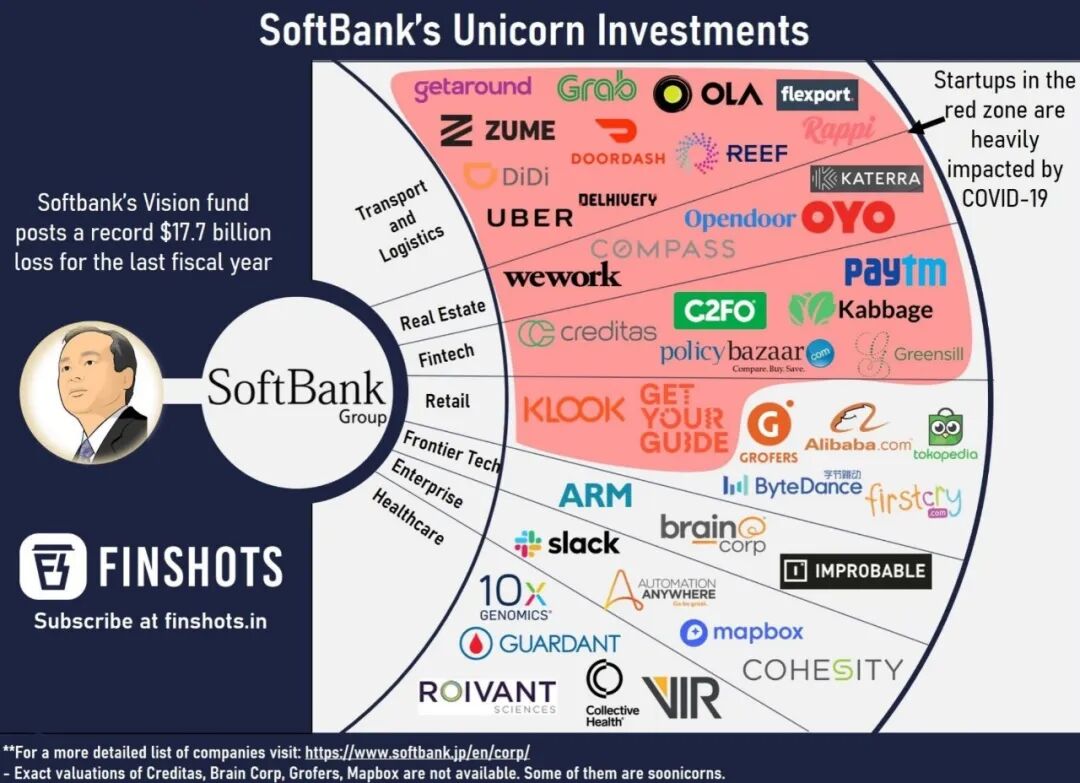
▲SoftBank's previous investment situation (Source: SoftBank's official website)
In addition, the rating agency S&P Global has warned that SoftBank's aggressive investment in the AI field, combined with the volatility of Arm's stock price, is putting pressure on SoftBank's credit rating. If OpenAI's valuation accounts for too large a proportion in SoftBank's asset structure, it may further amplify the investment portfolio risk.
A Bloomberg industry researcher mentioned that if SoftBank Group makes an additional investment of $30 billion in OpenAI, its BB+ credit rating may face downward pressure. After accounting for the unfinished transactions and assuming that SoftBank's current stake in OpenAI is re - valued upwards, SoftBank's loan - to - value ratio (LTV) may reach the 35% trigger line for a rating downgrade.
To keep the disclosed LTV below 25%, this deal is likely to require SoftBank to raise at least $15 billion (approximately RMB 104.19 billion) through asset sales and margin loans.
Meanwhile, the risk of SoftBank's investment portfolio will further increase. Based on Arm's stock price on January 27th, OpenAI's valuation may exceed that of Arm, becoming SoftBank's largest single holding, and its proportion in SoftBank's overall asset value may exceed 30%.
Japanese stock strategist Amir Anvarzadeh said that as models such as Google's Gemini and Anthropic's Claude are catching up rapidly, ChatGPT's leading edge is facing greater challenges.
"From a competitive perspective, OpenAI's future is no longer as certain as it was a year ago." But he also mentioned, "Masayoshi Son has clearly gone all - in and bet all his chips on ChatGPT."
OpenAI itself also faces a real problem: it burns money extremely fast. Model training requires a huge amount of computing power, the inference cost is continuously rising, and the competition for top - notch researchers is becoming more and more intense.
02. The debut of Prism: OpenAI brings AI into the'scientific research workflow'
While the financing news is fermenting, OpenAI has also sent an important signal at the product level.
On January 27th, OpenAI officially launched a free tool called Prism, which is positioned as an AI tool for scientists. Any user with a ChatGPT account can use it for free.
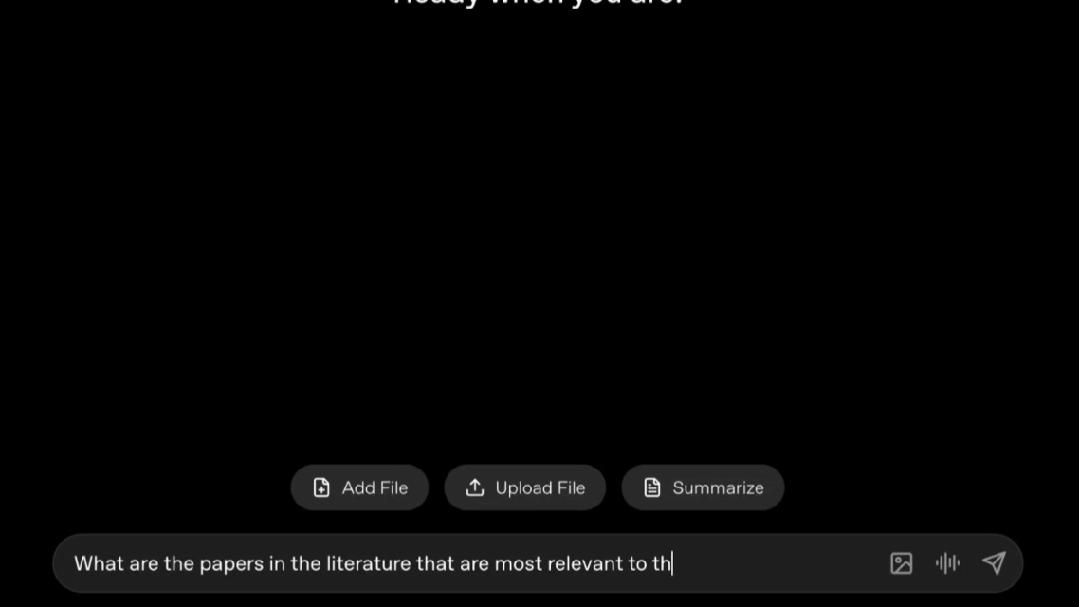
▲The interface of the Prism tool (Source: OpenAI's official website)
Different from the traditional chat interface, Prism is more like an "AI - enhanced scientific research writing and collaboration platform": it is based on the GPT - 5.2 model, natively supports LaTeX, can be used for paper writing, modification, literature retrieval, supports multi - person collaboration, and can quickly convert hand - drawn sketches into standard charts.
OpenAI officials said that Prism is not intended to replace scientists but to accelerate their workflow. The company's executives compared it to "Cursor or Windsurf" in the scientific research field, that is, a tool that is deeply embedded in the workflow and significantly improves efficiency.
Now, the development of AI is increasingly oriented towards vertical scenario applications.
OpenAI and its competitors, such as Google's DeepMind and Anthropic's Claude, are increasingly focusing on the application of AI in the fields of science and healthcare, from using the technology to help guide new drug research to reviewing personal medical data.
OpenAI's move to introduce Prism into the scientific research field is not accidental. The company's data shows that ChatGPT receives an average of 8.4 million messages related to advanced science and mathematics every week, and this number is expected to increase by 47% in 2025.
Kevin Weil, the vice - president of science at OpenAI, said bluntly: "I think 2026 will be to AI and science what 2025 was to AI and software engineering." In his view, AI - assisted scientific research is at a similar point in time as the "eve of the explosion of code assistants".
In the fields of mathematics and statistics, this trend has begun to emerge. Foreign media Tech Crunch mentioned that in December last year, a statistical paper titled "On Learning - Curve Monotonicity for Maximum Likelihood Estimators" used the GPT - 5.2 Pro model to complete a new proof of the core axiom, and human researchers were only responsible for prompting and verifying the model's work.
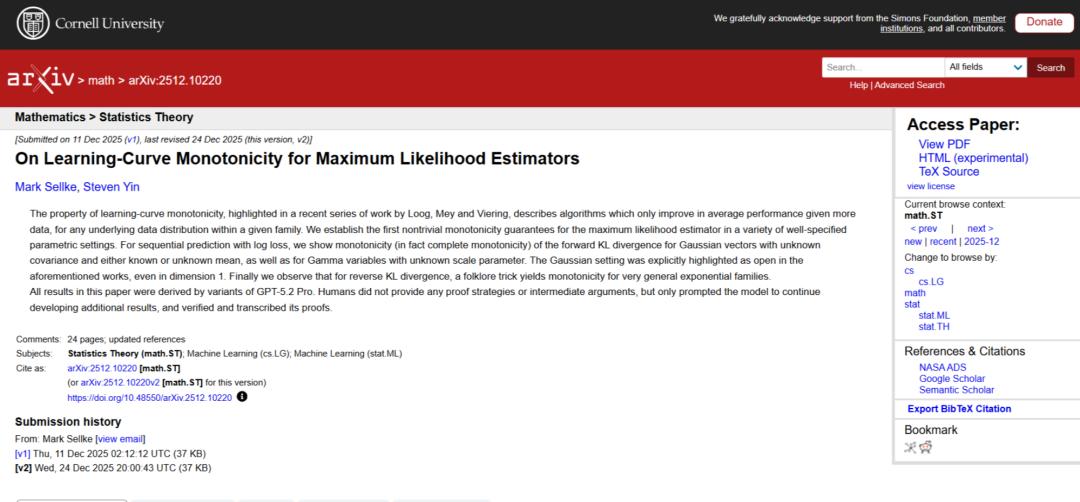
▲Details of the paper (Source: Cornell University's official website)
This kind of case is continuously strengthening OpenAI's judgment: AI will become an important participant in scientific discovery, not just a tool.
03. Conclusion: From ChatGPT to 'AI infrastructure', the ultimate vision of OpenAI
Looking at the financing and products together, we can see that OpenAI is moving forward along a very clear path.
On the one hand, OpenAI ensures the continuous leadership in model scale, computing power, and talent reserve through huge - scale financing; on the other hand, OpenAI deeply embeds AI into high - value workflows such as scientific research, education, and enterprises through tools like Prism.
And SoftBank, by investing a large amount of money in OpenAI, is betting on the ultimate possibility of AI reshaping industries.
This article is from the WeChat public account "Zhidongxi" (ID: zhidxcom), author: Wanguixia. It is published by 36Kr with authorization.