Judging from the Spring Festival Gala, 2026 is a crucial year for embodied intelligence to move from technology demonstration to practical application.
When it comes to robots, the first impression of many people is probably the Unitree robots twirling handkerchiefs on the stage of the 2025 Spring Festival Gala.
However, compared with Unitree's sole prominence last year, there will be a higher presence of robots in this year's Spring Festival Gala.
Currently, four embodied intelligence-related enterprises, namely Magic Atom, Galaxy Universal, Unitree Technology, and Dreame, have officially announced that they have become partners of this year's Spring Festival Gala.
The Spring Festival Gala, which has hundreds of millions of views, has never been just a simple cultural performance. Instead, it is an excellent window to observe the pulse of China's industries. Every year, the brands that appear on the Spring Festival Gala stage often correspond to the most expansive industrial development directions at that time and the growth ambitions of the brands.
Of course, in an era when physical AI is considered the inevitable path to AGI, robots naturally deserve such attention and expectations.
Who is vying for the traffic amplifier of the Spring Festival Gala?
What we can look forward to in this year's Spring Festival Gala is that not only will the number of robot enterprises making an appearance increase, but the form of performance will also shift from simple dancing to "intelligent interaction".
Take the Galaxy Universal Robot, which has been officially announced, as an example. It is reported that it will focus on demonstrating its autonomous decision-making ability and efficient collaboration level in complex scenarios. This means that the audience will not see repetitive actions from pre-programmed routines, but rather intelligent agents with environmental awareness, instant reaction, and a "warm service" experience.
Dreame Technology will also focus on demonstrating its interaction and perception capabilities. It is reported that the intelligent mobility robot under Dreame Technology's brand, Shouqu, which has environmental awareness, autonomous decision-making, and precise execution capabilities, will appear on the stage as a technological element.
It goes without saying that the Spring Festival Gala is an amplifier for brands. However, for the robot industry, choosing the Spring Festival Gala reveals the ambition and anxiety of the entire industry. Firstly, they hope to replicate Unitree Technology's phenomenal breakthrough into the mainstream.
Unitree's sudden popularity allowed the general public to directly feel the presence of robots through the screen. Later, Wang Xingxing even appeared at a symposium, sitting alongside industry titans like Ma Huateng and Ren Zhengfei, becoming a prominent new tech upstart. This value of "being seen" was directly translated into market application value.
According to the announcement released by Unitree Technology on January 22, 2026, the actual shipment volume of its humanoid robots in 2025 exceeded 5,500 units (referring to the actual number of units shipped to end customers, not the order volume, which was even higher). In 2025, more than 6,500 units of the robots were mass-produced and rolled off the production line.
Along with the commercial value, there has also been a wave of reflection in the primary market about "why they missed out on Unitree".
For a while, the entire investment circle was filled with a FOMO (fear of missing out) mentality, and funds rushed into this industry in search of the next Unitree.
According to media reports, many investment institutions previously rejected embodied intelligence-related projects due to reasons such as high cost and difficulty in implementation. However, after the Spring Festival in 2025, the decision-making level had a major change of attitude. They not only recognized the necessity of investment but even reflected on the fact that they had not invested enough at that time.
Coincidentally, with the capital winter in the consumer and software industries, the hot money in the industry naturally flowed into this industry, which is likely to be the next terminal entry point. Because everyone firmly believes that robots will, like humans, enter factories and households, replace humans, and create value for all industries.
This enthusiasm even seems a bit crazy. Many entrepreneurs have received large amounts of financing even without having a product yet. Many newly established start-up teams have completed multiple rounds of large-scale financing recently, despite making little progress.
According to IT Juzi data, in the past year, there were 304 financing events in the entire industry, and more than 37.9 billion yuan in funds flowed in, approximately three and four times the figures in 2024 respectively. Among these, there were huge financings of nearly 2 billion yuan per deal, as well as star projects that attracted a dozen or so institutions to compete for investment.
A number of enterprises with a valuation of tens of billions have emerged in the entire industry. Currently, Galaxy Universal leads with a valuation of 20 billion yuan, followed by Zhipu with a valuation of 15 billion yuan, and Unitree Technology with a valuation of 12 billion yuan.
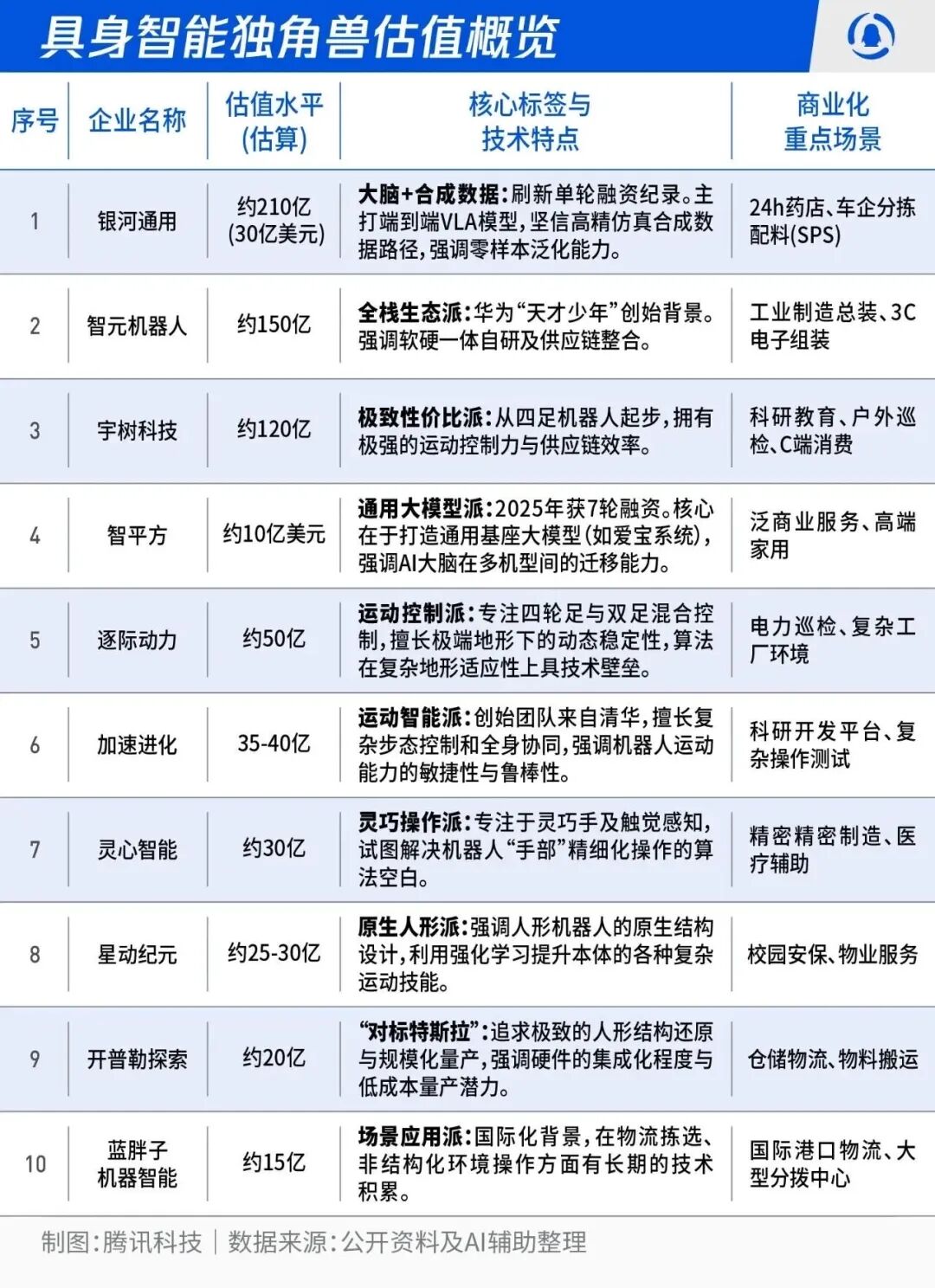
Financing and listing are progressing side by side, and more than a dozen enterprises are submitting IPO applications in a cluster.
According to public information, leading players such as Unitree Technology, Zhipu Robot, Leju Robot, Galaxy Universal, and DeepClouds are also accelerating their listing processes.
After the capital frenzy, who can stay at the table?
After explaining the reasons why robot enterprises are looking forward to the traffic from the Spring Festival Gala, next, we will explore their anxiety.
As mentioned above, the FOMO sentiment stems from investors' consensus that robots will surely play a huge role in all industries in the future. However, it should be noted that in the development of technology, bubbles are a common phenomenon, especially after a market consensus has formed. The embodied intelligence industry is no exception.
An undeniable reality is that the robot industry is still in the development stage.
At the beginning of 2025, Zhu Xiaohu, a partner at GSR Ventures, mercilessly poured cold water on the robot industry, saying, "Our angel fund has invested in some early-stage embodied intelligence projects in the past few years, and we have been exiting in the past few months... I asked these CEOs where their potential commercial customers were. I felt that the customers they mentioned were all just imagined. Who would spend hundreds of thousands of yuan to buy a robot to do these jobs?"
Zhu Xiaohu's view may be relatively radical. If you carefully observe the embodied intelligence industry, you will find that the pace of technological evolution in the past year was clearly visible.
At the beginning of last year, robots that could run and jump were enough to surprise people. However, by 2026, a new voice has emerged - we don't need one million robots that can only dance. More and more companies have gradually caught up in terms of motion intelligence. Therefore, embodied intelligence enterprises are betting on higher-level planning and decision-making capabilities.
According to public information, among the 11 whole-machine companies with a valuation of over 5 billion yuan, except for Unitree and Zhongqing, the rest are focusing on the development of embodied large models such as VLA.
As optimistic as Huang Renxun of NVIDIA, he predicts that humanoid robots and the technology to achieve them are just around the corner. He even said, "The ChatGPT moment in the robot field has arrived."
However, don't get too excited too soon. Although technology is advancing, the technological path of embodied large models is far from converging. No wonder investors can be basically divided into two camps.
One camp, for the sake of caution, is settling for the next best thing and starting to pursue order volume. After all, it's too difficult to understand the technological trend, and the quantifiable commercialization ability is the safest narrative starting point in the "accounting stage".
The other camp, with a touch of idealism, is willing to bet on the future and focuses more on "the breakthrough of intelligent technology and the verification of scenario adaptability".
Whether it's looking at orders or technology, leading enterprises have a first-mover advantage. They have taken away most of the capital and talents in the industry. Overall, the embodied intelligence enterprises have now reached a stage where the leading players attract most of the attention - the financing rounds are extending from the early stage to the middle and later stages, and the top 11 companies have taken away more than half of the funds in the industry this year.
Currently, the embodied intelligence industry is more like the era of great voyages. No one can predict when the ChatGPT moment of embodied large models will arrive. The players in the industry need to stock up on resources and survive, especially when the policy support is clear.
Song Xiaogang, the executive director and secretary-general of the China Robot Industry Alliance, introduced that during the "14th Five-Year Plan" period, in the face of the development of industries such as manufacturing and the demand in fields such as household services, China will focus on promoting the innovation and application of key products of industrial robots, service robots, and special robots, and promote the high-end and intelligent development of products.
The policy support gives enterprises the confidence to weather the cycle, but to survive until the end of the cycle, they still have to rely on themselves.
Without relying on financing, how can they survive until the "iPhone moment"?
The future is bright and worth looking forward to. For the players in the industry, as long as they stay at the table, there is hope. Maybe they will wait for the arrival of the VLA technology singularity, or there will be clear new application scenarios to fuel commercialization. However, before that, they need a strong self-hematopoietic ability to prove to the capital market that their business model is viable.
Yu Yinan, the founder of Vita Power, once said that in the initial stage, to achieve mass production of one million units within five years, an investment of tens of billions of yuan may be required to enter the game. However, this 10 billion yuan definitely cannot be obtained solely through financing. There must be products that are put into use first to achieve self-hematopoiesis.
Understanding this, it's not hard to understand why everyone is vying for a spot at the Spring Festival Gala. Once on the Spring Festival Gala, it will surely push the industry to a new peak in public opinion and capital, and set a more positive tone for the embodied intelligence market in 2026.
Gu Shitao of Magic Atom, which will appear on the Spring Festival Gala stage this year, clearly stated that 2026 will be a crucial node for Magic Atom's large-scale production. Each product line has set a shipment target of "thousands of units". In addition to the whole machine products, the company's data collection equipment and solutions have also been shipped one after another, providing services for other algorithm companies in the industry that need real-scenario data, and continuously expanding the business boundaries.
Galaxy Universal, which has won thousands of orders multiple times, also hopes to use the Spring Festival Gala stage to take its commercialization ability to a higher level.
What gives Galaxy Universal an even greater first-mover advantage is that it has long won mass production orders of thousands of units from enterprises such as Baida Precision. This is a symbolic numerical threshold, which means more stringent reliability, consistency, and cost control capabilities, involving multiple aspects such as supply chain management, production, and testing. Just in this regard, it will take at least a year for other companies to bridge the gap. Therefore, for enterprises like Galaxy Universal, which are quite advanced in commercialization, appearing on the Spring Festival Gala for exposure is to widen the gap and continue to consolidate their leading position.
This industry still has a long way to go. Fortunately, a consensus has been reached, and it's just a matter of time.
As Zhang Ying of Matrix Partners publicly said, "The robot field is booming. It's a large industry with a wide variety of players. It's very normal to have a bit of a bubble in the process. In the long run, large companies will definitely emerge in the humanoid robot industry."
Cui Kedi, a post - 95s investor, even believes that a group of great artificial intelligence companies will emerge in this generation, most likely between 2023 and 2026.
He prefers to compare the founders in the embodied intelligence field to captains. Their sense of direction comes from continuous trial and error and calibration. Investors and entrepreneurs are going through one adventure after another, moving forward step by step on the treasure map.
Currently, both the capital and the industry are full of positive and optimistic expectations, waiting quietly for the "iPhone moment" of embodied intelligence. Because historical experience tells us that enterprises with real core technologies and scenario adaptability will eventually weather the cycle and reveal their true value after the bubble subsides.
*The title image is generated by AI.
This article is from the WeChat official account "Jiedian Finance" (ID: jiedian2018), author: Liang Tian. Republished by 36Kr with permission.