2026 ushers in the first year of the AI Memory Era
Not long ago, LMArena.ai conducted statistics on the changes in the global large model market landscape and came to an interesting finding:
Since mid-2023, the iteration cycle of SOTA models has been rapidly compressed to 35 days. A former SOTA model could drop out of the Top 5 in just 5 months, and fail to even meet the Top 10 threshold 7 months later.
Behind the continuous updates of SOTA, models are indeed making progress, but eye-catching new products like ChatGPT and Deepseek have become increasingly rare. Technological advancement has entered a bottleneck period where only minor tweaks are made and no major breakthroughs can be achieved.
In stark contrast to the gradually fading momentum of model evolution is the bustling, fast-changing development centered on AI memory over the past two years.
The first to enter this track were vector database products emerging in 2023, represented by Milvus, Pinecone and faiss.
In the following year, built on mature semantic systems, knowledge graph libraries and keyword retrieval capabilities, various AI memory frameworks represented by Letta (MemGPT), Mem0, MemU and MemOS sprang up like mushrooms from 2024 to 2025. There are so many "Mem X" series products on GitHub that they can even form a matching game.
This boom quickly spread to model developers. A week ago, discussions about the news that Claude was reported to add memory capabilities for models in Cowork had not yet faded away, when Google followed closely and announced its latest Nested Learning achievement, which allows models to automatically modify parameters to realize model memory based on contextual reasoning results, once again causing a stir in the industry.
On the scenario side, including code completion, emotional companionship, intelligent customer service and other scenarios, the "model + memory" golden business model has seen more and more niche hit products that have successfully achieved Product-Market Fit. Following this trend, RedBear AI and other players focusing on commercial AI memory science solutions have also stepped into the spotlight and become the new focus of the industry.
It is beyond doubt that memory has become the new mid-game inflection point. However, the industry may have long held three misunderstandings about how to add memory to large models and how to enable models to memorize better.
Misunderstanding 1: Memory = RAG + Long Context?
Wen Deliang, founder of RedBear AI, is a veteran in the industry. But since he started his business, he has to face the sharp questions from investors and customers every day: "Who are your competitors?"
This question seems ordinary, but it puts people in a dilemma: claiming there are no competitors sounds arrogant, while claiming there are competitors means you cannot find a player that truly matches your positioning.
During the 2023-2024 AI infrastructure boom, RAG (Retrieval-Augmented Generation) technology once became a byword for AI memory. By equipping the model with an external vector database and storing various corporate private data and professional literature, large models can access information and private data knowledge that was not updated during the model training phase.
In that period, investors would inevitably ask about RAG performance when evaluating projects, and customers would definitely compare retrieval accuracy first when selecting solutions, as if the pain point of AI amnesia could be completely solved by simply stacking context windows and optimizing retrieval algorithms.
For a while, teams developing RAG frameworks, RAG solutions, and even further deploying fully private knowledge bases emerged in huge numbers around the world. Giants like Feishu, DingTalk and WeCom can rely on standardization and data accumulation to launch standardized products, while small and medium-sized teams can also capture one vertical scenario after another through private deployment.
But in business, the higher the level of consensus on a certain perception, the more correct it is, and the more it shows that it is a lagging variable.
The RAG approach is not wrong, but it will also expose its shortcomings as technology evolves. Starting from 2024, Wen Deliang found that traditional RAG seems to have been overly mythologized by everyone. In the implementation process, even for the most basic knowledge base projects, RAG can hit walls in all kinds of unexpected ways:
For example, in legal projects, there are often a large number of scenarios with similar semantics but vastly different applicable scopes and precedents. Specifically, in legal provisions, many key details that determine the applicable boundary (such as the requirement of a reminder procedure for contract termination) have extremely low weight at the semantic level and will be covered by overall similarity. In addition, the operation of the legal system is not isolated text matching, which needs to follow constraints such as "upper law prevails over lower law", "special law prevails over general law", and "new law prevails over old law". When facing similar conflicting provisions, if the model only sorts by semantic similarity instead of prioritizing legal provisions with higher validity, it will lead to deviations in overall understanding. Not to mention that in legal scenarios, retrieval itself must be bound to structured scenario information such as case cause, subject, and region. For example, legal provisions related to personal injury compensation may be semantically similar to sub-provisions applicable to traffic accidents and medical disputes, but the burden of proof and compensation standards are completely different, and pure semantic retrieval cannot accurately distinguish and adapt to scenarios at all.
As the difficulty increases, in various customer service AI scenarios, even if customization is done for the scenario and embedding, chunking, and ranking are all optimized to the fullest, the RAG solution still has problems: when repeatedly answering questions such as "What is the applicable scenario of the XX clause" and "How to calculate the repayment date" every day, it will incur unnecessary retrieval costs; and when users consult across sessions, the AI is like a completely different person, with no memory of the communication details from the last round.
Wen Deliang soon realized that the RAG solution based on semantic retrieval can only solve less than 60% of real demands, while what customers want is a complete scenario-based solution that can realize one-time consultation, lifelong memory and dynamic knowledge update.
As a passive retrieval tool, RAG is like installing an external dictionary for AI, which can solve the problem of unknown information, but cannot solve the core contradiction of being unable to remember. At the same time, on the writing side, RAG usually can only perform offline data updates on a weekly basis, and cannot dynamically write users' real-time session content and focus points.
On this basis, cross-session memory loss, inability to dynamically precipitate information, and inability to actively associate experience are all capability blind spots of RAG.
Therefore, in his view, real AI memory must replicate the working logic of the human brain, being able to remember information in the short term, maintain common sense in the long term, and make judgments with emotional awareness.
Specifically, human brain processes information through three major links: encoding, storage, and retrieval. External information is converted into neural signals by the sensory cortex, filtered by the prefrontal cortex and transmitted to the hippocampus, then integrated with the existing knowledge network, and finally stored in the cerebral cortex according to importance; during retrieval, the hippocampus links the corresponding areas to activate memories.
This is a dynamic, real-time, writable and retrievable intelligent system, which not only solves the problem of acquiring knowledge, but also internalizes "knowing" as part of the cognition and thinking logic, optimizing subsequent thinking, judgment and behavior.
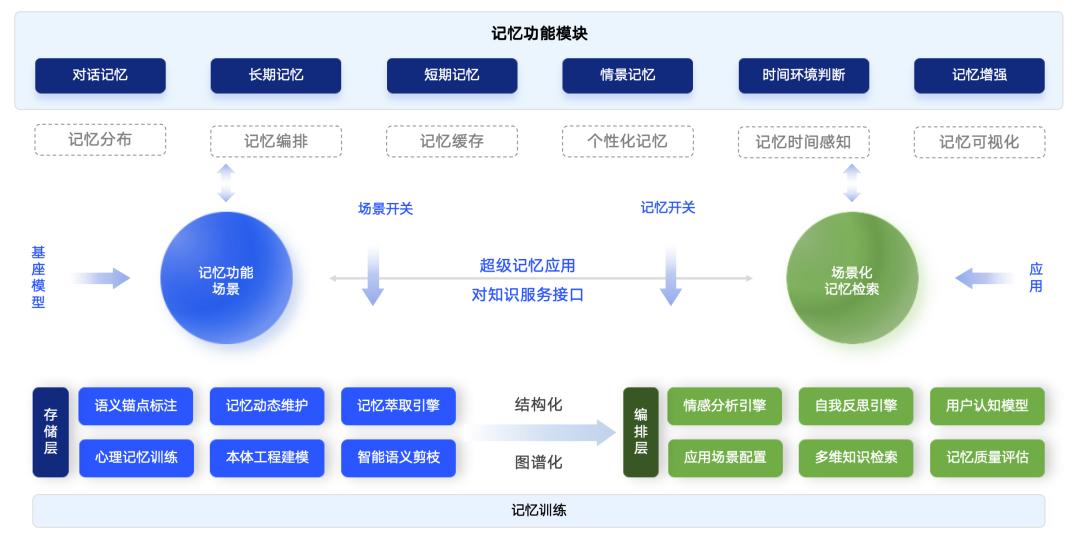
Drawing on this human memory-thinking logic, RedBear AI has built a complete memory science system, and launched MemoryBear v0.2.0 in January this year, which disassembles AI memory into explicit memory, implicit memory, associative memory and dynamically evolving memory. Different layers flow dynamically through intelligent algorithms and are used in different ways on different occasions.
More critically, this system is not limited to reading, writing and storing, but also adds capabilities such as emotional weighting, intelligent forgetting, and cross-agent collaboration to memory itself, reconstructing the logic of AI memory from the bottom layer. In this way, it not only solves the problems of exploding storage data volume, soaring costs and overly long context, but also assigns different weights to different memories, making the use of memory more efficient.
Misunderstanding 2: Factual retrieval is paramount? Emotional intelligence can solve problems better
After solving the problem of how to build the overall memory system architecture, the core R&D team of RedBear AI, like all technical teams, began to take accuracy as the only KPI for the memory system.
Most of the team members are engaged in engineering and R&D, and the majority of them are male staff with science and engineering backgrounds. The biggest advantage of this configuration is that everyone shares the same discourse system and has strong thinking ability. This logic can run very smoothly in scenarios such as financial risk control and technical operation and maintenance. After all, in these scenarios, facts come first, and a single wrong number may lead to unpredictable risks.
But the downside of this approach is that excessive bluntness and logical reasoning regardless of the occasion are essentially synonymous with indifference and confrontation.
An unexpected customer demand made all the team realize this point.
In 2025, the women's federation of a developed province approached the RedBear AI team, stating that they hoped to use AI to undertake late-night emotional counseling and family dispute assistance services.
When sorting out user demands, the team soon found that the troubles of those late-night visitors are sometimes very trivial and specific, with no standard solutions. Even the visitors themselves have already made judgments, and they only need a little external affirmation and encouragement. In such scenarios, users do not need, and there is no such thing as precise factual answers. What they need is to be understood, comforted and affirmed. For example, when a new user calls, the AI should quickly identify emotional fluctuations and guide them to vent their emotions; when returning visits to old users, it should remember their last troubles and what kind of comfort was most effective.
All in all, these emotional intelligence rules that humans follow in handling affairs, such as apologizing first when making a mistake, and giving priority to recognition, understanding and empathy when facing emotional troubles, also need to be proficiently mastered in AI implementation.
This also forced RedBear AI to overcome the emotional challenge of the memory system:
By attaching emotional weight labels to each memory, user emotions can be quantified from multiple dimensions. For example, in text scenarios, we can calculate a 0-100 emotional score by comprehensively considering the density of negative/positive words, sentence patterns (rhetorical questions, exclamatory sentences) and emotional intensity words (such as "extremely", "never again"); in voice scenarios, features such as speech speed, intonation, pause and volume need to be superimposed for calibration; in multi-modal scenarios, facial expression recognition can be added to make the quantification more accurate.
Just like when a friend is broken up in a relationship, we need to give them a hug first, instead of getting to the bottom of the reason for the breakup to act as an emotional judge. For AI implementation, emotional weight not only determines the priority of memory, but also affects the response logic of AI. For example, in RedBear AI's products, if a user gave a 90-point negative review last month due to logistics delay, this memory needs to be stored in long-term memory and marked with a high negative label. When the user asks again this month when the goods will arrive, the AI cannot just mechanically reply that the logistics is in transit, but first comfort the user by saying "Sorry for keeping you waiting for so long before, I checked the real-time logistics for you, and the goods will arrive soon" before synchronizing the factual information.
Misunderstanding 3: The future of Agent is standardization? Non-standardization is the destiny of the industry
At the beginning of this year, the explosive popularity and merger progress of Manus once made the entire Agent track fall into a carnival. For a while, replicating the next Manus and building a to B Manus became the hottest topic in the industry.
Capital is waiting for the birth of a super Agent, and users also expect to use one set of products to solve all problems in different scenarios. But Wen Deliang, who has worked in large factories, served as CTO in a SaaS company and now runs his own startup, has always had a question in his mind: The Agent market is indeed huge, but can there really be a so-called super winner?
A somewhat disappointing conclusion may be that the destiny of Agent products is to revolutionize SaaS, but they must also embark on the old path of SaaS.
The logic of revolutionizing SaaS lies in that the support of memory and tools greatly reduces the threshold of Agent development, so as to propose targeted solutions for each special scenario, and then disintegrate the scenario barriers of traditional SaaS.
Along with this natural advantage of infinite segmentation, there must be the non-standard fragmentation curse of traditional Chinese SaaS. In actual development, Wen Deliang realized that no standardized memory system can adapt to all industries, and even different categories in the same industry require differentiated customization. Even for e-commerce sales of general merchandise, merchants selling phone cases and merchants selling gloves have different concerns: the former focuses on material and pattern, while the latter focuses on size and comfort. The keywords are different, and the formulation of memory rules must also be different.
When it comes to the use and implementation of emotional intelligence, the proportion of emotional weight varies greatly across different industries. RedBear AI has summed up a set of industry rules: emotional weight accounts for 40%-50% in after-sales customer service and education scenarios, where calming emotions must be prioritized; the demand for emotional intelligence in medical treatment and financial risk control scenarios only accounts for 10%-20%, where facts come first; the general companionship scenario accounts for 20%-30%, which only needs to fit the user's mood. All of this requires lengthy industry exploration.
In this context, RedBear AI must, on the basis of doing a good job in standardized capabilities, accept the destiny of non-standard and tough business in the solution link.
The first step is the construction of common capabilities.
Although different customers have different data sources, data processing workflows, and demand patterns for memory, the long-term trend of the industry is multi-agent collaboration, and large models will increasingly use the multi-modal data of enterprises, which is the common general trend.
Therefore, in MemoryBear v0.2.0, RedBear AI has strengthened its clustered Agent memory collaboration capability. By introducing a unified Memory Hub, it can realize minimized, on-demand memory sharing among multiple Agents, solving the memory redundancy and conflict problems of traditional multi-Agent systems. It also supports the supervisor mode (centralized management of assembly line tasks) and collaboration mode (decentralized complex decision-making), adapting to the agent organization forms of different scenarios.
To meet the processing demand of multi-modal data, at the knowledge base level, RedBear AI has launched three major parsing engines (DeepDoc in-depth parsing, MinerU intelligent extraction, TextIn fast parsing) to achieve 100% layout restoration, support high-fidelity PPTX parsing, and audio/video text-based audio search. Through vector + graph dual-drive retrieval, the multi-hop reasoning accuracy is increased to 92.5%.
Based on the above common capability construction, the non-standard links are concentrated on the development of industry solutions such as industry vocabulary database accumulation and knowledge graph creation.
The product design structure of MemoryBear under RedBear AI can be understood as: the top layer of the product is a graph-like knowledge graph structure that is dynamically adjusted by small models according to user input, similar to a navigation map, and the lower layer is a memory management module composed of different databases.
The construction of the top-level graph is a process that requires in-depth exploration in one niche industry after another. When expanding new category customers for the first time, it takes several weeks to co-build with customers and sort out documents and knowledge, and thereafter, user data processing also consumes about 25% of the overall cost.
In this process, the team also needs to continuously learn and accumulate knowledge of different industries: for example, negative words in the medical industry are not "dissatisfied", but "pain, allergy, complication"; the core words in the financial industry are "position closing, position opening, net value", which need to be memorized first; "failure, shutdown" in the manufacturing industry must be forcibly stored in long-term memory.
On the other hand, this non-standardization and slowness in the early stage of development will become the source of the enterprise's first-mover advantage.
In the past decade or more, the growth path of SaaS has always followed the rule of winning lighthouse customers in a niche field, precipitating niche industry solutions, and then expanding across the whole industry. Although