What exactly is the MOF that won the Nobel Prize? Can it really extract water from the air in arid regions?
Not long ago, the winners of the 2025 Nobel Prize in Chemistry were announced. Three scientists who have made significant contributions to the development of Metal-Organic Frameworks (MOFs) - Susumu Kitagawa, Richard Robson, and Omar M. Yaghi - received this honor.
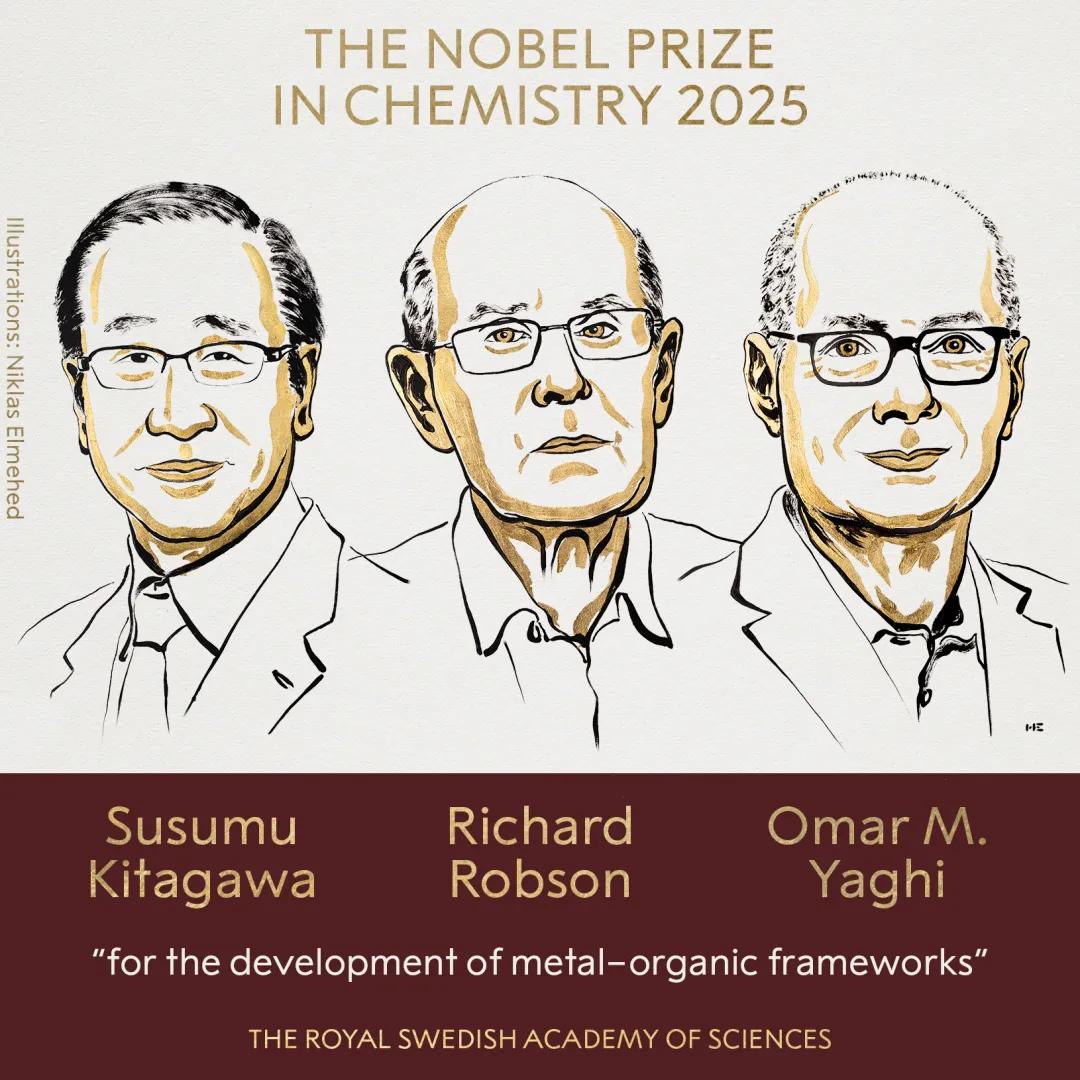
What are MOFs? Why did they propel three scientists onto the Nobel podium? What value and significance do they hold for human society? Recently, we had a conversation with Lü Yiran, the vice president of investment at GGV Capital. Lü Yiran is a doctor in materials science, having studied materials science and engineering at Tsinghua University, Columbia University in the United States, and Brown University in the United States.
MOFs, or Metal-Organic Frameworks, are crystalline structures composed of metals and organic compounds. They can be thought of as being made up of countless regularly arranged "small rooms." Crystals have repeating structures. For example, table salt (sodium chloride) at home still has a repeating internal crystal structure when magnified infinitely. The principle behind the function of MOFs is to change their ability to attract substances by controlling the shape, size, and surface functional groups of the "small houses" (MOF structures). For instance, if the surface functional group A attracts molecule a, molecule a may be adsorbed and fixed inside. Compared with other materials such as activated carbon or attapulgite, MOF materials have denser, more uniform, and more controllable pores. Therefore, they have a greater chance of being used for "targeted adsorption" and "precise screening," solving many separation and capture problems that were difficult to handle with previous materials.
Can the seemingly magical properties of MOF materials meet real needs in the actual market? Can't existing materials and technologies provide solutions for the same needs?
MOFs can adsorb gases, so they can remove formaldehyde from rooms after decoration. However, can't existing activated carbon and attapulgite achieve the same? MOFs can adsorb liquids, so they can transport domestic water to water-scarce areas. However, sewage recycling and seawater desalination technologies are already quite mature. If many things that MOFs can do today could already be done by other materials and technologies yesterday, what is their value and significance for tomorrow?
01
The Nobel laureates have also been answering the question: How can this research be applied to real-world scenarios?
In fact, since the birth of MOFs, there have always been doubts about whether they are "really useful."
Richard Robson, the pioneer of MOF technology, first had the inspiration for "molecular architecture" in a classroom in 1974. More than a decade later, he verified his idea through experiments and actually constructed a crystalline structure with a large number of internal cavities. Robson predicted that such materials might possess unprecedented properties and contain great application potential.
However, due to the poor stability and easy decomposition of the initial materials constructed by Robson at that time, many in the industry regarded them as "useless works."
The baton was then passed to Susumu Kitagawa. In fact, exploring the value of "useless things" has always been an important academic concept of Kitagawa. In the early research process of MOFs, it was difficult to prove the practical value of the research, and it was once difficult to obtain research funding.
In 1997, Kitagawa's team achieved their first major breakthrough: They used cobalt, nickel, or zinc ions and molecules called 4,4′-bipyridine to construct a three-dimensional metal-organic framework with intersecting open channels, which showed unprecedented stability and could maintain its shape during the process of adsorbing and releasing liquids and gases such as methane, oxygen, and nitrogen.
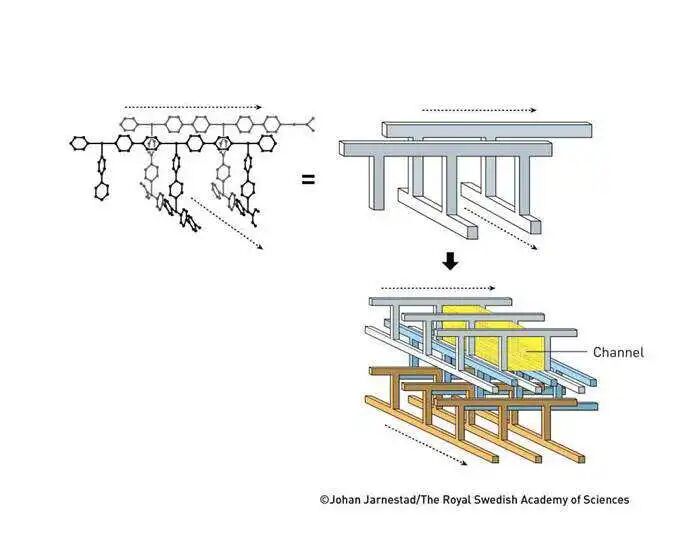
The three-dimensional metal-organic framework developed by Kitagawa's team
Even so, the industry still had many doubts about this research: There are already "zeolites" in the market that can also adsorb gases, and their adsorption effect is even better than that of MOFs. Why spend resources on developing new materials?
Facing these doubts, Kitagawa shifted the focus of his research to the development of flexible MOF materials. This is also one of his most significant contributions to the development of MOFs.
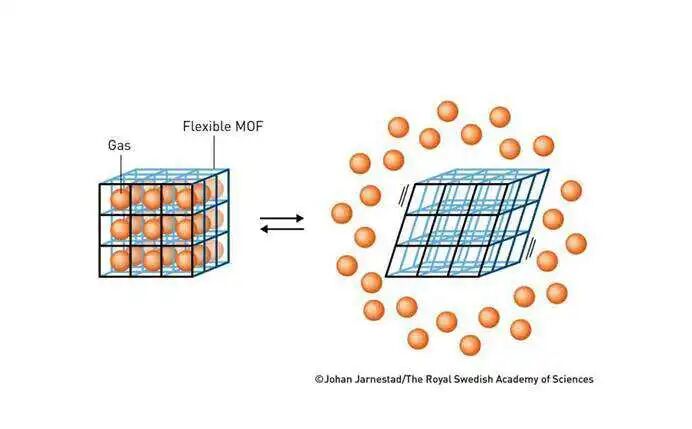
The flexible MOF material developed by Kitagawa
Meanwhile, Omar Yaghi, the scientist who truly named "MOFs," was also making his own contributions in the research and development of this new material. In 1999, his team developed MOF-5. This material can remain stable even at a high temperature of 300°C and has an incredibly large internal space - the internal area of just a few grams of MOF-5 is as large as a football field. This makes its adsorption capacity far superior to that of traditional zeolites. In this way, Yaghi answered the industry's doubts for Kitagawa across the ocean.
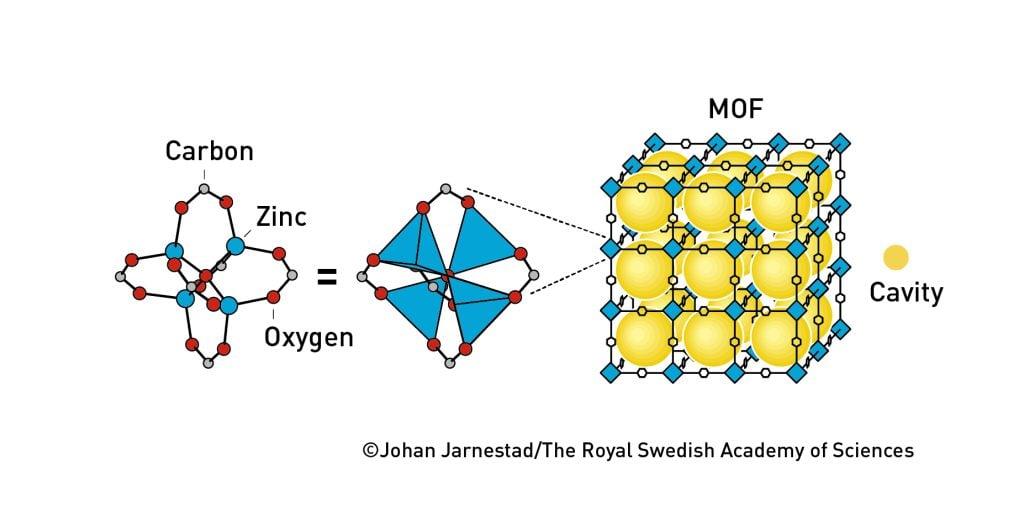
MOF-5 developed by Yaghi's team
Subsequently, Yaghi also developed a variety of MOF materials that can adsorb different substances and even created the miracle of "extracting water from the air" in arid areas: At night, MOFs adsorb water vapor from the air. During the day, they release liquid water for people to use.
Are MOFs useful? What are their uses? The three Nobel laureates and many other materials scientists have been answering these questions with their research.
02
New materials always have to go through the tests of "usefulness" and "availability" when moving from the laboratory to daily life or industry.
It's not surprising that the decades-long questions and responses have now continued into our conversation. Returning to the question raised at the beginning: Can MOF materials meet real market needs?
Lü Yiran believes that materials science is actually about finding the most suitable materials to solve specific problems and needs. The core of answering this question lies in two points: First, can a "killer application" be found for this technology; second, it's necessary to do the math and see if, through continuous cost reduction and efficiency improvement, the new technology can be more cost-effective than the old technology in meeting market needs.
The example of "extracting water from the air" in arid areas using MOF materials mentioned earlier is a good case for observation. This case took place in the Middle East.
The Middle East has a characteristic: Although there is not much available fresh water on land in many areas, the air humidity is relatively high because it is close to the ocean. In this environment, the strong adsorption capacity of MOFs can come into play - becoming a killer application.
Of course, as we know, seawater desalination technology in the Middle East is quite mature. So, what is the value of water extraction from the air using MOFs in the market? That's where we need to do the math. Traditional seawater desalination technology incurs a significant cost for transporting water. Therefore, if the material cost of MOFs can be lower than the cost of transporting seawater, MOFs can naturally replace traditional technologies and industries in this region, truly integrating into the market and meeting real market needs.
Lü Yiran mentioned that in the field of materials, many materials that meet real market needs cannot enter the application stage on the day the technology is born.
For example, lithium batteries, which also won the Nobel Prize in Chemistry, were invented by the academic community about 40 years before receiving this honor in 2019. We have also seen that in the past decade or so, the core indicators of lithium batteries such as battery life, cycle life, and safety have been continuously improved. From the application perspective, lithium batteries are being more and more widely used in consumer electronics, electric vehicles, and energy storage. Since their first commercial use in 1991, the cost of such batteries has decreased by 97%. By 2030, the cost of lithium batteries is expected to decrease by another 25%. From the cost perspective, with the continuous upgrading and cost reduction of lithium batteries, compared with gasoline-powered vehicles, electric vehicles are becoming more and more cost-effective. After consumer electronics, electric vehicles have become another popular application for lithium batteries.
Carbon fiber, another still quite prominent new material, had low strength and high cost in the early days of its discovery and was only used in a few fields such as aviation. With process optimization in the past 20 years, its strength has increased by 3 - 4 times, and the cost has decreased by more than 90%. It has also found more suitable application scenarios, such as carbon fiber racing cars, carbon fiber bicycles, carbon fiber rackets, carbon fiber cue sticks...
Similarly, GORE - TEX material, although still relatively expensive, has become a favorite of outdoor sports enthusiasts because of its "breathable but waterproof" property, which allows people to emit sweat smoothly and keeps them dry in rainy days.
In contrast, aluminum is widely used today because of its significant cost reduction. During Napoleon's era and even in the mid - 19th century, aluminum was far more valuable than gold. It was the electrolytic aluminum technology that greatly increased the production of aluminum, bringing it down from the noble status of the royal family and into the lives of countless ordinary people.
"Cases such as carbon fiber and lithium batteries also show that cost reduction opens up application scenarios, forming large - scale industrial chains, which in turn further reduce costs and open up more application scenarios," Lü Yiran introduced. "However, there are indeed many innovative materials with unique characteristics that have been stuck at the intersection of research and development and market application because they haven't found killer application scenarios or aren't cost - effective on paper."
03
What does materials science make us think about?
Materials science is a magical discipline.
It is the unity of science and engineering. Every exploration of scientific theories, laws, formulas, and theorems is for the purpose of one day demonstrating and implementing them at the engineering level.
It is the unity of the micro and the macro. Our painstaking research in the microscopic world is for the purpose of one day making new materials shine in the macroscopic world and market applications. In Lü Yiran's view, the essence of materials science is "Structure Determines Function" - the microscopic structure determines the macroscopic properties, and the core logic of modern materials science is to achieve the targeted optimization and innovation of macroscopic properties by precisely controlling the microscopic structure.
It is also the unity of the present and the future. Richard Robson, the pioneer of MOFs, was born in 1937. When he was researching early MOF technology, the world was not yet connected to the Internet, and globalization had not even begun. Of course, few people could understand what he was doing at that time. In 2025, this 88 - year - old scientist finally heard the world's response. The exclamation of this 88 - year - old man decades ago still sounds like a powerful voice that can reach into the future today.
We who live in the present often think that the world we live in is quite good and that our needs have been met. When the first car on the road was overtaken by a horse - drawn carriage, people couldn't help but laugh: What's this for? Is it necessary? Isn't it more comfortable to take a horse - drawn carriage? What's the point of this iron box with four wheels?
But somehow, in every era, there are always people who think that the world that seems good enough to most people can actually be better. When Susumu Kitagawa and Omar Yaghi were asked about the significance of their research, their feelings might have been just like this.
Today, MOF technology has already been applied to the delivery of targeted drugs, and some scientists in Northern Europe are using it to adsorb carbon dioxide from the air to improve the global greenhouse effect. It may be impossible to determine today whether the countless efforts and time invested by these great minds will definitely meet the practical needs of the human world, but science always deserves respect.
Just as the research in materials science is about "using appropriate structures to achieve appropriate functions" and then finding truly implementable and cost - effective applications in real needs - and every exploration is an indispensable step towards the answer.
This article is from the WeChat official account "GGV Capital". Author: GGV Capital. Reprinted with permission by 36Kr.