The valuation of Fei-Fei Li's World Model company has skyrocketed fivefold in one year, and it is in talks for a new round of $500 million in financing.
The main line of the world model has entered the "spring rally" ahead of schedule!
According to Bloomberg: World Labs, founded by Fei-Fei Li, is conducting a new round of financing at a valuation of approximately $5 billion, with a maximum financing scale of up to $500 million.

If the financing is completed: The valuation of World Labs will directly multiply by five to $5 billion from $1 billion in 2024.
In just over a year, a five-fold revaluation.
"The next main line after LLM" is truly gold-laden.

New financing of World Labs
A year ago, such a valuation was almost unimaginable; but now, Professor Fei has put it on the negotiation table.
A valuation of $5 billion with a financing of $500 million.
If the deal finally materializes, this will not be a round of investment based on the personal halo of the "Godmother of AI," but rather a re - pricing by capital of World Labs and its world model route.

Previously, World Labs had completed a cumulative financing of $230 million and reached a valuation of $1 billion.
World Labs was founded in April 2024. It completed its first - round financing that month, with a valuation of approximately $200 million.
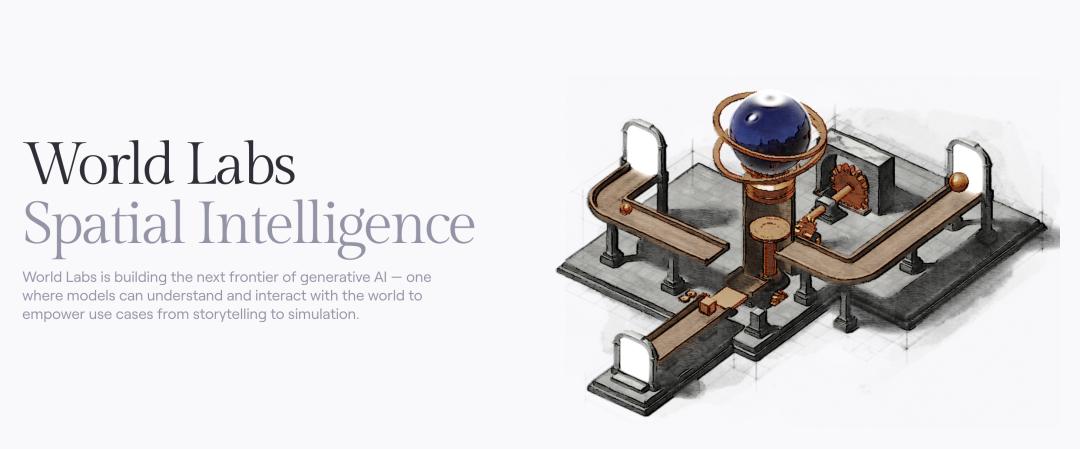
The investors in the first round included Andreessen Horowitz (a16z) and the Canadian investment institution Radical Ventures, the latter of which is also an institution where Fei - Fei Li serves as a scientific partner.
Subsequently, in June - July 2024, World Labs completed another round of $100 million financing, led by NEA. The company's valuation was raised to over $1 billion, officially entering the unicorn club.
According to Bloomberg, the investors in these two rounds of financing also included NVIDIA, Sanabil Investments of Saudi Arabia, and the Singaporean sovereign wealth fund Temasek.
Among individual investors are Google's chief scientist Jeff Dean, actor and investor Ashton Kutcher, and the "Godfather of AI" Geoffrey Hinton.
(Hinton is also an investor in Radical Ventures)
What is the financing for?
Of course, it's for the "world model."
World Labs is developing an AI system capable of navigation and decision - making in the three - dimensional world, building what it calls "large world models."
What it solves is not "generating a beautiful picture," but enabling the model to truly understand the structure and evolution of the real physical world.
At the product level, World Labs launched its first 3D world generation model, Marble, last November.

Marble can directly generate an explorable 3D world based on text or image prompts.
In the traditional process, 3D content usually starts from manually constructed polygon meshes:
The scene is composed of a large number of tiny triangles and then processed by a rendering engine, which has high engineering costs, long production cycles, and is difficult to scale.
Marble uses 3D Gaussian Splatting (3DGS) technology, representing the scene structure with millions of translucent points, thereby achieving more delicate visual effects while maintaining high rendering efficiency.
More importantly, Marble doesn't just aim for "looking real." It also outputs so - called "collider meshes" -
This is a geometric representation that sacrifices appearance details for computational speed, specifically used for physical simulation and robot simulation.
At the interaction level, Marble also provides the Chisel tool: Users can first quickly "build a framework" with simple geometric shapes and then generate detailed versions in different styles, which is a step towards controllable and editable world construction.
In addition, World Labs recently opened the World API. Developers can directly generate an explorable 3D world in applications through text, images, or videos, embedding the "world model" into specific products.
At the strategic level, Fei - Fei Li herself has clearly stated on multiple occasions:
The world model is the key to achieving spatial intelligence and is the core main line for AI in the next decade after the large language model (LLM).
In her framework, a world model truly equipped with spatial intelligence requires at least three capabilities:
Generative: It can create a world that obeys physical laws and is spatially consistent;
Multimodal: It can process multimodal inputs from images, videos to actions;
Interactive: It can predict the state of the world as it evolves or interacts over time.
For this reason, the world model is regarded as an "infrastructure - type capability."
Once established, its influence will not be limited to a single application scenario but will spread in multiple directions:
- AIGC: 3D asset generation, game world construction, film and television production, and virtual shooting.
- Embodied intelligence: Robots, simulation environments, and real - world task execution.
Taking embodied intelligence as an example, the world model provides a predictable representation of the environment, on which truly effective decision - making and control can be superimposed.
This includes control methods such as DP (Diffusion policy) and RL, as well as systematic evaluation of agent behavior (such as Lightwheel Intelligence).
One more thing
It's worth mentioning that another route of the world model has also attracted capital investment.
Recently, AMI Labs (Advanced Machine Intelligence, AMI), founded by former Meta chief scientist and Turing Award winner Yann LeCun, has attracted potential investors including Cathay Innovation. It is rumored that its financing valuation may reach $3.5 billion.
Different from Fei - Fei Li's bet on an explicit and generative three - dimensional/video world model, LeCun takes a route more inclined to "internal cognition" -
He adheres to using an implicit world model, that is, based on JEPA (Joint Embedding Prediction Architecture), to predict how the world evolves in an abstract latent space rather than restoring every pixel.
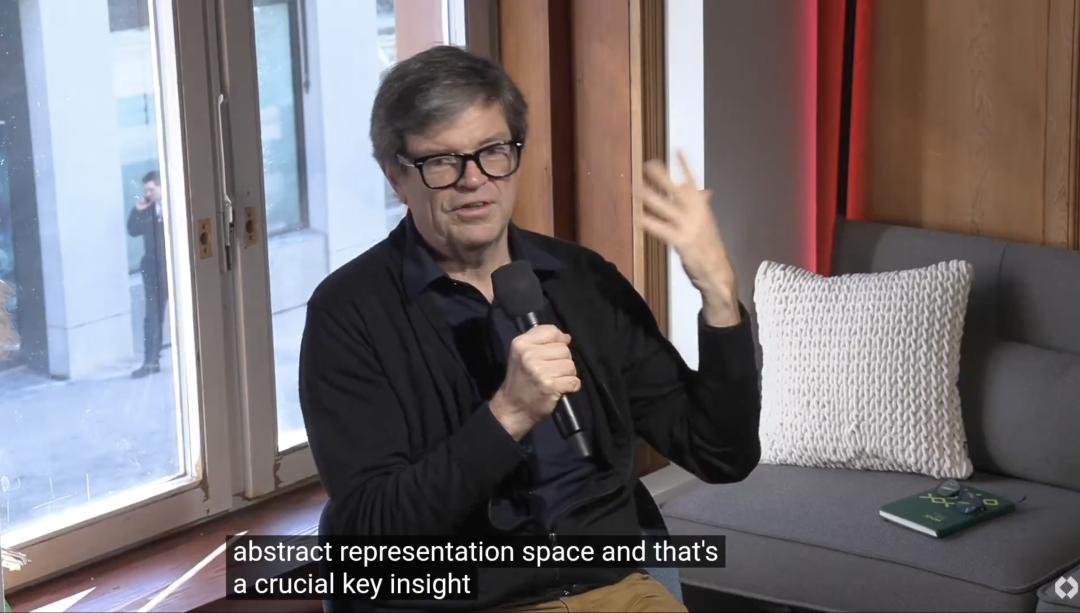
If we use an intuitive analogy to understand the current world model landscape, the world model is roughly divided into three layers, and LeCun's JEPA is at the top of the abstract hierarchy:
A viewable and editable world interface, such as Fei - Fei Li's Marble
A simulator for repeated trial and error, such as Google DeepMind's Genie 3
A cognitive world model centered on states and predictions, such as LeCun's JEPA route
From this perspective, it's clear that capital is not just betting on the personal halos of the "Godmother" and "Godfather of AI," but also making early bets on different technological paths of the world model.
Dear chairmen, how will you invest?
Reference links
[1]https://www.bloomberg.com/news/articles/2026-01-23/fei-fei-li-s-ai-startup-world-labs-in-funding-talks-at-5-billion-valuation
[2]https://x.com/rohanpaul_ai/status/2014877019021181164
[3]https://x.com/rohanpaul_ai/status/2015081447888212326
[4]https://techcrunch.com/2024/08/14/nea-led-a-100m-round-into-fei-fei-lis-new-ai-startup-now-valued-at-over-1b/
This article is from the WeChat official account "QbitAI", author: henry, published by 36Kr with authorization.