Yu Qian, CEO of QCraft: 4-5 companies will remain in the intelligent driving market | Exclusive interview by 36Kr
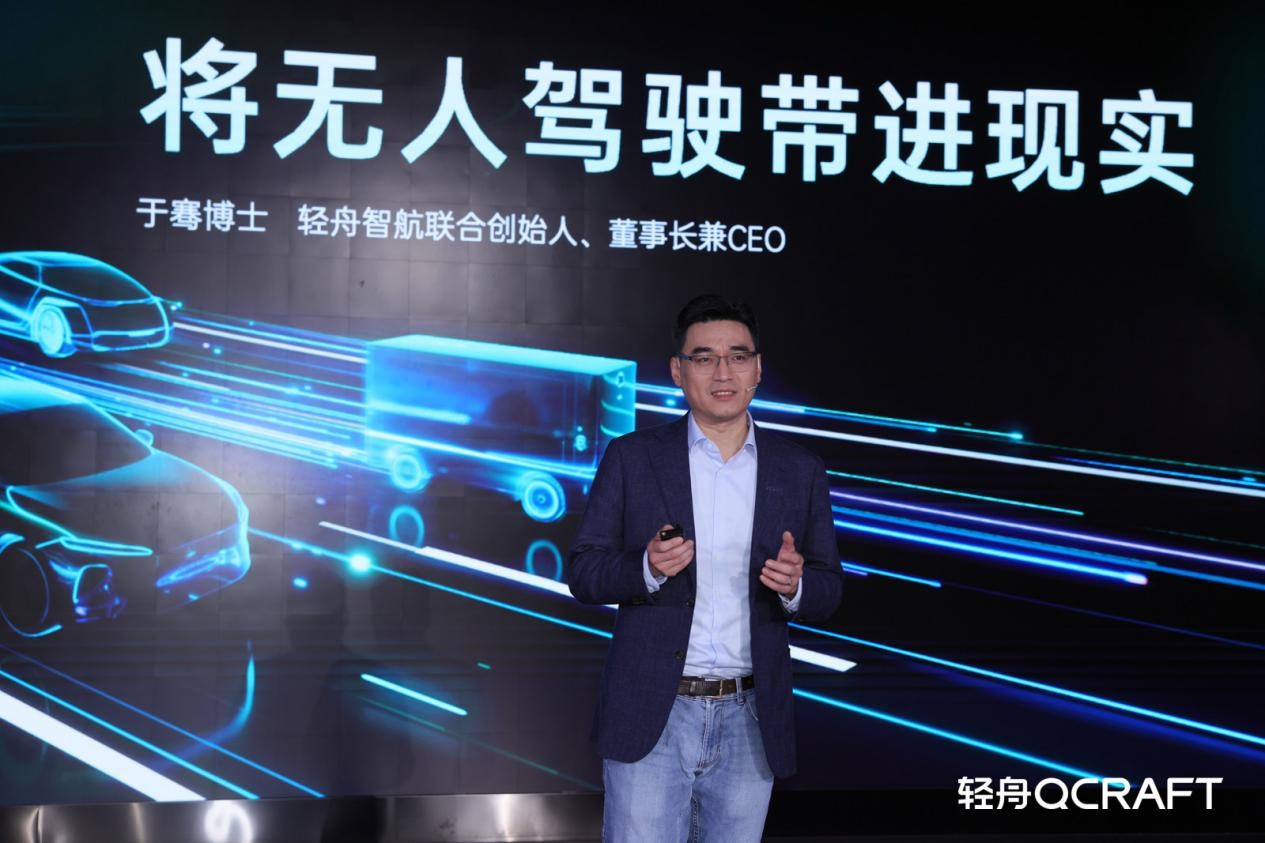
Yu Qian, Co-founder, Chairman, and CEO of QCraft
Text | Xiao Man
Editor | Li Qin
The intelligent driving industry is at a delicate cycle transition point.
On the one hand, the democratization of intelligent driving is truly moving towards mass production and entering lower vehicle price segments. On the other hand, greater computing power, more complex models, and more radical technology narratives are also emerging, with the goal directly targeting L3 or even L4. This is both an opportunity and a time for market cleansing.
In previous rounds of eliminations, QCraft became one of the survivors in the last round of the "great escape". It is not the intelligent driving company with the highest starting point or the most aggressive financing, but it has always been able to assess the situation and make relatively restrained but correct - direction choices at critical time nodes.
When the industry was still highly superstitious about the L4 narrative, QCraft was the first to shift from the L4 arena to L2 mass - production software delivery. It was one of the earliest manufacturers to actively shed the "technology burden" of autonomous driving companies. When the automotive industry fully embraced NVIDIA chips and the computing power competition intensified, QCraft chose to establish a deep cooperation relationship with Horizon Robotics, polished software solutions around Horizon's Journey chips, and entered the technology segment more sensitive to cost and efficiency in advance.
As an algorithm solution provider, QCraft has always maintained a close but independent relationship with automakers and chip manufacturers. Dr. Yu Qian, Co - founder, Chairman, and CEO of QCraft, told 36Kr Auto that the early deep - binding cooperation with Li Auto brought two extremely crucial capabilities to QCraft: mass - production delivery methods and product definition.
These are precisely the most scarce capabilities for most early - stage intelligent driving startups and are also the most easily overlooked sources of capabilities in technology narratives. Many manufacturers that have exited the market are not unable to run through the algorithms, but are unable to complete mass - production delivery stably in the long term and are eventually eliminated.
However, binding always comes at a cost. Once the automaker strengthens its self - research, the supplier may be quickly marginalized. This is almost an unavoidable proposition for all intelligent driving startups.
In QCraft's view, this is not a crisis but a positive signal. "Self - research is not a bad thing. I think automakers should have self - research capabilities, cultivate their own judgment on technology, and know what is good and what is not." Yu Qian said. Even when necessary, QCraft is willing to assist automakers in promoting the construction of self - research capabilities.
This idea of "finding a dynamic balance between dependence and independence" is not only reflected in QCraft's cooperation relationship with automakers but also in its relationship with Horizon Robotics.
Although QCraft is one of the early members of Horizon's ecosystem, it did not choose to be deeply bound to it. Instead, it is simultaneously promoting the adaptation of NVIDIA and Qualcomm solutions and maintaining the migration ability between different chip platforms.
"We are an important ecological partner of Horizon, and at the same time, we maintain independence. We do not rely on Horizon's algorithms, but only use its chips and general toolchains. The underlying algorithms, simulators, library files, etc. are all self - developed, and our roles do not conflict." Yu Qian said.
A series of key decisions have allowed QCraft to stay in the game continuously. QCraft revealed that the cumulative installation volume of its passenger car assisted driving system has exceeded one million units. It is expected that by 2026, the number of mass - production cooperation models will exceed 50, and almost all models will be equipped with the urban NOA function.
However, the elimination crisis has not been truly resolved. The current intelligent driving arena is still highly crowded: Horizon Robotics has entered the intelligent driving field with the HSD solution, and while automakers are cooperating with solution providers, they have never given up the self - research path. Yu Qian judged that the intelligent driving market will not move towards a unified monopoly pattern. Most likely, it will be like the engine or battery industry, with 4 - 5 leading enterprises remaining.
QCraft is still working hard to be one of the survivors. Looking towards the longer - term future, QCraft is expanding its business boundaries: on the one hand, it is expanding the L2 product layout and launching three - level product solutions based on different chip platforms; on the other hand, it is increasing its investment in L4 and entering new scenarios such as unmanned logistics.
QCraft's next step may be to impact the capital market.
Recently, 36Kr Auto conducted an exclusive interview with Yu Qian, Co - founder, Chairman, and CEO of QCraft. The following is the interview transcript, edited for content:
More models and hardware do not necessarily mean better experience
36Kr Auto: I heard that you experienced Tesla's FSD. How was it?
Yu Qian: Except for occasionally misjudging the exit position of the parking lot and sometimes missing some exits, whether inside the parking lot or on external roads, it can basically drive autonomously, and the experience is very smooth. Moreover, it can chat with you, and the interaction is great.
Tesla's V14 version really has excellent performance. Our current performance is close to that of V12. I think Chinese automakers and technology companies are not inferior in ability. They will definitely catch up with this level in half a year to a year.
36Kr Auto: What are the core advantages of QCraft's end - to - end solution?
Yu Qian: The core advantage is to "achieve the best experience with limited resources". The experience of our single J6M solution is better than that of many mass - produced dual Orin X solutions on the market. I won't name specific brands. The end - to - end solution uses computing power more economically. It doesn't need to stack too many models. One model can cover many features and is more efficient than the two - stage solution. We don't blindly stack computing power and parameters. We focus on the core needs of 90% of users and reject showy functions.
36Kr Auto: What are QCraft's plans for model adaptation and solution layout in 2026?
Yu Qian: In 2026, more than 50 new models will be added. Currently, more than 30 models are being supplied. The main domestic solution is Horizon's J6M, accounting for more than half. At the same time, J6E and Qualcomm solutions are being laid out. Overseas, NVIDIA and Qualcomm solutions are the main ones.
We have divided our product matrix into three levels:
• Air level (High - speed NOA + Active safety, suitable for gasoline and electric vehicles below 100,000 yuan, supporting air cooling)
• Pro level (Urban intelligent driving for 100,000 - yuan - level vehicles, about 200 TOPS computing power, with a cost of a few thousand yuan, 11V sensors, and lidar is optional)
• Max level (Computing power greater than 500 TOPS, ultimate urban NOA, the chip model is not disclosed yet, planned for mass production).
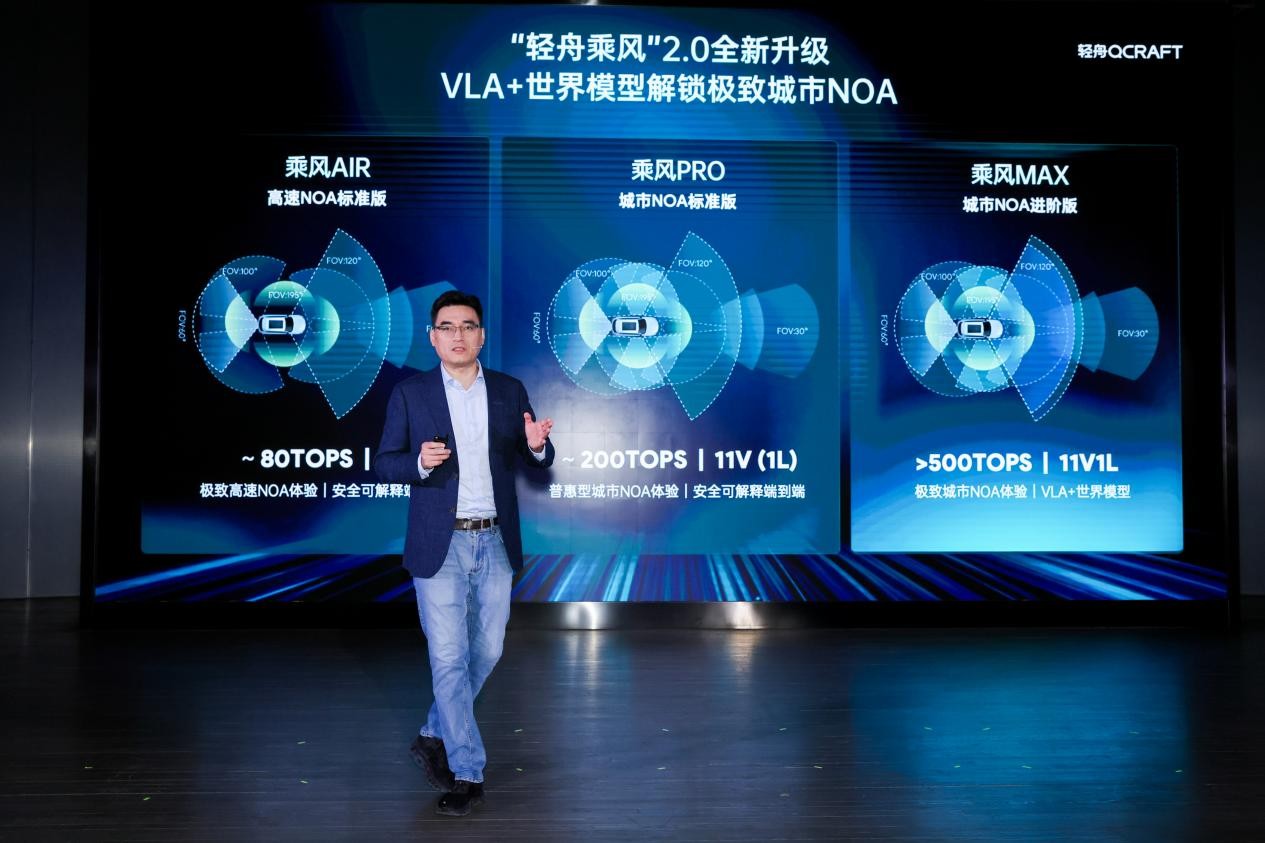
QCraft's product matrix
36Kr Auto: How does QCraft layout the end - to - end, world model, and VLA technologies in terms of the technical route?
Yu Qian: We focus on the end - to - end solution while also considering the world model and VLA technologies. The end - to - end solution is in the pre - research stage and is expected to be mass - produced in 2026.
VLA is essentially a type of end - to - end technology. The core is to achieve "knowing the reason as well as the result" and improve the model's generalization ability. It is not about translating image signals into language and then outputting actions. We plan to combine it with Robotaxi and L4 - level business for implementation.
At present, the world model is mainly used for cloud - based virtual training to solve the problem of virtual scenario reproduction. Its priority is much higher than that on the device side, and the application on the device side is not yet mature.
36Kr Auto: Why is the world model not mature on the device side?
Yu Qian: The current world model cannot replace road tests on a large scale. It may only play a 10% - 30% role. If one day the world model can completely replace road tests, the development curve of autonomous driving will change from gentle to upward in a straight line.
We believe that a real world model is to master all the laws of the physical world in a virtual environment, which requires a huge amount of computing power. The importance of the world model in solving problems in the cloud is far greater than that on the vehicle side.
36Kr Auto: How do you plan to implement VLA? Do you translate image information to a language model and then output actions?
Yu Qian: This is a misunderstanding. We don't do it this way. Translating images into language will lose a lot of details. Driving often relies on intuition, and there is no need for this extra step. The role of language is to refine and abstract driving behaviors, inject knowledge like a coach, enable the model to draw inferences from one instance, be more generalized, and be closer to the way humans learn, rather than simply translating signals.
36Kr Auto: What kind of experience do you want to bring with VLA?
Yu Qian: At present, our main goal is to enable most consumers to use cars and have a good experience when driving in the city. So we may make some trade - offs in the top - notch showy parts. But if we can enable 90% of ordinary people's cars to achieve 90% of the experience, VLA can help achieve this goal.
VLA can show some effects with greater computing power, but the incremental value may not be that large. We have done some pre - research and will combine it with the technologies of Robotaxi and L4. It can better draw inferences from one instance and better understand scenarios, but it will take a longer time to achieve.
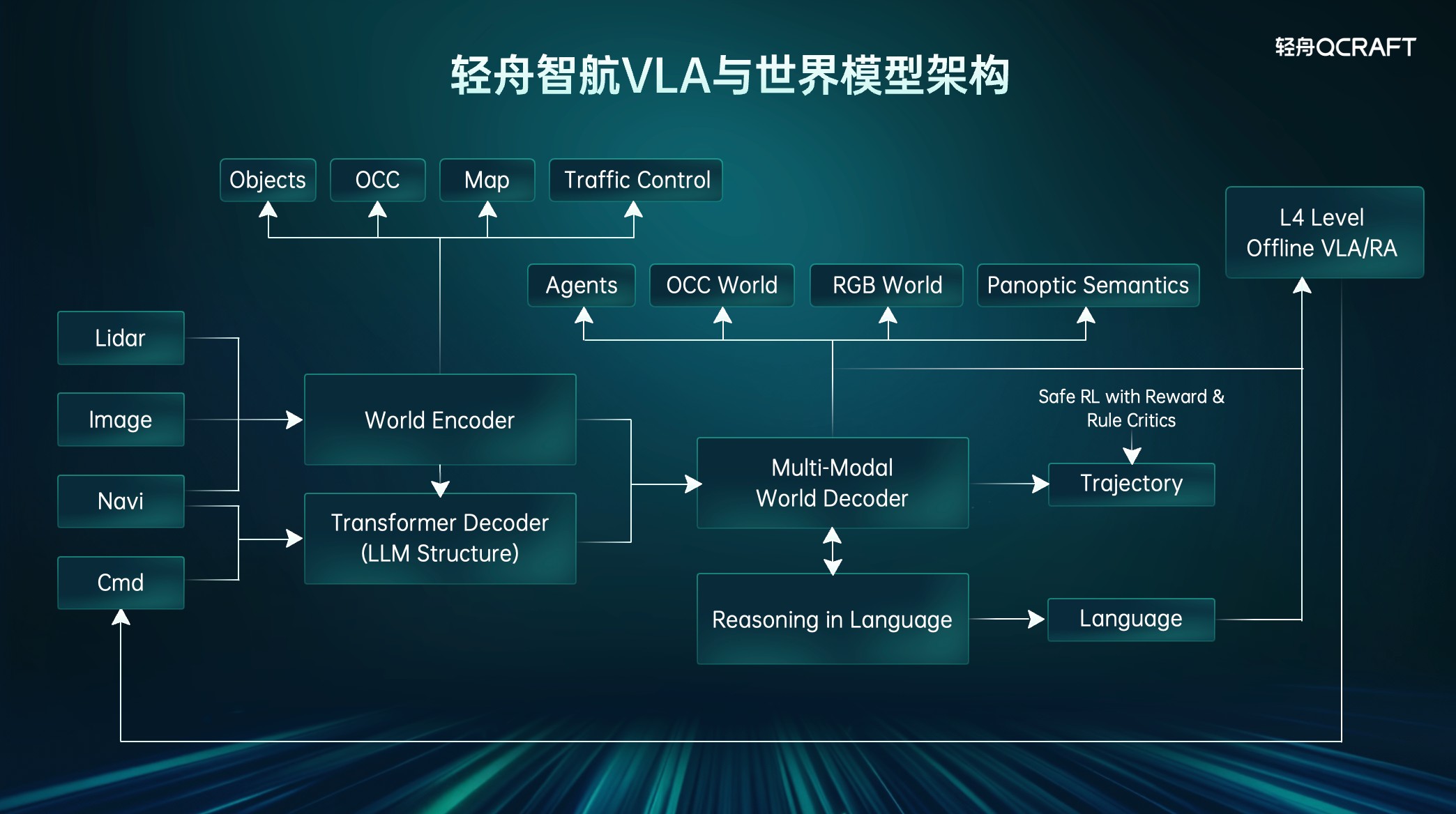
QCraft's VLA and world model architecture
36Kr Auto: Applications such as VLA and the world model all mean greater computing power investment. Has QCraft encountered a computing power threshold?
Yu Qian: This is a resource issue. If resources were really the most important factor, then DeepSeek would not have emerged.
We pay tribute to DeepSeek. It can achieve a good experience with limited computing power and very few resources through a large number of innovations. This is creating value for customers.
36Kr Auto: How can DeepSeek's approach be innovated in the intelligent driving field?
Yu Qian: For example, mixed - precision training and how to achieve better balance loading. We definitely need to invest resources and have also raised a lot of money, but we also want to focus. We can't spread our limited resources too thinly.
We never choose a platform easily. So we first understand Horizon thoroughly, and NVIDIA and Qualcomm solutions are still in mass - production. In this process, in addition to focusing on the three major directions, we also have rhythm control.
36Kr Auto: QCraft and self - research players have formed two different paths. They tend to use greater computing power and larger models, while you are making things more streamlined. Why are there these two differences?
Yu Qian: We need to innovate like DeepSeek. Innovation is not just about creating a large algorithm or model. Innovation needs a strong value orientation. For whom and why are we innovating? In addition, we need to do a good job in engineering and lay a good foundation to have innovation and compete in productivity.
Consumers pay for the experience, not for model parameters or computing power configurations. Stacking hardware does not create user value. There is no need to install a solution with one or two thousand TOPS of computing power in a 100,000 - yuan vehicle. The core competitiveness is to achieve better experience with lower cost under the same experience or better experience with the same cost. High - order computing power solutions should focus on L3/L4 goals rather than over - stacking on affordable models.
Just because you have good hardware and stack a lot of it doesn't mean the experience will be good. We never rely on stacking hardware. Everyone can stack hardware, but it doesn't create user value.
Automakers should have self - research capabilities to know what is good and what is not
36Kr Auto: Recently, Li Auto's AD Pro 4.0 was pushed, and your cooperation with Li Auto has taken another step forward. How did you first reach a cooperation with Li Auto?
Yu Qian: We first provided a planning and control solution for another Guangzhou - based automaker. But at that time, we already had the full - stack capabilities based on Horizon's Journey 5 solution. We showed a demo to Li Auto, and nearly a hundred of their people tested it. Later, they chose our solution.
We also learned a lot of mass - production delivery methods from Li Auto, such as how to define products well and ensure delivery nodes. At that time, our team mainly formed a set of strategies, which was very important.
36Kr Auto: How many people did you have working on the solution for Li Auto at most?
Yu Qian: One or two hundred people.
36Kr Auto: Is there always a game relationship between suppliers and automakers' self - research?
Yu Qian: We are not worried about automakers' self - research. Many of the automakers we cooperate with are doing self - research, such as Geely, Li Auto, and GAC. We never say, "Intelligent driving will end up the same anyway, so stop wasting your time." Instead, we think, "In addition to my own success, I also hope you succeed."
From our perspective, we are willing to help automakers achieve self - research. But whether they can succeed ultimately depends on the product and experience. Only with a good experience can there be competitive circulation.
Self - research is not a bad thing. I think automakers should have self - research capabilities. They should cultivate their own judgment on technology and know what is good and what is not.
36Kr Auto: Do you think the end - to - end technology has raised the threshold for self - research?
Yu Qian: Definitely more difficult. Globally, most automakers have not achieved it yet. It takes a long time, and there are difficulties in terms of talent, computing power investment, and data. This is essentially a low - probability success event.
36Kr Auto: Why did many previously silent peers suddenly emerge after the emergence of the end - to - end technology?
Yu Qian: These enterprises have a foundation. They didn't suddenly succeed. Many enterprises have been in the industry for nearly 10 years. They all have a background in L4 and have a technical foundation. Now they have found the right direction for matching and optimizing with models.
36Kr Auto: What is the positioning of QCraft's cooperation with Horizon? It seems that QCraft is both the client buying chips and an ecological partner?
Yu Qian: I don't think it's a