From recording cards to recording pods, is it worth investing in AI office hardware?
As a workplace employee, you'll find that there are more and more meetings, and the information is getting denser, but the amount of truly digested content hasn't increased.
After the meeting, the meeting minutes often arrive late. You have to rely on your memory to fill in the key points, and action items are constantly transferred between different tools. Even in a highly digitalized office environment, "voice" remains the most difficult type of information to be systematically processed.
This is the background against which AI office hardware has been pushed back into the spotlight.
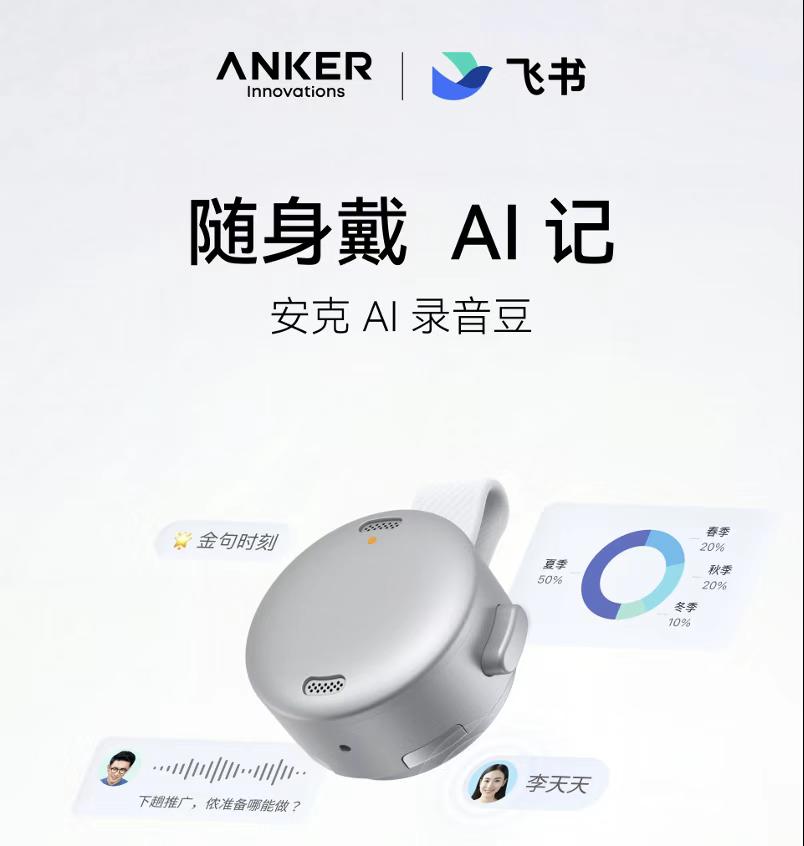
On January 19th, Anker Innovations and Feishu, a subsidiary of ByteDance, jointly launched the latest AI hardware - Anker AI Recording Bean. In terms of the cooperation, Anker Innovations is responsible for the R & D of the hardware end, while Feishu provides software AI adaptation and services, focusing more on software and AI capabilities support, as well as opening up interfaces to enable the device's recordings to be directly connected to the Feishu system, automatically importing the recording files into the Feishu ecosystem and depositing them as Feishu documents.
On December 23rd, 2025, at the second product launch event within half a year held by DingTalk, DingTalk's first AI hardware - DingTalk A1, quickly became a dark horse among domestic AI hardware products and has been topping the sales charts.
The two products differ in form and cooperation model, but they point to the same question: Is the business of AI office hardware really worth doing?
What AI office hardware solves is never the "recording problem."
If you only understand AI recording beans and recording cards as "smarter voice recorders," you'll easily underestimate that what this track is really targeting is a long - neglected but extremely crucial part: the input end of the office system.
In most enterprises, document, spreadsheet, knowledge base, and task systems are already very mature. However, they all have a common prerequisite: you must first "organize the information into text" before it can enter the system.
In real - world work, a large amount of high - value information doesn't appear in text form. Impromptu discussions in meetings, real feedback from customers on - site, post - event reviews within the team, in - depth conversations in industry interviews, and on - the - spot performances in project roadshows... These contents are naturally carried by "voice" but have long remained outside the system, becoming easily lost implicit knowledge.
What AI office hardware aims to solve is precisely this structural gap. It attempts to reconstruct the way of information input from three aspects.
First, it transforms the act of "whether to record" from a deliberately initiated action into a default behavior with low friction or even no perception, allowing people to focus more on the conversation itself. Second, it moves the "post - meeting organization" from a heavy task relying on manual review and summary to real - time voice transcription and content structuring by AI. Finally, it also enables scattered and short - lived voice information to be directly transformed into organizational knowledge assets that can be retrieved, collaborated on, and reused in the long term.
The Feishu Recording Bean emphasizes "wear it with you + record at any time." Weighing only 10 grams and being as small as a button, it essentially reduces the "recording start cost," making the recording behavior closer to a wearable habit. It can be deeply bound to the Feishu account, and the recordings are automatically synchronized to the cloud. With the help of Feishu Miaoji, it can achieve multi - language transcription, speaker differentiation, and topic summarization, and support one - click export of structured meeting minutes after the meeting. Its design logic is that as long as it continuously records on - site voices, AI can continuously build a usable voice knowledge base in the background.
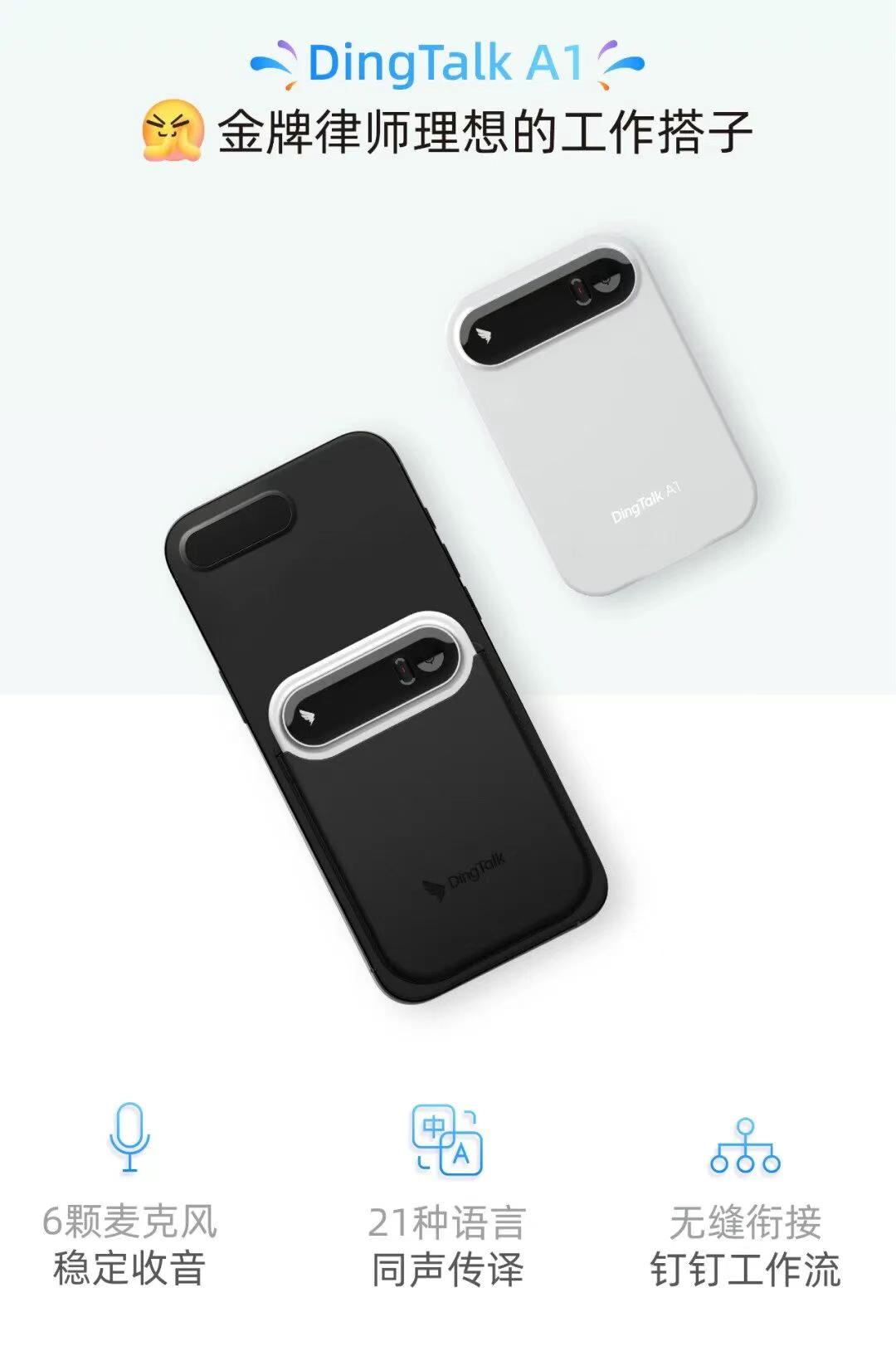
The DingTalk A1 recording device is in the form of a card and can be magnetically attached to a mobile phone. It emphasizes the combination of "meeting machine + voice recorder + translator + AI assistant," which is more like upgrading a mobile phone into a more powerful office collection terminal. Relying on DingTalk's collaborative scenarios, the recordings can be automatically associated with meeting schedules, transcribed into text in real - time and synchronized to DingTalk documents, and can even achieve Chinese - English translation and transcription during communication. Its value lies in naturally connecting the recordings with tasks, schedules, and projects within the DingTalk ecosystem, realizing a closed - loop from collection to distribution.
Although they differ in form, both are trying to pull as many real - world voices as possible into the collaborative system.
Why are recording beans and recording cards competing to have a "lower recording start cost"?
After the release of the recording bean and DingTalk A1 recording card by DingTalk, the outside world easily focuses on the form differences, AI functions, or price ranges. However, if you shift your perspective back to the product strategy itself, you'll find a highly consistent commonality: both products are almost constantly refining one thing: how to reduce the cost of "starting to record" to a sufficiently low level.
The "cost" here is not the hardware BOM or computing power cost, but the operational cost and cognitive cost that users pay to complete an effective recording in real - world work scenarios.
In the traditional office system, the "entrance" of information has long been the keyboard. Document, spreadsheet, and project systems are already highly mature, but they have a default prerequisite: information must first be organized into text. The problem is that the most valuable information in real - world work is precisely generated in moments that cannot be structured in advance, such as impromptu discussions in meetings, on - the - spot feedback from customers, key judgments during cross - departmental coordination, and supplementary views in interviews. These contents are mainly carried by voice but have long remained outside the system due to the "high recording cost."
Some seemingly minor resistances can be greatly magnified in high - frequency scenarios. Survey data shows that in the internal meeting scenarios of enterprises, the proportion of people who truly record the whole meeting actively and organize the recordings later is not high. In most cases, people only "record important meetings" and "may not even listen to the recordings later." The reason is simple. Taking out your phone, unlocking it, opening the app, clicking to record, and then switching your attention back to the meeting is a cognitive interruption in itself. Even if the whole process only takes a dozen seconds, it's enough to make people give up.
This is exactly why the new - generation AI recording hardware has unanimously focused its design on "recording without perception." The AI recording bean launched by Anker Innovations and Feishu weighs about 10 grams and is as small as a button, emphasizing "wear it with you and use it at any time." It doesn't emphasize how many things it can do but tries to lower a psychological threshold: Are you willing to casually keep the information as soon as it appears?
Correspondingly, DingTalk's DingTalk A1 chooses the card form and is extremely thin, aiming to be "stuck anywhere." The starting point of this design logic is also not function stacking but trying to let the recording device enter the scenario in advance: on the meeting room table, behind the monitor, or on the cubicle partition, making "whether to record" no longer a temporary decision but a default state.
Of course, the value of AI recording products doesn't depend on whether you can transcribe a recording into text, but on whether you can let more "voices that would otherwise not be recorded" enter the system.
If the recording start rate can't be increased, subsequent transcription, summarization, task extraction, and knowledge precipitation will be out of the question.
This is also why manufacturers invest so much in reducing the "recording start cost." The first layer is the physical cost. Is the device light, small, and close to the body? Does it need to be carried specially? The second layer is the operational cost. Does it require multiple steps of operation? Does it rely on a mobile phone? Is it easy to interrupt the current behavior? The third layer is the psychological cost. Will users think that "recording is a troublesome thing" or "is it worth recording now?" When these costs are simultaneously reduced, recording may turn from a "ritualized action" into an almost instinctive behavior.
It's worth noting that the target users of such products are not the traditional heavy users of voice recorders, but those who rarely recorded in the past but have a high information density, such as product managers, salespeople, consultants, researchers, and media practitioners. For them, the cost of missing a key expression is much higher than saving an extra piece of useless information.
This trend can also be seen from the data side. As remote meetings and cross - organizational collaborations become the norm, the scale of voice information within enterprises is continuously expanding, but the proportion that is truly converted into documents, tasks, or knowledge assets is still relatively low. Manufacturers clearly realize that if the problem of "whether to record" can't be solved at the source, no matter how powerful the AI is, it can only compete in the existing market.
Therefore, the current competition in AI recording hardware is more about who can become the lowest - friction entrance for voice information to enter the office system. Whoever can make the act of "starting to record" natural enough will have a better chance to move the AI capabilities to the first scene of information generation, rather than making up for it afterwards.
In this sense, reducing the recording start cost doesn't determine whether a piece of hardware sells well, but whether it has the qualification to become the input end of the next - generation AI office system.
And this may be the core position that Feishu and DingTalk really want to occupy in this round of product launches.
Whether this business is worth doing depends on who you are
Judging from the hardware business itself, this track is not very attractive. Whether it's the recording bean or the recording card, the unit price is limited, the update cycle is long, and the gross - profit structure is hard to compare with that of mature consumer electronics. Relying solely on "selling devices" is not enough to support a long - term growth story. This is why almost all the players in this round are not pure hardware companies working alone but are embedded in larger office platforms and collaborative systems.
What really deserves attention is not the hardware sales volume itself, but who is using the hardware to turn the "voice entrance" into a platform - level asset.
In the traditional office system, the entrances have long been highly fixed: you need to enter the document system to write documents, the project system to assign tasks, and the knowledge base to search for information. However, voice has always been a variable "floating outside the system." It is high - frequency, unstructured, and highly immediate, but it's difficult to be continuously captured and reused. This also means that whoever controls the voice entrance has the opportunity to intervene at the very front end of information formation, rather than making up for it at the result level.
This is the deep - seated logic behind Feishu and DingTalk's entry into the hardware market. They are not just supplementing a "recording tool" but competing for a more forward - looking control point: the moment a voice is recorded, whether it will enter the document, the meeting minutes, the task system, or the enterprise knowledge base in the future is essentially determined by the platform path.
From this perspective, AI recording hardware is more like a "forward - outpost node." It doesn't directly generate much revenue, but it can continuously send high - value original information into the platform, becoming the fuel for subsequent AI capabilities. Whether it's automatic meeting minutes, task decomposition, decision - making review, or long - term knowledge precipitation, the prerequisite is to collect this information first.
Once the entrance is established, the imagination space of the business model also changes. Hardware is just a one - time transaction, but the data, usage frequency, scenario distribution, and collaborative relationships formed around voice are naturally suitable to be included in the subscription system or platform value - added services. For enterprises, whether the device is charged is no longer the core issue. The key lies in: Can the recorded information really continuously improve organizational efficiency?
This is also why you'll find that the promotion focus of such products emphasizes more on "how many meeting scenarios are connected," "how many roles are covered," and "whether it can directly enter the workflow." Because what really determines success or failure is not the hardware penetration rate, but whether the entrance is high - frequency enough and irreplaceable enough.
From the platform perspective, once the voice entrance is firmly controlled, it means that AI can be upgraded from a "post - processing tool" to a "process participant." It doesn't just help you organize the meeting results but starts to understand the discussion process, judge the evolution of key points, identify decision - making nodes, and may even directly participate in collaboration in the future. This ability will never be born in an isolated hardware device but can only grow in a platform - level system.
Therefore, whether this track is worth doing doesn't depend on the hardware itself but on a more critical question: Do you have the ability to transform the act of "casually pressing the record button" into long - term reusable intelligent assets for the platform?
Whether it's the AI recording bean of Anker and Feishu or DingTalk's recording card, what they are really testing is not a new hardware category but the moment when AI starts to enter the very front end of the office system. Before the information is organized, judged, or even recognized as "important," it has been captured and understood in advance.
This is also why this track seems to be selling hardware but is actually competing for a more hidden and crucial ability: defining where information starts to be recorded. Once this entrance is occupied, the subsequent documents, tasks, knowledge bases, and collaboration efficiency will be natural spill - over results.
In this sense, the success or failure of AI recording beans and recording cards doesn't depend on which generation of products is lighter or thinner, and not even entirely on whether the transcription accuracy is a few percentage points higher. It lies in: Can they exist in the users' workflow for a long time and become a default choice without repeated decision - making?
If not, the hardware will soon be marginalized; but if so, they will no longer be devices but the "sensory extension" of the platform. This may be the real thing worth repeatedly examining in this seemingly low - key hardware competition.
This article is from the WeChat official account "AI Big Model Factory," author: Prune Juice, editor: Xing Nai. Republished by 36Kr with permission.